Key Statistics
Key Takeaways
- Market trajectory: the optical probe current sensor market has a 2026 value of USD 1,335 million and a 2036 projection of USD 3,168 million, representing 9.0% CAGR during 2027–2036. Demand is connected to substation reliability, high-current isolation and industrial measurement, although each procurement decision depends on lifecycle performance, field support and clear purchasing accountability. Unlike entire network or electrical infrastructure spending, the relevant products require an identifiable equipment sale.
- Fiber Optic Current Sensor leads: Fiber Optic Current Sensor represents an estimated ~43% of 2026 revenue, the leading type category. Fiber Optic Current Sensor is the fastest-growing type at around ~9.7% CAGR from a ~43% base share. The mix reflects application fit, production economics, installed compatibility and the pace at which buyers replace previously qualified hardware.
- Power Systems is the largest application: Power Systems accounts for an estimated ~51% of 2026 revenue and supports purchases triggered by operating capacity and reliability needs. Power Systems expands at about ~9.4% CAGR, but its spending pattern differs from other buyer classes in project scale, specifications and service life. This matters in optical current sensing because application-specific operating constraints must yield reliable field performance. Operators need documented sensor accuracy, safe installation, supplier support and reproducible test results. Purchases also depend on calibration, spare components and serviceability under actual operating conditions, rather than only on a nominal optical current measurement specification.
- Asia-Pacific has the largest geographical contribution: Asia-Pacific leads with an estimated ~45% base-year share; Middle East & Africa has the highest modeled regional expansion at roughly ~9.9% CAGR. Countries buy through different contracting and commissioning arrangements, and regional production concentration should not be confused with the place of final equipment installation. This matters in optical current sensing because geographic procurement and qualification must yield reliable field performance. Operators need documented sensor accuracy, safe installation, supplier support and reproducible test results. Purchases also depend on calibration, spare components and serviceability under actual operating conditions, rather than only on a nominal optical current measurement specification.
- Chief commercial restraint: higher project qualification expense limits adoption even when equipment has favorable engineering performance. Procurement teams examine integration cost, legacy compatibility and availability of qualified maintenance personnel, so higher technical capability does not always generate immediate equipment sales. Suppliers winning repeat programmes combine verified performance with training, parts availability and after-sales execution.
Optical Probe Current Sensor Market Overview
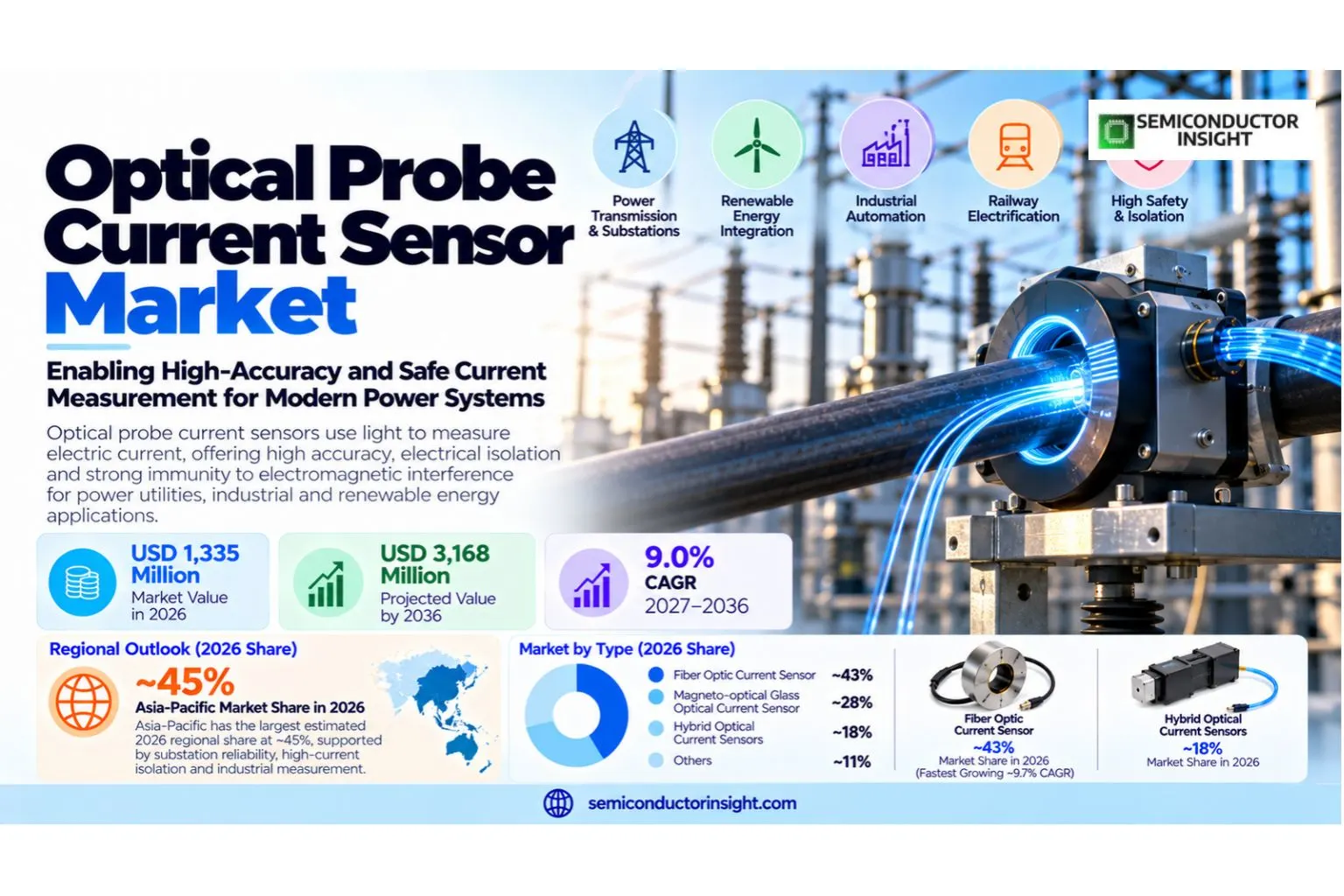
Optical probe current sensor market was valued at USD 1,335 million in 2026 and is projected to reach USD 3,168 million by 2036, recording a CAGR of 9.0% during 2027–2036. Asia-Pacific has the largest estimated 2026 regional share at ~45%, supported by substation reliability, high-current isolation and industrial measurement.
Optical current sensors use the Faraday magneto-optical effect to measure conductor magnetic fields without placing a conventional ferromagnetic transformer core in the measurement loop. Fiber loops, glass magneto-optical elements and hybrid electronics are materially different constructions, and field qualification relies on accurate calibration, thermal correction and protection-relay interoperability. The purchasing case depends on technical interfaces, installation conditions, qualification by operating organizations and subsequent maintenance commitments. A sale is commercially meaningful only when the device or equipment has a usable role in an operating infrastructure rather than a laboratory demonstration.
The revenue boundary covers optical current sensor heads, fiber and magneto-optical sensing loops, associated interrogation and readout electronics supplied for grid, industrial and instrumentation measurement; excludes conventional magnetic current transformers, electric power sales and complete substations. In many installations several firms supply interacting hardware, software, design services and ongoing network or power-system operation. Counting all associated spending as direct sensor or optical equipment sales would obscure product pricing and exaggerate the contribution of any one component class. Engineering and user support are relevant because they influence final purchasing, not because every related service must be priced as a component.
Product architecture is becoming more important as operating networks demand higher performance without complete reconstruction of existing infrastructure. Non-saturating fault-current measurement and digital substation instrumentation are commercially important when equipment lifetime, space and electrical power influence total costs. Standards-based interfaces offer buyers more predictable acceptance procedures, but successful installation still requires careful engineering of the actual site.
The purchasing cycle is often triggered by an infrastructure upgrade, customer capacity requirement or safety review rather than a continuous sequence of device replacements. Documentation from manufacturers, standards bodies and infrastructure agencies connects optical probe current sensor applications with verified changes in operational needs. These external drivers explain where spending pressure originates without equating broad network or electricity investment with this specific market revenue.
Competition increasingly rewards measurable reliability and integration efficiency. Utility engineering contractors, high-voltage equipment oems, industrial system integrators and laboratory instrument distributors compare existing assets with proposed equipment on performance, installation burden, availability and service continuity. Regional procurement is heterogeneous: a network greenfield project may favor a new architecture, while a heavily standardized brownfield site may postpone replacement. Suppliers must support migration as well as superior hardware specifications.
Segment Analysis: By Type
By type, optical probe current sensor is segmented into Magneto-optical Glass Optical Current Sensor, Fiber Optic Current Sensor, Hybrid Optical Current Sensors, Others. Fiber Optic Current Sensor is the largest class at an estimated ~43% share in 2026; Fiber Optic Current Sensor grows fastest at approximately ~9.7% CAGR from a ~43% starting share. Equipment economics are determined by field suitability, installation engineering and attainable performance within an installed environment.
| Type | Function | Market position |
|---|---|---|
| Magneto-optical Glass Optical Current Sensor | Solid-state Faraday rotator glass senses magnetic flux through polarization rotation, with precision affected by optical alignment, temperature compensation and stable field calibration. In service, the equipment must meet the stated measurement or throughput envelope, survive environmental changes and provide installation documentation that operating technicians can follow. Purchasing authorities also consider spare components, maintenance frequency and interoperability with the remaining network or electrical controls. | Specialized type: estimated ~34% share in 2026, ~9.1% CAGR. Solid-state Faraday rotator glass senses magnetic flux through polarization rotation, with precision affected by optical alignment, temperature compensation and stable field calibration. Price competition and qualification timelines differ materially from other type classes; a large installed fleet can generate steady replacement sales while a smaller technology class expands more quickly because of new deployments. |
| Fiber Optic Current Sensor | Fiber loops around a conductor support contactless Faraday-effect measurements and galvanic separation for high-current applications. Industrial units require dependable interrogators, polarization control and calibrated electronics. In service, the equipment must meet the stated measurement or throughput envelope, survive environmental changes and provide installation documentation that operating technicians can follow. Purchasing authorities also consider spare components, maintenance frequency and interoperability with the remaining network or electrical controls. | Largest type: estimated ~43% share in 2026, ~9.7% CAGR. Fiber loops around a conductor support contactless Faraday-effect measurements and galvanic separation for high-current applications. Industrial units require dependable interrogators, polarization control and calibrated electronics. Price competition and qualification timelines differ materially from other type classes; a large installed fleet can generate steady replacement sales while a smaller technology class expands more quickly because of new deployments. |
| Hybrid Optical Current Sensors | Hybrid architectures couple optical sensing elements to local electronic readout, offering packaging flexibility where the installation requires both isolation and familiar analog or digital interfaces. In service, the equipment must meet the stated measurement or throughput envelope, survive environmental changes and provide installation documentation that operating technicians can follow. Purchasing authorities also consider spare components, maintenance frequency and interoperability with the remaining network or electrical controls. | Specialized type: estimated ~17% share in 2026, ~8.1% CAGR. Hybrid architectures couple optical sensing elements to local electronic readout, offering packaging flexibility where the installation requires both isolation and familiar analog or digital interfaces. Price competition and qualification timelines differ materially from other type classes; a large installed fleet can generate steady replacement sales while a smaller technology class expands more quickly because of new deployments. |
| Others | Specialized optical current probes and niche sensing arrangements address application-specific measurement tasks that may not be economically compatible with standard high-voltage current-transformer assemblies. In service, the equipment must meet the stated measurement or throughput envelope, survive environmental changes and provide installation documentation that operating technicians can follow. Purchasing authorities also consider spare components, maintenance frequency and interoperability with the remaining network or electrical controls. | Specialized type: estimated ~6% share in 2026, ~6.4% CAGR. Specialized optical current probes and niche sensing arrangements address application-specific measurement tasks that may not be economically compatible with standard high-voltage current-transformer assemblies. Price competition and qualification timelines differ materially from other type classes; a large installed fleet can generate steady replacement sales while a smaller technology class expands more quickly because of new deployments. |
Secondary segmentation: By End-User
By End-User adds a different purchasing perspective to the primary type segmentation. Utilities is the largest member with an estimated ~50% of value in 2026. The listed members describe distinct devices, users or deployment choices rather than an additional revenue pool to sum on top of the type and application market. Engineering qualification, equipment service requirements and the cost of replacing installed assets explain relative demand.
| Axis | Members | Commercial role |
|---|---|---|
| By End-User | Utilities (~50%) | Utilities represents an estimated ~50% of 2026 value within By End-User. This class is distinguished by user requirements, engineering interfaces, procurement channels and the ability to service the installed base. The member retains a distinct technical definition rather than being folded into another technology or end-market category. This matters in optical current sensing because the selected by end-user member, Utilities, must yield reliable field performance. Operators need documented sensor accuracy, safe installation, supplier support and reproducible test results. Purchases also depend on calibration, spare components and serviceability under actual operating conditions, rather than only on a nominal optical current measurement specification. |
| By End-User | Manufacturing Industries (~28%) | Manufacturing Industries represents an estimated ~28% of 2026 value within By End-User. This class is distinguished by user requirements, engineering interfaces, procurement channels and the ability to service the installed base. The member retains a distinct technical definition rather than being folded into another technology or end-market category. This matters in optical current sensing because the selected by end-user member, Manufacturing Industries, must yield reliable field performance. Operators need documented sensor accuracy, safe installation, supplier support and reproducible test results. Purchases also depend on calibration, spare components and serviceability under actual operating conditions, rather than only on a nominal optical current measurement specification. |
| By End-User | Research Institutions (~11%) | Research Institutions represents an estimated ~11% of 2026 value within By End-User. This class is distinguished by user requirements, engineering interfaces, procurement channels and the ability to service the installed base. The member retains a distinct technical definition rather than being folded into another technology or end-market category. This matters in optical current sensing because the selected by end-user member, Research Institutions, must yield reliable field performance. Operators need documented sensor accuracy, safe installation, supplier support and reproducible test results. Purchases also depend on calibration, spare components and serviceability under actual operating conditions, rather than only on a nominal optical current measurement specification. |
| By End-User | Healthcare Providers (~5%) | Healthcare Providers represents an estimated ~5% of 2026 value within By End-User. This class is distinguished by user requirements, engineering interfaces, procurement channels and the ability to service the installed base. The member retains a distinct technical definition rather than being folded into another technology or end-market category. This matters in optical current sensing because the selected by end-user member, Healthcare Providers, must yield reliable field performance. Operators need documented sensor accuracy, safe installation, supplier support and reproducible test results. Purchases also depend on calibration, spare components and serviceability under actual operating conditions, rather than only on a nominal optical current measurement specification. |
| By End-User | Others (~6%) | Others represents an estimated ~6% of 2026 value within By End-User. This class is distinguished by user requirements, engineering interfaces, procurement channels and the ability to service the installed base. The member retains a distinct technical definition rather than being folded into another technology or end-market category. This matters in optical current sensing because the selected by end-user member, Others, must yield reliable field performance. Operators need documented sensor accuracy, safe installation, supplier support and reproducible test results. Purchases also depend on calibration, spare components and serviceability under actual operating conditions, rather than only on a nominal optical current measurement specification. |
Secondary segmentation: Fiber Optic Current Sensor Subtypes
Fiber Optic Current Sensor Subtypes adds a different purchasing perspective to the primary type segmentation. Polarimetric is the largest member with an estimated ~47% of value in 2026. The listed members describe distinct devices, users or deployment choices rather than an additional revenue pool to sum on top of the type and application market. Engineering qualification, equipment service requirements and the cost of replacing installed assets explain relative demand.
| Axis | Members | Commercial role |
|---|---|---|
| Fiber Optic Current Sensor Subtypes | Polarimetric (~47%) | Polarimetric represents an estimated ~47% of 2026 value within Fiber Optic Current Sensor Subtypes. This class is distinguished by user requirements, engineering interfaces, procurement channels and the ability to service the installed base. The member retains a distinct technical definition rather than being folded into another technology or end-market category. This matters in optical current sensing because the selected fiber optic current sensor subtypes member, Polarimetric, must yield reliable field performance. Operators need documented sensor accuracy, safe installation, supplier support and reproducible test results. Purchases also depend on calibration, spare components and serviceability under actual operating conditions, rather than only on a nominal optical current measurement specification. |
| Fiber Optic Current Sensor Subtypes | Interferometric (~43%) | Interferometric represents an estimated ~43% of 2026 value within Fiber Optic Current Sensor Subtypes. This class is distinguished by user requirements, engineering interfaces, procurement channels and the ability to service the installed base. The member retains a distinct technical definition rather than being folded into another technology or end-market category. This matters in optical current sensing because the selected fiber optic current sensor subtypes member, Interferometric, must yield reliable field performance. Operators need documented sensor accuracy, safe installation, supplier support and reproducible test results. Purchases also depend on calibration, spare components and serviceability under actual operating conditions, rather than only on a nominal optical current measurement specification. |
| Fiber Optic Current Sensor Subtypes | others (~10%) | others represents an estimated ~10% of 2026 value within Fiber Optic Current Sensor Subtypes. This class is distinguished by user requirements, engineering interfaces, procurement channels and the ability to service the installed base. The member retains a distinct technical definition rather than being folded into another technology or end-market category. This matters in optical current sensing because the selected fiber optic current sensor subtypes member, others, must yield reliable field performance. Operators need documented sensor accuracy, safe installation, supplier support and reproducible test results. Purchases also depend on calibration, spare components and serviceability under actual operating conditions, rather than only on a nominal optical current measurement specification. |
Secondary segmentation: Power Systems Subtypes
Power Systems Subtypes adds a different purchasing perspective to the primary type segmentation. Grid monitoring is the largest member with an estimated ~56% of value in 2026. The listed members describe distinct devices, users or deployment choices rather than an additional revenue pool to sum on top of the type and application market. Engineering qualification, equipment service requirements and the cost of replacing installed assets explain relative demand.
| Axis | Members | Commercial role |
|---|---|---|
| Power Systems Subtypes | Grid monitoring (~56%) | Grid monitoring represents an estimated ~56% of 2026 value within Power Systems Subtypes. This class is distinguished by user requirements, engineering interfaces, procurement channels and the ability to service the installed base. The member retains a distinct technical definition rather than being folded into another technology or end-market category. This matters in optical current sensing because the selected power systems subtypes member, Grid monitoring, must yield reliable field performance. Operators need documented sensor accuracy, safe installation, supplier support and reproducible test results. Purchases also depend on calibration, spare components and serviceability under actual operating conditions, rather than only on a nominal optical current measurement specification. |
| Power Systems Subtypes | Transformer monitoring (~35%) | Transformer monitoring represents an estimated ~35% of 2026 value within Power Systems Subtypes. This class is distinguished by user requirements, engineering interfaces, procurement channels and the ability to service the installed base. The member retains a distinct technical definition rather than being folded into another technology or end-market category. This matters in optical current sensing because the selected power systems subtypes member, Transformer monitoring, must yield reliable field performance. Operators need documented sensor accuracy, safe installation, supplier support and reproducible test results. Purchases also depend on calibration, spare components and serviceability under actual operating conditions, rather than only on a nominal optical current measurement specification. |
| Power Systems Subtypes | others (~9%) | others represents an estimated ~9% of 2026 value within Power Systems Subtypes. This class is distinguished by user requirements, engineering interfaces, procurement channels and the ability to service the installed base. The member retains a distinct technical definition rather than being folded into another technology or end-market category. This matters in optical current sensing because the selected power systems subtypes member, others, must yield reliable field performance. Operators need documented sensor accuracy, safe installation, supplier support and reproducible test results. Purchases also depend on calibration, spare components and serviceability under actual operating conditions, rather than only on a nominal optical current measurement specification. |
Segment Analysis: By Application
Principal applications include Power Systems, Industrial Production, Aerospace, Medical Equipment, Others. Power Systems contributes the largest estimated 2026 share at ~51%, while Power Systems expands fastest at ~9.4% CAGR. End users have distinct demand mechanisms: technology purchases are governed by plant or network investment, not automatically by the number of consumers using the finished service.
| Application | Demand characteristics |
|---|---|
| Power Systems | Estimated ~51% of 2026 revenue; ~9.4% CAGR. Transmission substations, HVDC links and protection systems require accurate fault and operational current measurements under electrical isolation. Orders are tied to a procurement event such as a new facility, upgrade, renewal or required system safety evaluation. Each buyer assesses specification compliance, technical training, installation burden and supplier continuity before approving a site-wide deployment. |
| Industrial Production | Estimated ~27% of 2026 revenue; ~9.2% CAGR. Smelters, converters and manufacturing lines can use calibrated fiber sensing near strong electromagnetic fields and high-current busbars. Orders are tied to a procurement event such as a new facility, upgrade, renewal or required system safety evaluation. Each buyer assesses specification compliance, technical training, installation burden and supplier continuity before approving a site-wide deployment. |
| Aerospace | Estimated ~9% of 2026 revenue; ~8.2% CAGR. Aerospace power-test programmes value galvanic isolation, reduced magnetic interference and accurate dynamic waveform capture in engineering equipment. Orders are tied to a procurement event such as a new facility, upgrade, renewal or required system safety evaluation. Each buyer assesses specification compliance, technical training, installation burden and supplier continuity before approving a site-wide deployment. |
| Medical Equipment | Estimated ~6% of 2026 revenue; ~7.6% CAGR. Medical instrumentation uses precision, isolation and specialized probe requirements in a smaller niche relative to utility infrastructure. Orders are tied to a procurement event such as a new facility, upgrade, renewal or required system safety evaluation. Each buyer assesses specification compliance, technical training, installation burden and supplier continuity before approving a site-wide deployment. |
| Others | Estimated ~7% of 2026 revenue; ~8.1% CAGR. Laboratories and specialized electrical test facilities procure optical systems for experimental high-current and transient measurement. Orders are tied to a procurement event such as a new facility, upgrade, renewal or required system safety evaluation. Each buyer assesses specification compliance, technical training, installation burden and supplier continuity before approving a site-wide deployment. |
The selling channel runs through utility engineering contractors, high-voltage equipment OEMs, industrial system integrators and laboratory instrument distributors. Technical proposals must clarify who provides commissioning, equipment diagnostics, compatibility testing and spare units over the installed life. Long sales cycles are common because procurement involves users, consulting engineers and infrastructure owners. Distributors can accelerate replacement sales, but full architectural redesign requires deeper systems integration and clear responsibility for the installed solution.
Regional Analysis
Asia-Pacific is the leading region with an estimated ~45% of 2026 revenue. North America contributes about ~23% and Europe around ~21%. Middle East & Africa has the strongest estimated regional expansion at ~9.9% CAGR. Regional market positions reflect different installation schedules and procurement profiles; manufacturing bases do not necessarily correspond to local deployment markets.
How does regional optical probe current sensor demand differ?
Five regions buy through different operating ecosystems. Chinese grid construction, Japanese optical sensing research and Indian power-system expansion create differing avenues for magneto-optical current measurement. Industrial electrification and high-voltage links favor galvanic isolation where traditional current transformers are bulky or can saturate. Utilities still require type testing, accurate temperature compensation and digital-substation interoperability before large-scale procurement. In North America and Europe, standards and brownfield asset protection shape many equipment purchases; across South America and the Middle East and Africa, large individual projects and integrator presence can be more decisive than continuous replacement demand. This is why regional growth is not a uniform multiple of population, telecom subscriptions or electricity capacity.
| Region | Position | Growth outlook | Demand profile | What decides supplier selection |
|---|---|---|---|---|
| Asia-Pacific | Largest (~45%) | ~9.7% CAGR | High-current instrumentation | Equipment qualification, country-specific installation skills, upfront funding and verified service continuity matter in Asia-Pacific. Buyers increasingly assess procurement for 2027 through 2036 against the operating needs of installed networks, buildings or electric grid systems. Contractors need clear functional acceptance tests, approved components and a practical plan for diagnostics and long-term replacement inventory. |
| North America | Second (~23%) | ~8.0% CAGR | High-current instrumentation | Equipment qualification, country-specific installation skills, upfront funding and verified service continuity matter in North America. Buyers increasingly assess procurement for 2027 through 2036 against the operating needs of installed networks, buildings or electric grid systems. Contractors need clear functional acceptance tests, approved components and a practical plan for diagnostics and long-term replacement inventory. |
| Europe | Third (~21%) | ~8.2% CAGR | High-current instrumentation | Equipment qualification, country-specific installation skills, upfront funding and verified service continuity matter in Europe. Buyers increasingly assess procurement for 2027 through 2036 against the operating needs of installed networks, buildings or electric grid systems. Contractors need clear functional acceptance tests, approved components and a practical plan for diagnostics and long-term replacement inventory. |
| South America | Fifth (~5%) | ~9.4% CAGR | High-current instrumentation | Equipment qualification, country-specific installation skills, upfront funding and verified service continuity matter in South America. Buyers increasingly assess procurement for 2027 through 2036 against the operating needs of installed networks, buildings or electric grid systems. Contractors need clear functional acceptance tests, approved components and a practical plan for diagnostics and long-term replacement inventory. |
| Middle East & Africa | Fourth (~6%) | ~9.9% CAGR | High-current instrumentation | Equipment qualification, country-specific installation skills, upfront funding and verified service continuity matter in Middle East & Africa. Buyers increasingly assess procurement for 2027 through 2036 against the operating needs of installed networks, buildings or electric grid systems. Contractors need clear functional acceptance tests, approved components and a practical plan for diagnostics and long-term replacement inventory. |
Competitive Landscape
Optical Probe Current Sensor competition depends on the ability to deliver equipment that can be installed, qualified and maintained in complex operating systems. Relevant companies in the competitive landscape include IWATSU ELECTRIC CO.,LTD., CITIZEN FINEDEVICE CO.,LTD., Orbray Co.Ltd., Hioki, Eaton, Infineon. Historical brands, acquired operations and adjacent component suppliers do not necessarily compete as independent present-day manufacturers, making current product availability more important than inherited company lists.
Platform vendors compete on whole-system qualification and channel support. Hitachi Energy and Orbray illustrate the range of companies associated with this sector, although product scope differs across suppliers. Winning long deployment programmes requires dependable maintenance, documentation and firmware or interface compatibility, not only short laboratory performance demonstrations. This matters in optical current sensing because qualification and life-cycle service must yield reliable field performance. Operators need documented sensor accuracy, safe installation, supplier support and reproducible test results. Purchases also depend on calibration, spare components and serviceability under actual operating conditions, rather than only on a nominal optical current measurement specification.
Companies serving more than one networking or sensing market often disclose broad company revenue, which includes products beyond optical probe current sensor. Commercial comparisons therefore depend on catalog-level verification, qualified installation references and confirmed manufacturing or service responsibility. A supplier specializing in an optical subsystem may have different risk exposure from a vendor delivering an entire transport or power-control platform.
Systems procurement is frequently formal and technical. Purchasers request vendor qualifications, test data, expected availability, replacement procedures and defined support periods. Utility engineering contractors, high-voltage equipment oems, industrial system integrators and laboratory instrument distributors can shorten implementation risk when they have relevant application experience. Distribution reach is valuable for installed equipment support but does not guarantee success in greenfield competitive tenders.
Technology competition includes maintaining existing equipment. Installed components and associated service skills can favor long-term incumbents, while standards-based designs open selective opportunities for new suppliers. The lowest quoted unit cost rarely reflects the full project economics: downtime exposure, spare inventory, calibration, training and energy consumption can alter the best commercially defensible choice.
Tier structure
| Tier | Companies | Basis of competition |
|---|---|---|
| Direct equipment leaders | Hitachi Energy, Orbray | This group competes with active product families, integration support and large network or industrial customer relationships. Purchasing decisions reward field performance, technical engineering coverage and the ability to support predictable supplies over the installation lifetime. This matters in optical current sensing because enterprise and utility qualification must yield reliable field performance. Operators need documented sensor accuracy, safe installation, supplier support and reproducible test results. Purchases also depend on calibration, spare components and serviceability under actual operating conditions, rather than only on a nominal optical current measurement specification. |
| Specialized and related suppliers | IWATSU ELECTRIC CO.,LTD., CITIZEN FINEDEVICE CO.,LTD., Hioki, Yokogawa Test & Measurement | These participants supply qualified modules, related optical devices and system infrastructure in different commercial roles. Customer qualification can differ significantly between legacy products, modern replacements and products sold only as a subassembly to a larger equipment manufacturer. This matters in optical current sensing because product scope and supply continuity must yield reliable field performance. Operators need documented sensor accuracy, safe installation, supplier support and reproducible test results. Purchases also depend on calibration, spare components and serviceability under actual operating conditions, rather than only on a nominal optical current measurement specification. |
| Systems and enabling ecosystem | Component makers, equipment integrators, standards laboratories | System integrators and component vendors influence design feasibility, testing, maintenance and interoperability but are not automatically independent sellers of the whole end-market product. Their bargaining power follows equipment qualification, installation competence and long-term service requirements. This matters in optical current sensing because vendor-channel responsibilities must yield reliable field performance. Operators need documented sensor accuracy, safe installation, supplier support and reproducible test results. Purchases also depend on calibration, spare components and serviceability under actual operating conditions, rather than only on a nominal optical current measurement specification. |
Key companies profiled
- IWATSU ELECTRIC CO.,LTD.
- CITIZEN FINEDEVICE CO.,LTD.
- Orbray Co.Ltd.
- Hioki
- Eaton
- Infineon
- PreSens
- Artifex
- FormFactor
- Molex
- Melexis
- EXALOS
- HBK World
- Fibercore
- Yokogawa Test & Measurement
Production Capacity Analysis
Capacity for optical probe current sensor is governed by equipment manufacturing and specialist installation expertise together. Component throughput, supplier qualification, field acceptance and spare-system availability affect delivery schedules. Capital spending on facilities or networks is not itself equivalent to product output, and supplier claims about larger technology portfolios do not establish sales volumes for every market type.
Production depends on the upstream optical or electronic elements used in optical probe current sensor, coupled with assembly and system testing. Manufacturers need reproducible performance and controlled documentation because a small component deviation can cause expensive field troubleshooting. Geographic diversification can reduce delivery concentration but also creates additional factory qualification work.
Overseas and diversified manufacturing help reduce logistics and origin risks, but changing a material supplier or factory is not always transparent to equipment buyers. Qualified bills of materials, agreed change-control processes and availability of repair or replacement units matter during project commissioning. The best sourcing decisions balance factory efficiency with customer-specific service expectations.
The upstream constraint is often specialist components, not simple enclosure assembly. Thermal drift and optical calibration can restrict usable output even if nominal hardware production is high. Maintaining multiple approved suppliers is expensive, but single-source dependency can increase schedule risk when a service provider or utility operates a critical communications or electrical system.
Market Dynamics
The market evolves through infrastructure investment, device modernization and installed-base replacement. Non-saturating fault-current measurement supports demand while higher project qualification expense can delay projects. Market growth is not uniform: an upgrade may substantially raise the performance of a system without increasing the number of sites, and equipment price declines can alter revenue even when deployed unit counts rise.
MARKET DRIVERS
Drivers Impact Analysis*
| Driver | (~) % impact on CAGR forecast | Geographic relevance | Impact timeline |
|---|---|---|---|
| Non-saturating fault-current measurement | +1.8% | Asia-Pacific | 2027–2030 |
| Digital substation instrumentation | +1.3% | North America | 2028–2032 |
| Growing renewable grid connections | +1.1% | Europe | 2027–2033 |
| Industrial galvanic isolation | +0.7% | South America | 2030–2036 |
| Non-saturating fault-current measurement | +0.6% | Middle East & Africa | 2029–2035 |
Non-saturating fault-current measurement
Non-saturating fault-current measurement creates demand where higher-capacity or safer operations cannot be achieved through an inexpensive incremental change to existing devices. The commercial response involves equipment specifications, systems integration and repeatable acceptance testing. In many customer installations, projects compete for capital with other priorities, so manufacturers benefit from quantifying reliability, operating cost and migration impact in procurement discussions.
Digital substation instrumentation
Digital substation instrumentation creates demand where higher-capacity or safer operations cannot be achieved through an inexpensive incremental change to existing devices. The commercial response involves equipment specifications, systems integration and repeatable acceptance testing. In many customer installations, projects compete for capital with other priorities, so manufacturers benefit from quantifying reliability, operating cost and migration impact in procurement discussions.
Growing renewable grid connections
Growing renewable grid connections creates demand where higher-capacity or safer operations cannot be achieved through an inexpensive incremental change to existing devices. The commercial response involves equipment specifications, systems integration and repeatable acceptance testing. In many customer installations, projects compete for capital with other priorities, so manufacturers benefit from quantifying reliability, operating cost and migration impact in procurement discussions.
Industrial galvanic isolation
Industrial galvanic isolation creates demand where higher-capacity or safer operations cannot be achieved through an inexpensive incremental change to existing devices. The commercial response involves equipment specifications, systems integration and repeatable acceptance testing. In many customer installations, projects compete for capital with other priorities, so manufacturers benefit from quantifying reliability, operating cost and migration impact in procurement discussions.
MARKET RESTRAINTS
Restraints Impact Analysis*
| Restraint | (~) % impact on CAGR forecast | Geographic relevance | Impact timeline |
|---|---|---|---|
| Higher project qualification expense | -1.5% | Asia-Pacific | 2027–2033 |
| Thermal drift and optical calibration | -1.0% | North America | 2027–2036 |
| Low-cost magnetic alternatives | -0.8% | Europe | 2028–2032 |
| Specialized field installation needs | -0.6% | South America | 2027–2034 |
Higher project qualification expense
Higher project qualification expense reduces near-term equipment adoption because technical improvements do not remove the need for customer retraining, accepted engineering interfaces and site-specific installation. Purchasers can postpone a refresh when working infrastructure still meets required service or safety levels. Suppliers mitigate this risk with incremental migration paths, transparent qualification evidence, field support and engineering services matched to the actual operating system.
Thermal drift and optical calibration
Thermal drift and optical calibration reduces near-term equipment adoption because technical improvements do not remove the need for customer retraining, accepted engineering interfaces and site-specific installation. Purchasers can postpone a refresh when working infrastructure still meets required service or safety levels. Suppliers mitigate this risk with incremental migration paths, transparent qualification evidence, field support and engineering services matched to the actual operating system.
Low-cost magnetic alternatives
Low-cost magnetic alternatives reduces near-term equipment adoption because technical improvements do not remove the need for customer retraining, accepted engineering interfaces and site-specific installation. Purchasers can postpone a refresh when working infrastructure still meets required service or safety levels. Suppliers mitigate this risk with incremental migration paths, transparent qualification evidence, field support and engineering services matched to the actual operating system.
Specialized field installation needs
Specialized field installation needs reduces near-term equipment adoption because technical improvements do not remove the need for customer retraining, accepted engineering interfaces and site-specific installation. Purchasers can postpone a refresh when working infrastructure still meets required service or safety levels. Suppliers mitigate this risk with incremental migration paths, transparent qualification evidence, field support and engineering services matched to the actual operating system.
MARKET OPPORTUNITIES
IEC 61869 digital measurement adoption
IEC 61869 digital measurement adoption offers a commercial opening when a new technical requirement intersects with a scheduled infrastructure decision. Equipment suppliers can develop offerings that reduce integration risk and make the installation outcome more predictable. Adoption remains tied to qualification, investment budgets, supply assurance and availability of maintenance skills; an attractive technological capability alone is not sufficient to generate a confirmed order.
High-voltage DC current monitoring
High-voltage DC current monitoring offers a commercial opening when a new technical requirement intersects with a scheduled infrastructure decision. Equipment suppliers can develop offerings that reduce integration risk and make the installation outcome more predictable. Adoption remains tied to qualification, investment budgets, supply assurance and availability of maintenance skills; an attractive technological capability alone is not sufficient to generate a confirmed order.
Flexible fiber sensing geometries
Flexible fiber sensing geometries offers a commercial opening when a new technical requirement intersects with a scheduled infrastructure decision. Equipment suppliers can develop offerings that reduce integration risk and make the installation outcome more predictable. Adoption remains tied to qualification, investment budgets, supply assurance and availability of maintenance skills; an attractive technological capability alone is not sufficient to generate a confirmed order.
Precision industrial electrical test
Precision industrial electrical test offers a commercial opening when a new technical requirement intersects with a scheduled infrastructure decision. Equipment suppliers can develop offerings that reduce integration risk and make the installation outcome more predictable. Adoption remains tied to qualification, investment budgets, supply assurance and availability of maintenance skills; an attractive technological capability alone is not sufficient to generate a confirmed order.
Supply Chain Analysis
The optical probe current sensor value chain links upstream engineered materials and specialty parts with equipment assembly, testing, project integration and the operating customer. Each handoff can affect delivery timing and serviceability. Mature supply relationships reduce the probability that a minor unqualified substitution changes performance or forces a costly acceptance test after the equipment has already been installed.
Upstream sourcing. Specialty materials and components need lot traceability. Reliability depends on clear acceptance thresholds and named engineering responsibilities. Long-lived equipment purchases benefit when replacement units, firmware or test interfaces remain available during operations. Commercial leverage follows the ability to protect customer uptime while controlling total installed cost. This matters in optical current sensing because Upstream sourcing must yield reliable field performance. Operators need documented sensor accuracy, safe installation, supplier support and reproducible test results. Purchases also depend on calibration, spare components and serviceability under actual operating conditions, rather than only on a nominal optical current measurement specification.
Manufacturing qualification. Systems must be tested before delivery. Reliability depends on clear acceptance thresholds and named engineering responsibilities. Long-lived equipment purchases benefit when replacement units, firmware or test interfaces remain available during operations. Commercial leverage follows the ability to protect customer uptime while controlling total installed cost. This matters in optical current sensing because Manufacturing qualification must yield reliable field performance. Operators need documented sensor accuracy, safe installation, supplier support and reproducible test results. Purchases also depend on calibration, spare components and serviceability under actual operating conditions, rather than only on a nominal optical current measurement specification.
Distribution and field integration. Integrators coordinate on-site network or electrical work. Reliability depends on clear acceptance thresholds and named engineering responsibilities. Long-lived equipment purchases benefit when replacement units, firmware or test interfaces remain available during operations. Commercial leverage follows the ability to protect customer uptime while controlling total installed cost. This matters in optical current sensing because Distribution and field integration must yield reliable field performance. Operators need documented sensor accuracy, safe installation, supplier support and reproducible test results. Purchases also depend on calibration, spare components and serviceability under actual operating conditions, rather than only on a nominal optical current measurement specification.
Downstream lifecycle. Customers maintain deployed systems over many years. Reliability depends on clear acceptance thresholds and named engineering responsibilities. Long-lived equipment purchases benefit when replacement units, firmware or test interfaces remain available during operations. Commercial leverage follows the ability to protect customer uptime while controlling total installed cost. This matters in optical current sensing because Downstream lifecycle must yield reliable field performance. Operators need documented sensor accuracy, safe installation, supplier support and reproducible test results. Purchases also depend on calibration, spare components and serviceability under actual operating conditions, rather than only on a nominal optical current measurement specification.
Recent Developments
- 2026 Published
The IEA Electricity 2026 grid assessment highlighted transmission and distribution constraints and the need for greater grid investment. These system pressures create conditions for upgraded measurement and protection infrastructure, although they do not imply that every new power line requires a Faraday-effect optical current sensor. This matters in optical current sensing because substation reliability, high-current isolation and industrial measurement must yield reliable field performance. Operators need documented sensor accuracy, safe installation, supplier support and reproducible test results. Purchases also depend on calibration, spare components and serviceability under actual operating conditions, rather than only on a nominal optical current measurement specification. Source - 2026 Published
IEA electricity supply analysis projected substantial additional solar and other low-emissions generation through 2030, reinforcing the operating complexity of interconnected power systems. Current measurement equipment is evaluated for accurate fault handling and protection signaling, but optical instruments remain one option among several conventional and non-conventional technologies. This matters in optical current sensing because substation reliability, high-current isolation and industrial measurement must yield reliable field performance. Operators need documented sensor accuracy, safe installation, supplier support and reproducible test results. Purchases also depend on calibration, spare components and serviceability under actual operating conditions, rather than only on a nominal optical current measurement specification. Source - October 2025 Published
The IEA Renewables 2025 outlook projected 4,600 GW of renewable capacity additions over 2025–2030. Grid connections, converter installations and high-voltage transmission can motivate improved monitoring, although sensor selection must be supported by service environment, instrument-transformer standards and project cost. This matters in optical current sensing because substation reliability, high-current isolation and industrial measurement must yield reliable field performance. Operators need documented sensor accuracy, safe installation, supplier support and reproducible test results. Purchases also depend on calibration, spare components and serviceability under actual operating conditions, rather than only on a nominal optical current measurement specification. Source - June 2025 Published
The IEA World Energy Investment 2025 study identified worldwide grid investment of roughly USD 400 billion per year. The scale of infrastructure spending provides context for equipment procurement, but the optical probe current sensor portion is much narrower and tied to specific metering, protection and process installations. This matters in optical current sensing because substation reliability, high-current isolation and industrial measurement must yield reliable field performance. Operators need documented sensor accuracy, safe installation, supplier support and reproducible test results. Purchases also depend on calibration, spare components and serviceability under actual operating conditions, rather than only on a nominal optical current measurement specification. Source - 2025 Published
Hitachi Energy detailed FOCS-FS non-conventional current measurement for digital substations, including Faraday-based sensing and Ethernet data output compatible with IEC 61850-9-2LE. That product design demonstrates that optical measurement can integrate with protection systems, subject to field calibration and utility acceptance. This matters in optical current sensing because substation reliability, high-current isolation and industrial measurement must yield reliable field performance. Operators need documented sensor accuracy, safe installation, supplier support and reproducible test results. Purchases also depend on calibration, spare components and serviceability under actual operating conditions, rather than only on a nominal optical current measurement specification. Source - 2016 In force
IEC 61869-9 established digital interface requirements for instrument transformer measurements, building on IEC 61850 communications conventions. The standard provides an interoperability anchor for electronic and optical instrument transformers but does not, by itself, compel utilities to replace functioning conventional current transformers. This matters in optical current sensing because substation reliability, high-current isolation and industrial measurement must yield reliable field performance. Operators need documented sensor accuracy, safe installation, supplier support and reproducible test results. Purchases also depend on calibration, spare components and serviceability under actual operating conditions, rather than only on a nominal optical current measurement specification. Source
REPORT SCOPE & SEGMENTATION
| Attribute | Details |
|---|---|
| Study Period | 2021–2036 |
| Base Year | 2026 |
| Estimated Year | 2027 |
| Forecast Period | 2027–2036 |
| Historical Period | 2021–2025 |
| 2026 Market Size | USD 1,335 million |
| 2027 Estimated Size | USD 1,455 million |
| 2036 Forecast Size | USD 3,168 million |
| Growth Rate | 9.0% |
| Revenue Unit | USD million |
| Market Definition | optical current sensor heads, fiber and magneto-optical sensing loops, associated interrogation and readout electronics supplied for grid, industrial and instrumentation measurement; excludes conventional magnetic current transformers, electric power sales and complete substations |
| By Type | Magneto-optical Glass Optical Current Sensor · Fiber Optic Current Sensor · Hybrid Optical Current Sensors · Others |
| By Application | Power Systems · Industrial Production · Aerospace · Medical Equipment · Others |
| By End-User | Utilities · Manufacturing Industries · Research Institutions · Healthcare Providers · Others |
| Fiber Optic Current Sensor Subtypes | Polarimetric · Interferometric · others |
| Power Systems Subtypes | Grid monitoring · Transformer monitoring · others |
| By Region | Coverage by purchase geography; region estimates refer to 2026 equipment revenue. Asia-PacificChina · Japan · India · South Korea North AmericaUnited States · Canada · Mexico EuropeGermany · United Kingdom · France South AmericaBrazil · Chile · Colombia Middle East & AfricaSaudi Arabia · United Arab Emirates · South Africa |
| Key Companies Profiled | IWATSU ELECTRIC CO.,LTD.; CITIZEN FINEDEVICE CO.,LTD.; Orbray Co.Ltd.; Hioki; Eaton; Infineon; PreSens; Artifex; FormFactor; Molex; Melexis; EXALOS; HBK World; Fibercore; Yokogawa Test & Measurement |
| Customization Scope | country-level equipment purchases, the listed type and application classes, supplier qualification, installed-base renewal, regional pricing and supply-chain information for optical probe current sensor. |
Frequently Asked Questions
What is the global optical probe current sensor market size?
The global optical probe current sensor market stands at USD 1,335 million for 2026 and is projected at USD 3,168 million by 2036, a 9.0% CAGR during 2027–2036. Sales depend on infrastructure investment, qualification and operating conditions rather than a simple multiplication of subscriber, building or electricity-load figures. Product cost and associated integration requirements can also move differently over time.
Which region leads the optical probe current sensor market?
Asia-Pacific holds the leading estimated 2026 share of ~45%, ahead of North America at ~23% and Europe at ~21%. Demand reflects customer projects, supply capability and system integration services. Region of component manufacture does not invariably equal region of the ultimate installation or equipment purchase. This matters in optical current sensing because FAQ commercial relevance must yield reliable field performance. Operators need documented sensor accuracy, safe installation, supplier support and reproducible test results. Purchases also depend on calibration, spare components and serviceability under actual operating conditions, rather than only on a nominal optical current measurement specification.
Which region is growing most quickly?
Middle East & Africa shows the highest estimated regional growth at ~9.9% CAGR through 2036. Saudi and Emirati high-voltage grid projects can justify sensors with improved galvanic isolation and reduced oil-filled equipment in particular substations. South African utilities face reliability and maintenance challenges that also influence instrument-transformer choices. Desert temperatures, commissioning skills and availability of proven relay interfaces remain practical adoption gates, even when optical principles offer technical advantages. The pace of conversion into purchase orders still depends on procurement budgets, local installer capabilities and compatibility with the equipment already in service.
What is the largest market segment by type?
Fiber Optic Current Sensor leads with an estimated ~43% of 2026 revenue. The position is driven by product fit, relative equipment price and installed use cases. Demand for other types is shaped by separate engineering constraints, so a segment with the greatest shipment volume need not be the class with the highest average unit value.
Which type has the fastest growth?
Fiber Optic Current Sensor has the strongest estimated type expansion at ~9.7% CAGR and an initial share of ~43%. Growth requires the product to satisfy real operating environments and integration standards, while more established types can continue generating revenue through maintenance and replacement requirements rather than new installations alone. This matters in optical current sensing because FAQ commercial relevance must yield reliable field performance. Operators need documented sensor accuracy, safe installation, supplier support and reproducible test results. Purchases also depend on calibration, spare components and serviceability under actual operating conditions, rather than only on a nominal optical current measurement specification.
What is the leading application?
Power Systems is the largest application at an estimated ~51% of 2026 sales. Project demand is connected with non-saturating fault-current measurement and reliable hardware availability. Purchasers specify site operating requirements before considering the optical equipment, which means overall infrastructure budgets cannot directly be interpreted as equipment revenue. This matters in optical current sensing because FAQ commercial relevance must yield reliable field performance. Operators need documented sensor accuracy, safe installation, supplier support and reproducible test results. Purchases also depend on calibration, spare components and serviceability under actual operating conditions, rather than only on a nominal optical current measurement specification.
Which application expands fastest?
Power Systems expands at an estimated ~9.4% CAGR from roughly ~51% initial share. Its purchasing dynamics are shaped by customer procurement cycles, technical regulation and system replacement plans. Suppliers must support design review, field commissioning and continuity of supply to convert growing application demand into repeatable sales. This matters in optical current sensing because FAQ commercial relevance must yield reliable field performance. Operators need documented sensor accuracy, safe installation, supplier support and reproducible test results. Purchases also depend on calibration, spare components and serviceability under actual operating conditions, rather than only on a nominal optical current measurement specification.
Who are the important companies in this market?
Relevant companies in the competitive landscape include IWATSU ELECTRIC CO.,LTD., CITIZEN FINEDEVICE CO.,LTD., Orbray Co.Ltd., Hioki, Eaton, Infineon, PreSens. These participants have different roles, including original equipment supply, optical components, system integration and historical acquired product lines. Present-day direct supplier status must be assessed at the product-family level rather than inferred from broad corporate revenues or former company names.
What restrains faster market adoption?
Higher project qualification expense and thermal drift and optical calibration are important barriers, alongside integration cost and customer reliance on existing equipment. A purchaser may defer adoption until scheduled refurbishment even when optical systems improve performance. Regulatory acceptance, training, field testing and end-to-end serviceability can matter more to a safety-critical or mission-critical operator than a headline technology specification.
What are the report period and segmentation?
The study uses 2026 as the base year, 2027 as the estimated year and 2036 as the forecast endpoint, with historical context from 2021 through 2025. Segmentation covers Magneto-optical Glass Optical Current Sensor, Fiber Optic Current Sensor, Hybrid Optical Current Sensors, Others by type and Power Systems, Industrial Production, Aerospace, Medical Equipment, Others by application across all five world regions. The discussion addresses equipment supply, qualification and procurement channels as well as customer needs.
Research Sources & Evidence Base

Get Sample Report PDF for Exclusive Insights
Report Sample Includes
- Table of Contents
- List of Tables & Figures
- Charts, Research Methodology, and more...
 Download Sample Report PDF