Magnetic, Inductive and Optical Encoders Market Insights
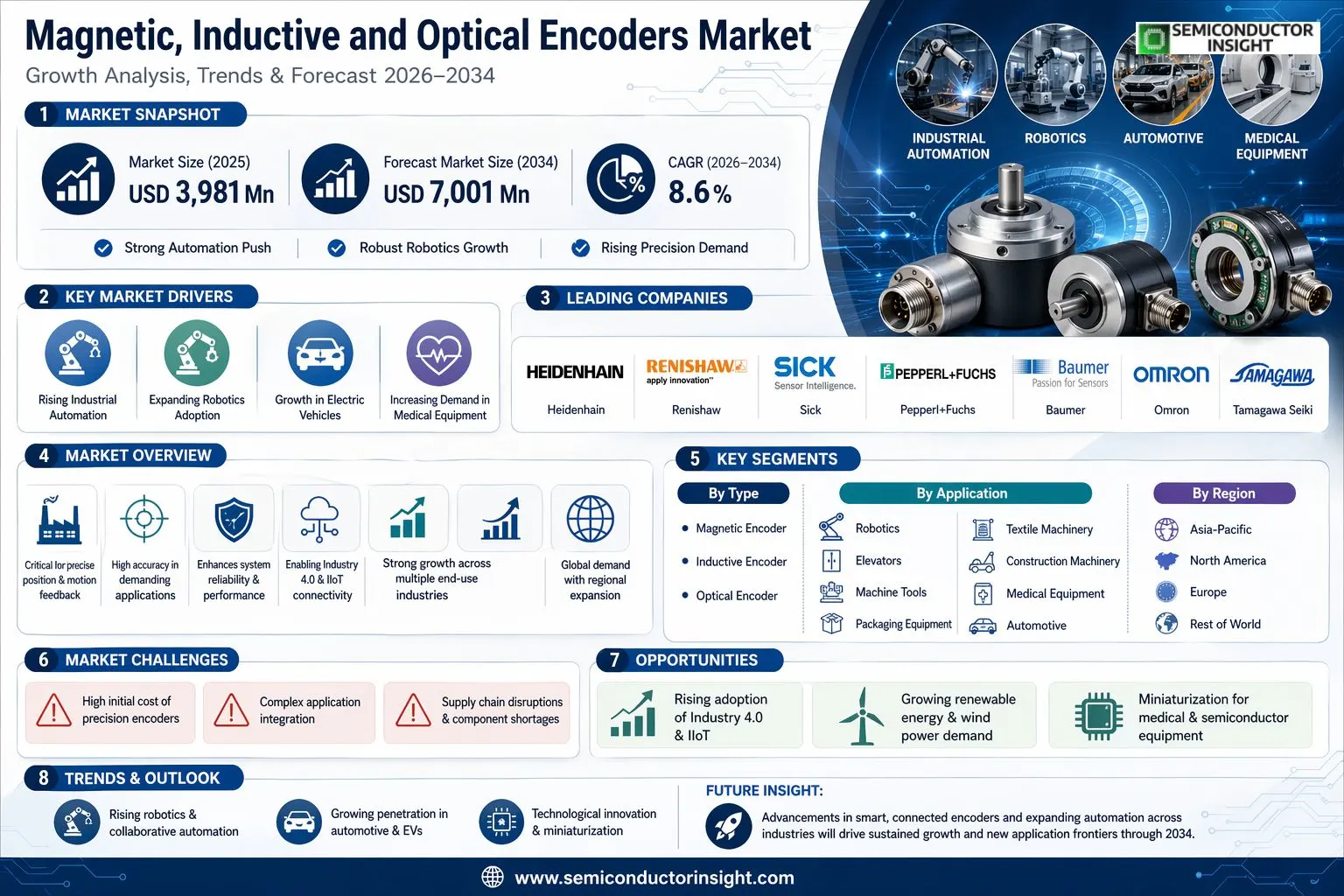
Global Magnetic, Inductive and Optical Encoders market size was valued at USD 3,981 million in 2025. The market is projected to grow from USD 4,324 million in 2026 to USD 7,001 million by 2034, exhibiting a CAGR of 8.6% during the forecast period.
Magnetic, Inductive, and Optical Encoders are precision position sensors designed to measure the position, angle, or rotational speed of a moving object. These encoders convert mechanical motion into electrical signals that serve as control or feedback inputs across a wide range of systems. The technology encompasses three primary types , Magnetic Encoders, which rely on magnetic field detection for robust performance in harsh environments; Inductive Encoders, valued for their contactless operation and resistance to contamination; and Optical Encoders, recognized for delivering high-resolution output in precision-critical applications. Together, these technologies find extensive deployment across industrial machinery, robotics, automation systems, automotive platforms, and medical equipment.
The market is experiencing sustained growth driven by the accelerating global adoption of industrial automation and the rapid expansion of robotics across manufacturing sectors. Furthermore, the rising integration of encoder technologies within electric vehicles and advanced driver-assistance systems (ADAS) is broadening the demand landscape significantly. Key players operating in Global market include Heidenhain, Renishaw, Sick AG, Pepperl+Fuchs, Baumer, Dynapar, Sensata Technologies, Broadcom, Omron, and Tamagawa Seiki, among others, each maintaining competitive portfolios across multiple encoder technologies and application verticals.
MARKET DRIVERS
Rising Industrial Automation and Robotics Adoption Fueling Demand for Magnetic, Inductive and Optical Encoders
Global Magnetic, Inductive and Optical Encoders Market is experiencing robust growth driven by the accelerating pace of industrial automation across manufacturing, automotive, and electronics sectors. As factories worldwide transition toward smart manufacturing frameworks and Industry 4.0 principles, the need for highly accurate position and motion feedback devices has intensified considerably. Magnetic encoders are increasingly favored in harsh industrial environments due to their resistance to dust, moisture, and vibration, while optical encoders continue to dominate applications requiring ultra-high resolution and precision. This dual demand is creating a sustained growth trajectory for the broader encoder market.
Expansion of Electric Vehicles and Advanced Motor Control Systems Supporting Encoder Integration
The rapid global expansion of electric vehicles (EVs) has emerged as one of the most significant demand drivers for Magnetic Inductive and Optical Encoders Market. Electric drivetrains require precise motor control, and inductive encoders and magnetic encoders are being extensively integrated into EV traction motors, servo systems, and battery management assemblies. Automotive OEMs and Tier-1 suppliers are increasingly specifying inductive encoder technologies for their robustness and contactless operation. The shift toward electrification across passenger vehicles, commercial transport, and two-wheelers is generating consistent long-term demand across all three encoder technology segments.
➤ The convergence of robotics, EV adoption, and smart factory investments is fundamentally reshaping the competitive and demand landscape of Global Magnetic, Inductive and Optical Encoders Market, with encoder manufacturers investing heavily in miniaturization, integration, and multi-turn absolute sensing capabilities to meet evolving application requirements.
Beyond automotive, the proliferation of collaborative robots (cobots), CNC machine tools, and semiconductor manufacturing equipment is further amplifying encoder adoption. Optical encoders in particular are widely deployed in semiconductor wafer handling and photonics applications where sub-micron positional accuracy is non-negotiable. The sustained capital expenditure in industrial machinery modernization across Asia-Pacific and North America continues to underpin strong volume demand for all encoder variants in Magnetic Inductive and Optical Encoders Market.
MARKET CHALLENGES
Technical Complexity and Integration Challenges Constraining Broader Adoption of Encoder Technologies
Despite strong growth fundamentals, Magnetic Inductive and Optical Encoders Market faces notable challenges related to technical complexity and system integration. Optical encoders, while offering superior resolution, are sensitive to contamination from oil, dust, and condensation, limiting their deployment in certain industrial environments without additional protective measures. End-users in sectors such as mining, heavy construction, and food processing often require extensive customization or protective enclosures, increasing total system cost and deployment time. Bridging the performance gap between encoder types while maintaining competitive pricing remains a persistent engineering and commercial challenge for market participants.
Other Challenges
Supply Chain Vulnerabilities and Component Sourcing
Magnetic Inductive and Optical Encoders Market is exposed to supply chain disruptions affecting precision optical components, rare earth magnets, and specialized semiconductor chips integral to encoder manufacturing. Global shortages and geopolitical trade tensions have periodically constrained the availability of key raw materials, leading to extended lead times and cost pressures for encoder manufacturers and their downstream customers.
Skilled Workforce and Calibration Requirements
Accurate installation, calibration, and maintenance of magnetic, inductive, and optical encoders require specialized technical expertise that is not uniformly available across all geographies. In emerging markets, the limited availability of trained technicians capable of handling high-resolution encoder systems poses a barrier to adoption, particularly among small and medium-sized enterprises seeking to automate operations without incurring significant additional service costs.
MARKET RESTRAINTS
High Initial Investment and Cost Sensitivity Among End-Users Limiting Market Penetration
One of the primary restraints affecting Magnetic Inductive and Optical Encoders Market is the relatively high upfront cost associated with precision encoder systems, particularly high-resolution optical encoders and multi-turn absolute magnetic encoders. For cost-sensitive industries and small-scale manufacturers in developing economies, the capital investment required for encoder-integrated automation systems can be prohibitive. While the long-term operational benefits in terms of reduced downtime and improved process accuracy are well-documented, the short-term payback period remains a concern that slows adoption rates in price-competitive markets.
Competition from Alternative Feedback Technologies Posing a Substitution Risk
Magnetic Inductive and Optical Encoders Market also faces substitution pressure from alternative position-sensing technologies including resolvers, linear variable differential transformers (LVDTs), and increasingly, Hall-effect sensor arrays. In certain automotive and industrial servo applications, resolvers are preferred for their extreme ruggedness and temperature tolerance, competing directly with inductive encoders. Additionally, advances in sensor fusion and vision-based positioning systems are beginning to offer viable alternatives in select robotics and autonomous vehicle applications, potentially limiting encoder market share in those segments over the medium term.
MARKET OPPORTUNITIES
Integration of Smart and Wireless Encoder Technologies Opening New Revenue Streams
The emergence of smart encoder solutions embedded with onboard diagnostics, condition monitoring, and Industrial IoT (IIoT) connectivity represents a transformative opportunity for Magnetic Inductive and Optical Encoders Market. Manufacturers are developing next-generation magnetic and optical encoders capable of transmitting real-time positional data, temperature readings, and predictive maintenance alerts via standard industrial protocols such as IO-Link, EtherCAT, and PROFINET. This intelligence layer significantly enhances encoder value propositions, enabling end-users to integrate encoder data directly into manufacturing execution systems (MES) and digital twin platforms for process optimization.
Growing Demand from Medical Devices, Aerospace, and Renewable Energy Sectors Broadening Application Scope
Diversification into high-growth verticals presents compelling opportunities for participants in Magnetic Inductive and Optical Encoders Market. In the medical device sector, miniaturized optical encoders are finding increasing application in surgical robotics, imaging systems, and prosthetics requiring precise, repeatable motion control. The aerospace and defense sector’s ongoing investment in UAVs, guidance systems, and satellite positioning equipment is generating demand for ruggedized magnetic and inductive encoders with high shock and vibration tolerance. Meanwhile, Global expansion of wind energy infrastructure is driving adoption of large-format absolute encoders in pitch and yaw control systems, further broadening the addressable market for Magnetic, Inductive and Optical Encoders well beyond traditional industrial automation applications.
Magnetic, Inductive and Optical Encoders Market Trends
Rising Adoption of Automation and Robotics Driving Encoder Demand
Magnetic Inductive and Optical Encoders Market is experiencing sustained momentum driven by rapid industrialization and the widespread deployment of automation technologies across manufacturing sectors. As industrial operations increasingly rely on precision motion control, encoders have become indispensable components in robotics, machine tools, and packaging equipment. The growing emphasis on operational efficiency and process accuracy in smart factories has reinforced the need for high-performance position sensing solutions. Manufacturers such as Heidenhain, Renishaw, and Sick continue to expand their encoder portfolios to meet evolving industry requirements, particularly in applications demanding real-time feedback with minimal latency. The integration of encoders within collaborative robots and automated guided vehicles further underscores the expanding role of these sensors in next-generation industrial ecosystems.
Other Trends
Expansion of Optical Encoders in High-Precision Applications
Optical encoders are witnessing growing adoption in industries where high resolution and accuracy are non-negotiable, including medical equipment manufacturing and semiconductor processing. Their ability to deliver fine positional data makes them a preferred choice in applications such as surgical robotics and diagnostic imaging systems. Leading players like Baumer and Broadcom have been advancing optical encoder technologies to support miniaturized, high-speed designs suited for compact medical and laboratory devices. This trend is reinforcing the position of optical encoders as a critical segment within the broader Magnetic, Inductive and Optical Encoders Market.
Magnetic and Inductive Encoders Gaining Traction in Harsh Environments
Magnetic and inductive encoders are increasingly favored in applications exposed to dust, moisture, and vibration, such as construction machinery, automotive systems, and textile machinery. Their robust, contactless sensing mechanisms offer durability advantages over optical alternatives in demanding operational conditions. Companies including Pepperl+Fuchs, Dynapar, and Sensata Technologies are investing in next-generation magnetic encoder designs that deliver enhanced reliability without compromising on resolution. This trend is particularly evident in the automotive sector, where encoder reliability directly impacts vehicle safety and powertrain efficiency.
Regionalization of Supply Chains and Manufacturing Investments
Geopolitical shifts and supply chain resilience strategies are prompting encoder manufacturers to localize production and diversify sourcing. Asia-Pacific, led by China, Japan, and South Korea, remains a dominant manufacturing hub, while North America and Europe are witnessing renewed investment in domestic encoder production capacity. Firms such as Rockwell Automation, POSITAL (FRABA), and Fagor Automation are aligning their regional strategies to serve local demand more efficiently and reduce exposure to global logistics disruptions.
Digital Integration and Industry 4.0 Compatibility Shaping Product Development
A defining trend in Magnetic Inductive and Optical Encoders Market is the shift toward digitally integrated encoder solutions compatible with Industry 4.0 frameworks. Encoders are increasingly being developed with embedded communication interfaces such as EtherCAT, PROFINET, and IO-Link, enabling seamless data exchange within connected industrial networks. This evolution supports predictive maintenance capabilities, reduces commissioning time, and enhances overall system diagnostics. Key players including Omron, Balluff, and Kubler are at the forefront of developing smart encoder platforms that align with the connectivity demands of modern industrial environments, positioning the market for continued technological advancement in the years ahead.
COMPETITIVE LANDSCAPE
Key Industry Players
Magnetic, Inductive and Optical Encoders Market , Global Competitive Analysis and Leading Manufacturer Profiles
Global Magnetic, Inductive and Optical Encoders market is characterized by intense competition among a mix of established multinational corporations and specialized regional players. As of 2025, the market is valued at approximately USD 3,981 million and is projected to reach USD 7,001 million by 2034, growing at a CAGR of 8.6%. Heidenhain stands out as one of the foremost players in this space, renowned for its high-precision optical and magnetic encoder solutions widely adopted in machine tools, robotics, and semiconductor manufacturing. Renishaw and Sick similarly command significant market presence, leveraging deep R&D investment and diversified encoder portfolios spanning inductive, magnetic, and optical technologies. These top-tier players collectively held a substantial share of global revenues in 2025, benefiting from strong brand equity, expansive distribution networks, and long-standing OEM partnerships across industrial automation, automotive, and medical equipment sectors. The competitive dynamics are further shaped by ongoing advancements in miniaturization, higher resolution sensing, and the integration of encoders with Industry 4.0-compatible communication interfaces such as EtherCAT and PROFINET.
Beyond the market leaders, a robust tier of niche and regionally significant players contributes to the competitive richness of this industry. Companies such as Baumer, Pepperl+Fuchs, Dynapar, and Omron serve critical verticals including packaging equipment, textile machinery, and construction machinery, competing on the basis of product reliability, application-specific customization, and competitive pricing. POSITAL (FRABA) and Kubler have carved out strong positions in absolute encoder segments, while TR Electronic, Balluff, and Fagor Automation address specialized industrial and machine tool requirements across Europe. Asian manufacturers, notably Tamagawa Seiki, JTEKT Electronics, and Changchun Yuheng Optics, are increasingly asserting their presence in cost-sensitive markets across Asia-Pacific and emerging economies. Sensata Technologies and TE Connectivity bring the additional advantage of broad sensor platform integration, catering to automotive and harsh-environment applications. The competitive landscape continues to evolve through mergers, acquisitions, and strategic collaborations as players seek to expand their geographic footprint and technology capabilities in an accelerating automation-driven global economy.
List of Key Magnetic, Inductive and Optical Encoders Companies Profiled
- Heidenhain
- Tamagawa Seiki
- Sick
- Renishaw
- Pepperl+Fuchs
- Dynapar
- Baumer
- Sensata Technologies
- Broadcom
- Omron
- TR Electronic
- Balluff
- Rockwell Automation
- Bourns
- TE Connectivity
- Fagor Automation
- Kubler
- SIKO
- JTEKT Electronics
- POSITAL (FRABA)
- Zhejiang Reagle Sensing
- Changchun Yuheng Optics
- Lenord+Bauer
- Faulhaber
Segment Analysis:
| Segment Category | Sub-Segments | Key Insights |
| By Type |
|
Optical Encoder continues to hold a dominant position in the market owing to its superior resolution and high accuracy in demanding applications.
|
| By Application |
|
Robotics stands as the most dynamic and rapidly expanding application segment, driven by Global surge in industrial automation and the proliferation of collaborative robots across manufacturing facilities.
|
| By End User |
|
Industrial Manufacturing remains the largest and most established end-user segment, anchoring demand across a broad spectrum of encoder technologies used in automated production lines, CNC machinery, and material handling systems.
|
| By Output Signal Type |
|
Absolute Encoders are gaining strong preference across mission-critical applications where retaining positional data after power loss is essential for safe and efficient system restart.
|
| By Interface Protocol |
|
Fieldbus & Industrial Ethernet-based Encoders represent the fastest-evolving interface segment, reflecting the broader industry shift toward digitally integrated and networked automation architectures.
|
Regional Analysis: Magnetic, Inductive and Optical Encoders Market
Asia-Pacific’s extraordinary growth in industrial automation has made it the most dynamic market for magnetic and optical encoders. Manufacturing hubs across China and South Korea are undergoing systematic robotic integration across automotive, electronics, and heavy industries. The demand for high-resolution encoders capable of delivering precise feedback in multi-axis robotic systems continues to intensify as manufacturers prioritize throughput, quality consistency, and smart factory compliance.
The electric vehicle revolution sweeping across China, Japan, and South Korea is creating substantial demand for encoder technologies used in motor control, powertrain management, and braking systems. Inductive and magnetic encoders, valued for their durability in harsh automotive environments, are being increasingly embedded into EV drivetrains and charging infrastructure, making the region a critical growth engine for encoder manufacturers targeting the automotive technology vertical.
Japan, South Korea, and Taiwan remain global leaders in semiconductor and advanced electronics manufacturing, sectors that depend heavily on ultra-precise optical encoders for wafer handling, photolithography, and quality inspection equipment. The ongoing investment in next-generation chip fabrication facilities across the region is significantly amplifying demand for nanometer-level precision encoders capable of operating in cleanroom environments without compromise.
Policy-driven manufacturing initiatives such as China’s “Made in China 2025,” India’s “Make in India,” and South Korea’s smart factory programs are structurally transforming the region’s industrial landscape. These frameworks prioritize digital integration, precision manufacturing, and intelligent automation, all of which create favorable long-term conditions for Magnetic Inductive and Optical Encoders Market to flourish with consistent institutional and private sector investment.
North America
North America represents one of the most technologically advanced and innovation-driven markets for magnetic, inductive and optical encoders globally. The United States, in particular, serves as a hub for high-value encoder applications across aerospace and defense, medical devices, semiconductor equipment, and industrial automation. Demand is significantly shaped by the region’s growing emphasis on reshoring critical manufacturing capabilities, which is accelerating investment in advanced production equipment that relies on precision encoder feedback systems. The presence of leading encoder manufacturers, a robust ecosystem of automation technology integrators, and a mature industrial base collectively sustain strong regional demand. Canada contributes meaningfully through its aerospace and energy sectors, while growing adoption of collaborative robotics in smaller manufacturing environments is expanding the addressable market. The transition toward Industry 4.0-compliant smart factory infrastructure is further reinforcing the adoption of both magnetic and optical encoder technologies across North American industrial operations throughout the forecast period.
Europe
Europe holds a prominent position in Global magnetic, inductive and optical encoders market, supported by its world-renowned precision engineering heritage, advanced automotive manufacturing, and leadership in industrial automation technology. Germany, as the continent’s industrial anchor, drives substantial encoder demand through its deeply integrated automotive supply chain, machine tool industry, and robotics sector. The broader European market benefits from stringent quality standards and strong regulatory frameworks that favor the adoption of high-performance, reliable encoder solutions. Countries including Italy, Switzerland, and Sweden contribute through their precision machinery and medical device manufacturing sectors, where optical encoders are preferred for their exceptional resolution and accuracy. Europe’s accelerating transition toward green energy, particularly in wind turbine pitch control and servo-driven industrial systems, is generating new and diversified demand streams for encoder technologies. The region’s commitment to digital industrial transformation continues to underpin sustained growth in the market.
South America
South America represents an emerging and gradually expanding market for magnetic, inductive and optical encoders, with Brazil serving as the primary demand center owing to its relatively diversified industrial base encompassing automotive assembly, agribusiness machinery, and mining equipment. While the region has historically lagged behind other markets in terms of automation adoption, growing infrastructure investment and an increasing awareness of productivity optimization are beginning to shift this dynamic. The ongoing modernization of manufacturing facilities in Brazil and Argentina is creating new opportunities for encoder suppliers, particularly in mid-range magnetic encoder applications that balance cost-effectiveness with adequate performance. Challenges related to economic instability and currency volatility continue to temper the pace of market growth; however, long-term industrial development initiatives and gradual foreign investment in regional manufacturing capacity are expected to support a positive growth trajectory in Magnetic Inductive and Optical Encoders Market through 2034.
Middle East & Africa
The Middle East and Africa region occupies a nascent but progressively developing position in Global magnetic, inductive and optical encoders market. In the Middle East, nations such as the United Arab Emirates and Saudi Arabia are investing heavily in industrial diversification and smart city infrastructure as part of broader economic transformation agendas. These initiatives are driving incremental demand for encoder technologies in oil and gas automation, water treatment systems, and emerging manufacturing facilities. Africa’s market remains in an early stage of development, with demand concentrated primarily in South Africa’s mining and industrial sectors. The growing penetration of automation technologies into regional industries, combined with investments in digital infrastructure, is expected to gradually elevate encoder adoption over the forecast horizon. Encoder manufacturers targeting this region are strategically focusing on cost-effective and environmentally robust magnetic and inductive solutions suited to the challenging operating conditions characteristic of many Middle Eastern and African industrial environments.
Report Scope
This market research report provides a comprehensive analysis of Magnetic Inductive and Optical Encoders Market, covering the forecast period 2026–2034. It offers detailed insights into market dynamics, technological advancements, competitive landscape, and key trends shaping the industry.
Key focus areas of the report include:
- Market Overview: The report begins with an overview outlining its current market scenario, key growth indicators, and industry transformation drivers. It discusses macroeconomic factors, demand–supply balance, regulatory landscape, and the strategic role of encoders in powering advancements across industries such as robotics, industrial automation, automotive, and medical equipment.
- Market Size & Forecast: Historical data and future projections for revenue, unit shipments, and market value across major regions and segments.
- Segmentation Analysis: Detailed breakdown by product type (Magnetic, Inductive, Optical), application, and end-user industry to identify high-growth segments and investment opportunities.
- Regional Insights: Insights into market performance across North America, Europe, Asia-Pacific, Latin America, and the Middle East & Africa, including country-level analysis where relevant.
- Competitive Landscape: Profiles of leading market participants, including their product offerings, R&D focus, manufacturing capacity, pricing strategies, and recent developments such as mergers, acquisitions, and partnerships.
- Technology Trends & Innovation: Assessment of emerging technologies, integration of AI/IoT, encoder design trends, fabrication techniques, and evolving industry standards.
- Market Drivers & Restraints: Evaluation of factors driving market growth along with challenges, supply chain constraints, regulatory issues, and market-entry barriers.
- Stakeholder Insights: Insights for component suppliers, OEMs, system integrators, investors, and policymakers regarding the evolving ecosystem and strategic opportunities.
Primary and secondary research methods are employed, including interviews with industry experts, data from verified sources, and real-time market intelligence to ensure the accuracy and reliability of the insights presented.
FREQUENTLY ASKED QUESTIONS:
What is the current market size of Magnetic Inductive and Optical Encoders Market?
-> Global Magnetic, Inductive and Optical Encoders Market was valued at USD 3,981 million in 2025 and is expected to reach USD 7,001 million by 2034, growing at a CAGR of 8.6% during the forecast period.
Which key companies operate in Magnetic Inductive and Optical Encoders Market?
-> Key players include Heidenhain, Tamagawa Seiki, Sick, Renishaw, Pepperl+Fuchs, Dynapar, Baumer, Sensata Technologies, Broadcom, and Omron, among others such as TR Electronic, Balluff, Rockwell Automation, Bourns, TE Connectivity, Fagor Automation, Kubler, SIKO, POSITAL (FRABA), and Faulhaber.
What are the key growth drivers of Magnetic Inductive and Optical Encoders Market?
-> Key growth drivers include rising adoption of industrial automation and robotics, increasing demand for precision motion control in machine tools and medical equipment, growth in automotive electronics, and expanding use of encoders in packaging and textile machinery.
Which region dominates Magnetic Inductive and Optical Encoders Market?
-> Asia (particularly China, Japan, and South Korea) represents a significant and fast-growing regional market, while North America and Europe remain dominant markets with strong industrial automation and manufacturing bases.
What are the emerging trends in Magnetic Inductive and Optical Encoders Market?
-> Emerging trends include integration of encoders with IoT-enabled systems, miniaturization of encoder designs, adoption of inductive encoders for harsh environment applications, and increasing use of high-resolution optical encoders in robotics and medical equipment.

Get Sample Report PDF for Exclusive Insights
Report Sample Includes
- Table of Contents
- List of Tables & Figures
- Charts, Research Methodology, and more...
 Download Sample Report PDF