Market Insights
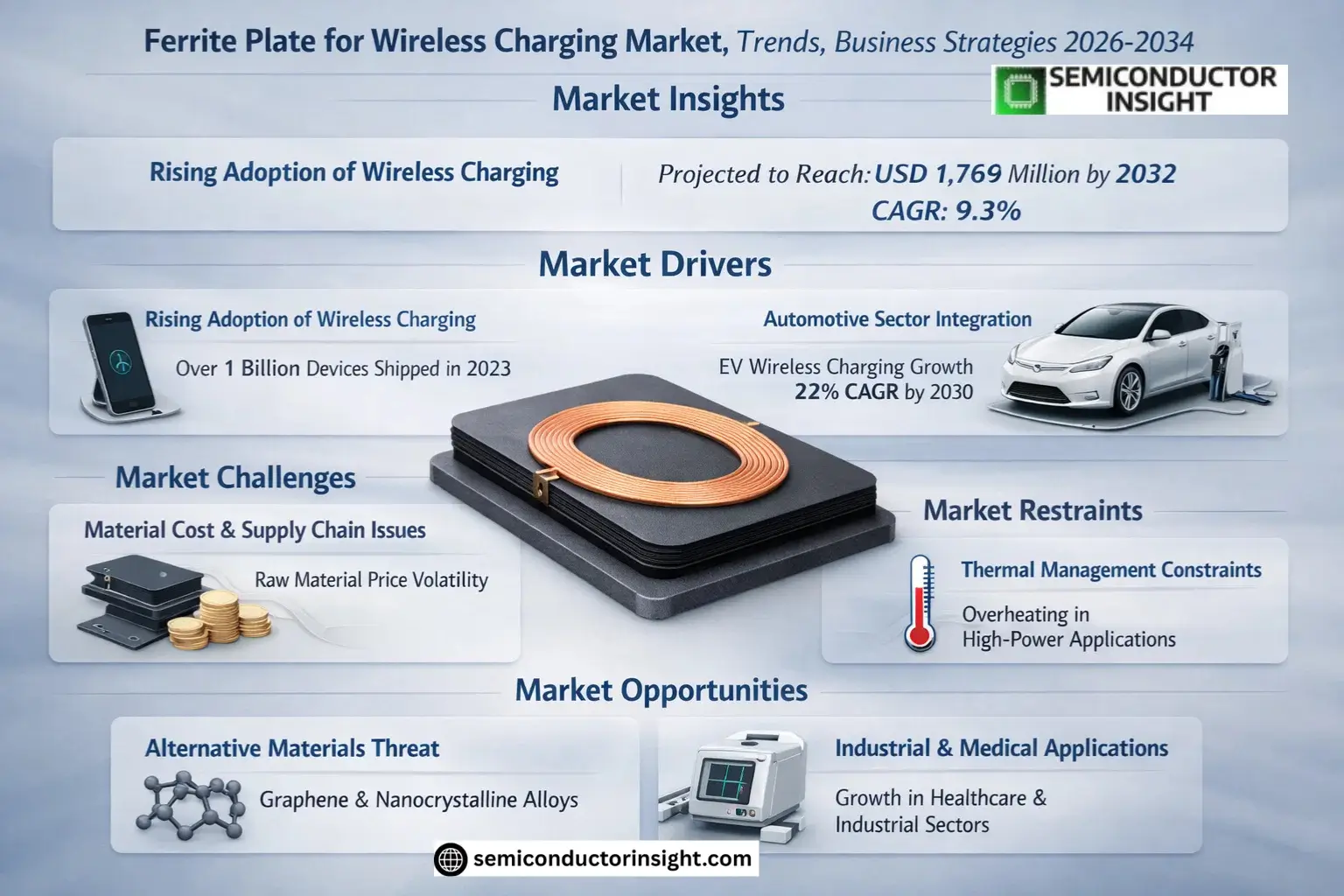
Global Ferrite Plate for Wireless Charging Market was valued at USD 959 million in 2025 and is projected to reach USD 1,766 million by 2032, exhibiting a CAGR of 9.3% during the forecast period.
A ferrite plate for wireless charging is a high-permeability soft-magnetic layer placed behind transmitter/receiver (Tx/Rx) coils, typically made of Mn-Zn or Ni-Zn ferrite or ferrite-filled composites. These plates enhance coupling efficiency by concentrating magnetic flux while minimizing stray fields and eddy-current losses near metals. They also help mitigate electromagnetic interference (EMI) and thermal issues in Qi/Qi2 inductive wireless power transfer systems.
The market growth is driven by increasing adoption of wireless charging in consumer electronics and automotive applications. In 2025, global production reached approximately 1,500 million pieces, with an average price range of USD 0.5–1 per piece. Key players such as TDK, Fair-Rite, and Kitagawa Industries dominate the market, collectively holding a significant revenue share.
MARKET DRIVERS
Rising Adoption of Wireless Charging Technology
Global Ferrite Plate for Wireless Charging Market is experiencing significant growth due to the increasing adoption of wireless charging technology across consumer electronics. With over 1 billion wireless charging-enabled devices shipped in 2023, the demand for efficient ferrite plates has surged. These components play a critical role in preventing energy loss and overheating in wireless charging systems.
Automotive Sector Integration
Automakers are increasingly integrating wireless charging systems in electric vehicles, driving demand for high-performance ferrite plates. The automotive segment is projected to grow at 22% CAGR through 2030, with ferrite plates being essential for efficient power transfer in vehicle charging pads.
Regulatory support for energy-efficient solutions and the standardization of wireless charging technologies are further accelerating market expansion.
MARKET CHALLENGES
Material Cost and Supply Chain Issues
Fluctuating raw material prices for nickel-zinc and manganese-zinc ferrites pose significant challenges for manufacturers. The ferrite plate production process requires rare earth elements, creating supply chain vulnerabilities that impact market stability.
Other Challenges
Thermal Management Constraints
Maintaining optimal operating temperatures remains a technical hurdle, as excessive heat can degrade ferrite plate performance in high-power wireless charging applications.
Standardization Barriers
Diverging wireless charging standards across regions create complexity for ferrite plate manufacturers developing universal solutions.
MARKET RESTRAINTS
Alternative Materials Development
Emerging alternative materials like graphene and nanocrystalline alloys present competitive threats to traditional ferrite plates in wireless charging applications. While currently more expensive, these materials offer superior thermal and electromagnetic properties that could disrupt the market.
MARKET OPPORTUNITIES
Industrial and Medical Applications Expansion
Ferrite Plate for Wireless Charging Market is finding new growth avenues in industrial equipment and medical devices. Wireless charging solutions for surgical instruments and portable medical equipment are creating specialized demand for high-precision ferrite components.
Ferrite Plate for Wireless Charging Market Trends
Increasing Demand for High-Efficiency Wireless Charging Solutions
Ferrite Plate for Wireless Charging Market is experiencing significant growth due to rising demand for efficient power transfer in consumer electronics and automotive applications. These plates, typically made from Mn-Zn or Ni-Zn ferrite materials, enhance charging efficiency by concentrating magnetic flux and reducing energy losses. Major manufacturers are focusing on developing ultra-thin ferrite plates to meet the compact design requirements of modern devices while maintaining optimal performance.
Other Trends
Material Innovation in Ferrite Plates
Manufacturers are investing in advanced ferrite composites that offer improved thermal stability and electromagnetic interference (EMI) suppression. The development of hybrid materials combining ferrite with polymers is addressing challenges related to weight reduction and flexibility, particularly for automotive wireless charging applications. Demand for Ni-Zn ferrite sheets is growing in high-frequency applications due to their superior performance characteristics.
Regional Market Developments
Asia Pacific dominates the Ferrite Plate for Wireless Charging Market, driven by strong consumer electronics production in China and South Korea. North America shows significant growth potential with increasing adoption in automotive wireless charging systems. European markets are advancing through stringent efficiency standards that require superior EMI shielding solutions in wireless power transfer applications.
Competitive Landscape Shifts
The market remains consolidated with top players like TDK, Fair-Rite, and Kitagawa Industries holding majority shares. Recent strategic collaborations between ferrite plate manufacturers and wireless charging module producers are creating integrated supply chain solutions. Price competition is intensifying as mid-sized manufacturers from China enter the market with cost-effective alternatives.
COMPETITIVE LANDSCAPE
Key Industry Players
Strategic Positioning of Ferrite Plate Suppliers in Wireless Charging Ecosystem
TDK Corporation dominates the ferrite plate market with an estimated 25% global revenue share in 2025, leveraging its proprietary Mn-Zn ferrite formulations and vertical integration across wireless charging components. The top five manufacturers collectively command 60% market share, with Japanese firms Fair-Rite and Kitagawa Industries maintaining strong positions through advanced material science capabilities and partnerships with automotive OEMs. Market consolidation is accelerating as tier-1 suppliers acquire smaller specialists to expand product portfolios.
Niche players like Acme Electronics and MARUWA compete through ultra-thin ferrite solutions (0.2-0.5mm thickness) for wearable applications, while Chinese manufacturers including Hengdian Group DMEGC Magnetics are gaining traction in consumer electronics with cost-competitive ferrite composites. Emerging technology trends include multi-layer ferrite structures for 15W+ fast charging and flexible ferrite-polymer hybrids enabling curved surface integration in automotive interiors.
List of Key Ferrite Plate for Wireless Charging Companies Profiled
- TDK Corporation
- Fair-Rite Products
- Kitagawa Industries
- Acme Electronics Corporation
- TODA KOGYO CORP.
- Laird Technologies
- MARUWA Co., Ltd.
- Würth Elektronik
- TDG Holding Co., Ltd.
- Hengdian Group DMEGC Magnetics
- Maanshan New Conda Magnetic Industrial
- MAGNETICS (Division of Arnold Magnetic Technologies)
- Hitachi Metals
- Nippon Chemical Industrial CO., LTD.
- Guangzhou Newlife New Material Co., Ltd.
Segment Analysis:
| Segment Category | Sub-Segments | Key Insights |
| By Type |
|
Mn-Zn Ferrite Sheets
|
| By Application |
|
Consumer Electronics
|
| By End User |
|
OEMs
|
| By Thickness |
|
Ultra-Thin
|
| By Geography |
|
Asia Pacific
|
Regional Analysis: Asia-Pacific Ferrite Plate for Wireless Charging Market
China’s complete electronics manufacturing ecosystem enables rapid prototyping and cost-efficient ferrite plate production. Proximity to rare earth mines and established material processing facilities gives Chinese manufacturers a strategic advantage in raw material procurement.
Major smartphone brands incorporate ferrite plates in Qi-compatible devices, driving standardization. Local R&D focuses on improving ferrite plate heat dissipation and interference reduction properties to support faster charging standards.
Policy directives promote wireless charging infrastructure in public transportation and urban centers. Subsidies for domestic ferrite material research strengthen China’s position in high-efficiency magnetic components for power transmission.
Growing middle-class adoption of premium smartphones fuels replacement cycles with wireless charging capability. Chinese manufacturers actively develop thinner ferrite plate solutions for compact consumer electronics designs.
South Korea
South Korea’s advanced consumer electronics industry drives demanding specifications for ferrite plate performance. Leading smartphone manufacturers require high-efficiency ferrite materials to support fast wireless charging standards while minimizing electromagnetic interference. Local component suppliers focus on developing ultra-thin ferrite plates compatible with foldable device designs. The automotive sector presents growth opportunities as domestic carmakers integrate in-vehicle wireless charging systems using multiple ferrite plate arrays.
Japan
Japanese manufacturers specialize in high-performance ferrite plates for industrial and automotive wireless charging applications. Proprietary material compositions offer superior thermal stability crucial for high-power transmission systems. The market benefits from Japan’s strong position in advanced material science and precision manufacturing capabilities. Aging infrastructure prompts investment in contactless charging solutions utilizing ferrite plates for public applications.
India
India’s expanding consumer electronics market creates opportunities for ferrite plate adoption in budget-conscious devices. Local manufacturers balance cost-efficiency with adequate performance standards for emerging wireless charging applications. Government initiatives to develop domestic electronic component manufacturing may boost local ferrite plate production capacity in coming years.
Southeast Asia
Thailand and Vietnam emerge as important manufacturing hubs for ferrite plate components due to competitive labor costs. Growing smartphone assembly operations drive demand for standardized ferrite solutions. Regional markets show increasing interest in public wireless charging infrastructure projects incorporating ferrite plate technology.
Report Scope
This market research report provides a comprehensive analysis of the Ferrite Plate for Wireless Charging Market, covering the forecast period 2025–2032. It offers detailed insights into market dynamics, technological advancements, competitive landscape, and key trends shaping the industry.
Key focus areas of the report include:
- Market Overview: The report begins with an overview outlining its current market scenario, key growth indicators, and industry transformation drivers. It discusses macroeconomic factors, demand–supply balance, regulatory landscape, and the strategic role of semiconductors in powering advancements across industries such as automotive, telecommunications, consumer electronics, and industrial automation.
- Market Size & Forecast: Historical data and future projections for revenue, unit shipments, and market value across major regions and segments.
- Segmentation Analysis: Detailed breakdown by product type, technology, application, and end-user industry to identify high-growth segments and investment opportunities.
- Regional Insights: Insights into market performance across North America, Europe, Asia-Pacific, Latin America, and the Middle East & Africa, including country-level analysis where relevant.
- Competitive Landscape: Profiles of leading market participants, including their product offerings, R&D focus, manufacturing capacity, pricing strategies, and recent developments such as mergers, acquisitions, and partnerships.
- Technology Trends & Innovation: Assessment of emerging technologies, integration of AI/IoT, semiconductor design trends, fabrication techniques, and evolving industry standards.
- Market Drivers & Restraints: Evaluation of factors driving market growth along with challenges, supply chain constraints, regulatory issues, and market-entry barriers.
- Stakeholder Insights: Insights for component suppliers, OEMs, system integrators, investors, and policymakers regarding the evolving ecosystem and strategic opportunities.
Primary and secondary research methods are employed, including interviews with industry experts, data from verified sources, and real-time market intelligence to ensure the accuracy and reliability of the insights presented.
FREQUENTLY ASKED QUESTIONS:
What is the current market size of Ferrite Plate for Wireless Charging Market?
-> Ferrite Plate for Wireless Charging Market was valued at USD 959 million in 2025 and is projected to reach USD 1,766 million by 2032, exhibiting a CAGR of 9.3% during the forecast period.
What is a ferrite plate for wireless charging?
-> A ferrite plate for wireless charging is a high-permeability soft-magnetic layer placed behind Tx/Rx coils (typically Mn-Zn or Ni-Zn ferrite, or ferrite-filled composites). It concentrates magnetic flux to improve coupling and efficiency, reduces stray fields and eddy-current losses near metals, and helps mitigate EMI/thermal issues in Qi/Qi2 inductive wireless power transfer systems.
Which key companies operate in Ferrite Plate for Wireless Charging Market?
-> Key players include TDK, Fair-Rite, Kitagawa Industries, Acme Electronics, TODA KOGYO, Laird, MARUWA, Würth, TDG, Hengdian Group DMEGC Magnetics, among others. Global top five players held approximately % market share in terms of revenue in 2025.
What are the key segments in this market?
-> The market is segmented by:
- Product Type: Mn-Zn Ferrite Sheets, Ni-Zn Ferrite Sheets, Others
- Thickness: Ultra-Thin, Medium Thickness, Thick
- Application: Consumer Electronics, Automotive, Other
What is the production volume of ferrite plates?
-> Global ferrite plate for wireless charging production reached approximately 1,500 million pieces in 2025, with an average market price of USD 0.5-1 per piece.
Get Sample Report PDF for Exclusive Insights
Report Sample Includes
- Table of Contents
- List of Tables & Figures
- Charts, Research Methodology, and more...
 Download Sample Report PDF