EV Pyro Switch Market Insights
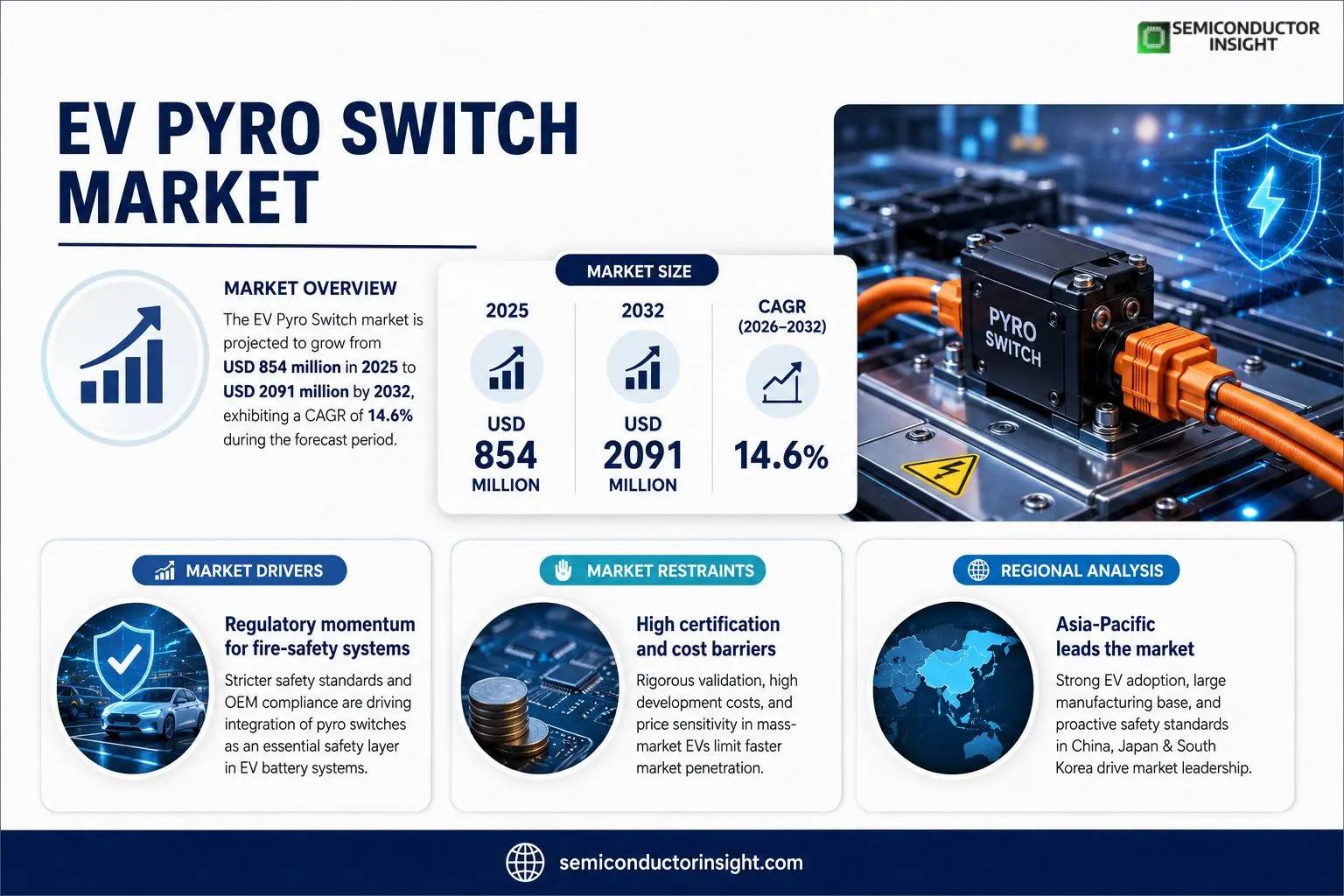
EV Pyro Switch market size was valued at USD 854 million in 2025. Forecasts indicate the market will rise from USD 854 million in 2025 to USD 2091 million by 2032, exhibiting a CAGR of 14.6% during the forecast period.
EV Pyro Switch is a safety‑critical electromechanical component designed for electric vehicles that physically disconnects high‑voltage battery circuits within milliseconds during severe collisions, thermal runaway, or major electrical faults. The device ensures rapid isolation, high reliability and compliance with automotive safety standards.
The sector benefits from several catalysts: production reached roughly 42.5 million units in 2025 at an average price of USD 22 per unit; capacity utilization stood at 85 % and industry gross margin averaged 43 %. Upstream inputs such as copper and silver wire, busbars, insulation materials and ECUs are supplied by firms like Mitsubishi Shindoh, Nexans, GE and Denso Corporation. Mid‑stream activities focus on structural‑thermal design, pyrotechnic integration and rigorous validation testing. Downstream adoption is strong among OEMs including Tesla, Volkswagen, BYD and SAIC Motor, which embed the switch into BEV and HEV battery systems to reinforce high‑voltage safety architectures.
MARKET DRIVERS
Regulatory momentum for fire‑safety systems
The push for stricter safety standards in electric vehicles has placed fire‑suppression devices at the forefront of design requirements. Legislators in Europe and North America are mandating integrated pyro‑switches that trigger rapid extinguishing actions, compelling OEMs to embed these components during the vehicle‑development phase. Compliance pressure is therefore converting a previously optional safety add‑on into a baseline specification for most new EV platforms.
Shift towards high‑energy‑density batteries
Battery manufacturers are delivering cells with greater energy density to meet consumer expectations for longer range. Higher energy content raises the potential severity of thermal events, prompting vehicle makers to adopt more sophisticated pyro‑switch architectures that can detect and isolate fault zones within milliseconds. Enhanced detection capability translates into a tangible reduction in claim costs and brand risk, making the technology a strategic investment for premium brands.
➤ “A reliable pyro‑switch can cut fire‑damage expenses by up to 40 %, while also preserving passenger safety metrics,”
Beyond safety, the switch’s ability to communicate fault data to the vehicle’s telematics platform creates a new source of diagnostic intelligence. Fleet operators can now schedule preventive maintenance before a thermal incident escalates, turning a protective device into a value‑added service that supports operational efficiency and customer loyalty.
MARKET CHALLENGES
High certification thresholds
Achieving certification for pyro‑switches entails extensive testing across fire‑scenario simulations, electromagnetic compatibility, and long‑term durability. The cost and time burden of these programs can exceed $5 million per model, discouraging smaller suppliers from entering the space. Consequently, the market remains concentrated among a handful of established players with deep engineering resources.
Other Challenges
Supply‑chain visibility
The critical componentssuch as high‑temperature resistant ceramics and precision‑cut switchesare sourced from a limited pool of manufacturers. Any disruption in raw‑material availability quickly ripples through production schedules, forcing OEMs to hold larger safety stocks and thereby inflating inventory overhead.
MARKET RESTRAINTS
Cost sensitivity in mass‑market segments
The added bill of materials for a pyro‑switch, typically ranging from $25 to $45 per unit, represents a noticeable increase for budget‑oriented electric models. Price‑conscious manufacturers often defer the integration until production volumes guarantee economies of scale, thereby slowing broader adoption.The aftermarket retro‑fit market remains nascent because most consumers replace vehicles rather than components. Without a clear pathway for third‑party installation, the potential revenue from post‑sale upgrades stays limited.Finally, limited awareness among end‑users about the functional benefits of pyro‑switches reduces the perceived value proposition, making it harder for marketing teams to justify the premium cost to buyers.
MARKET OPPORTUNITIES
Integration with autonomous driving platforms
Autonomous vehicles rely heavily on sensor suites and real‑time decision algorithms. Embedding a pyro‑switch that can instantly relay fire‑detection signals to the vehicle’s AI layer opens a pathway for automated emergency response actions, such as safe‑stop maneuvers and remote alerts. This synergy creates a differentiated safety envelope that can be marketed as a premium feature for autonomous fleets.
Regional incentive programs
Several jurisdictions are rolling out subsidies for safety‑enhanced electric vehicles. Programs that earmark funds for fire‑suppression systems effectively lower the net cost for manufacturers and buyers, accelerating deployment in markets like California, Scandinavia, and South Korea. Companies that position their pyro‑switch solutions to qualify for these incentives can capture early‑mover market share.Emerging standards for vehicle‑to‑infrastructure communication also beckon. A pyro‑switch that can report incident data to roadside emergency services enables faster response times, a capability that municipal authorities are beginning to factor into procurement criteria. Leveraging this trend can open public‑sector contracts and diversify revenue streams beyond the traditional OEM channel.
EV Pyro Switch Market Trends
Higher‑Voltage Platforms Fuel Accelerated Adoption
Manufacturers of electric vehicles are increasingly configuring battery packs above 700 V to cut charging times and improve range. This shift raises the stakes of a high‑voltage fault, prompting automakers to integrate EV Pyro Switch devices that can interrupt power within a few milliseconds. The result is a noticeable uptick in component orders, reflected in the jump from roughly 42 million units shipped in 2025 to a forecasted 84 million by 2032. For suppliers, the surge translates into tighter production scheduling and a need to sustain gross margins near 43 percent while keeping unit prices competitive at roughly USD 22. The trend underscores why the EV Pyro Switch Market is rapidly becoming a cornerstone of next‑generation EV safety architectures.
Other Trends
Supply‑Chain Pressures on Critical Materials
Key inputs such as copper and silver wire, busbar assemblies, and high‑temperature insulation are sourced from a limited pool of tier‑one vendors. Recent capacity constraints at major copper mills have nudged material costs upward by 6‑8 percent, squeezing manufacturer margins unless price adjustments are passed downstream. Companies like Mitsubishi Shindoh and Nexans are responding with longer‑term contracts and investments in alloys that retain conductivity while reducing reliance on premium metals. The supply‑chain dynamic forces strategic sourcing decisions that can affect delivery lead times and ultimately the speed at which new EV models reach market.
Regulatory Momentum Tightens Safety Requirements
safety authorities are revising crash‑worthiness standards to mandate physical isolation of high‑voltage circuits in severe impact scenarios. The updated UN R100 and ISO 6469 clauses specify sub‑10 ms response times, a benchmark that aligns directly with the functional capabilities of pyrotechnic switches. As a consequence, OEMs are accelerating qualification programs and allocating larger portions of their safety budgets to EV Pyro Switch integration. This regulatory pressure not only expands demand across passenger and commercial segments but also creates a competitive advantage for suppliers that can demonstrate proven compliance and reliability in validation testing.
COMPETITIVE LANDSCAPEKey Industry Players
EV Pyro Switch Market – Competitive Structure and Player Dynamics
Autoliv dominates the EV pyro‑switch segment, translating its extensive automotive safety expertise into a comprehensive product line that satisfies the most stringent crash‑validation standards. The company’s ability to offer turnkey solutionscombining pyrotechnic initiators, control electronics, and system‑level validationhas secured long‑term contracts with Tier‑1 OEMs such as Tesla and Volkswagen. Autoliv’s scale enables a production footprint that comfortably meets the current 42 million‑unit volume while preserving a gross margin well above the industry average. This cost advantage, paired with a reputation for reliability, has forced smaller rivals to specialize in niche voltage bands or emerging regional markets where volume pressures are lower.
Beyond the clear leader, a constellation of mid‑size and niche manufacturers fuels competition. Daicel and Littelfuse, both with strong electro‑explosive heritage, focus on high‑voltage (above 700 V) modules that cater to premium BEV platforms. Mersen and Eaton differentiate through integrated thermal‑management designs, targeting commercial‑light‑truck applications where durability matters. Asian players such as Xi’an Sinofuse Electric, Hangzhou Superfuse, and MTA Group have leveraged local EV manufacturers to capture market share in China’s rapidly expanding fleet. Meanwhile, material‑supply specialists like Mitsubishi Shindoh, Nexans, GE and Denso reinforce the supply chain, offering proprietary bus‑bar and wiring solutions that improve switch response times. This mosaic of capabilities creates a competitive environment where success hinges on engineering precision, regulatory compliance, and the agility to address divergent OEM specifications.
List of Key EV Pyro Switch Companies Profiled
- Autoliv
- Daicel
- Pacific Engineering Corporation
- Littelfuse
- Mersen
- Eaton
- Miba AG
- MTA Group
- Xi’an Sinofuse Electric
- Hangzhou Superfuse
- Mitsubishi Shindoh
- Nexans
- GE
- Denso Corporation
- ZF Friedrichshafen
Segment Analysis:
| Segment Category | Sub-Segments | Key Insights |
| By Type |
|
High Voltage is emerging as the dominant type because:
|
| By Application |
|
Battery Electric Vehicles drive the bulk of demand because:
|
| By End User |
|
Passenger Vehicle OEMs prioritize pyro switches because:
|
| By Voltage Level |
|
Above 700 V segment is gaining attention as:
|
| By Qualification |
|
UN R100 Compliant devices are favored because:
|
Regional Analysis: EV Pyro Switch Market
Federal mandates in the U.S. now require integrated pyro‑switch modules in all new electric‑vehicle models, prompting OEMs to redesign battery packs. State‑level programs add layers of testing that elevate component resilience, creating a steady demand for higher‑grade switches.
Early‑stage adopters are integrating nanocomposite materials within pyro‑switches, achieving faster response times. This technical edge is attracting partnerships with top‑tier battery manufacturers who seek to differentiate their products on safety performance.
A concentration of specialty metal producers in the Midwest supplies the critical alloys needed for pyro‑switch housings, reducing lead times. However, recent shortages in high‑purity silicon have spurred alternate material research, reshaping sourcing strategies.
Market entrants that leverage proprietary trigger algorithms are gaining traction with premium EV brands. Established players defend territory through expanded service networks and long‑term warranty schemes that embed switch performance guarantees.
Europe
European manufacturers are responding to a patchwork of safety directives that demand higher fire‑suppression standards across the continent. The EU’s emphasis on circular economy principles encourages designers to select pyro‑switches that are both recyclable and low‑maintenance, steering R&D toward modular architectures. German and French OEMs, in particular, are piloting integrated monitoring systems that relay switch status to fleet management dashboards, creating a data‑driven value proposition for commercial operators.
Asia‑Pacific
In Asia‑Pacific, rapid electrification of public transport is the primary catalyst for pyro‑switch uptake. Countries such as China and South Korea have introduced subsidy schemes that favor vehicles equipped with advanced fire‑mitigation components. Local suppliers are scaling production of cost‑effective switch designs, yet face pressure to meet evolving safety benchmarks that mirror Western expectations, prompting a convergence of quality standards across the region.
South America
South American markets are still nascent, but emerging regulatory frameworks are beginning to incorporate safety clauses for electric vehicles. Brazil’s recent automotive safety legislation references pyro‑switch functionality as a compliance metric, nudging regional assemblers to source components from established vendors. The shift signals a gradual alignment with international best practices, opening avenues for cross‑border technology transfer.
Middle East & Africa
In the Middle East and Africa, the primary driver is the growing demand for electric‑bus fleets in urban centers seeking to reduce emissions. Governments are leveraging public‑private partnerships to fund safety‑critical components, including pyro‑switches, as part of broader sustainability initiatives. While the market remains fragmented, the region’s strategic investment in resilient infrastructure is laying the groundwork for future expansion of the EV Pyro Switch Market.
Report Scope
This market research report provides a comprehensive analysis of the EV Pyro Switch Market , covering the forecast period 2026–2034. It offers detailed insights into market dynamics, technological advancements, competitive landscape, and key trends shaping the industry.
Key focus areas of the report include:
- Market Overview: The report begins with an overview outlining its current market scenario, key growth indicators, and industry transformation drivers. It discusses macroeconomic factors, demand–supply balance, regulatory landscape, and the strategic role of semiconductors in powering advancements across industries such as automotive, telecommunications, consumer electronics, and industrial automation.
- Market Size & Forecast: Historical data and future projections for revenue, unit shipments, and market value across major regions and segments.
- Segmentation Analysis: Detailed breakdown by product type, technology, application, and end-user industry to identify high-growth segments and investment opportunities.
- Regional Insights: Insights into market performance across North America, Europe, Asia-Pacific, Latin America, and the Middle East & Africa, including country-level analysis where relevant.
- Competitive Landscape: Profiles of leading market participants, including their product offerings, R&D focus, manufacturing capacity, pricing strategies, and recent developments such as mergers, acquisitions, and partnerships.
- Technology Trends & Innovation: Assessment of emerging technologies, integration of AI/IoT, semiconductor design trends, fabrication techniques, and evolving industry standards.
- Market Drivers & Restraints: Evaluation of factors driving market growth along with challenges, supply chain constraints, regulatory issues, and market-entry barriers.
- Stakeholder Insights: Insights for component suppliers, OEMs, system integrators, investors, and policymakers regarding the evolving ecosystem and strategic opportunities.
Primary and secondary research methods are employed, including interviews with industry experts, data from verified sources, and real-time market intelligence to ensure the accuracy and reliability of the insights presented.
FREQUENTLY ASKED QUESTIONS:
What is the current market size of EV Pyro Switch Market?
-> EV Pyro Switch Market was valued at USD 854 million in 2025 and is expected to reach USD 2091 million by 2032, growing at a CAGR of 14.6% during the forecast period.
Which key companies operate in EV Pyro Switch Market?
-> Key players include Autoliv, Daicel, Pacific Engineering Corporation, Littelfuse, Mersen, Eaton, Miba AG, MTA Group, Xi’an Sinofuse Electric, Hangzhou Superfuse, as well as major vehicle manufacturers such as Tesla, Volkswagen, BYD, and SAIC Motor.
What are the key growth drivers?
-> Key growth drivers include rising adoption of higher‑voltage EV platforms, stricter safety regulations, increasing battery capacity and charging power, and the need for rapid physical disconnection to mitigate thermal‑runaway and fault risks.
Which region dominates the market?
-> Asia‑Pacific leads the market, driven by strong EV adoption, extensive manufacturing bases, and proactive safety standards in countries such as China, Japan, and South Korea.
What are the emerging trends?
-> Emerging trends include integration of pyro‑switches with advanced BMS algorithms, multi‑layer safety architectures, higher‑voltage (>700V) designs, and the use of AI‑based predictive safety monitoring.

Get Sample Report PDF for Exclusive Insights
Report Sample Includes
- Table of Contents
- List of Tables & Figures
- Charts, Research Methodology, and more...
 Download Sample Report PDF