MARKET INSIGHTS
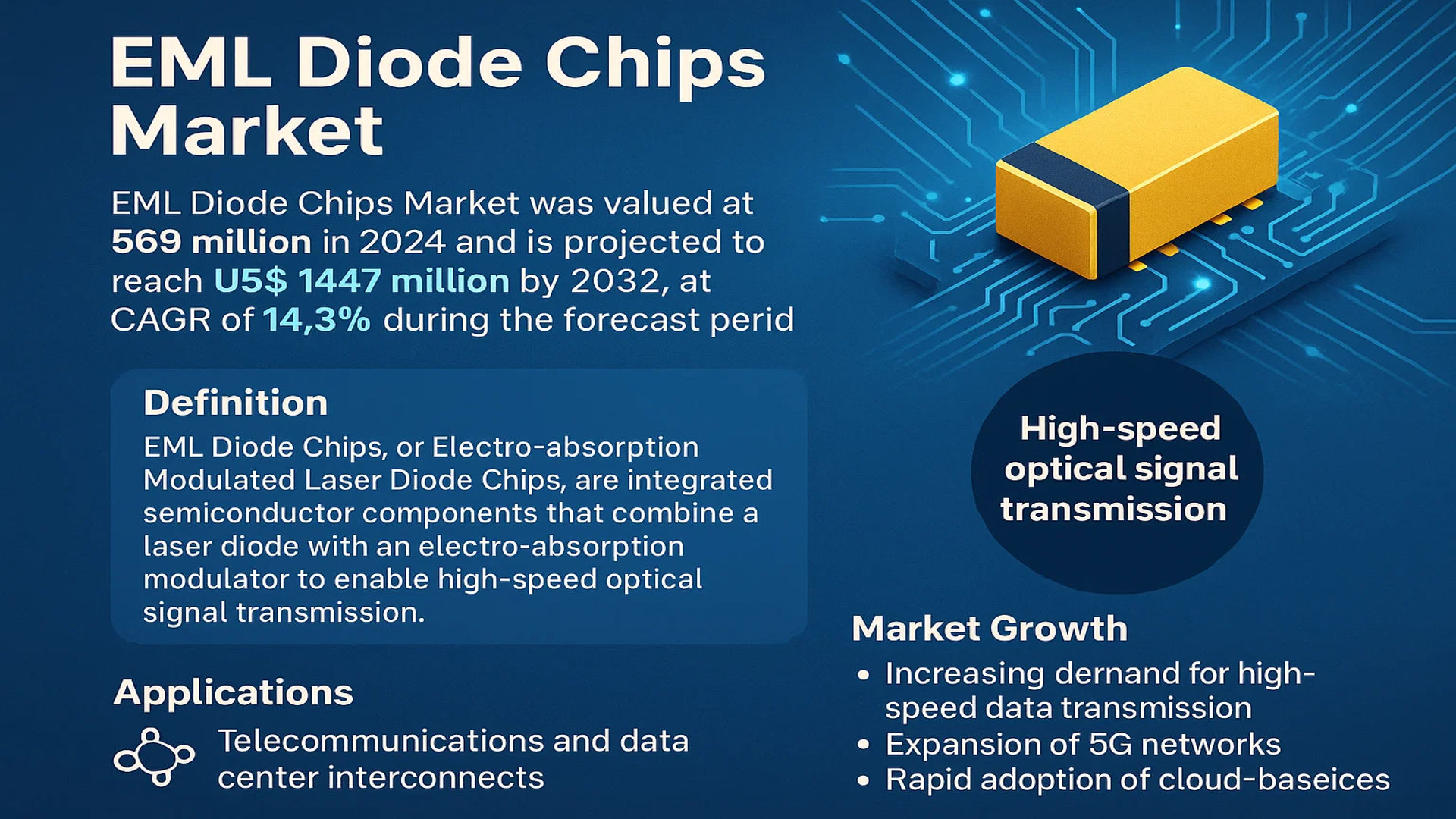
The global EML Diode Chips Market was valued at 569 million in 2024 and is projected to reach US$ 1447 million by 2032, at a CAGR of 14.3% during the forecast period.
EML Diode Chips, or Electro-absorption Modulated Laser Diode Chips, are integrated semiconductor components that combine a laser diode with an electro-absorption modulator to enable high-speed optical signal transmission. These chips play a critical role in fiber-optic communication systems by converting electrical signals into modulated light signals with high efficiency and precision. Their application spans across telecommunications and data center interconnects, where they facilitate high-bandwidth data transfer over long distances with minimal signal degradation.
The market growth is primarily driven by increasing demand for high-speed data transmission, expansion of 5G networks, and the rapid adoption of cloud-based services. While North America currently holds a significant market share, Asia-Pacific is expected to witness the fastest growth due to large-scale telecom infrastructure projects. The 10 GBaud segment remains dominant in terms of revenue, but higher-speed variants like 56 GBaud and 112 GBaud are gaining traction to meet evolving industry requirements. Key players such as Lumentum, Coherent (II-VI), and Mitsubishi Electric are investing in R&D to develop advanced solutions, further propelling market expansion.
MARKET DYNAMICS
MARKET DRIVERS
Exponential Growth in Data Traffic to Drive Demand for EML Diode Chips
The global surge in data consumption, driven by 5G deployment, cloud computing, and IoT proliferation, is accelerating demand for high-speed optical communication solutions. With internet traffic projected to grow threefold over the next five years, network operators are investing heavily in upgrading infrastructure to 400G and beyond. EML diode chips, offering superior modulation efficiency and transmission distances exceeding 80km, have become critical components in these next-gen networks. Telecommunications providers are rapidly adopting these chips to meet bandwidth demands while maintaining signal integrity.
Data Center Expansion Creating Sustained Demand
The booming hyperscale data center market, expected to grow at 15% annually through 2030, represents a key growth driver for EML chip adoption. Modern data centers require ultra-high-speed interconnects between servers and storage systems, with 112Gbaud EML solutions becoming the standard for spine-leaf architectures. Recent technological advancements have improved chip power efficiency by 30% compared to previous generations, making them economically viable for large-scale deployments. Major cloud service providers are now specifying EML-based optics for their next-generation infrastructure builds.
Emerging Co-Packaged Optics Applications
The shift toward co-packaged optics in AI/ML hardware presents new opportunities for EML technology. Leading semiconductor manufacturers are integrating optical interfaces directly into processing units to overcome electrical I/O bottlenecks. EML chips’ compact form factor and thermal stability make them ideal candidates for these applications. Prototype systems have demonstrated 8Tbps aggregate bandwidth using EML arrays, with commercial deployments expected within the next two years. This convergence of computing and optical networking is creating additional demand streams beyond traditional telecom applications.
➤ For instance, multiple silicon photonics startups have secured Series C funding exceeding $50 million to develop EML-integrated co-packaging solutions for AI accelerators.
MARKET RESTRAINTS
Complex Manufacturing Processes Limit Yield Rates
EML diode chip production requires highly specialized III-V semiconductor fabrication facilities with sub-nanometer precision capabilities. The multi-step epitaxial growth and precise alignment of modulator sections result in typical yields below 60% for high-performance devices. This manufacturing complexity creates supply constraints and elevates production costs, particularly for cutting-edge 112Gbaud designs. While some manufacturers have achieved 75% yields through process optimization, the industry still faces challenges in scaling output to meet projected demand.
Thermal Management Challenges in High-Density Applications
As data rates increase beyond 100Gbps, managing thermal crosstalk between densely packed EML arrays becomes increasingly difficult. The chips’ operating temperature must be maintained within ±1°C to ensure wavelength stability, requiring sophisticated cooling systems in router line cards. Some network equipment providers report that thermal considerations now account for 20% of total system design complexity when implementing EML-based solutions. These engineering challenges are prompting some operators to evaluate lower-performance alternatives for certain applications.
Other Restraints
Component Shortages Impact Production
The specialized materials used in EML fabrication, including indium phosphide and gallium arsenide, face periodic supply chain disruptions. Recent geopolitical events have caused lead times for certain substrates to extend beyond six months, delaying product shipments.
Testing Infrastructure Bottlenecks
Validating EML performance at 112Gbaud requires $5+ million automated test systems that can precisely measure picosecond-level jitter. The limited availability of this equipment creates testing throughput constraints across the industry.
MARKET CHALLENGES
Competition from Silicon Photonics Alternatives
The rise of silicon photonics solutions presents a formidable challenge to traditional EML technology. While EMLs maintain performance advantages for long-haul transmission, silicon-based alternatives offer compelling cost benefits for distances under 2km. Several major cloud providers have begun qualifying silicon photonic transceivers that undercut EML solutions by 40% in price points. This competitive pressure is forcing EML manufacturers to accelerate their roadmap for cost reduction while maintaining performance leadership.
Standardization Lag for Next-Gen Interfaces
The telecommunications industry faces challenges in harmonizing specifications for 800G and 1.6T interfaces that will utilize EML technology. While the OIF has published preliminary standards, full interoperability profiles won’t be finalized until late 2025. This uncertainty causes equipment vendors to delay procurement decisions, creating a “wait-and-see” environment that temporarily slows market growth. Some carriers have begun implementing proprietary solutions, risking fragmentation across the ecosystem.
Other Challenges
Talent Shortage in Compound Semiconductor Engineering
The specialized knowledge required for EML design and manufacturing creates workforce limitations. Only a handful of universities worldwide offer dedicated programs in III-V optoelectronics, resulting in intense competition for qualified engineers.
Patents Create Barriers to Entry
Over 5,000 active patents cover various aspects of EML technology, creating a complex IP landscape that discourages new market entrants and slows innovation cycles.
MARKET OPPORTUNITIES
Undersea Cable Upgrades Present High-Value Opportunities
The global undersea cable network, carrying over 99% of international data traffic, is undergoing a massive capacity upgrade cycle. New generation cables are adopting EML-based repeaters to achieve 20Tbps per fiber pair – a fourfold increase over previous technologies. With $10 billion in planned projects through 2030, this represents a significant addressable market for high-reliability EML solutions. Manufacturers are developing specialized packages that can withstand decades of operation in harsh marine environments.
Emerging LiDAR Applications Beyond Communications
Automotive and industrial LiDAR systems are increasingly leveraging EML technology for its superior coherence and modulation characteristics. While currently a niche application, the LiDAR market is forecast to grow twentyfold by 2030 as autonomous vehicles reach commercialization. EML variants designed for 1550nm operation offer eye-safety advantages over competing technologies, making them attractive for consumer-facing applications. Several Tier 1 automotive suppliers have begun qualification processes with EML manufacturers.
Integration with Quantum Networking Infrastructure
National quantum network initiatives are creating unexpected demand for specialized EML devices. The chips’ precise wavelength control and fast modulation capabilities make them ideal for quantum key distribution systems. Pilot deployments have demonstrated successful quantum transmissions over 300km using EML-based transmitters. With governments allocating billions to quantum communication projects, this represents a strategically important growth avenue for manufacturers willing to adapt their technology stacks.
EML DIODE CHIPS MARKET TRENDS
High-Speed Data Transmission Drives Adoption of EML Diode Chips
The growing demand for high-speed data transmission is a key driver for the EML Diode Chips market. With the global market valued at $569 million in 2024 and projected to reach $1.47 billion by 2032, EML Diode Chips are becoming increasingly critical for optical communication systems. These chips, composed of laser diodes, modulators, and detectors, enable ultra-fast signal transmission, making them indispensable for next-generation fiber-optic networks. The surge in 5G deployment and cloud computing services further amplifies this demand, particularly for chips with higher baud rates like 56 GBaud and 112 GBaud, which are expected to see substantial growth due to their application in data-dense environments.
Other Trends
Telecommunications Infrastructure Expansion
Telecommunication providers worldwide are heavily investing in fiber-optic infrastructure to support escalating bandwidth requirements. For instance, the U.S. market is expected to grow significantly, driven by federal broadband initiatives and private-sector investments in network upgrades. Similarly, China’s aggressive fiber-optic rollout is contributing to regional market expansion, pushing demand for high-performance EML Diode Chips in the 10 GBaud to 112 GBaud range. Leading manufacturers such as Lumentum, Broadcom, and Mitsubishi Electric are scaling production to meet this rising demand, particularly in regions with burgeoning digital economies.
Data Center Interconnection (DCI) Network Growth
Data Center Interconnection networks are emerging as a major application segment for EML Diode Chips, propelled by the exponential growth of hyperscale data centers. The need for low-latency, high-efficiency optical communication between data centers is accelerating the adoption of 56 GBaud and 112 GBaud chips, which offer enhanced transmission speeds and energy efficiency. Additionally, technological advancements in chip miniaturization and integration are enabling denser, more cost-effective solutions, further driving market uptake. As enterprises increasingly shift to cloud-based services, DCI networks are expected to remain a dominant growth area, with North America and Asia-Pacific leading in deployment.
Challenges in Supply Chain and Manufacturing
While the market outlook is strong, supply chain disruptions and high manufacturing costs present notable challenges. The top five global players, including Coherent (II-VI) and Sumitomo, collectively hold a significant revenue share but face pressure to optimize production efficiencies. The complexity of manufacturing high-baud-rate chips, coupled with shortages of key semiconductor materials, may temporarily constrain supply. However, ongoing research in chip design and production automation, along with strategic collaborations among industry leaders, are expected to mitigate these constraints over the forecast period.
COMPETITIVE LANDSCAPE
Key Industry Players
Leading Manufacturers Focus on Innovation to Address Growing Demand for High-Speed Optical Communication
The global EML Diode Chips market features a competitive yet consolidated structure, dominated by a mix of semiconductor giants and specialized photonics firms. Lumentum Holdings Inc. emerges as a frontrunner, commanding significant market share through its comprehensive portfolio of high-performance EML solutions optimized for 100G and 400G applications. The company’s technological edge stems from vertically integrated manufacturing capabilities and strategic partnerships with telecom infrastructure providers.
Meanwhile, Coherent (II-VI) has strengthened its position through the 2022 merger with II-VI Incorporated, combining expertise in laser diodes and compound semiconductors. This integration allows the company to offer end-to-end solutions for data center and 5G networks – two key growth sectors driving EML adoption. Their 56 GBaud and 112 GBaud chipsets are particularly favored for next-generation DCI applications.
Asian manufacturers like Mitsubishi Electric and Sumitomo Electric maintain strong regional footholds, benefitting from proximity to the thriving APAC telecommunications market. These players are investing heavily in production capacity expansions to meet local demand, with Mitsubishi recently announcing a 20% increase in EML chip output at its Kyoto facility.
The competitive intensity is further heightened by emerging innovators such as Source Photonics and Applied Optoelectronics, who are leveraging novel modulation techniques to challenge established players. Their focus on cost-optimized solutions for hyperscale data centers provides an alternative to premium offerings from larger competitors.
List of Key EML Diode Chips Manufacturers
- Lumentum Holdings Inc. (U.S.)
- Coherent, Inc. (II-VI) (U.S.)
- Mitsubishi Electric Corporation (Japan)
- Source Photonics (U.S.)
- Broadcom Inc. (U.S.)
- Sumitomo Electric Industries, Ltd. (Japan)
- Applied Optoelectronics, Inc. (U.S.)
- NTT Electronics Corporation (Japan)
Segment Analysis:
By Type
10 GBaud Segment Maintains Strong Market Position Due to Widespread Deployment in Telecom Networks
The market is segmented based on type into:
- 10 GBaud
- 28 GBaud
- 56 GBaud
- 112 GBaud
- Others
By Application
Telecommunications Segment Leads Market Share with Increasing Demand for High-Speed Data Transmission
The market is segmented based on application into:
- Telecommunications
- Data Center Interconnection (DCI Network)
By End User
Network Service Providers Dominate Adoption Rates with Growing Cloud Infrastructure Needs
The market is segmented based on end user into:
- Network Service Providers
- Cloud Service Providers
- Enterprises
- Government Organizations
By Bandwidth
C-Band Solutions Preferred for Long-Haul Optical Communication Applications
The market is segmented based on bandwidth into:
- C-Band
- L-Band
- Others
Regional Analysis: EML Diode Chips Market
Asia-Pacific
The Asia-Pacific region dominates the EML Diode Chips market, accounting for the highest revenue share due to rapid expansion of 5G networks and hyperscale data centers. China leads regional demand, driven by its ambitious digital infrastructure projects and strong semiconductor manufacturing ecosystem. Countries like Japan and South Korea contribute significantly with their advanced optical communication technologies. The growing adoption of cloud computing and AI across enterprises is accelerating the need for high-speed data transmission, further propelling the EML Diode Chips market. However, supply chain complexities and geopolitical tensions create some volatility in component availability.
North America
North America remains a critical market for EML Diode Chips, with the United States at the forefront of technological innovation and deployment. The region benefits from robust investments in data center infrastructure and next-generation telecommunication networks. Major cloud service providers and telecom operators are transitioning to 100G/400G optical solutions, creating steady demand for high-performance EML chips. Regulatory support for broadband expansion and research initiatives in photonics contribute to market growth. Competition among key players like Lumentum and Coherent (II-VI) drives innovation in chip performance and energy efficiency.
Europe
Europe demonstrates consistent growth in the EML Diode Chips market, supported by the EU’s digital transformation agenda and emphasis on secure communication networks. Germany and the UK lead in R&D investments for advanced optical components, while increasing data center construction in Nordic countries creates new opportunities. The region’s focus on sustainability aligns with industry trends toward energy-efficient optical solutions. However, strict data sovereignty regulations and relatively slower 5G rollout compared to Asia impact the pace of market expansion. Collaborative projects between academia and industry aim to strengthen Europe’s position in photonic integrated circuits.
Middle East & Africa
The Middle East & Africa region presents emerging potential for EML Diode Chips, particularly in Gulf Cooperation Council (GCC) countries investing heavily in smart city initiatives and digital infrastructure. The growing adoption of cloud services and increasing internet penetration drive demand for optical communication components. While currently a smaller market, strategic investments by global hyperscalers in data center facilities indicate long-term growth prospects. Challenges include limited local manufacturing capabilities and reliance on imports, though governments are implementing policies to develop domestic technology sectors.
South America
South America’s EML Diode Chips market is in early growth stages, with Brazil and Argentina showing gradual adoption driven by improving telecom infrastructure. Economic constraints and currency fluctuations currently hinder large-scale investments in advanced optical technologies. The region’s growing digital economy and increasing mobile data consumption create foundational demand, but market development depends on stable economic conditions and government support for technology upgrades. Partnerships between regional telecom operators and global equipment providers may accelerate adoption in coming years.
Industry Outlook
The global EML Diode Chips market continues to evolve with technology transitions toward higher baud rates and co-packaged optics. While Asia-Pacific maintains leadership through manufacturing scale and infrastructure growth, North America and Europe differentiate through innovation in next-generation applications. Emerging regions show promise but require coordinated investments across the value chain to realize their potential. Market players are focusing on product differentiation through improved power efficiency and integration capabilities to meet diverse regional requirements.
Report Scope
This market research report provides a comprehensive analysis of the Global EML Diode Chips Market, covering the forecast period 2024–2032. It offers detailed insights into market dynamics, technological advancements, competitive landscape, and key trends shaping the industry.
Key focus areas of the report include:
- Market Size & Forecast: Historical data and future projections for revenue, unit shipments, and market value across major regions and segments. The global EML Diode Chips market was valued at USD 569 million in 2024 and is projected to reach USD 1,447 million by 2032, growing at a CAGR of 14.3%.
- Segmentation Analysis: Detailed breakdown by product type (10 GBaud, 28 GBaud, 56 GBaud, 112 GBaud, Others), application (Telecommunications, Data Center Interconnection), and end-user industry to identify high-growth segments and investment opportunities.
- Regional Outlook: Insights into market performance across North America, Europe, Asia-Pacific, Latin America, and the Middle East & Africa. The U.S. market size is estimated at USD million in 2024, while China is projected to reach USD million by 2032.
- Competitive Landscape: Profiles of leading market participants, including Lumentum, Coherent (II-VI), Mitsubishi Electric, Source Photonics, Broadcom, Sumitomo, Applied Optoelectronics, and NTT Electronics, among others. In 2024, the global top five players held a significant market share.
- Technology Trends & Innovation: Assessment of emerging technologies, integration of AI/IoT, semiconductor design trends, and evolving industry standards in EML Diode Chips manufacturing.
- Market Drivers & Restraints: Evaluation of factors driving market growth, such as increasing demand for high-speed optical communication, along with challenges like supply chain constraints and regulatory issues.
- Stakeholder Analysis: Insights for component suppliers, OEMs, system integrators, investors, and policymakers regarding the evolving ecosystem and strategic opportunities in the EML Diode Chips market.
Primary and secondary research methods are employed, including interviews with industry experts, data from verified sources, and real-time market intelligence to ensure the accuracy and reliability of the insights presented.
FREQUENTLY ASKED QUESTIONS:
What is the current market size of Global EML Diode Chips Market?
-> EML Diode Chips Market was valued at 569 million in 2024 and is projected to reach US$ 1447 million by 2032, at a CAGR of 14.3% during the forecast period..
Which key companies operate in Global EML Diode Chips Market?
-> Key players include Lumentum, Coherent (II-VI), Mitsubishi Electric, Source Photonics, Broadcom, Sumitomo, Applied Optoelectronics, and NTT Electronics, among others.
What are the key growth drivers?
-> Key growth drivers include increasing demand for high-speed optical communication, expansion of 5G networks, and growth in data center infrastructure.
Which region dominates the market?
-> Asia-Pacific is the fastest-growing region, while North America remains a dominant market due to advanced telecommunications infrastructure.
What are the emerging trends?
-> Emerging trends include development of higher baud rate chips (112 GBaud and beyond), integration with AI-driven networks, and advancements in semiconductor fabrication techniques.

Get Sample Report PDF for Exclusive Insights
Report Sample Includes
- Table of Contents
- List of Tables & Figures
- Charts, Research Methodology, and more...