MARKET INSIGHTS
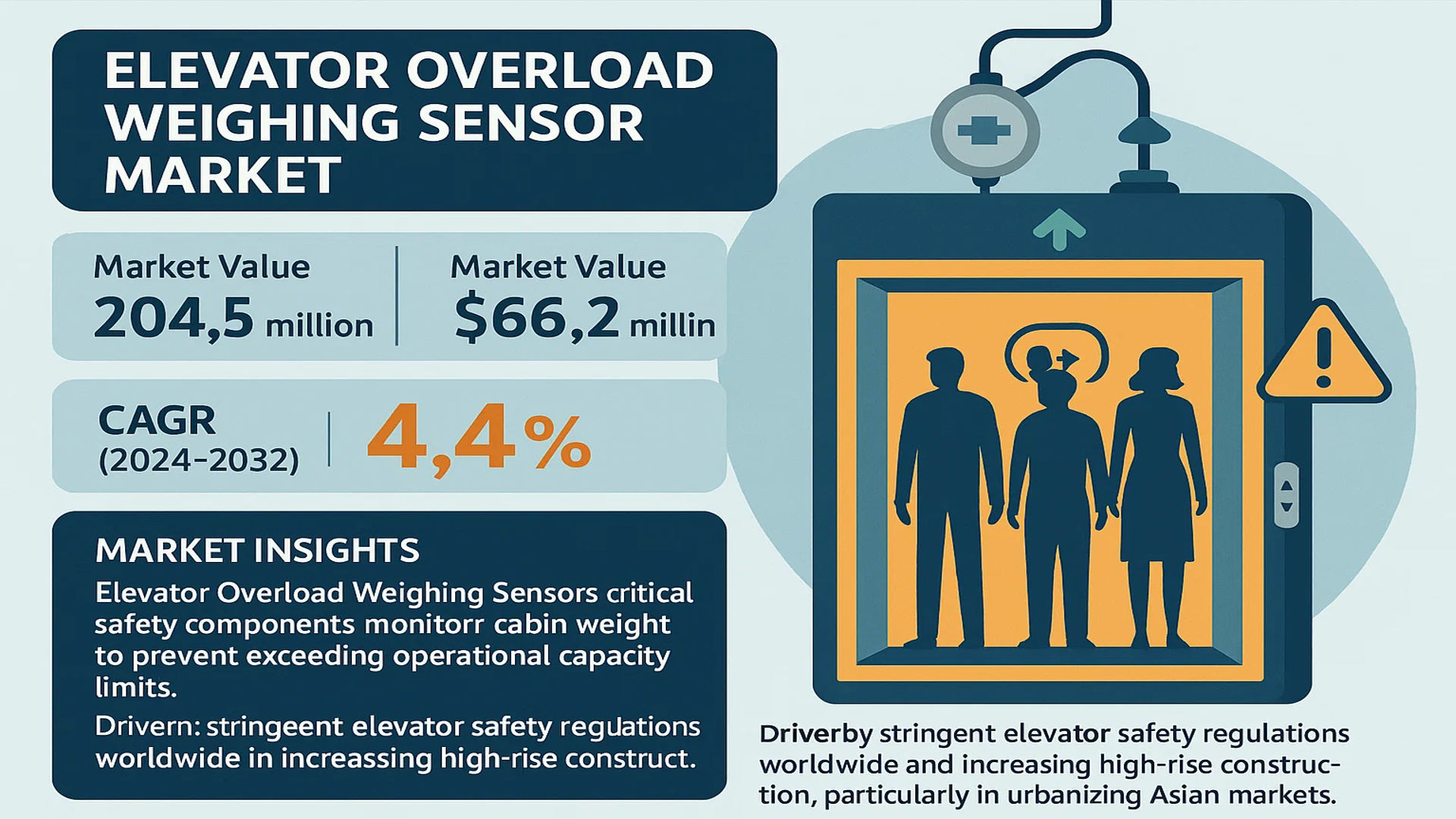
The global Elevator Overload Weighing Sensor market was valued at 49.5 million in 2024 and is projected to reach US$ 66.2 million by 2032, at a CAGR of 4.4% during the forecast period.
Elevator overload weighing sensors are critical safety components that monitor cabin weight to prevent exceeding operational capacity limits. These precision devices utilize strain gauge, capacitive, or hydraulic measurement technologies to provide real-time load data. When thresholds are breached, integrated systems can prevent elevator movement or trigger alerts – significantly reducing mechanical stress and accident risks.
Market growth is driven by stringent elevator safety regulations worldwide and increasing high-rise construction, particularly in urbanizing Asian markets. However, price sensitivity among smaller elevator manufacturers presents adoption challenges. The rope tension sensor segment shows particular promise, projected to grow at above-market rates through 2032. Key players like Flexco Industries and Zemic Europe dominate with combined 35-40% market share, while Chinese manufacturers are gaining traction through cost-competitive solutions.
MARKET DYNAMICS
MARKET DRIVERS
Rapid Urbanization and Infrastructure Development Fueling Market Expansion
The global elevator overload weighing sensor market is experiencing significant growth due to rapid urbanization and the consequent rise in high-rise building construction. Urban populations are expected to grow by 2.5 billion people by 2050, creating immense demand for vertical transportation solutions. Elevator safety systems, including overload weighing sensors, have become mandatory in most jurisdictions as building codes tighten worldwide. These regulations are driving adoption as building owners prioritize passenger safety and equipment protection to avoid costly downtime and liability issues. The increasing focus on smart buildings and IoT integration in elevators is further propelling demand for advanced sensor technologies that can provide real-time monitoring data to facility managers.
Technological Advancements in Sensor Accuracy and Reliability
Recent innovations in sensor technology, particularly in strain gauge and capacitive measurement systems, are significantly improving the accuracy and reliability of elevator overload detection. Modern sensors can now detect weight variations within 1% accuracy, compared to 5-10% in earlier generations. This precision is crucial for preventing false alarms while maintaining rigorous safety standards. The integration of wireless connectivity allows for continuous monitoring and predictive maintenance capabilities, reducing unplanned downtime by up to 30%. Major manufacturers are investing heavily in R&D to develop sensors compatible with emerging elevator technologies such as magnetic levitation and ultra-high-speed systems.
Increasing Safety Regulations and Compliance Requirements
Global safety standards for elevators have become increasingly stringent, with many countries mandating real-time load monitoring systems in all new installations. Regulatory bodies are focusing on preventing accidents caused by overloading, which account for 8-12% of all elevator-related incidents. Recent updates to international elevator safety codes require overload protection systems to be fail-safe and include redundant measurement capabilities. These regulatory changes are creating substantial demand for compliant systems, particularly in developing markets that are adopting international safety standards as their construction industries mature. The European market alone is expected to upgrade 40% of its existing elevator systems with modern overload protection by 2030 to meet new directives.
MARKET RESTRAINTS
High Installation and Maintenance Costs Limiting Market Penetration
While safety concerns drive adoption, the substantial costs associated with implementing and maintaining elevator overload weighing systems present a significant barrier. Retrofitting existing elevators with modern sensors often requires structural modifications that can cost up to 20% of a new elevator installation. Small and medium building owners, particularly in price-sensitive markets, frequently delay upgrades due to these expenses. Maintenance contracts for advanced sensor systems can add 15-25% to annual operating costs, creating additional financial burdens. This cost sensitivity is especially acute in developing regions where building operators prioritize basic functionality over advanced safety features.
Technical Complexities in System Integration
Integrating overload weighing sensors with diverse elevator control systems presents substantial technical challenges. Legacy elevator systems often lack the necessary interfaces for modern sensors, requiring expensive control system upgrades. Compatibility issues between sensor manufacturers’ proprietary protocols and elevator OEM systems can create implementation delays and additional costs. The lack of universal communication standards leads to vendor lock-in situations, limiting building owners’ flexibility in choosing system components. These integration challenges are particularly problematic in mixed-fleet buildings where multiple elevator models from different manufacturers must work together seamlessly.
Limitations in Sensor Durability and Environmental Resistance
Elevator weighing sensors face significant durability challenges in real-world operating conditions. Temperature fluctuations, humidity, vibration, and electromagnetic interference can all impact measurement accuracy over time. Sensors installed in harsh environments such as coastal areas or industrial facilities typically require replacement every 5-7 years rather than the standard 10-year lifespan. Developing sensors that maintain accuracy through millions of load cycles while resisting environmental factors adds substantial R&D and manufacturing costs. These durability concerns are particularly acute for outdoor elevator applications and high-traffic installations where sensor performance is critical for safety.
MARKET OPPORTUNITIES
Emerging Markets Present Significant Growth Potential
Developing economies in Asia, Africa, and Latin America represent substantial untapped potential for elevator safety systems. With urban populations growing rapidly and building codes becoming more stringent, these regions are expected to account for over 60% of new elevator installations through 2032. Local manufacturers are increasingly partnering with international technology providers to develop cost-effective sensor solutions tailored to regional requirements. Government initiatives promoting safe vertical transportation in rapidly growing cities are creating favorable conditions for market expansion. Infrastructure development programs in these regions frequently include provisions for modern elevator safety systems as part of basic building requirements.
Integration with Smart Building Ecosystems
The growing adoption of IoT and smart building technologies creates opportunities for advanced overload sensor applications. Modern sensors equipped with wireless connectivity can provide real-time data to building management systems, enabling predictive maintenance and optimizing elevator performance. Integration with AI-powered analytics platforms allows for pattern recognition that can predict peak load times and optimize elevator scheduling. These capabilities are particularly valuable in high-traffic buildings such as offices, hospitals, and transportation hubs where efficient vertical transportation directly impacts operational performance and user satisfaction.
Development of Advanced Materials and Sensing Technologies
Innovations in materials science and sensing technologies are creating new possibilities for elevator overload detection. Nanomaterial-based sensors offer improved accuracy and durability while reducing size and power requirements. Research into fiber optic sensing and acoustic measurement techniques may provide alternatives to traditional strain gauge approaches. These technological advancements allow for non-intrusive installation methods that reduce retrofit costs and simplify maintenance. Manufacturers investing in next-generation sensor technologies will be well-positioned to capitalize on the growing demand for reliable, high-performance overload protection systems.
MARKET CHALLENGES
Standardization and Certification Hurdles
The elevator overload weighing sensor market faces significant challenges related to inconsistent standards and certification requirements across different regions. While safety regulations are becoming more rigorous globally, the absence of unified testing and certification processes creates obstacles for manufacturers. Products often need to undergo multiple, sometimes redundant, certification processes to be sold in different markets, adding substantial time and cost to product development cycles. The varying interpretations of safety standards among certification bodies can lead to confusion and delays in product approvals. This fragmentation is particularly challenging for small and medium-sized manufacturers looking to expand into international markets.
Skilled Labor Shortage in Installation and Maintenance
The industry faces a growing shortage of technicians qualified to install and maintain sophisticated overload weighing systems. Proper installation requires specialized knowledge of both mechanical systems and electronic instrumentation, skills that are in short supply globally. Training programs often lag behind technological advancements, leaving many technicians unprepared to work with the latest sensor technologies. This skills gap is particularly acute in emerging markets where elevator adoption is growing fastest, potentially compromising system reliability and safety. The situation is further complicated by the retirement of experienced technicians in developed markets without adequate replacement by trained younger workers.
Cybersecurity Risks in Connected Systems
As overload sensors become increasingly connected to building networks and elevator control systems, cybersecurity emerges as a critical challenge. Vulnerabilities in sensor communication protocols could potentially be exploited to manipulate safety systems or disrupt elevator operations. Building owners are becoming more cautious about implementing connected sensor solutions due to these risks, particularly in sensitive environments. Manufacturers face increasing pressure to implement robust encryption, authentication, and intrusion detection capabilities while maintaining system reliability and real-time performance. These security requirements add complexity and cost to product development while necessitating ongoing software updates throughout the product lifecycle.
ELEVATOR OVERLOAD WEIGHING SENSOR MARKET TRENDS
Smart Sensor Integration and IoT Adoption Driving Market Growth
The global Elevator Overload Weighing Sensor market is undergoing a significant transformation due to advancements in smart sensor technology and the integration of IoT (Internet of Things). Modern sensors now incorporate wireless connectivity, real-time data analytics, and predictive maintenance capabilities, allowing building managers to optimize elevator performance while minimizing downtime. Major manufacturers are increasingly incorporating AI-powered weight detection algorithms, which enhance accuracy by up to 98% compared to traditional strain gauge systems. These innovations not only improve safety but also extend elevator lifespan by preventing mechanical stress. Furthermore, the rise of smart buildings with centralized monitoring systems has accelerated demand for connected overload sensors, expected to account for nearly 40% of new installations by 2025.
Other Trends
Regulatory Compliance and Safety Standards
Stringent government regulations regarding elevator safety are profoundly shaping market dynamics, particularly in developed regions like North America and Europe. Recent updates to EN 81-20/50 and ASME A17.1 standards now mandate advanced overload protection systems in all new elevator installations, with retrofitting requirements for older buildings. This has created a surge in demand for precision weighing sensors capable of detecting load variations as low as 1% of rated capacity. Meanwhile, emerging economies are adopting similar frameworks, with China’s GB 7588-2020 standard driving a 15% annual growth in sensor replacements across the country’s extensive vertical transportation infrastructure.
Material Science Breakthroughs Enhancing Sensor Durability
Cutting-edge material innovations are addressing longstanding challenges in sensor longevity and environmental resilience. Nanocomposite strain gauges can now withstand temperature fluctuations from -40°C to 85°C while maintaining measurement consistency, making them ideal for harsh climates. Manufacturers are also deploying corrosion-resistant titanium alloys in hydraulic sensor components, reducing failure rates by approximately 30% in coastal regions with high salinity. These advancements are critical as the market shifts toward maintenance-free sensor solutions, particularly in commercial high-rises where accessibility for repairs poses logistical challenges. Industry leaders project that next-generation materials will dominate 60% of the premium sensor segment within three years.
Urbanization and High-Rise Construction Boom
The relentless global urbanization wave continues to fuel market expansion, with Asia-Pacific accounting for over 45% of new elevator installations. Megacities experiencing vertical expansion, particularly in China, India, and Southeast Asia, require sophisticated load monitoring systems to handle dense passenger traffic. Developers increasingly favor elevator systems with integrated overload prevention as a standard feature, recognizing its role in minimizing liability risks while optimizing transport efficiency. This trend aligns with the construction industry’s broader shift toward intelligent vertical mobility solutions in super-tall buildings exceeding 300 meters, where safety systems undergo particularly rigorous testing protocols.
COMPETITIVE LANDSCAPE
Key Industry Players
Manufacturers Focus on Advanced Sensor Technologies to Gain Market Share
The global elevator overload weighing sensor market is characterized by the presence of both established players and emerging manufacturers striving to enhance their product portfolios. Flexco Industries leads the competitive landscape, owing to its extensive range of high-precision rope tension sensors and load monitoring solutions. The company’s dominance stems from its strong partnerships with elevator OEMs and consistent R&D investments in smart sensor technologies.
Meanwhile, European players like Zemic Europe and CENTA Asansör have carved significant market shares through their expertise in strain-gauge based weighing systems. These companies benefit from stringent EU safety regulations driving adoption of advanced overload protection systems in commercial elevators.
The competitive environment remains dynamic as Chinese manufacturers such as Xi’an Gavin Electronic Technology and Hangzhou Yisen Tech expand aggressively through cost-competitive solutions. Their growth is further propelled by China’s booming construction sector where elevator installations surpassed 800,000 units annually in recent years.
Several mid-sized players are adopting differentiation strategies – Puretronics focuses on IoT-enabled sensors with real-time monitoring capabilities while Rudrra Sensor specializes in ruggedized designs for industrial elevator applications. Such specialized offerings help vendors compete against larger players.
List of Key Elevator Overload Weighing Sensor Manufacturers
- Flexco Industries (U.S.)
- Zemic Europe (Netherlands)
- Puretronics (India)
- Excella Electronics (Japan)
- SAM Electronics (South Korea)
- Kobastar (Turkey)
- CENTA Asansör (Turkey)
- Rudrra Sensor (India)
- Qinhuangdao Development Zone PROSPECT Photoelectric Tech (China)
- Xi’an Gavin Electronic Technology (China)
- Xi’an Excellent Electromechnical (China)
- Beijing Keyuanlong Technology (China)
- Hangzhou Yisen Tech (China)
Segment Analysis:
By Type
Rope Tension Sensor Segment Leads Due to High Adoption in Elevator Safety Systems
The market is segmented based on type into:
- Rope Tension Sensor
- Subtypes: Mechanical, Electromechanical, and others
- Platform Load Sensor
- Others
By Application
Passenger Elevator Segment Dominates Due to High Demand in Commercial and Residential Buildings
The market is segmented based on application into:
- Passenger Elevator
- Subtypes: Commercial, Residential, and others
- Cargo Elevator
By Technology
Strain Gauge Technology Segment Leads Due to Its Accuracy and Reliability
The market is segmented based on technology into:
- Strain Gauge
- Capacitive
- Hydraulic
- Others
By End-User
Commercial Segment Dominates Due to High Installation in Office Buildings and Shopping Malls
The market is segmented based on end-user into:
- Commercial
- Residential
- Industrial
- Others
Regional Analysis: Elevator Overload Weighing Sensor Market
Asia-Pacific
The Asia-Pacific region dominates the global elevator overload weighing sensor market, driven by rapid urbanization and large-scale infrastructure development. China and India account for over 55% of regional demand due to booming construction activities and increasing high-rise building projects. Stringent safety regulations in countries like Japan and South Korea further propel adoption of advanced weighing systems. Local manufacturers such as Xi’an Gavin Electronic Technology and Qinhuangdao Development Zone PROSPECT Photoelectric Tech are gaining traction, though price competition remains intense. The shift toward smart buildings and IoT-enabled elevator systems presents growth opportunities, though service infrastructure in developing nations needs improvement.
North America
The North American market prioritizes high-precision sensors with connectivity features, aligned with strict safety standards like ASME A17.1. The U.S. holds an 80% share of regional demand, driven by elevator modernization projects and replacement of aging systems. Canadian regulations emphasize fail-safe mechanisms, creating opportunities for suppliers like Flexco Industries and Excella Electronics. While growth is steady, higher production costs limit price competitiveness against Asian imports. Emerging smart city initiatives in major metros are expected to drive demand for integrated sensor solutions over the forecast period.
Europe
Europe’s mature market focuses on energy-efficient and compliant solutions, with Germany and France leading in technological adoption. EU machinery directives mandate rigorous certification processes, benefiting established players like Zemic Europe and SAM Electronics. The region shows strong preference for rope tension sensors due to their reliability in historic buildings. Growth is moderate at 3.8% CAGR, constrained by slower construction activity compared to Asia. However, increasing investments in elevator upgrades across Eastern Europe present untapped potential, particularly for retrofit solutions.
South America
Market growth in South America is uneven, with Brazil accounting for 60% of regional sensor demand. Economic instability and currency fluctuations hinder large-scale deployments, though safety regulations in Argentina and Chile drive steady replacement demand. Local sourcing challenges lead to reliance on Chinese imports, creating pricing pressure. The cargo elevator segment shows above-average growth due to logistics sector expansion. Infrastructure projects in Colombia and Peru offer future opportunities, contingent on political stability and foreign investment flows.
Middle East & Africa
The MEA market is nascent but growing rapidly at 5.1% CAGR, led by UAE and Saudi Arabia’s smart city projects. High-rise developments in Dubai and NEOM demand advanced overload protection systems, though price sensitivity persists. South Africa exhibits potential for aftermarket solutions due to aging elevator stock. Challenges include lack of local manufacturing and dependence on European/Asian imports. Partnerships with global players like CENTA Asansör are helping bridge technology gaps, particularly for luxury and commercial developments.
Report Scope
This market research report provides a comprehensive analysis of the global and regional Elevator Overload Weighing Sensor markets, covering the forecast period 2024–2032. It offers detailed insights into market dynamics, technological advancements, competitive landscape, and key trends shaping the industry.
Key focus areas of the report include:
- Market Size & Forecast: Historical data and future projections for revenue, unit shipments, and market value across major regions and segments. The global market was valued at USD 49.5 million in 2024 and is projected to reach USD 66.2 million by 2032 at a CAGR of 4.4%.
- Segmentation Analysis: Detailed breakdown by product type (Rope Tension Sensor, Platform Load Sensor, Others), application (Passenger Elevator, Cargo Elevator), and end-user industry to identify high-growth segments.
- Regional Outlook: Insights into market performance across North America, Europe, Asia-Pacific, Latin America, and the Middle East & Africa, with China and the U.S. as key markets.
- Competitive Landscape: Profiles of leading market participants including Flexco Industries, Zemic Europe, Puretronics, Excella Electronics, and SAM Electronics, covering their product offerings, market share, and recent developments.
- Technology Trends & Innovation: Assessment of sensor technologies (strain gauges, capacitive elements), integration with elevator control systems, and evolving safety standards.
- Market Drivers & Restraints: Evaluation of factors such as urbanization, smart building adoption, safety regulations, along with cost sensitivity and technical challenges.
- Stakeholder Analysis: Insights for sensor manufacturers, elevator OEMs, system integrators, and regulatory bodies regarding market opportunities and challenges.
The research employs both primary and secondary methodologies, including interviews with industry experts and analysis of verified market data, to ensure accuracy and reliability.
FREQUENTLY ASKED QUESTIONS:
What is the current market size of Global Elevator Overload Weighing Sensor Market?
-> Elevator Overload Weighing Sensor market was valued at 49.5 million in 2024 and is projected to reach US$ 66.2 million by 2032, at a CAGR of 4.4% during the forecast period.
Which key companies operate in Global Elevator Overload Weighing Sensor Market?
-> Key players include Flexco Industries, Zemic Europe, Puretronics, Excella Electronics, SAM Electronics, Kobastar, and CENTA Asansör among others.
What are the key growth drivers?
-> Key growth drivers include urbanization, increasing high-rise construction, stringent safety regulations, and smart building adoption.
Which region dominates the market?
-> Asia-Pacific is the largest market due to rapid urbanization, while North America maintains strong demand for advanced safety systems.
What are the emerging trends?
-> Emerging trends include IoT-enabled sensors, wireless connectivity, AI-based load prediction, and integration with building management systems.

Get Sample Report PDF for Exclusive Insights
Report Sample Includes
- Table of Contents
- List of Tables & Figures
- Charts, Research Methodology, and more...
 Download Sample Report PDF