MARKET INSIGHTS
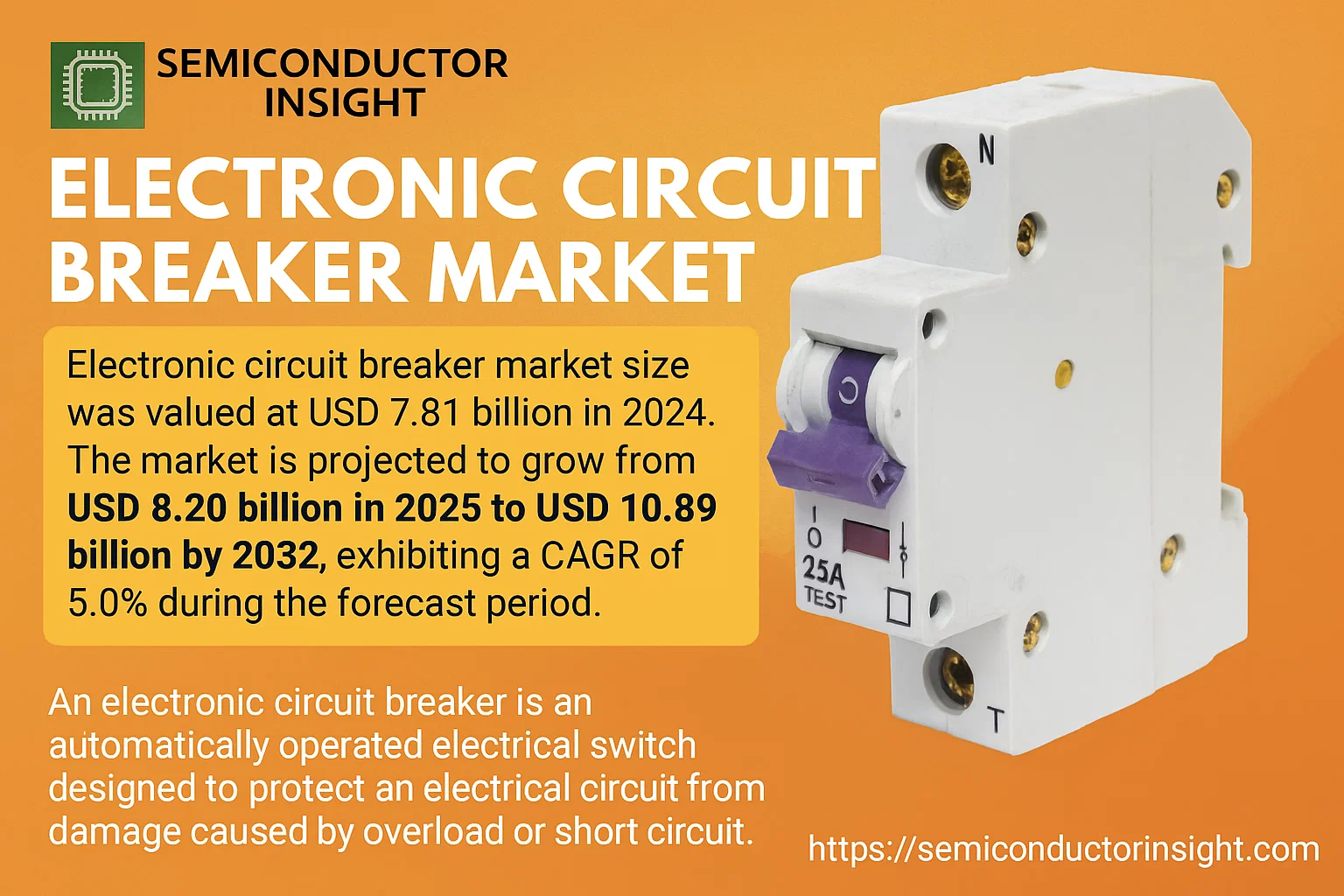
Global Electronic Circuit Breaker Market size was valued at USD 7.81 billion in 2024 to USD 10.89 billion by 2032, exhibiting a CAGR of 5.0% during the forecast period.
An electronic circuit breaker is an automatically operated electrical switch designed to protect an electrical circuit from damage caused by overload or short circuit. Its fundamental function is to detect a fault condition and, by interrupting continuity, to immediately discontinue electrical flow. Unlike a fuse, which operates once and then must be replaced, a circuit breaker can be reset (either manually or automatically) to resume normal operation. These devices are manufactured in varying sizes, ranging from small units that protect low-current circuits or individual household appliances to large switchgear designed to protect high voltage circuits supplying an entire city.
The market growth is primarily driven by increasing investments in smart grid infrastructure, rising demand for reliable electricity supply across industrial and residential sectors, and stringent government regulations for electrical safety. Furthermore, the ongoing modernization of aging power infrastructure and the rapid urbanization in developing economies are creating significant expansion opportunities. Key industry players are focusing on technological advancements, such as the integration of IoT for predictive maintenance and real-time monitoring. For instance, major manufacturers like ABB Limited, Schneider Electric, and Siemens are continuously innovating their product portfolios with smart and connected solutions to strengthen their market position.
MARKET DRIVERS
Rising Demand for Enhanced Electrical Safety and Grid Modernization
The global push for safer and more resilient electrical infrastructure is a primary driver for the electronic circuit breaker market. Traditional electromechanical circuit breakers are increasingly being replaced by electronic variants that offer faster response times, precision protection, and advanced diagnostics. This shift is critical for modern smart grids, data centers, and industrial automation, where minimizing downtime and preventing equipment damage is paramount.
Integration with Renewable Energy and IoT Systems
The rapid expansion of renewable energy sources like solar and wind power creates complex power management challenges that require sophisticated protection devices. Electronic circuit breakers, with their ability to handle bidirectional power flow and communicate with energy management systems, are essential. Furthermore, their compatibility with the Internet of Things (IoT) enables real-time monitoring and remote control, which is vital for modern energy networks.
➤ The global market for electronic circuit breakers is projected to grow at a CAGR of over 6% in the coming years, driven by regulatory standards emphasizing electrical safety and energy efficiency.
Government regulations and incentives aimed at improving energy efficiency and reducing carbon footprints also propel market growth. Standards like the IEC 60947-2 are evolving to include requirements that favor electronic protection technologies, compelling manufacturers and utilities to upgrade their systems.
MARKET CHALLENGES
High Initial Cost and Complexity of Implementation
Despite their advantages, electronic circuit breakers face significant adoption barriers due to their higher upfront cost compared to traditional models. The initial investment includes not only the breakers themselves but also the associated costs for system integration, software, and skilled labor for installation and maintenance. This can be particularly challenging for small and medium-sized enterprises and in developing regions with budget constraints.
Other Challenges
Cybersecurity Vulnerabilities
As connected devices, electronic circuit breakers are potentially vulnerable to cyber-attacks that could disrupt power systems. Ensuring robust cybersecurity measures adds another layer of complexity and cost for manufacturers and end-users.
Technical Standardization and Interoperability
The lack of universal communication protocols can hinder seamless integration with existing building management or grid control systems, creating interoperability issues that slow down widespread adoption.
MARKET RESTRAINTS
Economic Volatility and Supply Chain Disruptions
Global economic uncertainties and fluctuations in the prices of key raw materials, such as semiconductors and specialized plastics, can restrain market growth. The electronic circuit breaker industry is highly dependent on a stable supply chain for electronic components. Recent disruptions have highlighted vulnerabilities, leading to production delays and increased costs, which can deter investment and slow down market expansion.
MARKET OPPORTUNITIES
Expansion in Electric Vehicle Infrastructure and Smart Buildings
The massive global investment in electric vehicle (EV) charging infrastructure presents a substantial growth opportunity. Electronic circuit breakers are critical for managing the high-power demands of fast-charging stations and ensuring safety. Similarly, the proliferation of smart buildings and home automation systems drives demand for intelligent circuit protection that can be monitored and controlled remotely.
Advancements in Solid-State Circuit Breaker Technology
The development and commercialization of solid-state circuit breakers, which use semiconductor components to interrupt current almost instantaneously, represent a frontier for the market. This technology offers superior performance in terms of speed and reliability, opening up new applications in high-value sectors like aerospace, defense, and advanced manufacturing.
Electronic Circuit Breaker Market Trends
Sustained Global Growth Trajectory
The global Electronic Circuit Breaker market is on a definitive upward path, driven by increasing electrification and the demand for reliable power protection. The market, valued at $7,810 million in 2024, is projected to expand to $10,890 million by 2032, representing a steady Compound Annual Growth Rate (CAGR) of 5.0% during the forecast period. This growth is underpinned by the fundamental role of circuit breakers in protecting electrical circuits from damage caused by overloads or short circuits across a vast range of applications, from household appliances to city-wide high-voltage infrastructure.
Other Trends
Regional Market Leadership and Concentration
The global market landscape is characterized by distinct regional concentrations. The United States stands as the largest market, commanding approximately 33% of the global market share. Europe follows as a significant player, accounting for about 27% of the market. This concentration reflects the advanced state of industrial and residential electrical infrastructure in these regions. Meanwhile, the Asia-Pacific region is expected to see accelerated growth, fueled by rapid industrialization and urbanization, particularly in countries like China and India.
Competitive Landscape and Application Diversification
The competitive environment is fragmented yet anchored by key global players. Top companies including ABB Limited, Schneider Electric, Eaton, Mitsubishi Electric, and Legrand collectively hold a significant portion of the market, with the top five companies occupying approximately 39% of the total market share. The market is further segmented by product type, with common voltage ratings like 220V, 250V, and 380V, and by application across Industry, Residential, Transport, and other sectors. This diversification highlights the widespread reliance on electronic circuit breakers for safety and operational continuity, making them a critical component in the modern electrical ecosystem.
COMPETITIVE LANDSCAPE
Key Industry Players
A Market Characterized by the Dominance of Global Electrical Giants
The global Electronic Circuit Breaker market is a consolidated landscape dominated by a handful of established multinational corporations with extensive product portfolios and global distribution networks. ABB Limited, Schneider Electric, and Eaton collectively represent a significant portion of the market, leveraging their strong brand recognition and technological expertise in power management and industrial automation. Siemens and Mitsubishi Electric further reinforce this top tier, offering advanced electronic circuit breakers integral to smart grid infrastructure, industrial control systems, and building automation. These leading players compete intensely on innovation, focusing on features like remote monitoring, predictive maintenance capabilities, and integration with IoT platforms. The market is highly competitive with the top five companies occupying approximately 39% of the global market share, driving advancements in safety, reliability, and energy efficiency.
Beyond the market leaders, a diverse group of significant players compete effectively in regional markets and specialized niches. Companies like Legrand and Hager hold substantial shares, particularly in the residential and commercial building sectors in Europe. In the Asia-Pacific region, manufacturers such as Fuji Electric, Hitachi, Toshiba, and Hyundai are key contenders, supported by strong domestic demand. Chinese players, including DELIXI, Shanghai Renmin, Changshu Switchgear, and Nader, have grown significantly, catering to the massive industrial and infrastructure development within the country and competing on cost-effectiveness. Specialized component manufacturers like Mersen SA also play a crucial role in the supply chain. This diverse competitive environment ensures a wide range of products are available across different voltage ratings and applications, from industrial uses to residential and transport sectors.
List of Key Electronic Circuit Breaker Companies Profiled
- ABB Limited
- Schneider Electric
- Eaton
- Mitsubishi Electric
- Legrand
- Siemens
- DELIXI
- Nader
- Fuji Electric
- Hitachi
- Shanghai Renmin
- Hager
- Changshu Switchgear
- Toshiba
- Hyundai
- Mersen SA
Segment Analysis:
| Segment Category | Sub-Segments | Key Insights |
| By Type |
|
380V breakers represent the leading segment, primarily due to their extensive use in industrial and heavy commercial applications where higher power distribution is essential. This segment’s dominance is driven by the critical need for robust circuit protection in manufacturing plants, data centers, and large infrastructure projects that operate on three-phase power systems. The demand for reliable and advanced protection at this voltage level continues to strengthen as industrial automation and electrification expand globally. |
| By Application |
|
Industry is the predominant application segment, fueled by widespread adoption across manufacturing, energy, and utilities sectors. The integration of electronic circuit breakers is critical for protecting sophisticated machinery, controlling systems, and ensuring operational safety and efficiency. This segment benefits from strong demand driven by industrial modernization, the rise of smart factories, and stringent safety regulations that mandate advanced electrical protection solutions over traditional alternatives. |
| By End User |
|
Industrial & Manufacturing is the leading end-user segment, reflecting substantial reliance on electronic circuit breakers for ensuring operational continuity and equipment protection. These users require high-performance breakers capable of handling complex electrical loads and providing precise fault interruption. The segment’s growth is further supported by investments in industrial automation, the expansion of renewable energy infrastructure, and the ongoing electrification of industrial processes, which collectively drive the need for sophisticated and reliable circuit protection. |
| By Technology |
|
Solid-State technology is emerging as the most advanced and fastest-growing segment, offering superior precision, faster response times, and enhanced diagnostic capabilities compared to traditional technologies. The adoption of solid-state electronic circuit breakers is accelerating in applications demanding high reliability and smart features, such as data centers, electric vehicle charging infrastructure, and renewable energy systems. This segment benefits from ongoing technological innovation and the increasing integration of IoT and connectivity features for predictive maintenance and remote monitoring. |
| By Mounting |
|
Drawout mounting is the leading configuration, particularly valued in industrial and utility settings for its ease of maintenance, testing, and replacement without de-energizing the entire panel. This segment’s prominence is driven by the critical need for minimal downtime in continuous operations, such as in power plants and large manufacturing facilities. The drawout design offers enhanced safety for personnel and flexibility for system upgrades, making it a preferred choice for complex and high-availability electrical distribution systems. |
Regional Analysis: Electronic Circuit Breaker Market
Asia-Pacific
The region’s status as a global manufacturing powerhouse creates immense demand for reliable circuit protection within factories and industrial plants, driving the adoption of advanced electronic breakers for machinery control and power distribution systems to ensure operational safety and minimize downtime from electrical faults.
Rapid construction of smart cities, commercial complexes, and new residential areas fuels the need for modern electrical systems. This boom strongly promotes the integration of electronic circuit breakers with smart metering and building management systems for enhanced safety and energy monitoring capabilities.
Significant investments in solar and wind power projects necessitate sophisticated protection devices. Electronic circuit breakers are critical for managing the variable output from renewables and ensuring grid stability, a key priority for governments across the region aiming to meet clean energy targets.
A strong local ecosystem of electronics manufacturers fosters continuous innovation in breaker technology, leading to more compact, intelligent, and cost-effective products. This robust supply chain advantage allows for quicker adaptation to market needs and competitive pricing compared to other regions.
North America
The North American market for electronic circuit breakers is characterized by a strong focus on upgrading aging electrical infrastructure and enhancing grid resilience. There is significant demand driven by the modernization of power grids to incorporate smart technologies and distributed energy resources. The region’s stringent safety standards and building codes mandate the use of advanced protection devices in both commercial and residential constructions. Furthermore, the high penetration of data centers, which require ultra-reliable power protection, and the growing adoption of electric vehicles, which necessitate robust charging infrastructure, are key growth drivers. The market is also influenced by a trend towards home automation and energy management systems, increasing the adoption of smart electronic breakers in the consumer sector.
Europe
Europe represents a mature yet innovation-driven market for electronic circuit breakers, heavily influenced by the region’s ambitious climate and energy efficiency goals. The push for decarbonization is accelerating the integration of renewable energy sources, creating a need for advanced grid protection and management solutions. Strict regulations regarding energy efficiency in buildings under directives like the Energy Performance of Buildings Directive (EPBD) foster the adoption of smart electrical components. The industrial sector’s focus on Industry 4.0 and automation necessitates sophisticated circuit protection for complex machinery. Additionally, investments in modernizing transmission and distribution networks across the European Union to improve reliability and accommodate electric mobility are significant contributors to market growth.
South America
The South American market for electronic circuit breakers is developing, with growth primarily fueled by investments in industrial development and power infrastructure expansion. Countries like Brazil and Chile are focusing on modernizing their electrical grids to reduce losses and improve service reliability, which creates opportunities for advanced protective devices. The mining and industrial sectors are key end-users, requiring robust circuit protection for heavy machinery. However, market growth can be uneven, influenced by economic volatility and varying paces of infrastructure investment across different countries. The gradual increase in renewable energy projects, particularly hydroelectric, wind, and solar, also contributes to a slowly growing demand for more sophisticated circuit breaking technology.
Middle East & Africa
The Middle East & Africa region presents a market with diverse dynamics. In the Gulf Cooperation Council (GCC) countries, massive investments in smart city projects, luxury commercial real estate, and industrial diversification away from oil drive demand for high-end electronic circuit breakers. The focus is on building state-of-the-art infrastructure with integrated smart grid capabilities. In contrast, parts of Africa are experiencing growth driven by rapid urbanization and efforts to expand access to electricity, leading to increased construction and infrastructure development. The market across the region is also supported by investments in large-scale power generation projects and a growing industrial base, although adoption rates can be hindered by economic constraints in certain areas.
Report Scope
This market research report provides a comprehensive analysis of the Electronic Circuit Breaker Market , covering the forecast period 2025–2032. It offers detailed insights into market dynamics, technological advancements, competitive landscape, and key trends shaping the industry.
Key focus areas of the report include:
- Market Overview: The report begins with an overview outlining its current market scenario, key growth indicators, and industry transformation drivers. It discusses macroeconomic factors, demand–supply balance, regulatory landscape, and the strategic role of semiconductors in powering advancements across industries such as automotive, telecommunications, consumer electronics, and industrial automation.
- Market Size & Forecast: Historical data and future projections for revenue, unit shipments, and market value across major regions and segments.
- Segmentation Analysis: Detailed breakdown by product type, technology, application, and end-user industry to identify high-growth segments and investment opportunities.
- Regional Insights: Insights into market performance across North America, Europe, Asia-Pacific, Latin America, and the Middle East & Africa, including country-level analysis where relevant.
- Competitive Landscape: Profiles of leading market participants, including their product offerings, R&D focus, manufacturing capacity, pricing strategies, and recent developments such as mergers, acquisitions, and partnerships.
- Technology Trends & Innovation: Assessment of emerging technologies, integration of AI/IoT, semiconductor design trends, fabrication techniques, and evolving industry standards.
- Market Drivers & Restraints: Evaluation of factors driving market growth along with challenges, supply chain constraints, regulatory issues, and market-entry barriers.
- Stakeholder Insights: Insights for component suppliers, OEMs, system integrators, investors, and policymakers regarding the evolving ecosystem and strategic opportunities.
Primary and secondary research methods are employed, including interviews with industry experts, data from verified sources, and real-time market intelligence to ensure the accuracy and reliability of the insights presented.
FREQUENTLY ASKED QUESTIONS:
What is the current market size of Electronic Circuit Breaker Market?
-> Global Electronic Circuit Breaker Market was valued at USD 7810 million in 2024 and is projected to reach USD 10890 million by 2032, exhibiting a CAGR of 5.0% during the forecast period.
Which key companies operate in Electronic Circuit Breaker Market?
-> Key players include ABB Limited, Schneider Electric, Eaton, Mitsubishi Electric, Legrand, Siemens, DELIXI, Nader, Fuji Electric, Hitachi, Shanghai Renmin, Hager, Changshu Switchgear, Toshiba, Hyundai, Mersen SA, among others.
What are the key growth drivers?
-> Key growth drivers include the essential function of circuit breakers in protecting electrical circuits from damage caused by overload or short circuit and the advantage of being resettable compared to fuses, which supports demand across various applications from household appliances to high-voltage city grids.
Which region dominates the market?
-> The United States is the largest Electronic Circuit Breaker market, accounting for about 33% market share. Europe is the follower, accounting for about 27% market share.
What are the emerging trends?
-> Emerging trends include technological advancements in fault detection, integration with smart grid systems, and the development of circuit breakers for a wider range of voltages and applications.

Get Sample Report PDF for Exclusive Insights
Report Sample Includes
- Table of Contents
- List of Tables & Figures
- Charts, Research Methodology, and more...