MARKET INSIGHTS
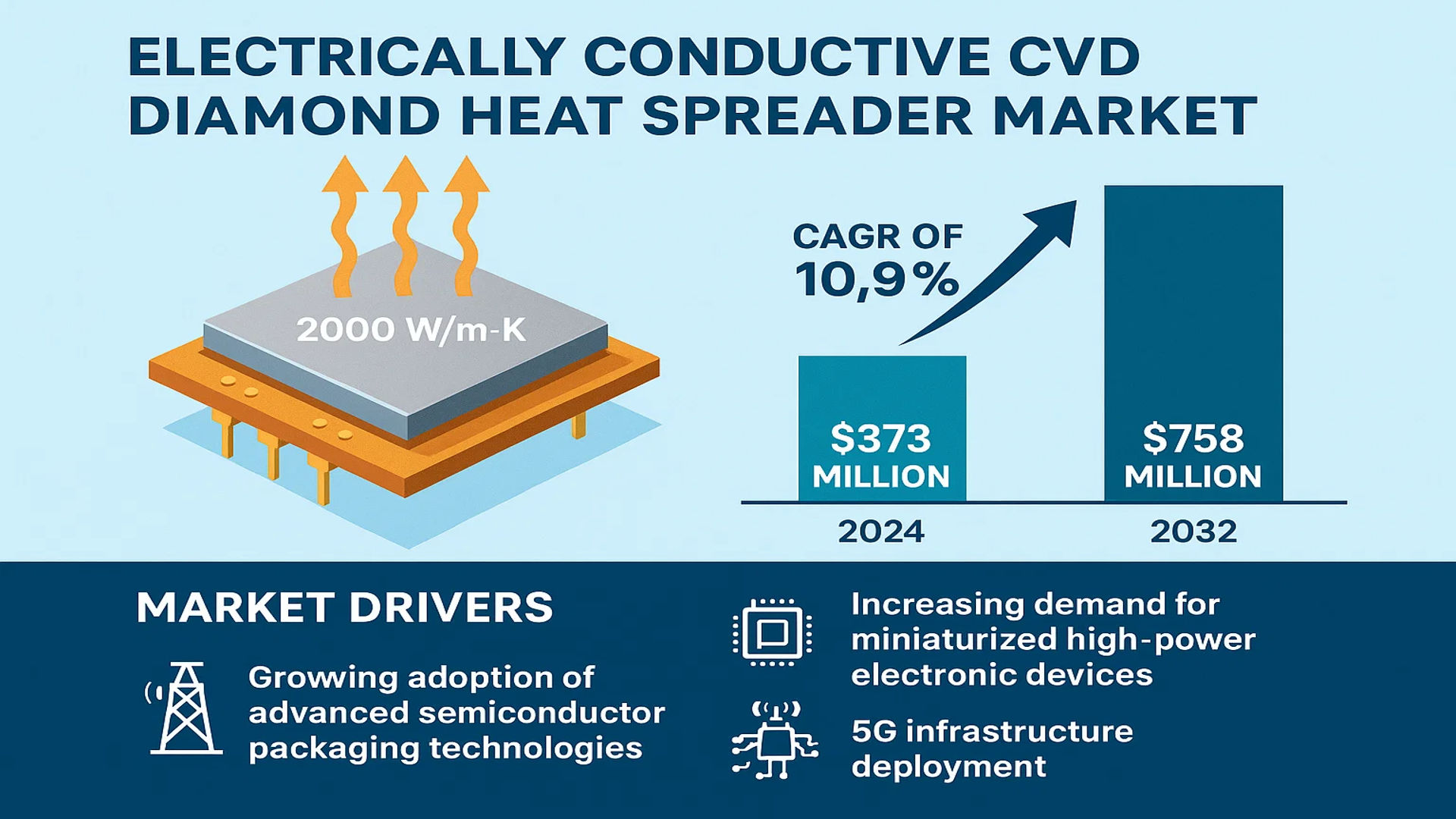
The global Electrically Conductive CVD Diamond Heat Spreader Market was valued at 373 million in 2024 and is projected to reach US$ 758 million by 2032, at a CAGR of 10.9% during the forecast period.
Electrically conductive CVD diamond heat spreaders are advanced thermal management components that leverage the ultra-high thermal conductivity of diamond (up to 2000 W/m.K) while maintaining electrical insulation properties. These components are critical for dissipating heat in high-power electronic devices, semiconductor lasers, and aerospace applications where traditional materials like copper or aluminum fall short. The unique properties of CVD diamond—including its exceptional thermal conductivity, mechanical strength, and chemical stability—make it indispensable for next-generation thermal management solutions.
The market is driven by increasing demand for miniaturized high-power electronic devices, 5G infrastructure deployment, and the growing adoption of advanced semiconductor packaging technologies. However, challenges such as high production costs and limited availability of large-area CVD diamond substrates persist. Key players like Element Six, II-VI Incorporated, and Applied Diamond, Inc. are investing in scaling up production capabilities to meet the rising demand from telecommunications, aerospace, and semiconductor sectors.
MARKET DYNAMICS
MARKET DRIVERS
Rising Demand for High-Performance Thermal Management Solutions in Electronics
The global semiconductor industry’s rapid expansion is driving unprecedented demand for advanced thermal management solutions like CVD diamond heat spreaders. With transistors shrinking below 5nm nodes and power densities exceeding 100W/cm² in some applications, traditional materials struggle to maintain optimal operating temperatures. CVD diamond’s exceptional thermal conductivity – often exceeding 1800 W/m·K compared to copper’s 400 W/m·K – makes it indispensable for next-gen chips. The semiconductor market is projected to exceed $800 billion by 2030, with Asia-Pacific accounting for over 60% of demand, creating substantial growth opportunities for high-performance thermal solutions.
Military and Aerospace Applications Accelerating Adoption
Defense applications represent one of the fastest-growing segments for electrically conductive CVD diamond heat spreaders. Modern radar systems, electronic warfare equipment, and satellite communications demand materials that can withstand extreme thermal loads while maintaining signal integrity. The combination of diamond’s RF transparency and thermal properties makes it ideal for these applications. Global defense spending reached nearly $2 trillion in 2023, with significant portions allocated to electronic warfare systems that benefit from advanced thermal management capabilities. The unique requirements of these systems often justify the premium pricing of CVD diamond solutions.
5G Infrastructure Expansion Creating New Growth Avenues
The global rollout of 5G networks is generating substantial demand for high-frequency, high-power electronics where thermal management is critical. Base station power amplifiers and other RF components increasingly utilize CVD diamond heat spreaders to manage thermal loads in compact form factors. With over 5 million 5G base stations expected to be deployed by 2027, this represents a significant growth vector for the market. The transition to mmWave frequencies in 5G networks further intensifies thermal challenges, making diamond’s properties increasingly valuable for maintaining component reliability and performance.
MARKET RESTRAINTS
High Production Costs Limit Widespread Adoption
Despite its exceptional properties, CVD diamond production remains expensive compared to traditional thermal materials. The specialized deposition processes require significant capital investment in equipment that can cost several million dollars per system. Additionally, achieving consistent quality across large-area substrates presents technical challenges that impact yields. While costs have decreased approximately 40% over the past decade, prices still remain 5-10× higher than copper-based solutions for equivalent thermal performance. This creates economic barriers for price-sensitive applications and limits market penetration outside high-value segments.
Other Restraints
Technical Integration Challenges
Integrating CVD diamond with other materials in electronic packages presents significant engineering challenges. The mismatch in coefficients of thermal expansion (CTE) between diamond (1×10⁻⁶/K) and common semiconductor materials (2.6-4×10⁻⁶/K) creates reliability concerns during thermal cycling. Advanced bonding and interface technologies are required to overcome these issues, adding complexity and cost to the manufacturing process.
Limited Production Capacity
The specialized nature of CVD diamond production has resulted in constrained manufacturing capacity across the industry. Scaling production to meet potential demand remains challenging due to the technical complexity and capital intensity of the deposition processes. This capacity limitation could inhibit market growth as application opportunities expand in sectors like automotive power electronics and optoelectronics.
MARKET OPPORTUNITIES
Emerging Electric Vehicle Power Electronics Offer Significant Growth Potential
The rapid electrification of automotive systems presents a major opportunity for CVD diamond heat spreaders. Next-generation EV power modules operating at 800V and higher require thermal solutions that can handle increasing power densities while maintaining reliability. With the global EV market projected to grow at a CAGR of over 20% through 2030, the demand for advanced thermal management in power electronics could create substantial opportunities. Recent developments in diamond integration with wide-bandgap semiconductors like SiC and GaN further enhance the potential in this sector.
Quantum Computing Applications Present Long-Term Growth Prospects
The emerging quantum computing sector represents another promising frontier for CVD diamond heat spreaders. Quantum processors operating at cryogenic temperatures require materials with both high thermal conductivity and low thermal mass. Synthetic diamond’s properties make it uniquely suited for these applications, particularly in quantum systems utilizing nitrogen-vacancy centers. While still in early stages, quantum computing R&D investments exceeded $1 billion globally in 2023, signaling strong future demand potential for specialized thermal solutions.
MARKET CHALLENGES
Material Quality and Performance Consistency Concerns
Maintaining consistent material quality across production batches remains a significant challenge for CVD diamond manufacturers. Variations in crystal structure, defect density, and impurity levels can impact thermal and electrical properties. These inconsistencies create reliability concerns for mission-critical applications where performance predictability is essential. The industry continues to work on process optimization and quality control measures, but achieving industrial-grade consistency at scale remains a work in progress.
Other Challenges
Limited Standardization
The lack of standardized specifications for CVD diamond heat spreaders creates challenges for both suppliers and end-users. Unlike traditional thermal materials that have well-established industry standards, diamond-based solutions often require custom qualification processes for each application. This increases development cycles and complicates the adoption process for new use cases.
Competition from Alternative Materials
Emerging thermal materials like oriented pyrolytic graphite (OPG) and advanced composites present increasing competition for CVD diamond. While these alternatives generally don’t match diamond’s thermal performance, they often offer cost advantages in less demanding applications. The development of diamond composites and hybrid solutions may help address this challenge by balancing performance and cost considerations.
ELECTRICALLY CONDUCTIVE CVD DIAMOND HEAT SPREADER MARKET TRENDS
Increasing Demand for High-Power Electronics Driving Market Growth
The global Electrically Conductive CVD Diamond Heat Spreader market is witnessing robust expansion, propelled by the escalating demand for high-performance thermal management solutions in next-generation electronics. With a market valuation of $373 million in 2024 and projected growth to $758 million by 2032, the sector is flourishing at a CAGR of 10.9%. This surge is largely attributed to the unique thermal conductivity of synthetic diamond layers, which exceeds copper by a factor of five while maintaining superior electrical insulation. Advanced applications in 5G infrastructure and high-frequency semiconductor devices particularly benefit from these properties, as heat dissipation directly impacts operational stability and device longevity. Emerging research indicates that integrating CVD diamond heat spreaders can improve thermal performance by up to 40% in power amplifiers and laser diodes.
Other Trends
Miniaturization of Electronic Components
The relentless push toward smaller, more powerful electronic devices is accelerating adoption across industries. As semiconductor manufacturers shrink transistor sizes below 5nm, conventional heat sink materials struggle with localized thermal hotspots. CVD diamond’s exceptional thermal diffusivity (800-2000 W/m.K) allows efficient heat spreading in constrained geometries, making it indispensable in cutting-edge microprocessors and RF modules. Recent innovations demonstrate that diamond-based thermal solutions enable 20-30% higher power densities in GaN and SiC power electronics compared to traditional materials. Furthermore, the aerospace sector increasingly relies on these components for satellite communications systems where weight reduction and thermal efficiency are mission-critical.
Expansion in Compound Semiconductor Manufacturing
The proliferation of wide-bandgap semiconductors (GaN, SiC) in electric vehicles and renewable energy systems is creating substantial demand for compatible thermal management solutions. These materials operate at higher temperatures and power levels than silicon, necessitating heat spreaders that can withstand extreme conditions without performance degradation. Industrial data suggests that over 60% of new power electronics prototypes now incorporate diamond-based thermal interfaces for reliability testing. Leading manufacturers are developing hybrid solutions combining metallic bonding layers with CVD diamond to optimize both thermal conductance and mechanical stability. This trend is particularly pronounced in Europe and Asia, where government initiatives are accelerating the transition to energy-efficient power systems.
Emergence of Quantum Computing Applications
Quantum computing represents a frontier application for electrically conductive diamond heat spreaders, given the extreme sensitivity of qubits to thermal fluctuations. Research institutions and tech giants are evaluating diamond’s potential to maintain cryogenic temperatures while mitigating electromagnetic interference in quantum processors. Early-stage prototypes utilizing nitrogen-vacancy centers in diamond lattices show promise for scalable quantum architectures. Though still in nascent development, these applications could redefine high-end thermal management requirements by 2030, potentially unlocking a $120-$150 million niche market segment within the broader CVD diamond industry.
COMPETITIVE LANDSCAPE
Key Industry Players
Innovation and Expansion Drive Competition in the CVD Diamond Heat Spreader Market
The global Electrically Conductive CVD Diamond Heat Spreader market exhibits a semi-consolidated competitive structure, with established international players competing alongside specialized regional manufacturers. Element Six, a De Beers Group company, dominates the market with approximately 32% revenue share in 2024, attributed to its vertically integrated manufacturing capabilities and extensive R&D investment in advanced diamond technologies.
II-VI Incorporated (now Coherent Corp.) and A.L.M.T. Corp. follow closely, collectively accounting for nearly 28% of the market. These companies benefit from their strong positioning in semiconductor and aerospace applications, where thermal management requirements are most stringent. Their growth strategies emphasize customized solutions for high-power electronic devices, particularly in 5G infrastructure and electric vehicle power modules.
The market has witnessed increased competition from emerging players specializing in niche applications. Applied Diamond, Inc. has gained significant traction in defense applications, leveraging the material’s unique combination of thermal conductivity and electrical insulation. Meanwhile, Leo Da Vinci Group has differentiated itself through proprietary doping techniques that enhance diamond’s electrical conductivity without compromising thermal performance.
Recent strategic movements include Element Six’s 2023 acquisition of a Japanese diamond substrate manufacturer, expanding its Asia-Pacific production capacity. Concurrently, II-VI Incorporated announced a $50 million investment to scale up its CVD diamond production, anticipating growing demand from the electric vehicle sector.
List of Key Electrically Conductive CVD Diamond Heat Spreader Companies
- Element Six (UK) (De Beers Group)
- II-VI Incorporated (U.S.) (Now Coherent Corp.)
- A.L.M.T. Corp. (Japan)
- Leo Da Vinci Group (Israel)
- Applied Diamond, Inc. (U.S.)
- Appsilon Scientific (Poland)
Segment Analysis:
By Type
1500-2000 W/m.K Segment Leads Due to Superior Thermal Conductivity for High-Performance Applications
The market is segmented based on thermal conductivity range into:
- 500-1000 W/m.K
- 1000-1500 W/m.K
- 1500-2000 W/m.K
- Others
By Application
Semiconductor Segment Dominates Market Share Owing to Rising Demand for Efficient Heat Dissipation Solutions
The market is segmented based on application into:
- Aerospace & Defense
- Telecommunications
- Semiconductor
- Others
Regional Analysis: Electrically Conductive CVD Diamond Heat Spreader Market
Asia-Pacific
The Asia-Pacific region dominates the global Electrically Conductive CVD Diamond Heat Spreader market, accounting for over 42% of revenue share as of 2024. This leadership position stems from concentrated semiconductor manufacturing clusters in China, Taiwan, South Korea, and Japan. The region benefits from massive investments in 5G infrastructure, which increased demand for high-performance thermal management solutions in RF power amplifiers. China’s semiconductor self-sufficiency initiatives have accelerated domestic CVD diamond production, with thermal conductivity grades between 1000-2000 W/m.K showing highest adoption. However, price sensitivity remains a challenge, pushing manufacturers to optimize cost structures without compromising the exceptional thermal conductivity (5× copper) that makes CVD diamond indispensable for high-frequency applications.
North America
North America represents the second-largest market, driven by cutting-edge aerospace and defense applications where reliability supersedes cost considerations. The U.S. defense budget allocation of $842 billion in 2024 includes substantial funding for radar and electronic warfare systems utilizing CVD diamond heat spreaders. The region shows strongest adoption in the 1500-2000 W/m.K segment, particularly for GaN-based power electronics. Strict ITAR regulations influence supply chains, fostering localized production. Recent developments include partnerships between material scientists and semiconductor firms to integrate diamond heat spreaders in next-gen CPU packaging, addressing thermal densities exceeding 1 kW/cm² in AI accelerators.
Europe
Europe maintains a technology-driven market, with Germany and France leading in photonics and automotive power module applications. The region’s emphasis on energy-efficient electronics aligns with CVD diamond’s ability to improve device longevity by reducing operating temperatures by 30-40°C. EU-funded projects like the €95 billion Horizon Europe program support advanced thermal material research. A notable trend is the integration of diamond heat spreaders in electric vehicle power inverters, where manufacturers prioritize materials that withstand >10,000 thermal cycles. However, competition from alternative ceramics and high production costs restrain broader industrial adoption beyond high-value applications.
South America
The South American market remains nascent but shows gradual growth in Brazil’s telecommunications sector, where 5G rollouts necessitate improved thermal management. The region primarily imports mid-range conductivity products (500-1000 W/m.K) due to budget constraints. Limited local CVD synthesis capabilities and reliance on foreign suppliers create supply chain vulnerabilities. However, increasing foreign direct investment in Argentina’s technology parks suggests future potential for localized diamond-based thermal solutions, particularly for satellite and renewable energy applications where thermal stability proves critical.
Middle East & Africa
This emerging market demonstrates selective adoption in oil/gas sensing equipment and defense systems across UAE and Israel. The region’s extreme ambient temperatures amplify the value proposition of CVD diamond’s thermal management capabilities. Recent partnerships between Middle Eastern universities and global players like Element Six aim to develop customized solutions for desert-operating electronics. While economic diversification initiatives support market growth, the current focus remains on import substitution rather than indigenous production, with most high-end products sourced from European and American suppliers for mission-critical applications.
Report Scope
This market research report provides a comprehensive analysis of the Global Electrically Conductive CVD Diamond Heat Spreader market, covering the forecast period 2025–2032. It offers detailed insights into market dynamics, technological advancements, competitive landscape, and key trends shaping the industry.
Key focus areas of the report include:
- Market Size & Forecast: Historical data and future projections for revenue, unit shipments, and market value across major regions and segments. The market was valued at USD 373 million in 2024 and is projected to reach USD 758 million by 2032, growing at a CAGR of 10.9%.
- Segmentation Analysis: Detailed breakdown by product type (500-1000 W/m.K, 1000-1500 W/m.K, 1500-2000 W/m.K, Others), application (Aerospace & Defense, Telecommunications, Semiconductor, Others), and end-user industry to identify high-growth segments.
- Regional Outlook: Insights into market performance across North America, Europe, Asia-Pacific, Latin America, and the Middle East & Africa, with country-level analysis for key markets like the US, China, Japan, and Germany.
- Competitive Landscape: Profiles of leading market participants including Element Six, II-VI Incorporated, A. L. M. T. Corp., and others, covering their product portfolios, market share, and strategic initiatives.
- Technology Trends & Innovation: Assessment of CVD diamond fabrication advancements, thermal management solutions, and integration with next-generation semiconductor devices.
- Market Drivers & Restraints: Evaluation of factors such as increasing demand for high-power electronics, miniaturization trends, and challenges related to high production costs.
- Stakeholder Analysis: Strategic insights for material suppliers, component manufacturers, OEMs, and investors in the thermal management solutions ecosystem.
The research methodology combines primary interviews with industry experts and analysis of verified market data from authoritative sources to ensure accuracy and reliability.
FREQUENTLY ASKED QUESTIONS:
What is the current market size of Global Electrically Conductive CVD Diamond Heat Spreader Market?
-> Electrically Conductive CVD Diamond Heat Spreader market was valued at 373 million in 2024 and is projected to reach US$ 758 million by 2032, at a CAGR of 10.9% during the forecast period.
Which key companies operate in this market?
-> Key players include Element Six, II-VI Incorporated, A. L. M. T. Corp., Leo Da Vinci Group, Applied Diamond Inc., and Appsilon Scientific.
What are the key growth drivers?
-> Growth is driven by increasing demand for high-power electronics, 5G infrastructure development, and aerospace thermal management requirements.
Which region dominates the market?
-> Asia-Pacific leads in market share due to semiconductor industry growth, while North America shows strong adoption in defense applications.
What are the emerging trends?
-> Emerging trends include integration with GaN devices, development of ultra-high conductivity diamonds, and applications in quantum computing thermal management.

Get Sample Report PDF for Exclusive Insights
Report Sample Includes
- Table of Contents
- List of Tables & Figures
- Charts, Research Methodology, and more...
 Download Sample Report PDF