
Market Insights
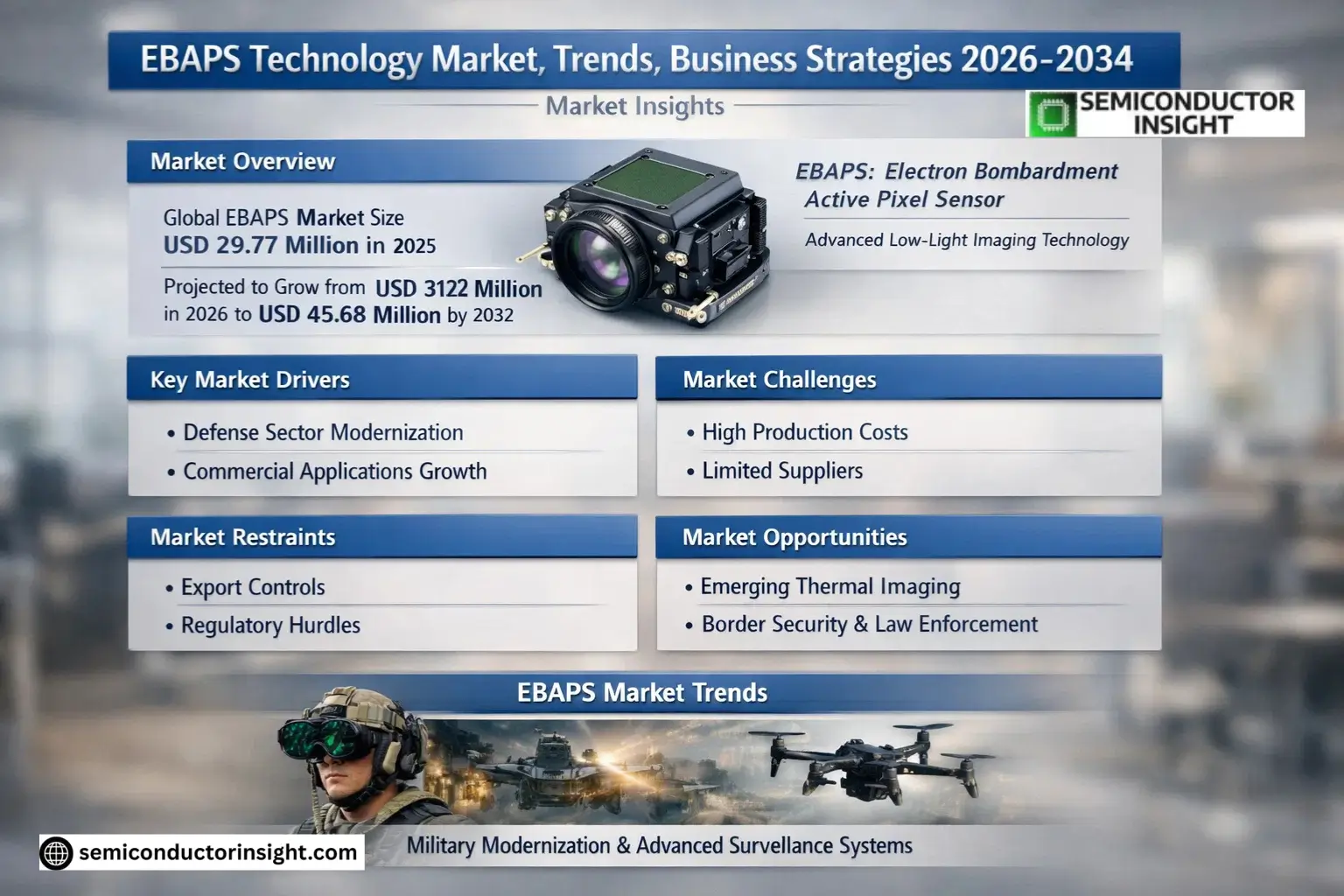
Global EBAPS Technology Market size was valued at USD 29.77 million in 2025. The market is projected to grow from USD 31.82 million in 2026 to USD 45.68 million by 2032, exhibiting a CAGR of 6.4% during the forecast period.
EBAPS (Electron Bombardment Active Pixel Sensor) technology is an advanced digital low-light imaging solution that integrates vacuum optoelectronics and solid-state semiconductor components. This hybrid system converts extremely weak light signals into high-quality digital video with exceptional sensitivity, rapid response times, and minimal power consumption. Its applications span military night vision systems, security surveillance infrastructure, and specialized scientific instrumentation requiring ultra-low-light detection capabilities.
Market expansion is primarily driven by defense sector modernization programs prioritizing all-weather reconnaissance capabilities and the security industry’s transition toward intelligent surveillance solutions. Technological convergence with AI-powered image processing algorithms further enhances performance in challenging environments, creating new opportunities across both defense and commercial sectors.
MARKET DRIVERS
Defense Sector Modernization Boosts EBAPS Demand
Global EBAPS Technology Market is experiencing significant growth due to increasing defense modernization programs. Governments worldwide are investing heavily in advanced imaging solutions, with EBAPS (Electron Bombarded Active Pixel Sensor) technology gaining traction for its superior low-light performance. The technology’s ability to provide high-resolution imaging in challenging conditions makes it indispensable for military applications.
Commercial Applications Expanding Market Reach
Beyond defense, EBAPS technology is finding new applications in commercial sectors such as medical imaging and industrial inspection. The growing demand for high-performance night vision in automotive safety systems and surveillance equipment is further propelling market expansion. Analysts project the EBAPS Technology Market to grow at an estimated 8.2% CAGR through 2028.
The integration of EBAPS with artificial intelligence for real-time image processing represents another significant driver, particularly in autonomous systems and smart city infrastructure.
MARKET CHALLENGES
High Production Costs Limit Market Penetration
Despite its advantages, EBAPS technology faces challenges from its complex manufacturing process and high production costs. The specialized materials and precise fabrication requirements make EBAPS sensors significantly more expensive than conventional CMOS alternatives. This price differential remains a barrier for price-sensitive applications and budget-constrained buyers.
Other Challenges
Technical Complexity and Limited Suppliers
EBAPS Technology Market is constrained by the limited number of qualified manufacturers capable of producing these sophisticated sensors. The highly specialized nature of the technology creates supply chain vulnerabilities and potential bottlenecks in meeting growing demand.
MARKET RESTRAINTS
Export Controls and Regulatory Hurdles
Stringent export controls, particularly on dual-use technologies, significantly impact the EBAPS Technology Market. Many countries impose strict regulations on the transfer of advanced imaging technologies, limiting international market expansion. Compliance with various national standards and certification requirements adds complexity to product development cycles and distribution strategies.
MARKET OPPORTUNITIES
Emerging Thermal Imaging Applications
EBAPS Technology Market stands to benefit from growing demand in thermal imaging applications across multiple sectors. Firefighting, law enforcement, and border security operations increasingly require the combination of high resolution and thermal sensitivity that EBAPS provides. Recent technological advancements have reduced power consumption while improving performance, opening new commercial possibilities.
EBAPS Technology Market Trends
Military Modernization Driving EBAPS Technology Adoption
The military sector remains the primary growth driver for EBAPS technology, accounting for over 60% of current market demand. Modern warfare requirements for all-weather surveillance and rapid response capabilities have accelerated deployment in soldier-mounted systems and UAV reconnaissance platforms. The technology’s ability to deliver sub-3-second startup with high-resolution imaging under 0.001 lux conditions provides critical tactical advantages in low-altitude security scenarios.
Other Trends
Civilian Security Applications Expanding
Urban surveillance systems are adopting EBAPS sensors at a 12% annual growth rate due to requirements for color imaging in near-total darkness. Integration with f/1.0 lenses enables border monitoring and critical infrastructure protection at illumination levels below starlight conditions. Security installations now represent 22% of the total EBAPS Technology Market.
Technological Convergence with AI Processing
Embedded neural network processors are being integrated with EBAPS sensors to enable real-time image enhancement and target recognition. This combination maintains imaging clarity in challenging light conditions such as direct glare or shadow transitions, opening new applications in autonomous vehicle navigation and smart city infrastructure. The industrial inspection segment is leveraging these capabilities for micron-level defect detection in semiconductor manufacturing.
Regional Market Developments
North America currently leads EBAPS technology deployment with 45% market share, driven by military modernization programs. The Asia-Pacific region is experiencing 8.2% annual growth as countries upgrade border surveillance systems. Europe’s market growth focuses on advanced industrial and scientific applications, particularly in semiconductor defect detection and astronomical observation systems.
COMPETITIVE LANDSCAPE
Key Industry Players
Electron Bombardment Active Pixel Sensor Market Dominated by Defense-Oriented Tech Giants
EBAPS Technology Market is characterized by high barriers to entry due to its specialized military applications and complex manufacturing processes. Intevac Photonics (EOTECH) leads the sector with proprietary wafer-scale EBAPS fabrication technology, holding approximately 38% of the global market share as of 2025. The industry structure is semi-consolidated with top five players controlling 72% of revenue, primarily serving defense contracts through stringent ITAR-regulated supply chains.
Emerging competitors are gaining traction by addressing commercial applications – Exosens has made significant strides in industrial inspection solutions, while Northern Night Vision focuses on compact modules for UAV platforms. Chinese manufacturers like NVT Photonics are challenging incumbents through government-backed R&D programs, though currently limited to domestic military procurement due to export restrictions.
List of Key EBAPS Technology Companies Profiled
- Intevac Photonics (EOTECH)
- Exosens
- Northern Night Vision
- Teledyne FLIR
- BAE Systems
- L3Harris Technologies
- Elbit Systems
- NVT Photonics
- Thales Group
- Safran
- Leonardo DRS
- Aselsan
- Raptor Photonics
- Spectral Instruments
- Photonis Technologies
Segment Analysis:
| Segment Category | Sub-Segments | Key Insights |
| By Type |
|
Military Grade dominates due to critical defense requirements:
|
| By Application |
|
Military Reconnaissance shows strongest adoption:
|
| By End User |
|
Defense Organizations represent the primary market:
|
| By Technology Integration |
|
AI-Enhanced Systems show strongest growth potential:
|
| By Product Form |
|
High Resolution models gaining traction:
|
Regional Analysis: EBAPS Technology Market
North America
The U.S. Department of Defense remains the largest consumer of EBAPS technology, with increasing demand for lightweight, high-resolution imaging in soldier systems and unmanned platforms. Contracts for next-generation vision systems consistently favor domestic EBAPS providers.
Non-defense applications are growing rapidly, particularly in border surveillance and critical infrastructure protection. EBAPS technology delivers superior performance in low-light industrial inspection where thermal alternatives prove insufficient.
Continuous improvements in EBAPS sensor resolution and power efficiency originate primarily from North American labs. Ongoing miniaturization efforts enable integration into wearable devices and small UAVs with strict size constraints.
Established semiconductor fabrication facilities and proximity to defense primes create a self-reliant EBAPS ecosystem. Strategic partnerships between material suppliers and system integrators reduce production bottlenecks.
Europe
Europe demonstrates strong EBAPS technology adoption, particularly in aerospace and naval applications. EU-funded defense initiatives prioritize night vision capabilities, driving procurement of advanced imaging systems. The region benefits from collaborative R&D programs across member states, though market fragmentation persists due to varying national security requirements. Civilian applications are gaining traction in transportation safety systems and industrial automation.
Asia-Pacific
The Asia-Pacific EBAPS market grows rapidly, fueled by expanding defense budgets and indigenous production initiatives. China and India lead regional adoption, focusing on technology transfer and domestic manufacturing capabilities. Commercial applications emerge in maritime surveillance and smart city infrastructure, though technological gaps compared to Western competitors remain.
Middle East & Africa
Middle Eastern nations invest heavily in EBAPS-equipped surveillance systems for border security and critical infrastructure protection. The African market remains nascent but shows potential in UN peacekeeping applications and natural resource monitoring. Region-specific challenges include harsh environmental conditions impacting sensor performance.
South America
South America’s EBAPS adoption focuses on counter-narcotics and border surveillance operations. Limited defense budgets constrain large-scale procurement, but regional cooperation agreements create shared technology access opportunities. Commercial mining operations drive demand for specialized inspection systems using EBAPS technology.
Report Scope
This market research report provides a comprehensive analysis of the EBAPS Technology Market , covering the forecast period 2025–2032. It offers detailed insights into market dynamics, technological advancements, competitive landscape, and key trends shaping the industry.
Key focus areas of the report include:
- Market Overview: The report begins with an overview outlining its current market scenario, key growth indicators, and industry transformation drivers. It discusses macroeconomic factors, demand–supply balance, regulatory landscape, and the strategic role of semiconductors in powering advancements across industries such as automotive, telecommunications, consumer electronics, and industrial automation.
- Market Size & Forecast: Historical data and future projections for revenue, unit shipments, and market value across major regions and segments.
- Segmentation Analysis: Detailed breakdown by product type, technology, application, and end-user industry to identify high-growth segments and investment opportunities.
- Regional Insights: Insights into market performance across North America, Europe, Asia-Pacific, Latin America, and the Middle East & Africa, including country-level analysis where relevant.
- Competitive Landscape: Profiles of leading market participants, including their product offerings, R&D focus, manufacturing capacity, pricing strategies, and recent developments such as mergers, acquisitions, and partnerships.
- Technology Trends & Innovation: Assessment of emerging technologies, integration of AI/IoT, semiconductor design trends, fabrication techniques, and evolving industry standards.
- Market Drivers & Restraints: Evaluation of factors driving market growth along with challenges, supply chain constraints, regulatory issues, and market-entry barriers.
- Stakeholder Insights: Insights for component suppliers, OEMs, system integrators, investors, and policymakers regarding the evolving ecosystem and strategic opportunities.
Primary and secondary research methods are employed, including interviews with industry experts, data from verified sources, and real-time market intelligence to ensure the accuracy and reliability of the insights presented.
FREQUENTLY ASKED QUESTIONS:
What is the current market size of EBAPS Technology Market?
-> EBAPS Technology Market size was valued at USD 29.77 million in 2025. The market is projected to grow from USD 31.82 million in 2026 to USD 45.68 million by 2032, exhibiting a CAGR of 6.4% during the forecast period.
Which key companies operate in EBAPS Technology Market?
-> Key players include Intevac Photonics (EOTECH), Exosens, and Northern Night Vision, among others.
What are the key growth drivers?
-> Key growth drivers include upgraded military needs for all-weather reconnaissance, expansion into civilian security applications, and technological integration with AI algorithms.
Which region dominates the market?
-> Global market segmentation shows significant adoption across North America, Europe, and Asia, with military and security applications driving regional demand.
What are the emerging trends?
-> Emerging trends include integration of EBAPS with neural networks for real-time image enhancement, development of starlight-level cameras, and applications in autonomous driving systems.
Get Sample Report PDF for Exclusive Insights
Report Sample Includes
- Table of Contents
- List of Tables & Figures
- Charts, Research Methodology, and more...
 Download Sample Report PDF



