Key Statistics
Key Takeaways
- Home Appliances are the largest source-page type segment, accounting for a stated 55% of recycled e-waste products. Refrigerators, TVs, air conditioners and washing machines generate bulky metal, plastic and glass streams and often require controlled handling of refrigerants, capacitors and other hazardous components.
- Refrigerator is identified as the most critical application because it combines valuable metals and plastics with refrigerants that require professional capture. This makes unit economics dependent on both recovered commodity value and compliant depollution rather than simple scrap weight.
- Europe is the largest market with a source-page share of 30%. The European Commission’s 2025 WEEE evaluation found that only about 40% of WEEE is recycled in the EU and nearly half of generated WEEE is still not collected, showing that even the most mature region retains a substantial formalization and recovery opportunity.
- Global feedstock continues to outgrow documented recycling. UNITAR’s Global E-waste Monitor reported 62 million tonnes of e-waste generated in 2022, with only 22.3% documented as properly collected and recycled; global generation is projected to reach 82 million tonnes by 2030.
- The source page’s 8.6% CAGR does not reconcile with its revenue anchors. USD 16.88 billion in 2025 and USD 29.59 billion in 2033 imply approximately 7.3% annual compound growth, so the anchor-derived rate is used for the 2026–2034 rebasing.
E-waste Recycling Market Overview
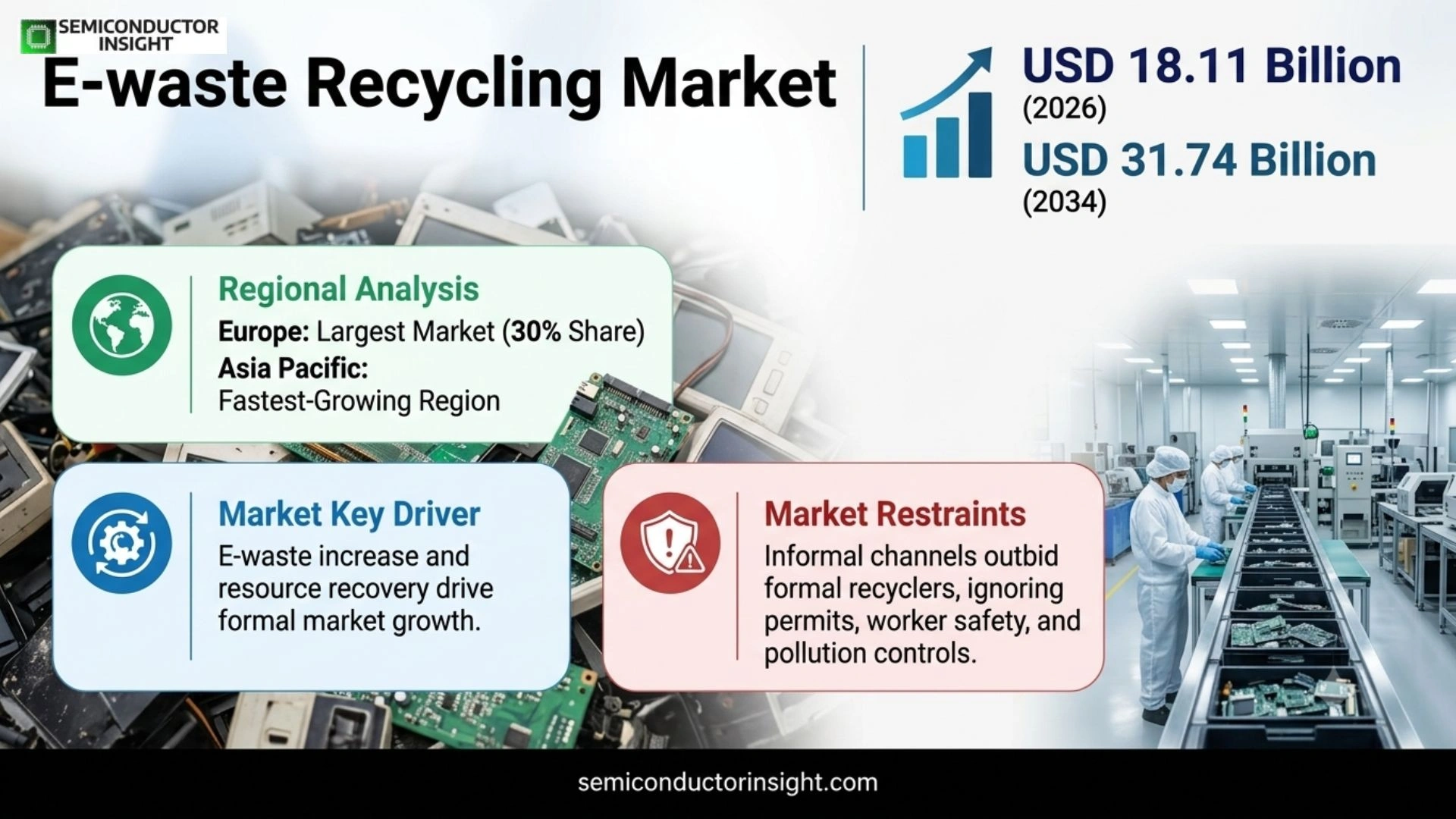
E-waste recycling market is rebased to USD 16.88 billion in 2025, increases to an estimated USD 18.11 billion in 2026, and is projected to reach USD 31.74 billion by 2034. The selected source-page size anchors imply a 7.3% CAGR during 2026–2034. Europe is the largest market in 2025 with the source page assigning the region a 30% share, while current demand is being reshaped by rapid e-waste generation, extended producer responsibility, Basel Convention controls on cross-border e-waste shipments, recovery of critical raw materials, certified IT asset disposition and the shift from basic dismantling toward automated separation and high-quality material recovery.
E-waste recycling converts discarded electrical and electronic equipment into reusable metals, plastics, glass, components and safely managed residues through collection, depollution, dismantling, shredding, sorting and metallurgical recovery. Commercial value is generated from processing fees, producer-responsibility contracts, IT asset disposition, data destruction and recovered materials. Because equipment mixes high-value copper and precious metals with hazardous chemicals and low-value fractions, profitable recycling depends on feedstock quality, collection cost and the ability to recover a broad material basket rather than one commodity alone.
The scale of the resource opportunity is large. UNITAR’s Global E-waste Monitor 2024 reported 62 million tonnes of e-waste generated worldwide in 2022 and only 22.3% documented as properly collected and recycled. The same work estimated metals embedded in that waste at about USD 91 billion in value, with documented recycling recovering only a portion of the resource. For recyclers, this gap represents both an addressable feedstock pool and a warning that collection, informal handling and illegal trade remain as important as processing technology.
Regulation is becoming more globally coordinated. Basel Convention e-waste amendments took effect on January 1, 2025, bringing both hazardous and non-hazardous international e-waste shipments under prior-informed-consent controls. In Europe, the Commission’s 2025 WEEE evaluation identified gaps in collection, critical-raw-material recovery, EPR harmonization and treatment quality. In the United States, EPA continues to promote R2 and e-Stewards certification and notes that 25 states plus the District of Columbia have electronics recycling legislation, reinforcing the role of auditable downstream management and data security.
Segment Analysis: By Type
The source page segments the market by waste type into Infocomm Technology (ICT) Equipment, Home Appliances and Other Types. Home Appliances are stated to dominate with 55% of recycled e-waste products because refrigerators, televisions, air conditioners and washing machines generate large recurring tonnage. ICT equipment is generally smaller by weight but often richer in printed circuit boards, precious metals and data-security requirements, giving it a distinct revenue profile.
| Type | Technical / commercial role | Market position |
|---|---|---|
| Home Appliances | Large household appliances contain steel, aluminum, copper, compressors, wiring, plastics, glass and—in refrigeration products—controlled gases or oils. Collection is logistics-intensive because units are bulky, but high mass yields predictable ferrous and non-ferrous recovery. Depollution equipment is required before shredding so refrigerants, capacitors and hazardous components do not contaminate downstream material streams. | Largest source-page segment with a stated 55% share of recycled products. Economic scale comes from large tonnage and established municipal or retailer take-back channels. Margin improves when facilities combine efficient logistics, automated shredding and strong downstream metal markets while capturing refrigerants compliantly. |
| Infocomm Technology (ICT) Equipment | Computers, servers, phones, networking devices and peripherals contain printed circuit boards, CPUs, memory, connectors and high-grade copper or precious-metal fractions. Corporate equipment also requires secure chain-of-custody and verified data destruction. Devices are lighter than appliances but can have substantially higher recoverable value per tonne if batteries and low-value housings are separated efficiently. | High-value growth segment. Cloud hardware refresh, enterprise IT asset disposition and device replacement create concentrated lots with known ownership. Certified recyclers can earn service revenue from inventory management and data destruction before material recovery, making the segment less dependent on commodity prices than appliance-only recycling. |
| Other Types | Other e-waste includes lighting, medical devices, tools, small consumer equipment, monitoring systems, photovoltaic electronics and specialized industrial products. Composition varies widely, so recyclers must identify hazardous components and route niche material streams to specialized downstream processors. Small devices can be collection-intensive despite high-value electronics content. | Fragmented opportunity. Commercial attractiveness depends on whether producer schemes or collection programs aggregate enough volume to overcome logistics. New digital and renewable-energy products also create future waste streams containing critical raw materials that conventional appliance-oriented plants may not be equipped to recover. |
Secondary segmentation: By End User
The source page identifies Individual Consumers, Businesses/Corporations and Government Entities. Businesses are described as the strongest-adopting end user because corporate sustainability, data protection and formal IT asset-disposition procedures make documented recycling a procurement requirement rather than an optional disposal choice. For e-waste recyclers, the commercial consequence is that documented feedstock, collection efficiency, treatment quality and recovered-material yield determine revenue quality more directly than the headline volume of discarded electronics.
| End user | Commercial characteristics |
|---|---|
| Individual Consumers | Household e-waste is dispersed across millions of owners and often remains stored, repaired, resold or sold into informal channels. Formal recyclers therefore depend on municipal collection, retailer take-back, deposit incentives and producer schemes. Acquisition cost per kilogram is generally higher than for bulk corporate lots, but consumer appliances provide large total tonnage. |
| Businesses / Corporations | Enterprises generate concentrated batches of computers, servers, networking equipment and office electronics with asset records. They require data erasure, chain-of-custody, serial-number reporting and sustainability documentation. These service requirements support higher-value ITAD contracts and give certified recyclers recurring relationships that are less exposed to spot scrap prices. |
| Government Entities | Public agencies, schools, hospitals and municipalities generate both ICT and appliance waste. Procurement is documentation-heavy and may require certified recyclers, secure data destruction and domestic downstream processing. Government collection programs also shape household access to formal recycling infrastructure. |
Secondary segmentation: By Material Recovery
The source page divides recovered output into Metals, Plastics, Glass and Hazardous Materials, with metals identified as the leading segment. Material recovery economics are uneven because metals create positive commodity value while hazardous fractions may impose treatment cost; high-quality recycling therefore depends on maximizing valuable separation without diverting problem fractions into uncontrolled disposal.
| Recovered material | Market implication |
|---|---|
| Metals | Ferrous steel, copper, aluminum, gold, silver, palladium and other metals form the economic core of e-waste recycling. UNITAR estimated 31 million tonnes of metals embedded in global 2022 e-waste and about USD 91 billion of total metal value. Advanced metallurgical recovery can retain more value than exporting mixed shredded fractions. |
| Plastics | Electronics plastics include ABS, HIPS, polycarbonate and flame-retarded formulations. Mixed additives can make mechanical recycling difficult. The EU-backed PLAST2bCLEANED project demonstrated dissolution-based recovery of clean polymers, bromine and antimony trioxide from hazardous WEEE plastics, showing a pathway toward higher-quality closed-loop reuse. |
| Glass | Displays, screens, lamps and appliance doors create glass streams with differing coatings and contaminants. Clean flat glass may have secondary uses, while leaded CRT or specialty display glass requires controlled treatment. Revenue is usually lower than metals, so collection and processing efficiency determine whether the fraction is recovered or becomes a disposal cost. |
| Hazardous Materials | Mercury, lead, brominated flame retardants, refrigerants and batteries require controlled removal and downstream treatment. These fractions can carry negative economic value but are central to the environmental service provided by formal recyclers. Regulatory compliance and worker protection therefore form part of the market’s value proposition. |
Secondary segmentation: By Service Type
The source page segments services into Collection Services, Recycling Processing and Data Destruction. Recycling processing is the largest operational service, while data destruction is a high-value add-on for corporate ICT streams. Collection determines feedstock utilization, so even sophisticated plants can remain underused if convenient take-back networks do not route devices into formal channels.
| Service type | Commercial role |
|---|---|
| Collection Services | Collection includes take-back, municipal drop-off, retailer programs, pickup, sorting and transport. It is often the most difficult part of the economics because devices are geographically dispersed and bulky appliances are expensive to move. Producer financing and route optimization can convert collection from a cost center into a reliable feedstock pipeline. |
| Recycling Processing | Processing covers depollution, dismantling, shredding, physical sorting and metallurgical recovery. Capital intensity increases as facilities adopt automated optical sorting, eddy-current separation, advanced hydrometallurgy and emission controls. Scale improves recovery yield and allows recyclers to process more complex fractions in-house instead of selling low-grade concentrates. |
| Data Destruction | Data destruction includes certified erasure, physical destruction and reporting for drives, phones and storage media. EPA notes that R2 and e-Stewards certification includes data-security practices. This service is particularly valuable for enterprises and governments because information risk can exceed the material value of the retired equipment. |
Segment Analysis: By Application
By application, the source page lists Refrigerator, TV Set, Air Conditioner and Washing Machine. Refrigerator recycling is identified as the most critical application because appliances contain valuable metals and plastics alongside refrigerants that require professional recovery. The application table therefore reflects major appliance streams rather than the full global range of computers, phones and small electronics.
| Application | Demand characteristics |
|---|---|
| Refrigerator | Refrigerators contain compressors, copper tubing, steel, aluminum, plastics, insulation foam and refrigerants. Formal treatment requires refrigerant and oil recovery before shredding. The combination of high material mass and environmental-control requirements creates a large service value per unit, while metals can offset depollution and transport costs when plants operate at scale. |
| TV Set | Televisions generate display glass, plastics, printed circuit boards and metal frames. Legacy CRT units may contain substantial lead, while modern flat-panel displays use different backlights and electronic boards. Recyclers need device-specific dismantling to separate hazardous display components from high-value circuit-board fractions and reusable plastics. |
| Air Conditioner | Air conditioners contain compressors, copper, aluminum heat exchangers, steel and refrigerants. Their high copper content can make them economically attractive, but uncontrolled refrigerant release creates substantial environmental risk. Formal recovery therefore combines commodity value with regulated gas capture and safe compressor handling. |
| Washing Machine | Washing machines are metal-intensive appliances containing steel drums, motors, wiring, electronics, plastics and sometimes concrete counterweights. Their composition is well suited to mechanical recycling after basic depollution, making logistics and plant throughput more important to profitability than precious-metal content. |
Broader equipment-stream relevance
The source application list is appliance-centric, but the market definition also explicitly includes computers, smartphones and televisions. A reliable global analysis therefore distinguishes large appliances, ICT equipment and small electronics because each produces different material value, collection behavior and treatment requirements. This distinction matters because the same device can create positive value through metals and reuse while also imposing cost through batteries, refrigerants, flame retardants or other hazardous fractions that must be handled safely.
| Equipment stream | Recycling economics |
|---|---|
| Large Appliances | High mass and relatively standardized construction make mechanical processing efficient, but collection and depollution are expensive. Retailer take-back and municipal systems are particularly important because consumers cannot easily transport large units independently. |
| ICT & Data-Center Equipment | Servers, network devices, computers and drives produce concentrated corporate lots with valuable boards and metals. Data-security requirements create fee-based services in addition to material recovery, and rapid technology refresh can make this stream especially attractive to certified recyclers. |
| Small Consumer Electronics | Phones, tablets, wearables and accessories can contain high-value metals per kilogram but are difficult to collect because users store devices or discard them in household waste. Convenient return programs and battery-safe handling determine whether this theoretically valuable feedstock reaches formal recyclers. |
Regional Analysis
The source page identifies Europe as the largest market with a 30% share and Asia Pacific as the fastest-growing region. Europe’s lead is grounded in long-standing WEEE regulation and collection infrastructure, but official 2025 Commission evaluation still found major gaps: nearly half of generated WEEE is not collected, only about 40% is recycled, and only about 23% of facilities implement high-quality treatment standards.
How do regulation, collection systems and informal activity shape regional e-waste economics?
Europe has the most mature producer-responsibility framework and formal infrastructure. North America relies on state and provincial programs plus private certification. Asia Pacific combines the fastest electronics consumption growth with both advanced systems in Japan and Korea and substantial informal activity in emerging markets. South America and MEA are expanding formal rules but still face collection and infrastructure gaps, making feedstock capture the main regional constraint.
| Region | Position | Growth outlook | Demand profile | What decides supplier selection |
|---|---|---|---|---|
| Europe | Largest – 30% source-page share | Moderate to high | Regulation, EPR and critical-material recovery-led | Collection rate, treatment quality and secondary-material value |
| North America | Large mature market | Moderate to high | Corporate ITAD, state programs and certified recycling-led | Data security, certification and downstream traceability |
| Asia Pacific | Fastest-growing | High | Electronics consumption and formalization-led | Collection, informal competition and technology scale |
| South America | Emerging | High from small base | EPR and municipal infrastructure-led | Collection economics and domestic processing capacity |
| Middle East & Africa | Early-stage | High from small base | Device growth and policy development-led | Formal collection, worker safety and cross-border controls |
Competitive Landscape
The source page describes a fragmented industry with the top five players holding about 15% share. It profiles global recyclers, ITAD specialists, metal refiners and regional operators, so competitive strength depends on service mix and geography rather than one standardized technology. The source roster is retained, while the analysis distinguishes processing scale, precious-metal capability and corporate ITAD expertise.
Sims Recycling Solutions and Electronic Recyclers International compete strongly in corporate electronics and IT asset disposition, where nationwide collection, serialized asset management, data destruction and certified downstream processing are critical. These businesses can earn service fees before material recovery, reducing dependence on metal prices and differentiating them from commodity scrap processors.
Umicore competes at the high-value metallurgical end of the chain. Its e-scrap business accepts printed circuit boards, phones, CPUs, connectors and shredded PCB-rich fractions and recovers gold, silver, palladium and copper through advanced refining. This makes Umicore an important downstream partner even when it does not collect consumer appliances directly.
Kuusakoski, Stena Metall, Veolia, GEM, Dongjiang Environmental, Electrocycling, E-Parisaraa and other regional players combine collection, mechanical processing and material recovery in different markets. The top-five concentration figure of only about 15% is credible for a sector where municipal programs, producer schemes, scrap traders and specialized downstream refiners all participate in different stages.
| Competitive tier | Companies | Why they matter |
|---|---|---|
| Global integrated recyclers / ITAD leaders | Sims Recycling Solutions; Electronic Recyclers International; Stena Metall Group; Veolia Environnement | These firms combine collection, enterprise services, processing and certified downstream networks across multiple regions. Their advantage is customer trust, logistics scale and the ability to handle complex compliance requirements rather than one proprietary separation technology. |
| Advanced metallurgical / resource recovery specialists | Umicore; GEM Co., Ltd.; Dongjiang Environmental | These companies capture value from precious and strategic metals through advanced downstream processing. They are especially important for circuit boards and high-grade fractions where sampling, assay, hydrometallurgy or pyrometallurgy determine recovery yield. |
| Regional and specialized processors | Kuusakoski Group; GEEP; Electrocycling GmbH; Cimelia Resource Recovery; Enviro-Hub Holdings; E-Parisaraa; environCom; Waste Management | These participants address regional collection, appliance processing, corporate electronics or municipal streams. Their competitive position depends on local permits, feedstock contracts, collection reach and access to qualified downstream refiners. |
Companies profiled in the report
The source page profiles Sims Recycling Solutions, Electronic Recyclers International, Kuusakoski Group, Umicore, Waste Management, Inc., GEM Co., Ltd., Stena Metall Group, GEEP (Global Electric Electronic Processing), Dongjiang Environmental, Electrocycling GmbH, Cimelia Resource Recovery, Veolia Environnement, Enviro-Hub Holdings Ltd., E-Parisaraa Pvt. Ltd. and environCom. This distinction matters because the same device can create positive value through metals and reuse while also imposing cost through batteries, refrigerants, flame retardants or other hazardous fractions that must be handled safely.
Production Capacity Analysis: Recycling Infrastructure & Processing Capacity
Conventional production capacity is not the relevant metric for recycling; effective capacity is the tonnes of feedstock that can be collected, depolluted, dismantled, mechanically separated and refined under environmental and data-security standards. A plant can have large installed shredding capacity but remain underutilized if collection networks fail to secure formal feedstock, while a smaller ITAD facility can generate high revenue through data services and resale before recycling.
Collection is the first capacity constraint. UNITAR’s 22.3% documented global recycling rate shows that most e-waste never reaches formal plants. Recyclers therefore invest in producer take-back, municipal partnerships, corporate pickup, reverse logistics and aggregation. Increasing plant throughput without improving collection can simply intensify competition for the same documented feedstock. Buyers and producers therefore evaluate chain-of-custody, environmental compliance, data security, material recovery and downstream transparency rather than treating electronics recycling as a simple commodity scrap transaction.
Mechanical-processing capacity includes depollution stations, shredders, magnetic separation, eddy-current systems, optical sorters and density separation. Large appliance streams can be processed at high tonnage, while mixed electronics require more manual preprocessing to protect batteries, hazardous components and high-grade circuit boards. Automated sorting raises capital requirements but can improve material purity and downstream value.
Metallurgical capacity determines how much value remains with the recycler. Umicore’s e-scrap business processes concentrated PCB and precious-metal-bearing fractions through advanced refining, while newer projects target hazardous plastics and critical-material recovery. Facilities that only shred and sell mixed concentrate capture less margin than integrated operators able to recover saleable metals or polymers at high purity.
Market Dynamics
The market is driven by rising electronic waste, EPR, certified asset disposition and urban mining, but growth is restrained by weak collection, informal competition, hazardous-material complexity and commodity volatility. The commercial challenge is to make formal recycling economically attractive enough that devices flow into auditable systems before valuable fractions are cherry-picked or exported informally.
Market Drivers
| Driver | Directional impact* | Commercial mechanism |
|---|---|---|
| Rising e-waste generation | High | UNITAR reported 62 million tonnes in 2022 and projects 82 million tonnes by 2030. More devices create a growing feedstock pool for collection and processing. |
| Producer responsibility & regulation | High | WEEE, state laws, EPR and Basel controls create funded or mandatory formal channels and improve downstream traceability. |
| Corporate ITAD & data security | Medium to High | Enterprises require secure erasure, chain-of-custody and certified recycling, generating service revenue in addition to recovered material value. |
| Critical-material recovery | Medium to High | Copper, precious metals and critical raw materials increase the strategic and economic value of high-quality recycling and urban mining. |
E-waste generation is growing faster than formal recycling
UNITAR estimated global e-waste rising by about 2.6 million tonnes per year and reaching 82 million tonnes by 2030. Documented recycling is not keeping pace, so the market has a large structural feedstock opportunity. The challenge is converting physical waste growth into formal collected tonnes through convenient and financed return systems.
Regulation creates recurring financed demand
Extended producer responsibility shifts end-of-life cost toward manufacturers and creates collection or recycling obligations. The WEEE Directive, U.S. state programs and similar systems allow formal recyclers to compete on compliance value rather than scrap price alone. Basel shipment controls also raise the cost of uncontrolled cross-border disposal and reward documented downstream chains.
Corporate data risk raises ITAD value
A retired server or laptop can contain information worth far more than its metal content. Enterprises therefore pay for serial-number tracking, certified erasure, physical destruction and documented downstream processing. EPA’s recognition of R2 and e-Stewards reinforces data-security requirements as part of responsible electronics recycling, creating a high-margin service layer. Through 2034, operators that combine collection scale with certified ITAD and advanced resource recovery can capture more value per tonne while improving the share of electronics that move through formal documented channels.
Urban mining links recycling to resource security
Electronics contain copper, gold, palladium and critical materials whose primary supply is concentrated geographically. Europe’s WEEE review and Circular Economy Act work increasingly connect recycling with strategic autonomy. Recyclers that recover high-purity materials can therefore participate in industrial supply policy, not just waste management. The market implication is that installed processing equipment does not create revenue when devices remain stored, exported informally or diverted before high-value and hazardous fractions reach a compliant facility.
Market Restraints
| Restraint | Directional impact* | Commercial mechanism |
|---|---|---|
| Informal-sector competition | High | Informal collectors can pay aggressively for high-value devices while avoiding environmental, labor and documentation costs, reducing feedstock available to formal plants. |
| Collection and logistics | High | Small devices are dispersed and appliances are bulky. Transport cost can erase commodity value before material reaches a recycler. |
| Complex hazardous composition | Medium to High | Batteries, mercury, refrigerants, flame retardants and mixed polymers require special treatment, increasing capital and worker-safety costs. |
| Commodity-price volatility | Medium | Copper, steel, aluminum and precious-metal prices influence recovered-value margins and what recyclers can afford to pay for feedstock. |
Informal channels can outbid compliant recyclers
Formal operators pay for permits, worker protection, pollution controls, data security and safe downstream disposal. Informal processors may avoid those costs and cherry-pick copper or circuit boards while discarding hazardous residues. This creates structural price pressure unless regulation is enforced and producer-responsibility financing compensates formal systems for full treatment. For e-waste recyclers, the commercial consequence is that documented feedstock, collection efficiency, treatment quality and recovered-material yield determine revenue quality more directly than the headline volume of discarded electronics.
Collection economics remain difficult
A smartphone may contain valuable metals but weighs very little, while a refrigerator contains substantial material but is expensive to transport. The collection model must therefore match product characteristics. Drop-off points, retailer take-back, scheduled pickups and corporate aggregation all solve different logistics problems, making one universal channel inefficient. This distinction matters because the same device can create positive value through metals and reuse while also imposing cost through batteries, refrigerants, flame retardants or other hazardous fractions that must be handled safely.
E-waste composition keeps changing
Electronics combine adhesives, batteries, flame retardants, miniaturized components and new material systems. A line optimized for older televisions may not efficiently process thin displays, wearables or battery-rich devices. Recyclers need flexible dismantling and sorting while maintaining worker safety as product designs evolve. Buyers and producers therefore evaluate chain-of-custody, environmental compliance, data security, material recovery and downstream transparency rather than treating electronics recycling as a simple commodity scrap transaction.
Recovered-material prices can weaken margins
Formal recyclers depend partly on copper, aluminum, steel and precious-metal values. A commodity downturn can reduce settlement revenue immediately while labor, transport and compliance costs remain fixed. Service fees, producer contracts and ITAD revenue therefore provide important margin diversification. Through 2034, operators that combine collection scale with certified ITAD and advanced resource recovery can capture more value per tonne while improving the share of electronics that move through formal documented channels.
Market Opportunities
Critical raw materials recovery
The EU is explicitly linking WEEE reform with copper, rare-earth, gallium, germanium and tungsten recovery. Advanced sampling, separation and metallurgy can capture more strategic value from electronics and support domestic manufacturing supply chains. The market implication is that installed processing equipment does not create revenue when devices remain stored, exported informally or diverted before high-value and hazardous fractions reach a compliant facility.
High-quality WEEE plastics recycling
The PLAST2bCLEANED process demonstrates that hazardous flame-retarded plastics can be separated into reusable polymers and recovered bromine or antimony compounds. Commercial scale-up could turn a costly residue into a secondary-material revenue stream while reducing incineration or disposal. For e-waste recyclers, the commercial consequence is that documented feedstock, collection efficiency, treatment quality and recovered-material yield determine revenue quality more directly than the headline volume of discarded electronics.
Certified IT asset disposition
Corporate server, storage and networking refresh cycles create high-value lots with strong data-security needs. Recyclers that combine reuse, resale, erasure and material recovery can earn multiple revenue streams and secure recurring enterprise contracts. This distinction matters because the same device can create positive value through metals and reuse while also imposing cost through batteries, refrigerants, flame retardants or other hazardous fractions that must be handled safely.
Digital traceability and product passports
Digital product information can improve knowledge of batteries, hazardous additives and material content before dismantling. As product-passport requirements expand, recyclers can use component-level data to route devices more safely and increase recovery yield. Buyers and producers therefore evaluate chain-of-custody, environmental compliance, data security, material recovery and downstream transparency rather than treating electronics recycling as a simple commodity scrap transaction.
Supply Chain Analysis
Device generation & take-back
Collection, sorting & depollution
Mechanical separation & upgrading
Metallurgical refining & secondary-material return
Device generation & take-back
Households, enterprises, governments and manufacturers generate obsolete electronics. Producer schemes, retailers, municipalities and corporate ITAD programs determine whether devices enter formal collection or remain stored, resold or diverted into informal scrap channels. Through 2034, operators that combine collection scale with certified ITAD and advanced resource recovery can capture more value per tonne while improving the share of electronics that move through formal documented channels.
Collection, sorting & depollution
Facilities aggregate equipment, remove batteries, refrigerants, lamps, mercury devices and other hazards, then separate reusable assets from recycling feedstock. Safe preprocessing protects workers and prevents valuable fractions from being contaminated during shredding. The market implication is that installed processing equipment does not create revenue when devices remain stored, exported informally or diverted before high-value and hazardous fractions reach a compliant facility.
Mechanical separation & upgrading
Shredders, magnets, eddy-current systems, optical sorting and manual quality control produce ferrous, non-ferrous, plastic, glass and PCB-rich fractions. Purity at this stage determines whether downstream refiners pay a premium or discount material for contamination. For e-waste recyclers, the commercial consequence is that documented feedstock, collection efficiency, treatment quality and recovered-material yield determine revenue quality more directly than the headline volume of discarded electronics.
Metallurgical refining & secondary-material return
Pyrometallurgy, hydrometallurgy and specialized polymer processes recover saleable metals and materials. Refined outputs re-enter electronics, metal or plastics supply chains, while hazardous residues go to controlled treatment. The highest-value recyclers manage both physical recovery and auditable material provenance. This distinction matters because the same device can create positive value through metals and reuse while also imposing cost through batteries, refrigerants, flame retardants or other hazardous fractions that must be handled safely.
Recent Developments
Recent developments show e-waste policy shifting toward higher-quality recovery, digital traceability and tighter cross-border controls. The most relevant evidence comes from regulators and public research because these changes reshape feedstock availability and treatment requirements across the entire recycling industry. Buyers and producers therefore evaluate chain-of-custody, environmental compliance, data security, material recovery and downstream transparency rather than treating electronics recycling as a simple commodity scrap transaction.
July 10, 2026 — EU JRC identified priority waste streams for critical raw material recovery
The European Commission’s Joint Research Centre published a 2026 factsheet identifying waste streams with meaningful recovery potential for strategic and critical raw materials under the Critical Raw Materials Act. The work supports national circularity measures and strengthens the policy case for recovering high-value materials from electronics rather than treating WEEE only as bulk waste.
April 30, 2026 — European Commission advanced Circular Economy Act discussions
The Commission’s final stakeholder workshop for the forthcoming Circular Economy Act considered measures to reduce dependence on critical-raw-material imports, simplify secondary-material regulation and improve access to circular feedstocks. The process follows the WEEE Directive evaluation and could materially affect electronics collection, recovery standards and secondary-material demand. Through 2034, operators that combine collection scale with certified ITAD and advanced resource recovery can capture more value per tonne while improving the share of electronics that move through formal documented channels.
January 22, 2026 — EU highlighted hazardous WEEE plastics recovery technology
The European Commission reported progress from the PLAST2bCLEANED project, which uses dissolution to recover clean polymers, bromine and antimony trioxide from flame-retarded WEEE plastics. The technology addresses a difficult low-value fraction and demonstrates how higher-quality processing can create circular feedstocks from material that previously faced hazardous-waste constraints. The market implication is that installed processing equipment does not create revenue when devices remain stored, exported informally or diverted before high-value and hazardous fractions reach a compliant facility.
January 1, 2025 — Basel Convention e-waste shipment amendments took effect
Basel Convention amendments brought international shipments of both hazardous and non-hazardous covered e-waste and scrap under prior-informed-consent controls. EPA guidance explains that importing and transit countries must provide written consent, increasing compliance requirements for recyclers that rely on cross-border downstream processing or export of electronic scrap. For e-waste recyclers, the commercial consequence is that documented feedstock, collection efficiency, treatment quality and recovered-material yield determine revenue quality more directly than the headline volume of discarded electronics.
Report Scope & Segmentation
| Attribute | Coverage |
|---|---|
| Market | E-waste Recycling |
| Base Year | 2025 |
| Estimated Year | 2026 |
| Forecast Period | 2026–2034 |
| 2025 Market Size | USD 16.88 billion |
| 2034 Forecast Size | USD 31.74 billion |
| CAGR | 7.3% (2026–2034) |
| Largest Market in 2025 | Europe |
| By Type | Infocomm Technology (ICT) Equipment; Home Appliances; Other Types |
| By Application | Refrigerator; TV Set; Air Conditioner; Washing Machine |
| By End User | Individual Consumers; Businesses/Corporations; Government Entities |
| By Material Recovery | Metals; Plastics; Glass; Hazardous Materials |
| By Service Type | Collection Services; Recycling Processing; Data Destruction |
| Regions | Europe; North America; Asia Pacific; South America; Middle East & Africa |
| Companies Profiled | Sims Recycling Solutions; Electronic Recyclers International; Kuusakoski Group; Umicore; Waste Management, Inc.; GEM Co., Ltd.; Stena Metall Group; GEEP (Global Electric Electronic Processing); Dongjiang Environmental; Electrocycling GmbH; Cimelia Resource Recovery; Veolia Environnement; Enviro-Hub Holdings Ltd.; E-Parisaraa Pvt. Ltd.; environCom |
Frequently Asked Questions
What is the E-waste Recycling market size in 2025?
The source page publishes a 2025 market size of USD 16.88 billion, so that base-year figure is preserved exactly. Using the page’s USD 29.59 billion 2033 endpoint implies a 2026 estimate of approximately USD 18.11 billion and a rebased 2034 market size of approximately USD 31.74 billion. This distinction matters because the same device can create positive value through metals and reuse while also imposing cost through batteries, refrigerants, flame retardants or other hazardous fractions that must be handled safely.
What is the projected E-waste Recycling market size by 2034?
The rebased 2034 market is approximately USD 31.74 billion. This extends the source page’s 2025–2033 market-size anchors by one year using the compound annual rate implied by the endpoints, keeping the requested 2025 base, 2026 estimate and 2034 forecast internally consistent. Buyers and producers therefore evaluate chain-of-custody, environmental compliance, data security, material recovery and downstream transparency rather than treating electronics recycling as a simple commodity scrap transaction.
Why is the CAGR 7.3% instead of the page’s 8.6%?
USD 16.88 billion in 2025 and USD 29.59 billion in 2033 imply approximately 7.27% compound annual growth over eight years, not 8.6%. Under the validation workflow, the two published market-size anchors control when the printed CAGR does not mathematically reconcile. Through 2034, operators that combine collection scale with certified ITAD and advanced resource recovery can capture more value per tonne while improving the share of electronics that move through formal documented channels.
Which e-waste type leads the market?
The source page identifies Home Appliances as the largest type and states that they account for 55% of recycled e-waste products. Refrigerators, televisions, air conditioners and washing machines generate large material tonnage and require specialized handling of metals, plastics, glass and hazardous components. The market implication is that installed processing equipment does not create revenue when devices remain stored, exported informally or diverted before high-value and hazardous fractions reach a compliant facility.
Which application is the most important?
The source page identifies Refrigerator recycling as especially important because it combines valuable recoverable metals and plastics with refrigerants that require professional handling. This creates both material value and a regulated depollution service that informal recycling cannot safely provide. For e-waste recyclers, the commercial consequence is that documented feedstock, collection efficiency, treatment quality and recovered-material yield determine revenue quality more directly than the headline volume of discarded electronics.
Which region leads the global market?
Europe is the largest region with a source-page share of 30%. Long-standing WEEE legislation and producer responsibility support collection and formal processing, although the European Commission’s 2025 evaluation found that collection and high-quality material recovery still fall short of policy targets. This distinction matters because the same device can create positive value through metals and reuse while also imposing cost through batteries, refrigerants, flame retardants or other hazardous fractions that must be handled safely.
How large is the global e-waste problem?
UNITAR’s Global E-waste Monitor reported 62 million tonnes of e-waste generated worldwide in 2022, with only 22.3% documented as properly collected and recycled. Global generation is projected to reach 82 million tonnes by 2030, creating a growing feedstock and environmental-management challenge. Buyers and producers therefore evaluate chain-of-custody, environmental compliance, data security, material recovery and downstream transparency rather than treating electronics recycling as a simple commodity scrap transaction.
What is the main market restraint?
The biggest structural restraint is weak formal collection combined with informal competition. Valuable devices can be diverted before reaching compliant plants, while bulky appliances are expensive to transport. Formal recyclers therefore need producer financing, convenient take-back and strong enforcement in addition to processing technology. Through 2034, operators that combine collection scale with certified ITAD and advanced resource recovery can capture more value per tonne while improving the share of electronics that move through formal documented channels.
Who are the major companies profiled?
The source page profiles Sims Recycling Solutions, Electronic Recyclers International, Kuusakoski, Umicore, Waste Management, GEM, Stena Metall, GEEP, Dongjiang Environmental, Electrocycling, Cimelia Resource Recovery, Veolia, Enviro-Hub, E-Parisaraa and environCom. The market implication is that installed processing equipment does not create revenue when devices remain stored, exported informally or diverted before high-value and hazardous fractions reach a compliant facility.
What is the strongest strategic opportunity through 2034?
The strongest opportunity is higher-value urban mining: recovering critical and precious materials, improving WEEE plastics recycling and combining certified ITAD with data destruction. These services can raise revenue per tonne and reduce dependence on volatile bulk scrap prices while supporting circular-economy and resource-security goals. For e-waste recyclers, the commercial consequence is that documented feedstock, collection efficiency, treatment quality and recovered-material yield determine revenue quality more directly than the headline volume of discarded electronics.
Get Sample Report PDF for Exclusive Insights
Report Sample Includes
- Table of Contents
- List of Tables & Figures
- Charts, Research Methodology, and more...
 Download Sample Report PDF