MARKET INSIGHTS
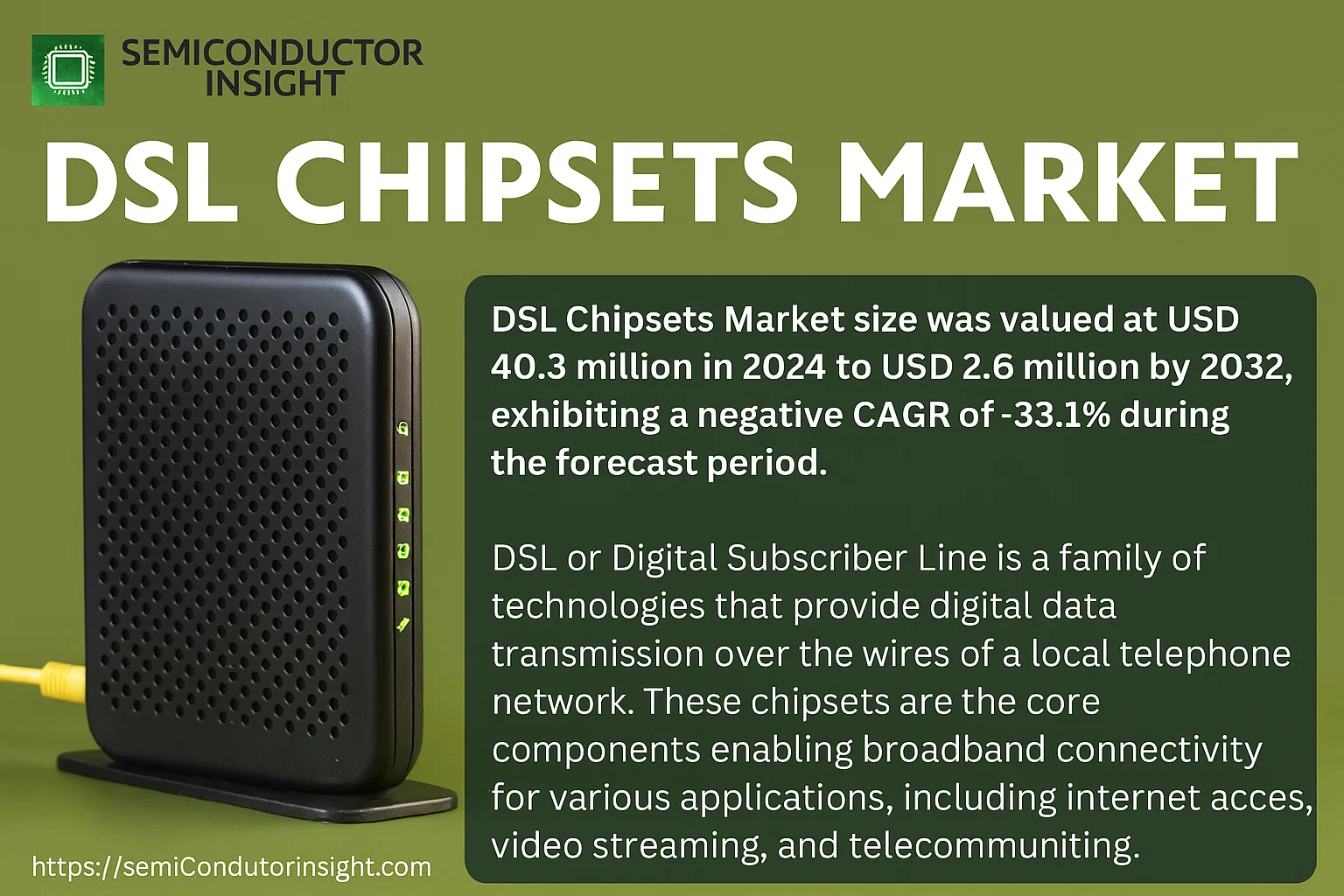
Global DSL Chipsets Market size was valued at USD 40.3 million in 2024 to USD 2.6 million by 2032, exhibiting a negative CAGR of -33.1% during the forecast period.
DSL or Digital Subscriber Line is a family of technologies that provide digital data transmission over the wires of a local telephone network. These chipsets are the core components enabling broadband connectivity for various applications, including internet access, video streaming, and telecommuting.
The market is experiencing a significant contraction due to several factors, primarily the rapid migration towards fiber-optic networks (FTTH) and advanced wireless solutions like 5G fixed wireless access, which offer superior speed and reliability. However, DSL technology continues to serve as a critical broadband solution in regions where fiber deployment is not yet economically feasible. The competitive landscape is highly concentrated; the top two players, Broadcom (Avago) and Intel (Lantiq), hold a combined market share of approximately 96%. North America is the largest production hub with around 42% share, while Asia-Pacific represents the largest consumption market with about 26% share.
MARKET DRIVERS
Surge in Global Demand for High-Speed Broadband
The persistent global demand for higher internet speeds, driven by bandwidth-intensive applications like 4K/8K video streaming, online gaming, and remote work infrastructure, is a primary driver for the DSL chipsets market. Telecommunications operators are upgrading their existing copper line infrastructures using advanced DSL technologies such as G.fast and VDSL2 Vectoring to deliver fiber-like speeds, thereby prolonging the economic life of their networks and fueling demand for next-generation chipsets.
Cost-Effective Network Upgrades
Compared to the high capital expenditure required for full fiber-to-the-home (FTTH) deployments, upgrading existing copper networks with advanced DSL technologies represents a significantly more cost-effective solution for many service providers. This economic advantage is particularly strong in suburban and semi-rural areas, driving sustained investment in and deployment of modern DSL chipsets that support multi-gigabit speeds over short copper loops.
Furthermore, the standardization of technologies like G.mgfast, which promises multi-gigabit symmetric speeds, ensures a clear roadmap for DSL evolution, providing manufacturers and operators with the confidence to continue investing in DSL chipset development and deployment.
MARKET CHALLENGES
Intense Competition from Fiber and Wireless Alternatives
DSL chipsets market faces significant competitive pressure from the rapid global rollout of fiber optic networks and the emergence of 5G Fixed Wireless Access (FWA). As fiber offers superior bandwidth and latency, and 5G FWA provides a wireless alternative for last-mile connectivity, the value proposition of DSL is being challenged, particularly in new build-outs and competitive urban markets.
Other Challenges
Distance and Quality Limitations
The performance of DSL technology is intrinsically limited by the length and quality of the copper line. Signal degradation over distance means that the highest speeds are only achievable over very short loops, constraining its application and pushing operators toward fiber for long-term planning.
Technological Fragmentation and Standardization Delays
The market must navigate a complex landscape of different DSL standards (ADSL2+, VDSL2, G.fast, G.mgfast) and profiles. Delays in the finalization and interoperability testing of new standards can slow down product development cycles and market adoption, creating uncertainty for chipset vendors.
MARKET RESTRAINTS
Long-Term Shift Towards Fiber Optic Infrastructure
The overarching long-term trend in telecommunications is the migration from copper-based networks to all-fiber infrastructure. National broadband plans and significant government funding in regions like North America, Europe, and Asia-Pacific are prioritizing FTTH/FTTP deployments. This strategic shift represents a fundamental restraint on the long-term growth potential of the DSL chipsets market, as it is increasingly viewed as an interim rather than a permanent solution.
Maturity and Price Erosion in Core Markets
The market for basic ADSL/VDSL chipsets is highly mature, leading to intense price competition and margin pressure for semiconductor manufacturers. While advanced chipsets for G.fast command higher prices, the overall volume in this segment is smaller, and the total available market for DSL chipsets is contracting in many developed regions.
MARKET OPPORTUNITIES
Hybrid Fiber-Copper Deployments
A significant opportunity lies in hybrid network architectures that combine fiber backhaul with DSL for the final drop. Technologies like Fiber-to-the-Distribution-Point (FTTdp) or Fiber-to-the-Curb (FTTC) leverage advanced DSL chipsets to deliver high speeds without the cost of full fiber trenching to each premises. This approach is particularly attractive for maximizing the return on existing copper assets.
Emerging Markets and MDU Deployments
In many emerging economies, the cost of ubiquitous FTTH deployment remains prohibitive. DSL technology offers a more affordable path to rapidly expand broadband access. Additionally, Multi-Dwelling Units (MDUs) and business parks present a strong use case for G.fast and similar technologies, where short copper runs within a building can deliver very high speeds efficiently, creating a niche but viable market segment.
Power Efficiency and Sustainability
There is a growing focus on developing more power-efficient DSL chipsets to reduce the operational expenditure for operators and meet stricter environmental regulations. Chipsets that offer superior performance per watt present a compelling product differentiation and align with the broader industry goals of sustainability, opening up opportunities for innovation-led growth.
DSL Chipsets Market Trends
Market Contraction and Regional Shifts
Global DSL Chipsets market is undergoing a significant phase of transition, characterized by a projected market contraction. After being valued at US$ 40.3 million in 2024, the market is forecast to decline to US$ 2.6 million by 2032, representing a compound annual growth rate (CAGR) of -33.1%. This sharp decline is primarily driven by the aggressive global rollout of fiber-optic infrastructure and the increasing adoption of wireless broadband technologies, which offer superior speeds and bandwidth. Despite this overarching trend, the market dynamics reveal important regional variations and shifts in application demand.
Other Trends
Dominant Players and Production Hubs
The competitive landscape of the DSL chipsets market is highly concentrated, with the top two players, Broadcom (Avago) and Intel (Lantiq), collectively holding approximately 96% of the market share. This indicates significant barriers to entry and a mature, consolidated supplier base. Geographically, North America stands as the largest production hub, accounting for around 42% of global output, followed closely by Europe with a 39% share and Japan with 7%. This production footprint reflects historical strengths in semiconductor manufacturing within these regions.
Application and Technology Segmentation
The market is segmented by type, primarily into ADSL, VDSL, and the newer G.fast standards. G.fast technology, designed to deliver fiber-like speeds over existing copper lines, represents a key development area intended to extend the life of copper infrastructure in the face of fiber competition. In terms of application, the DSL chipsets market is segmented into key areas such as Internet Access & File Sharing, Video Streaming, Telecommuting, Online Education & Shopping, Telemedicine, and Online Gaming. The demand from these applications, particularly video and telecommuting, has historically driven the need for stable and widely available broadband access that DSL provides.
Asia-Pacific Emerges as Key Consumption Region
While production is concentrated in North America and Europe, the Asia-Pacific region represents the largest consumption market for DSL chipsets, holding about 26% of the global market share. This is followed by North America at 23% and Europe at 18%. The significant market share in Asia-Pacific is attributed to the extensive existing copper line infrastructure and ongoing demand for cost-effective broadband solutions in many developing economies within the region. This regional consumption pattern underscores the differing stages of telecom infrastructure development globally, with some regions continuing to rely on DSL as a primary broadband technology while others transition more rapidly to fiber and 5G fixed wireless access.
COMPETITIVE LANDSCAPE
Key Industry Players
A Market Dominated by a Select Few Through Technological Prowess
Global DSL chipsets market is characterized by an exceptionally high level of concentration, with the top two players, Broadcom (following its acquisition of Avago) and Intel (through its acquisition of Lantiq), collectively commanding a staggering share of approximately 96%. This duopoly is a result of intense consolidation within the semiconductor industry and the significant research and development investments required to advance DSL technologies, such as VDSL and G.fast, which deliver higher data rates over existing copper telephone lines. These leading companies leverage their extensive patent portfolios, global scale, and deep relationships with major telecommunications equipment manufacturers to maintain their dominant positions. Their strategies are increasingly focused on integrating DSL technology with other connectivity solutions like Wi-Fi and fiber extension (G.fast) to offer comprehensive customer premises equipment (CPE) platforms.
Beyond the market leaders, a niche group of semiconductor suppliers and specialized technology firms compete for the remaining market share. These players, including MediaTek (Ralink), Qualcomm (Ikanos), and Marvell (Cavium), often focus on specific geographical markets, cost-optimized solutions, or particular DSL standards. For instance, companies like Sckipio have been instrumental in pioneering and promoting G.fast technology. While the overall market is experiencing a decline due to the long-term migration to pure fiber-optic (FTTH) networks, these niche players continue to find opportunities in regions where copper infrastructure upgrades are a more cost-effective solution for delivering high-speed internet, particularly in the multi-dwelling unit (MDU) segment.
List of Key DSL Chipsets Companies Profiled
- Broadcom (Avago)
- MediaTek (Ralink)
- Intel (Lantiq)
- Qualcomm (Ikanos)
- NXP (Freescale)
- Marvell (Cavium)
- Sckipio
- Analog Devices Inc.
- Infineon Technologies
- STMicroelectronics
- Toshiba Electronic Devices & Storage Corporation
- Microchip Technology
- Leadcore Technology
- Actions Semiconductor
Segment Analysis:
| Segment Category | Sub-Segments | Key Insights |
| By Type |
|
VDSL Type represents a critical evolution, offering substantially higher data transmission rates over existing copper telephone lines compared to ADSL, which positions it as a key technology for bridging the gap to full fiber deployments. The G.fast Type is emerging as the technology frontier, pushing the performance boundaries of copper infrastructure to deliver near-fiber speeds, making it a strategic focus for operators in dense urban environments where fiber-to-the-home is cost-prohibitive. Despite market pressures, the demand for higher bandwidth for applications like 4K/8K video streaming continues to drive innovation within these chipset types. |
| By Application |
|
Video applications, including high-definition streaming and video conferencing, constitute the most bandwidth-intensive and demanding use case, fundamentally driving the need for advanced DSL technologies like VDSL and G.fast. The sustained global shift towards Telecommuting and Online Education has entrenched reliable, high-speed internet as essential infrastructure, creating consistent demand for robust DSL solutions in areas lacking fiber optic coverage. While online gaming and telemedicine require low latency and high reliability, the sheer volume of data consumed by video traffic makes it the predominant driver for performance upgrades in DSL networks worldwide. |
| By End User |
|
Telecommunication Service Providers are the primary end users, as they are responsible for deploying and maintaining the network infrastructure that utilizes DSL chipsets in customer premises equipment (CPE) and central offices. This segment’s investment decisions are heavily influenced by the cost-effectiveness of extending high-speed broadband coverage using existing copper assets. The Residential Consumers segment represents the largest volume demand, driven by the need for high-speed internet for entertainment, work, and education. Meanwhile, Enterprises & SMEs rely on DSL for reliable and cost-effective connectivity for business operations, particularly in secondary locations where fiber is not available. |
| By Technology Generation |
|
Second-Generation (VDSL/VDSL2) chipsets currently represent the mainstream deployment for service providers seeking to offer triple-play services with high-bandwidth video. This generation strikes a balance between performance enhancement and deployment feasibility on existing infrastructure. The market for First-Generation technology is largely mature and concentrated in regions with basic broadband needs, while Next-Generation technologies are the focal point for innovation, aiming to maximize the utility of copper networks and delay the capital-intensive transition to full fiber in many markets, representing the strategic future of the DSL segment. |
| By Deployment Architecture |
|
Fiber to the Node/Curb (FTTN/FTTC) is the dominant deployment architecture for modern DSL services, as it significantly shortens the copper loop length, thereby enabling the high speeds of VDSL2 and G.fast technologies. This approach allows providers to leverage fiber backhaul for most of the distance while utilizing the existing copper for the final connection. Central Office Deployment is typically associated with older ADSL services and offers more limited speeds due to longer copper lines. The FTTB architecture is gaining traction in multi-dwelling units, where fiber is run to the building’s basement and DSL technology distributes the signal to individual apartments, representing an efficient upgrade path for urban connectivity. |
Regional Analysis: DSL Chipsets Market
The region’s unparalleled electronics manufacturing infrastructure is a critical advantage. Leading chipset vendors and contract manufacturers are based here, creating a highly efficient supply chain for DSL components. This proximity to production facilities reduces costs and accelerates time-to-market for new DSL technologies like G.fast, allowing for rapid deployment to meet the massive regional demand for broadband equipment.
Unlike mature markets, many Asia-Pacific countries are still in the midst of large-scale broadband rollout programs. Governments are actively promoting digital inclusion, leading to continuous investment in copper network upgrades. This provides a long-term, stable demand base for DSL technology as a cost-effective solution for last-mile connectivity, ensuring a strong and resilient market for chipsets.
Telecom operators are strategically using advanced DSL technologies, such as vectoring and G.fast, to extend the life and capabilities of their extensive existing copper networks. These upgrades are often deployed in conjunction with Fiber-to-the-Cabinet (FTTC) architectures, making DSL chipsets a crucial component for delivering high-speed services cost-effectively without requiring a full fiber replacement.
The competitive environment among chipset suppliers in Asia-Pacific is intense, fostering rapid innovation and feature development. Vendors are pushed to enhance power efficiency, improve performance over long loops, and integrate additional functionalities to differentiate their products. This dynamic drives the evolution of DSL technology and ensures a steady pipeline of advanced chipsets tailored to the region’s specific needs.
North America
The North American market for DSL chipsets is characterized by a mature yet strategic landscape. While fiber-optic deployment is a primary long-term goal for major carriers, DSL technology remains highly relevant. Its role has evolved towards supporting specific use cases, such as providing reliable broadband in rural and underserved areas where fiber deployment is not economically feasible. There is a sustained demand for chipsets that power business-dedicated internet access lines and for bonding multiple copper lines to achieve higher bandwidths. The market dynamics are influenced by regulations and government funding aimed at closing the digital divide, which often favors cost-effective DSL solutions over more expensive infrastructure projects. The focus for chipset technology is on robustness, reliability, and advanced management features for service providers.
Europe
Europe presents a mixed and highly competitive environment for DSL chipsets. Many countries possess extensive legacy copper networks, and operators are actively investing in technologies like VDSL2 vectoring and G.fast to maximize their value. This creates a significant market for advanced chipsets capable of delivering near-fiber speeds over short copper loops, particularly in dense urban areas competing with cable and nascent fiber operators. The regulatory landscape, which often promotes local loop unbundling, encourages a diverse ecosystem of service providers who rely on DSL technology. However, the market is also facing pressure from aggressive fiber-to-the-home deployments in several Western European nations, shifting the long-term demand for DSL towards maintenance and specific upgrade scenarios rather than widespread new deployments.
South America
The DSL chipsets market in South America is driven by the ongoing need to expand broadband penetration across its vast and varied geography. Copper-based DSL remains a fundamental technology for providing initial broadband access to a growing middle class in urban and peri-urban areas. While some countries are embarking on national fiber projects, the cost-effectiveness of utilizing existing telephone infrastructure makes DSL upgrades a pragmatic choice for many operators. The market demand is for reliable, cost-optimized chipsets that can perform well often under challenging line conditions. Economic fluctuations in the region can impact the pace of network investment, but the essential nature of broadband connectivity ensures a steady, if price-sensitive, demand for DSL solutions.
Middle East & Africa
The Middle East & Africa region exhibits a dualistic market for DSL chipsets. In the more developed Gulf Cooperation Council (GCC) countries, there is a rapid transition towards fiber-optic networks, limiting the growth prospects for new DSL deployments. However, DSL still plays a role in certain multi-dwelling units and as a backup technology. In contrast, across much of Africa and less developed Middle Eastern nations, DSL is a critical technology for establishing basic broadband infrastructure. It is often the most feasible technology for upgrading legacy copper networks to provide internet access. The market demand is primarily for entry-level and robust chipsets that can deliver service reliably, with a focus on affordability and ease of deployment to connect new subscribers.
Report Scope
This market research report provides a comprehensive analysis of the DSL Chipsets Market , covering the forecast period 2025–2032. It offers detailed insights into market dynamics, technological advancements, competitive landscape, and key trends shaping the industry.
Key focus areas of the report include:
- Market Overview: The report begins with an overview outlining its current market scenario, key growth indicators, and industry transformation drivers. It discusses macroeconomic factors, demand–supply balance, regulatory landscape, and the strategic role of semiconductors in powering advancements across industries such as automotive, telecommunications, consumer electronics, and industrial automation.
- Market Size & Forecast: Historical data and future projections for revenue, unit shipments, and market value across major regions and segments.
- Segmentation Analysis: Detailed breakdown by product type, technology, application, and end-user industry to identify high-growth segments and investment opportunities.
- Regional Insights: Insights into market performance across North America, Europe, Asia-Pacific, Latin America, and the Middle East & Africa, including country-level analysis where relevant.
- Competitive Landscape: Profiles of leading market participants, including their product offerings, R&D focus, manufacturing capacity, pricing strategies, and recent developments such as mergers, acquisitions, and partnerships.
- Technology Trends & Innovation: Assessment of emerging technologies, integration of AI/IoT, semiconductor design trends, fabrication techniques, and evolving industry standards.
- Market Drivers & Restraints: Evaluation of factors driving market growth along with challenges, supply chain constraints, regulatory issues, and market-entry barriers.
- Stakeholder Insights: Insights for component suppliers, OEMs, system integrators, investors, and policymakers regarding the evolving ecosystem and strategic opportunities.
Primary and secondary research methods are employed, including interviews with industry experts, data from verified sources, and real-time market intelligence to ensure the accuracy and reliability of the insights presented.
FREQUENTLY ASKED QUESTIONS:
What is the current market size of DSL Chipsets Market?
-> DSL Chipsets Market size was valued at USD 40.3 million in 2024 to USD 2.6 million by 2032, exhibiting a negative CAGR of -33.1% during the forecast period.
Which key companies operate in DSL Chipsets Market?
-> Key players include Broadcom (Avago), Intel (Lantiq), MediaTek (Ralink), Qualcomm (Ikanos), and NXP (Freescale), among others. The top two players hold a share of about 96%.
What are the key growth drivers?
-> The market is driven by the demand for digital data transmission over local telephone networks, supporting applications such as internet access, video streaming, telecommuting, and online education.
Which region dominates the market?
-> The largest market is Asia-Pacific, with a share of about 26%, followed by North America and Europe, with around 23% and 18% market share respectively.
What are the emerging trends?
-> Emerging trends include the adoption of advanced DSL technologies like G.fast, integration with next-generation networks, and increasing demand for high-speed broadband in emerging economies.

Get Sample Report PDF for Exclusive Insights
Report Sample Includes
- Table of Contents
- List of Tables & Figures
- Charts, Research Methodology, and more...
 Download Sample Report PDF