Key Statistics
Key Takeaways
- Market trajectory: Global revenue for merchant discrete silicon-carbide power devices reached USD 1,914.94 million in 2025 and is projected at USD 8,756.29 million in 2034, equivalent to a 18.4% compound annual expansion over nine years. Higher switching efficiency supports the conversion of electric mobility, industrial drives and distributed energy equipment.
- MOSFET leadership: Silicon Carbide MOSFET Discretes lead the type mix at an estimated ~66% share in 2025, supported by 650 V, 750 V, 1,200 V and 3.3 kV product families. SiC diodes retain a differentiated role in rectification and power-factor correction rather than competing for every transistor socket.
- Automotive pull: Automotive and EV/HEV applications account for an estimated ~44% of the 2025 market, ahead of charging, industrial drives and renewable conversion. Vehicle-platform qualifications can sustain component shipments for several model years after initial design selection.
- Geographic pattern: Asia-Pacific holds an estimated ~46% of the base-year opportunity, reflecting vehicle assembly, electronics manufacturing and an extensive supplier ecosystem. North America and Europe emphasize performance qualification, reliability and supply-chain traceability, while emerging regions remain comparatively small.
- Competitive constraint: Crystal defects, wafer costs, package parasitics and automotive-grade qualification temper growth even when system-level efficiency is attractive. Manufacturers with reliable device screening and established inverter design support have a more defensible position than sellers competing only on nominal voltage ratings.
Discrete SiC Power Devices Market Overview
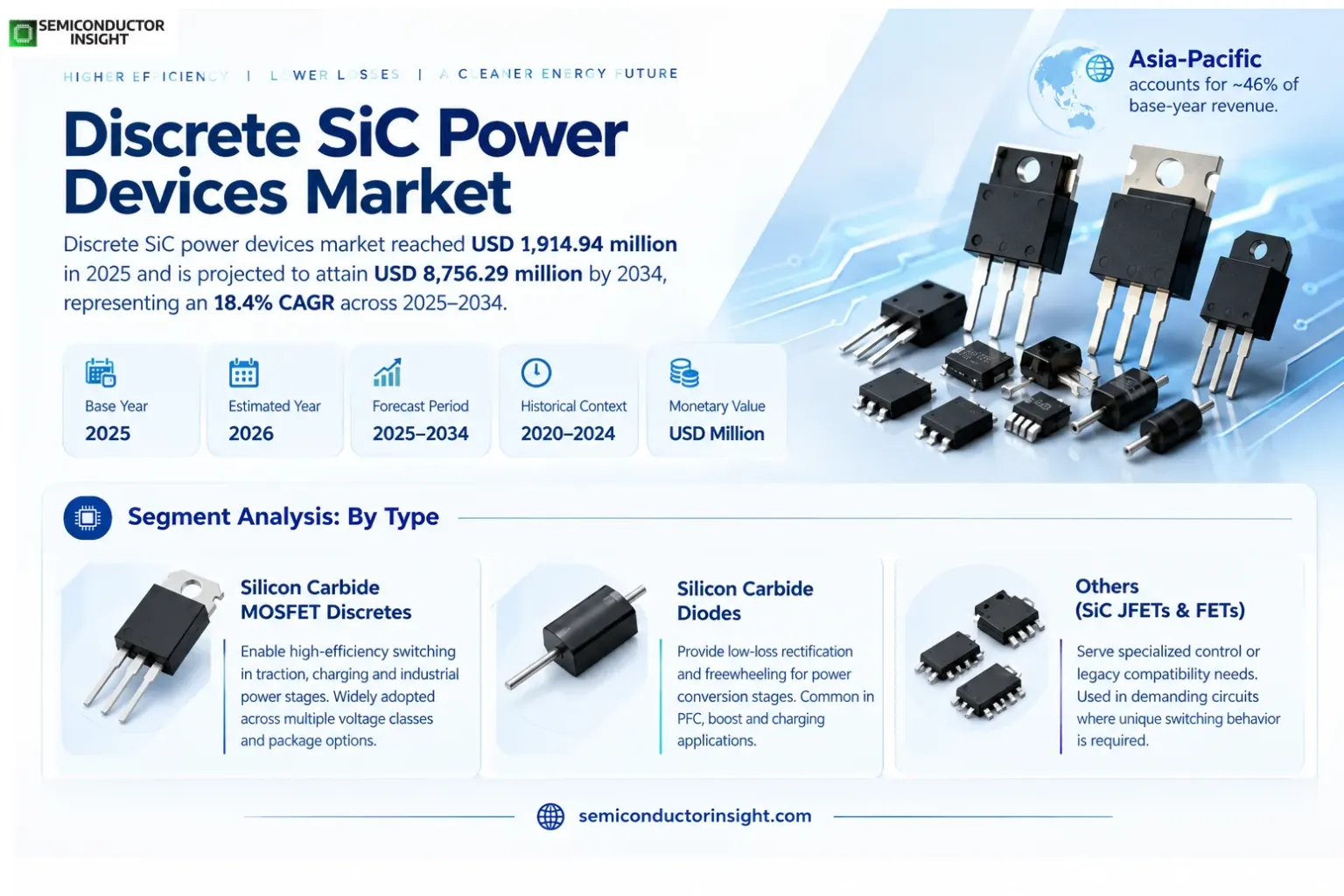
Discrete SiC power devices market reached USD 1,914.94 million in 2025 and is projected to attain USD 8,756.29 million by 2034, representing a 18.4% CAGR across 2025–2034. The market advances as silicon-carbide switches and rectifiers displace selected silicon components in high-voltage, high-frequency power stages; Asia-Pacific accounts for an estimated ~46% of base-year revenue.
A discrete silicon-carbide power device is an individually packaged semiconductor switch or rectifier sold for installation in an electrical power stage. The principal commercial products are enhancement-mode SiC MOSFETs, silicon-carbide Schottky barrier diodes and selected junction field-effect transistor variants. Their wide-bandgap material supports high blocking voltage, comparatively low switching losses and elevated junction-temperature operation. Designers nevertheless evaluate each device together with gate drivers, thermal interfaces, busbar geometry and electromagnetic compatibility because the die cannot deliver its rated efficiency without a suitable circuit.
The revenue boundary includes merchant sales of SiC MOSFET discretes, rectifier diodes and related discrete FET products, including automotive-qualified and industrial-grade packages. Complete traction inverters, assembled multi-die power modules, finished vehicles, unprocessed SiC substrates and bare epitaxial wafers are outside this product market. A module maker purchasing discrete components is a downstream customer, not an additional semiconductor sale. The distinction separates the market from neighboring SiC power-module and wafer studies whose revenue objects differ materially.
The 2026 market estimate is USD 2,267.28 million, following the 2025 base under a 9-year growth trajectory. Commercial deployment is strongest where higher efficiency reduces battery energy loss, heat-sink mass or cooling demand enough to offset the purchase premium. A 400 V or 800 V vehicle architecture can require a different switch topology and package choice, while a 1,200 V industrial converter faces its own surge, insulation and switching-speed constraints. Consequently, the competitive field is segmented by proven system reliability rather than wafer material alone.
Supplier qualification has become a decisive purchasing stage. AEC-Q101 component testing, short-circuit robustness, avalanche behavior, body-diode degradation and power-cycling performance all influence automotive sourcing. Industrial buyers may accept different qualification timelines but still scrutinize lot-to-lot variation and lifetime projections. A lower quoted on-resistance can be offset by increased gate-drive loss or package inductance, so purchasing teams increasingly compare measured inverter or charger efficiency rather than transistor data-sheet figures in isolation.
Production economics are shaped by substrate quality, epitaxial defects, wafer utilization and final device yield. Expanding from 150 mm toward 200 mm manufacturing can increase usable die output, but new equipment and process tuning introduce temporary costs. This manufacturing transition occurs alongside stronger price competition as capacity grows, making dependable yields and customer-specific engineering support more valuable than simple capacity announcements. The resulting market rewards integrated device development, fabrication control and packaging know-how across the forecast horizon.
Segment Analysis: By Type
The type split distinguishes Silicon Carbide MOSFET Discretes, Silicon Carbide Diodes and Others (SiC JFETs & FETs). MOSFET products contribute an estimated ~66% of 2025 revenue because they switch traction, charging and industrial converter currents, whereas diode families serve rectification and freewheeling duties. The residual group includes specialized transistor architectures with narrower qualification ecosystems.
| Device type | Technical role | Commercial interpretation |
|---|---|---|
| Silicon Carbide MOSFET Discretes | MOSFET discretes replace selected silicon IGBTs and superjunction MOSFETs in hard-switching or resonant stages. Commercial packages span surface-mount, through-hole and Kelvin-source variants; device engineers balance 650 V, 750 V, 1,200 V and higher voltage classes against switching frequency, thermal resistance and gate-drive requirements. | This type has the leading modeled share at ~66% in 2025. Vehicle inverter programs and compact power supplies support design wins, while reliability evidence and usable switching performance matter more than an isolated headline on-resistance. Automotive qualification and supply continuity make the socket comparatively sticky after approval. |
| Silicon Carbide Diodes | Schottky barrier rectifiers avoid reverse-recovery behavior associated with many silicon PN diodes and can improve power-factor correction or boost stages. Designers select current ratings, package outlines and surge capability according to the converter architecture, with 650 V and 1,200 V devices common across industrial and charging use cases. | An estimated ~30% share reflects continuing demand for low-loss rectification in established topologies. Diodes are easier to introduce into certain power stages than a complete transistor redesign, but their market value can be limited by falling selling prices and integration into combined switch packages. |
| Others (SiC JFETs & FETs) | Normally-on and cascode field-effect approaches serve specialized control or legacy compatibility requirements. Qualification depends on safe startup behavior, gate bias management and application-specific fault handling; these architectures are not direct substitutes for every enhancement-mode MOSFET in a vehicle traction platform. | The residual category represents an estimated ~4% of the 2025 value mix. Its prospects depend on differentiated performance or compatibility in demanding circuits rather than broad platform standardization, and smaller production runs can increase the relative importance of application engineering. |
MOSFET Discretes: platform qualification and loss optimization
The main engineering decision is the trade-off between conduction loss and switching loss across a realistic drive cycle. A 750 V part optimized for an onboard charger may emphasize compact packaging and efficiency at partial load, while a 1,200 V component in a traction inverter must also withstand repetitive transient stresses. Kelvin-source packages help reduce common-source inductance, but board layout and driver selection determine whether the system realizes the advertised speed advantage. The largest suppliers therefore provide reference circuits, reliability data and switching waveforms alongside the die itself.
Commercial procurement differs between vehicle and industrial applications. Automakers seek multi-year change control, traceable production lots and production-part approval; industrial converters often permit more frequent component substitutions but require assurance that replacements preserve thermal and EMC behavior. The same nominal 40 mΩ class can vary significantly in die area and package performance across generations. Those differences support premium pricing for qualified products even when commodity device prices fall.
SiC Schottky Diodes: rectification without reverse-recovery penalties
A Schottky diode can lower losses in a high-frequency boost stage because stored-charge recovery is much smaller than in a comparable silicon PN rectifier. That benefit is especially relevant when switching frequencies rise to shrink magnetics in charging or industrial power equipment. However, forward voltage, leakage at temperature and surge current remain material trade-offs, so manufacturers compete on the entire safe operating envelope rather than one forward-current number.
The 650 V and 1,200 V ranges span many charger and inverter auxiliary circuits, but package choice determines assembly economics. Surface-mount devices favor automated production, whereas bolt-down and through-hole formats remain relevant where thermal paths or maintenance practices require them. Diode qualification can open a supplier relationship before a customer redesigns the main power switch, making the category strategically useful even where its share of the final bill of materials is smaller.
Specialty FETs: targeted performance niches
JFET-based devices retain a place in circuits with unusual switching, startup or high-temperature requirements. A normally-on topology demands carefully designed fail-safe gate control, while a cascode arrangement can provide a more familiar gate interface at the cost of additional device interactions. Buyers consider these trade-offs case by case, which limits direct competition with mainstream automotive MOSFET sockets but creates defensible positions in specialized industrial systems.
Annual revenue allocation by device type
Modeled revenue by discrete device type, 2025–2034 (USD million)
Annual type values are scenario allocations calculated from the 2025 type shares and differentiated growth rates, normalized to the aggregate annual market path. They are modeled component revenues rather than observed shipments, and they exclude assembled modules and upstream wafer sales. The values should be interpreted as an internally consistent sensitivity pathway rather than annual invoices from named manufacturers or distributors.
| Year | MOSFET | Diode | Other FET | Total |
|---|---|---|---|---|
| 2025 | 1,263.9 | 574.5 | 76.6 | 1,914.9 |
| 2026 | 1,511.1 | 666.3 | 89.9 | 2,267.3 |
| 2027 | 1,806.2 | 772.7 | 105.5 | 2,684.5 |
| 2028 | 2,158.7 | 895.9 | 123.8 | 3,178.4 |
| 2029 | 2,579.5 | 1,038.5 | 145.3 | 3,763.2 |
| 2030 | 3,081.6 | 1,203.6 | 170.4 | 4,455.7 |
| 2031 | 3,680.9 | 1,394.7 | 199.9 | 5,275.5 |
| 2032 | 4,396.0 | 1,615.9 | 234.3 | 6,246.2 |
| 2033 | 5,249.0 | 1,871.8 | 274.7 | 7,395.5 |
| 2034 | 6,266.4 | 2,167.8 | 322.0 | 8,756.3 |
Segment Analysis: By Application
By application, Automotive & EV/HEV is the leading segment at an estimated ~44% of 2025 revenue. EV Charging, Industrial Motor/Drive, PV/Energy Storage/Wind Power, UPS/Data Center/Server, Rail Transport and Others provide separate sources of component demand. The end-market mix matters because qualification, voltage selection, shipment cadence and product life differ sharply among these categories.
| Application | Demand characteristics |
|---|---|
| Automotive & EV/HEV | Electric propulsion inverters, onboard chargers and DC-DC converters use SiC devices where efficiency, power density and thermal margins justify the component premium. Automotive qualification can require years of testing and supplier audits; an approved design then supports repeat orders over a vehicle-platform cycle. The modeled ~44% share reflects the scale of vehicle electrification rather than finished-vehicle revenue. |
| EV Charging | Offboard charging cabinets and high-power rectifier stages require switches and diodes that tolerate repeated power cycles, grid disturbances and demanding cooling conditions. Charging infrastructure growth raises the installed base of converters, but procurement often occurs through specialist equipment makers rather than automakers. The modeled ~14% share captures discrete semiconductor value in charging hardware, not the price of installed charging stations. |
| Industrial Motor/Drive | Variable-speed motor drives, robotics and factory power converters prioritize uptime and predictable thermal performance. High switching speed can reduce filter size, although electromagnetic interference and retrofit compatibility can limit the pace of replacement. An estimated ~13% of base-year sales reflects a diversified industrial customer set with longer maintenance horizons and different purchasing cycles from passenger vehicles. |
| PV, Energy Storage, Wind Power | Solar inverters, battery energy-storage converters and wind-power auxiliary stages seek reduced conversion losses and compact cooling systems. Their component selections depend on grid-code requirements, fault ride-through, outdoor temperature and the economics of multi-year generation output. The modeled ~13% share recognizes renewable-energy conversion equipment while excluding the capital cost of solar arrays, batteries and turbines. |
| UPS, Data Center & Server | High-efficiency uninterruptible power supplies and server power shelves value lower conversion losses because heat and electricity costs compound at high utilization. Designs can favor 650 V devices and advanced packages, but adoption is constrained by supply qualification and the need for stable electromagnetic behavior. An estimated ~9% share captures semiconductor devices installed in these systems, not rack or server revenue. |
| Rail Transport | Traction auxiliaries, station power conversion and rail energy systems operate under demanding lifetime, vibration and maintenance constraints. Device voltage and current needs differ from passenger-car applications, and supplier approval may be tied to an extended rolling-stock program. The modeled ~4% share remains smaller than road-vehicle demand but can support technically differentiated high-voltage products. |
| Others | A residual ~3% share includes aerospace power conditioning, specialized test equipment, marine converters and smaller high-voltage industrial installations. Such customers often purchase low volumes with unusually detailed environmental or reliability specifications. Their value lies in qualification expertise and application-specific design support rather than the mass-market economies that characterize traction or consumer charging equipment. |
Automotive buyers frequently integrate several SiC discretes into a half-bridge or power stage, but the device manufacturer records only the value of the semiconductors supplied. Industrial and renewable-system buyers may purchase devices through distributors, which makes channel inventory and design-registration data important indicators of demand. This difference in procurement channels explains why quarterly component orders can move independently of vehicle deliveries or renewable installations.
Regional Analysis
Asia-Pacific leads with a modeled ~46% share of 2025 merchant discrete SiC device revenue, ahead of North America (~23%) and Europe (~22%). South America (~5%) and the Middle East & Africa (~4%) have smaller bases but potentially faster deployment growth. Country-specific vehicle assembly, grid conversion, manufacturing capacity and supplier qualification drive distinct regional purchasing patterns.
Where are discrete SiC device sales concentrated, and what shapes the five regional outlooks?
Demand for silicon-carbide power devices follows the location of converter design decisions as well as final equipment assembly. Asia-Pacific combines large vehicle production clusters with semiconductor fabrication and electronics manufacturing; North America has high-value vehicle and energy infrastructure programs; Europe relies on advanced automotive and industrial power engineering. South America and the Middle East and Africa buy through smaller numbers of inverter, charging and infrastructure projects, making shipment timing less predictable. The shares represent a modeled distribution of device revenue, not the geography of consolidated supplier turnover.
| Region | Position | Growth outlook | Demand profile | What decides supplier selection |
|---|---|---|---|---|
| Asia-Pacific | Largest, ~46% | ~18.9% CAGR | EV traction, industrial drives and regional electronics assembly | Cost-qualified devices, manufacturing scale and local engineering |
| North America | Second, ~23% | ~17.5% CAGR | Vehicle platform design, charging equipment and grid power | Automotive reliability, supply agreements and traceability |
| Europe | Third, ~22% | ~17.2% CAGR | Premium automotive platforms, automation and renewables | Lifecycle documentation, EMC performance and design support |
| South America | Emerging, ~5% | ~20.2% CAGR | Solar conversion, bus fleets and charging rollout | Importer availability, ruggedness and system cost |
| Middle East & Africa | Emerging, ~4% | ~20.8% CAGR | Solar projects, data infrastructure and transport electrification | Heat tolerance, project certification and maintenance access |
Discrete SiC Power Devices Competitive Landscape
Competition spans integrated semiconductor manufacturers, specialized wide-bandgap device suppliers and regional power-component producers. STMicroelectronics, Infineon, onsemi, ROHM and Wolfspeed participate in the established supply ecosystem, while Navitas through GeneSiC, Microchip, Vishay, Toshiba and others compete through voltage selection, package performance and customer qualification. Market positioning must distinguish discrete device sales from consolidated corporate or module revenue.
Automotive-grade qualification creates an advantage for suppliers that can document stable electrical behavior across production lots and support long-term change control. Infineon and onsemi offer broad application ecosystems around traction and charging; ROHM has extensive automotive power-device expertise; and STMicroelectronics participates in integrated SiC manufacturing. These positions are not interchangeable, because some firms emphasize merchant devices while others supply a broader combination of substrates, modules and finished power stages.
Product announcements demonstrate competition for specific voltage and package sockets rather than independently establishing global market shares. Navitas’ GeneSiC portfolio includes automotive-qualified products, Microchip addresses industrial high-voltage applications and Vishay markets discrete Schottky diodes. Device catalogs should be compared on actual blocking voltage, current rating, short-circuit behavior, package thermal impedance and qualification status; a larger company’s total revenue cannot be treated as discrete SiC revenue.
Acquisition histories and brand changes also affect company comparisons. GeneSiC operates within Navitas, while UnitedSiC is associated with Qorvo rather than a separately counted independent supplier. Semikron Danfoss is more strongly associated with power modules and should not automatically be ranked as a leading merchant discrete-device producer. Such distinctions prevent double counting and keep the competitive analysis aligned with the specific semiconductor product boundary.
Tier structure
| Tier | Companies | Basis of competition |
|---|---|---|
| Global integrated suppliers | STMicroelectronics; Infineon Technologies; onsemi; ROHM; Wolfspeed | Broad fabrication, automotive and industrial engineering capabilities with extensive product qualification and supply commitments. |
| Specialized component vendors | Navitas Semiconductor (GeneSiC); Microchip Technology; Vishay Intertechnology; Toshiba | Differentiated discrete packages, voltage classes and application support for charging, industrial conversion and vehicle power stages. |
| Regional and diversified participants | Fuji Electric; BYD Semiconductor; SemiQ; Littelfuse; Diodes Incorporated | Selected regional relationships, specialized product ranges and opportunities where customers need qualified alternatives. |
Key companies profiled
- STMicroelectronics
- Infineon Technologies
- onsemi
- ROHM Semiconductor
- Wolfspeed
- Navitas Semiconductor (GeneSiC)
- Microchip Technology
- Vishay Intertechnology
- Toshiba
- Fuji Electric
- BYD Semiconductor
- SemiQ
- Littelfuse
- Diodes Incorporated
Discrete SiC Power Device Production and Manufacturing Economics
Manufacturing performance is governed by the quality of silicon-carbide crystal substrates, epitaxial layers, device processing, wafer test and package assembly. Yield losses at any stage can overwhelm nominal efficiency gains from a larger wafer format, so production strategy combines process maturity with customer qualification and careful capital deployment. The move toward 200 mm manufacturing introduces both potential die-cost improvements and near-term execution risk.
Crystal defects, micropipes and epitaxial nonuniformity can reduce the number of saleable die per wafer, especially for devices intended to block high voltages. Manufacturers therefore track defect density, oxide integrity, threshold-voltage stability and electrical screening results rather than relying on wafer diameter as a proxy for cost. An improved process at 150 mm may outperform a poorly optimized 200 mm line during its early ramp, which explains why capacity expansion and shipment growth do not necessarily move together.
Packaging is a second source of differentiation. Kelvin-source leads, low-inductance connections and controlled thermal paths help designers exploit rapid SiC switching without excessive voltage overshoot. Through-hole, surface-mount and advanced automotive packages address different assembly and cooling requirements. A device with attractive die characteristics may lose a design competition if its package causes additional electromagnetic interference or requires expensive changes to the converter enclosure.
The production system must also sustain traceability over multi-year equipment lifetimes. Automotive programs demand formal change notification and often impose stringent lot acceptance criteria, whereas industrial buyers may focus more heavily on replacement continuity and field-failure analysis. A supplier capable of maintaining stable characteristics across successive wafer and package generations can command stronger customer retention, even when industry capacity additions place pressure on average selling prices.
Discrete SiC Power Devices Market Dynamics: Drivers, Restraints and Opportunities
The expansion reflects electrified transport, charging networks, renewable conversion, industrial efficiency and higher-density computing power supplies. Counterweights include costly wafers, manufacturing defects, application qualification and design complexity. The impact allocation below expresses the modeled contribution of these forces to the headline growth path; it is a directional decomposition of market dynamics rather than a measurement of individual corporate sales.
MARKET DRIVERS
Drivers Impact Analysis*
| Market Drivers | Impact Rank | CAGR Contribution (%) | 2026–2028 | 2029–2031 | 2032–2034 |
|---|---|---|---|---|---|
| EV traction inverter and onboard conversion adoption | High | +7.10% | High | High | Medium |
| Charging infrastructure and grid interface upgrades | High | +5.10% | Medium | High | High |
| Industrial motor efficiency and automation | Medium-High | +4.10% | Medium | High | High |
| Renewable energy and storage converter deployment | Medium | +3.30% | Medium | High | High |
| UPS, server and high-density power supplies | Low-Medium | +2.30% | Medium | Medium | High |
| Others (rail auxiliaries, specialty transport and marine power) | Low | +1.30% | Low | Medium | Medium |
Vehicle powertrain design wins extend shipment visibility
Traction inverters and onboard charging circuits can use SiC discretes to reduce switching and conduction losses. The value proposition is strongest when system designers can also reduce cooling mass or improve driving efficiency without compromising protection. Once an automotive program qualifies a transistor family, suppliers may retain the socket for several production years, creating revenue persistence beyond the original engineering award.
Charging equipment requires efficient repeated conversion
High-power charging cabinets contain multiple AC-DC and DC-DC stages that operate under changing loads and grid conditions. Silicon-carbide devices can improve conversion efficiency and shrink some passive components, although field serviceability and thermal cycling remain central requirements. Charging infrastructure purchases occur in projects, so semiconductor orders can fluctuate with construction financing and equipment maker inventories.
Industrial drives reward lifetime energy savings
Factories use motor drives across pumps, compressors, conveyors and automation equipment. A SiC design can reduce losses and improve power density where switching speed and control architecture justify it, but replacement cycles are often tied to scheduled maintenance. Device suppliers that document realistic operating efficiency and electromagnetic performance have an advantage over products promoted only through idealized switching benchmarks.
Renewable converters diversify the customer base
Solar and storage installations require reliable conversion of variable DC sources into grid-compatible power. SiC switches can contribute to lower losses, but adoption depends on converter topology, surge protection and utility compliance. This end market broadens demand beyond passenger vehicles and can support different voltage and package classes, reducing dependence on a single automotive procurement cycle.
MARKET RESTRAINTS
Restraints Impact Analysis*
| Market Restraints | Impact Rank | CAGR Contribution (%) | 2026–2028 | 2029–2031 | 2032–2034 |
|---|---|---|---|---|---|
| Substrate defects and wafer manufacturing cost | High | -1.90% | High | Medium | Medium |
| Long automotive and industrial qualification | Medium-High | -1.40% | High | Medium | Low |
| Gate-drive, EMI and package integration complexity | Medium | -1.00% | Medium | High | Medium |
| Others (price competition, inventory cycles and capacity ramp losses) | Low | -0.50% | Medium | High | Medium |
Defect-related losses keep device economics demanding
SiC substrates and epitaxy can be more expensive than established silicon processes, and manufacturing defects reduce saleable output. As new wafer formats enter production, process stability may initially lag mature lines. Suppliers must recover development and capital costs while facing increasing price competition, which can constrain investment even when end-system efficiency creates substantial technical interest.
Customer approvals delay conversion of engineering wins
An attractive laboratory demonstration is not equivalent to a released automotive part. Customers assess accelerated lifetime, power cycling, short-circuit events, oxide stability and product-change management before authorizing production. These processes can take multiple design iterations and make revenue recognition lag product launch dates, particularly in safety-critical vehicle and transportation applications.
Fast switching complicates complete converter design
Higher switching speed reduces certain electrical losses but can raise voltage overshoot, electromagnetic emissions and insulation stress. The gate driver, package layout and cooling design must be co-optimized with the semiconductor. Equipment manufacturers may retain silicon devices where the incremental system redesign cost exceeds the efficiency benefit, slowing adoption in cost-sensitive industrial or legacy platforms.
MARKET OPPORTUNITIES
Low-inductance discrete packages
Manufacturers can differentiate through Kelvin-source and advanced thermal packages that reduce overshoot and improve usable switching speed. Application-specific package engineering may protect margins better than incremental improvements in a published on-resistance figure, particularly for compact onboard chargers and high-density industrial power supplies. The practical advantage is stronger control over production tolerance and application-specific switching waveforms.
Qualified second-source programs
Automotive and infrastructure customers seek continuity of supply over long equipment lifetimes. Vendors able to demonstrate consistent electrical parameters, comparable gate-drive behavior and transparent change control can compete for approved alternate positions. Such awards require engineering investment but can provide access to customers that previously relied on a single established semiconductor supplier.
Power supplies for data infrastructure
Server and UPS manufacturers face sustained pressure to reduce conversion loss and thermal burden. Discrete SiC products can enter selected front-end and backup power stages when the total efficiency benefit outweighs device price and integration work. This application offers a distinct route to growth that is less directly correlated with vehicle production schedules.
High-voltage specialized conversion
Rail auxiliaries, industrial distribution equipment and large renewable converters can use devices beyond conventional low-voltage supply classes. Manufacturers with reliable 1,200 V and 3.3 kV products can address these niches through close cooperation with protection and insulation designers, although program volumes are smaller and qualification more customized. Such projects also reward suppliers that can maintain technical support across long equipment service lives.
Discrete SiC Power Device Supply Chain Analysis
The chain begins with crystal growth and wafer preparation, moves through epitaxy and transistor or diode fabrication, and ends with package assembly, electrical screening and customer qualification. Discrete-device producers capture value through yield, reliability and circuit integration, while substrate makers and equipment vendors influence input economics without belonging to the finished semiconductor-device revenue boundary.
Upstream. High-quality SiC substrates and epitaxial films are critical because defects can degrade blocking voltage, leakage and device yield. Suppliers balance wafer size, crystal quality and long-term purchase commitments to manage input risk. The cost of raw materials is only one element of finished device economics, since defect screening and process losses determine how much substrate area becomes qualified saleable semiconductor output.
Fabrication. Transistor and diode production requires controlled implantation, annealing, oxide formation, metallization and electrical testing. Process windows differ among MOSFET, Schottky and specialized FET products, and reliability screens must be matched to target applications. High-voltage devices are especially sensitive to material defects, making stable yield a commercial differentiator that is not captured by nameplate fab capacity.
Packaging. Packaging translates die performance into usable system characteristics. Parasitic inductance, thermal resistance and terminal geometry affect switching loss and voltage overshoot, while assembly consistency determines production reliability. Suppliers offering detailed thermal models and measured switching data can help customers reduce redesign risk and defend pricing despite increasing competition in standard package outlines.
Downstream. Equipment makers select SiC devices after evaluating complete converter performance and lifecycle economics. Automakers emphasize qualification and change control; industrial users prioritize serviceability; renewable equipment makers focus on energy yield and grid compliance. Distribution inventory can distort short-term shipment data, so sustainable demand is better indicated by released equipment platforms and repeat orders than by component bookings alone.
Recent Developments in the Discrete SiC Power Devices Market
- 10 December 2025 Announced
Infineon broadened its CoolSiC 750 V G2 package portfolio for automotive charging and power-supply applications. The extension illustrates how a device generation is adapted to distinct thermal and assembly constraints after the initial transistor launch. For buyers, additional package choices can reduce board redesign effort while maintaining the electrical qualification framework of an established family. Source - 30 September 2025 Announced
Infineon described 400 V and 440 V CoolSiC MOSFET variants aimed at server and industrial power conversion. Lower-voltage offerings broaden the addressable circuit set beyond high-voltage traction and renewable applications, but the system advantage still depends on switching frequency and total conduction loss. The development highlights competition for compact power-supply sockets rather than a measured increase in aggregate market revenue. Source - 26 August 2025 Announced
Infineon introduced additional 650 V G2 SiC MOSFET options for power supply and charging designs. Their relevance lies in giving engineers a wider choice of electrical ratings and package arrangements as they optimize efficiency, thermal design and switching noise. Product availability does not automatically establish adoption; customers still validate gate-drive compatibility and application-specific reliability before placing production orders. Source - 24 July 2025 Announced
onsemi and Schaeffler expanded their collaboration around an EliteSiC-based automotive traction inverter design. The agreement indicates that semiconductor selection is increasingly embedded in a larger system engineering relationship covering inverter efficiency and production qualification. Its market significance is the potential for sustained device content across a vehicle platform, while the value of the complete inverter is outside discrete-device revenue. Source - 17 July 2025 Announced
Microchip and Delta Electronics disclosed a power-management technology collaboration that includes silicon-carbide capabilities. Partnerships between component suppliers and equipment makers can shorten the feedback cycle on protection, thermal behavior and converter efficiency. The commercial effect is a stronger route from device development to qualified system design, although collaboration announcements are not equivalent to audited shipments of individual SiC transistors. Source - 9 July 2025 Announced
Vishay launched silicon-carbide Schottky diode products spanning industrially relevant voltage classes. The release reinforces the continuing importance of rectification components alongside the more visible MOSFET category. Designers can use low-recovery diodes in selected power-factor correction and converter stages, but final component choice depends on forward loss, surge rating, thermal resistance and mechanical package fit. Source - 5 May 2025 Announced
Navitas presented automotive-qualified GeneSiC MOSFET products addressing high-voltage vehicle applications. The announcement emphasizes device reliability and packaging as key differentiators for powertrain engineers evaluating wide-bandgap components. A published product family expands the available qualification pool, but the transition to series production depends on individual automaker approval, manufacturing stability and integration into complete inverter designs. Source - 29 April 2025 Announced
Infineon unveiled CoolSiC 750 V G2 devices for onboard charging and automotive DC-DC conversion. The product class addresses power stages where lower losses can support smaller cooling systems and higher energy efficiency. It also underscores the importance of matching a discrete switch to the converter topology, since voltage margin, gate-drive settings and qualification requirements differ between charging and traction applications. Source
REPORT SCOPE & SEGMENTATION
| Attribute | Details |
|---|---|
| Study Period | 2020–2034 |
| Base Year | 2025 |
| Estimated Year | 2026 |
| Forecast Period | 2025–2034 |
| Historical Period | 2020–2024 |
| Market Size 2025 | USD 1,914.94 million |
| Market Size 2026 | USD 2,267.28 million |
| Market Size 2034 | USD 8,756.29 million |
| Growth Rate | CAGR of 18.4% from 2025–2034 |
| Unit | Revenue (USD million) |
| Segmentation | By Type, By Application and By Region |
| By Type | Silicon Carbide MOSFET Discretes · Silicon Carbide Diodes · Others (SiC JFETs & FETs) |
| By Application | Automotive & EV/HEV · EV Charging · Industrial Motor/Drive · PV, Energy Storage, Wind Power · UPS, Data Center & Server · Rail Transport · Others |
| By Region | Each regional assessment is linked to device type, application, end-equipment design and country-level demand conditions. North AmericaUnited States, Canada, Mexico EuropeGermany, France, Italy, United Kingdom, Nordic countries, Rest of Europe Asia-PacificChina, Japan, South Korea, Taiwan, India, Southeast Asia South AmericaBrazil, Argentina, Chile, Rest of South America Middle East & AfricaSaudi Arabia, UAE, South Africa, Egypt, Morocco, Rest of Middle East & Africa |
| Key Companies Profiled | STMicroelectronics, Infineon Technologies, onsemi, ROHM, Wolfspeed, Navitas (GeneSiC), Microchip, Vishay, Toshiba, Fuji Electric, BYD Semiconductor, SemiQ, Littelfuse, Diodes Incorporated |
| Customization Scope | Optional country, voltage class and end-use scope refinement can be discussed for purchaser-specific analysis. |
Frequently Asked Questions
How large is the discrete SiC power devices market?
The merchant device market was valued at USD 1,914.94 million in 2025 and is projected to reach USD 8,756.29 million by 2034, representing 18.4% CAGR over the modeled period. It includes separately sold SiC transistors and rectifier diodes rather than the price of entire inverters, vehicles or power modules. Growth depends on released designs and manufacturing yield as well as the expansion of high-efficiency power equipment.
Which device types are included?
The principal product groups are SiC MOSFET discretes, SiC Schottky diodes and a smaller collection of specialized JFET or FET designs. MOSFETs control current in switching power stages, while Schottky devices provide low-recovery rectification in suitable converter topologies. Product comparisons require attention to voltage rating, thermal behavior, package inductance and qualification status rather than treating all silicon-carbide chips as interchangeable.
Why do vehicle makers select SiC power components?
Electric-vehicle engineers consider silicon-carbide switches when reduced conversion loss can improve driving efficiency, thermal management or package size. The economic case varies with battery voltage, duty cycle, inverter topology and cooling architecture. Even after a supplier wins an engineering evaluation, customer-specific reliability testing and production validation determine whether the design proceeds to sustained volume shipments.
Which application has the highest revenue share?
Automotive and EV/HEV power conversion is the leading application, modeled at ~44% of 2025 discrete-device revenue. Charging infrastructure, industrial drives, renewable converters and data power supplies account for much of the remaining opportunity. The automotive lead reflects high semiconductor content in qualified traction and charging platforms, but a vehicle’s retail value is not counted in this component market.
Which region is the largest market?
Asia-Pacific is the leading region at an estimated ~46% base-year share, supported by vehicle manufacturing, electronics assembly and a broad supplier network. North America and Europe have significant design and qualification ecosystems, while South America and the Middle East and Africa expand from smaller installed bases. Regional figures describe modeled device sales rather than the location of each supplier’s headquarters.
What are the main barriers to faster adoption?
Substrate defects, epitaxial yield, qualification duration and system redesign expense remain important obstacles. A device may offer lower switching loss but require new gate-drive protection, insulation design or electromagnetic filtering. Manufacturers also face pressure to reduce average selling prices as fabrication capacity expands, making consistent yield and long-term customer support central to commercial competitiveness.
How are SiC MOSFETs different from silicon IGBTs?
A silicon-carbide MOSFET can switch rapidly and operate efficiently at high blocking voltage, potentially reducing losses and passive-component size in selected circuits. Silicon IGBTs remain economical in many established applications and have a mature qualification history. The preferred device depends on power level, frequency, protection strategy and the complete cost of cooling and conversion hardware, not a single semiconductor specification.
Do raw SiC wafers belong in this market?
No. The market concerns finished discrete switching and rectification devices sold as semiconductor components. Raw substrates, epitaxial wafers, fabrication equipment and packaged multi-die modules occupy different revenue boundaries. Those upstream and downstream markets affect cost and demand, but their sales are not added to discrete-device revenue, avoiding the double counting that can arise when broad SiC industry totals are compared.
Which companies supply these devices?
Established suppliers include Infineon, onsemi, ROHM, STMicroelectronics and Wolfspeed, with specialized participation from Navitas through GeneSiC, Microchip, Vishay, Toshiba and additional regional firms. Their competitive roles differ by voltage class, package and application approval. Corporate revenue totals are not reliable proxies for this product category because most vendors also sell silicon devices, modules, wafers or other semiconductor families.
What period and geography does the study cover?
The analysis uses 2025 as the base year, 2026 as the estimate and 2034 as the terminal forecast year, with contextual history extending through 2020–2024. It examines device types, seven application groups and five geographic regions, including country-level industry patterns. Values refer to merchant semiconductor-device revenue, and market shares represent modeled allocations aligned to the defined product boundary.
Research Sources & Evidence Base

Get Sample Report PDF for Exclusive Insights
Report Sample Includes
- Table of Contents
- List of Tables & Figures
- Charts, Research Methodology, and more...
 Download Sample Report PDF