Market Insights
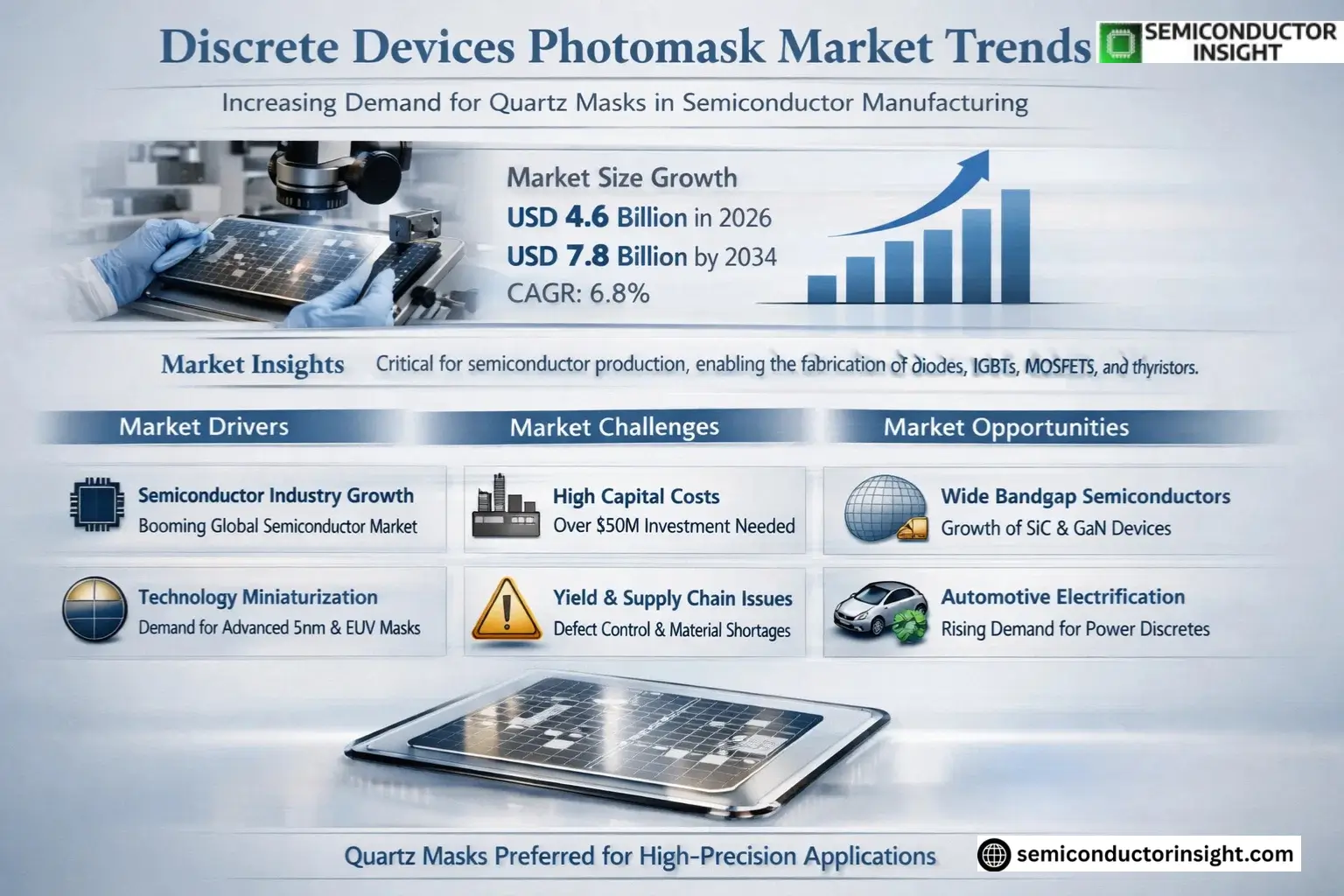
Global Discrete Devices Photomask Market size was valued at USD 4.2 billion in 2025. The market is projected to grow from USD 4.6 billion in 2026 to USD 7.8 billion by 2034, exhibiting a CAGR of 6.8% during the forecast period.
Discrete Devices Photomasks are critical components in semiconductor manufacturing, used to transfer intricate circuit patterns onto silicon wafers during photolithography. These masks consist of quartz or soda-lime substrates coated with chromium patterns, enabling precise replication of designs for discrete semiconductor devices such as diodes, IGBTs, MOSFETs, and thyristors.
The market growth is driven by increasing demand for power electronics in automotive and industrial applications, coupled with advancements in semiconductor miniaturization. Furthermore, rising investments in 5G infrastructure and IoT devices are accelerating adoption. Key players like Photronics and Toppan are expanding production capacities to meet growing demand, while innovations in EUV lithography are expected to further propel market expansion.
MARKET DRIVERS
Growing Demand from Semiconductor Industry
Discrete Devices Photomask Market is experiencing substantial growth driven by the expanding semiconductor industry. With the global semiconductor market projected to reach USD 600 billion by 2025, manufacturers are increasing production, directly boosting demand for high-precision photomasks. Advances in power devices and RF components further accelerate adoption.
Technology Miniaturization Trends
Continuous node shrinkage in semiconductor fabrication necessitates more sophisticated photomasks. The transition to 5nm and below process nodes requires advanced Discrete Devices Photomasks with tighter tolerances, creating sustained demand from foundries and IDMs. Over 60% of new fabrication facilities now require EUV-compatible masks.
Automotive electrification trends are creating new demand drivers, with power discretes requiring specialized masks for high-voltage applications.
MARKET CHALLENGES
High Capital Investment Requirements
Establishing photomask production facilities requires investments exceeding USD 50 million for advanced nodes. The complex equipment and cleanroom specifications create significant barriers to entry, limiting supplier capacity expansion despite growing Discrete Devices Photomask Market demand.
Other Challenges
Yield Optimization Pressures
As feature sizes shrink below 10nm, mask defect rates increase significantly. Manufacturers face mounting pressure to maintain <0.01% defect rates while controlling costs, requiring continuous R&D investment.
Supply Chain Complexities
The specialized materials ecosystem for Discrete Devices Photomasks remains concentrated, with quartz blanks and pellicles facing occasional shortages that disrupt production timelines.
MARKET RESTRAINTS
Design Complexity and Cycle Times
Developing photomasks for advanced discrete devices now requires 40-60 days of design verification and pattern optimization. This extended turnaround time creates bottlenecks in new product introduction cycles, particularly for high-frequency and power semiconductor applications.
MARKET OPPORTUNITIES
Emerging Wide Bandgap Semiconductor Applications
Discrete Devices Photomask Market stands to benefit from the rapid adoption of SiC and GaN devices, expected to grow at 35% CAGR through 2030. These materials require specialized mask solutions with unique pattern requirements, creating premium pricing opportunities for suppliers with technical expertise.
MAIN TITLE HERE () Trends
Increasing Demand for Quartz Masks in Semiconductor Manufacturing
Discrete Devices Photomask Market is witnessing significant growth in quartz mask adoption due to superior thermal stability and durability. Semiconductor manufacturers prefer quartz masks for high-precision applications like IGBT and MOSFET production, where dimensional accuracy is critical. This trend aligns with the industry’s shift toward smaller node technologies requiring defect-free mask solutions.
Other Trends
Regional Market Expansion in Asia-Pacific
China, Japan, and South Korea are experiencing accelerated demand for Discrete Devices Photomasks, driven by expanding semiconductor fabrication facilities. Local manufacturers like ShenZheng QingVi and Taiwan Mask are capturing market share through cost-competitive offerings. The region’s focus on domestic semiconductor self-sufficiency further propels photomask consumption.
Technological Advancements in Mask Fabrication
Leading companies such as Photronics and Toppan are investing in advanced inspection systems to reduce defects in Discrete Devices Photomasks. Emerging technologies like multi-beam mask writers enhance pattern fidelity for complex power device applications. This technological progression supports the development of next-generation discrete semiconductors with improved efficiency.
Rising Adoption in Power Electronics
Discrete Devices Photomasks see growing usage in power management applications, particularly for thyristors and bipolar junction transistors. The automotive industry’s transition to electric vehicles creates sustained demand for high-voltage discrete components, directly influencing photomask requirements for specialized power device production.
Supply Chain Optimization Strategies
Major photomask suppliers are implementing just-in-time inventory systems to address regional demand fluctuations. With lead times becoming a critical factor, manufacturers like DNP and Compugraphics are establishing localized production hubs near key semiconductor clusters to improve responsiveness.
COMPETITIVE LANDSCAPE
Key Industry Players
Global Discrete Devices Photomask Market Dominated by Top 5 Players Holding Majority Share
Global Discrete Devices Photomask Market exhibits a moderately consolidated structure, with Photronics, Toppan, and DNP collectively commanding a significant revenue share. These leaders maintain technological superiority in quartz mask production and have established robust foundry relationships with major semiconductor manufacturers. Their capability to handle advanced node technologies (sub-10nm) and provide defect-free masks gives them competitive insulation against smaller players.
Regional specialists like Taiwan Mask and ShenZheng QingVi are gaining traction through cost-competitive solutions for mid-range applications. Emerging Chinese players such as SMIC-Mask Service and CR Micro are making strategic investments to capture domestic demand, leveraging government semiconductor initiatives. The market also sees niche participation from precision-focused manufacturers like Compugraphics and Nippon Filcon in specialized optical component applications.
List of Key Discrete Devices Photomask Companies Profiled
- Photronics
- Toppan
- DNP
- ShenZheng QingVi
- Taiwan Mask
- Nippon Filcon
- Compugraphics
- Newway Photomask
- Shenzhen Longtu Photomask
- Wuxi Zhongwei Mask Electronics
- CR Micro
- SMIC-Mask Service
Segment Analysis:
| Segment Category | Sub-Segments | Key Insights |
| By Type |
|
Quartz Mask dominates as the preferred material due to its superior durability and precision in semiconductor manufacturing. The growth is driven by:
|
| By Application |
|
MOSFET represents the fastest growing application due to several industry trends:
|
| By End User |
|
Foundries account for the largest share of demand, driven by:
|
| By Technology Node |
|
90nm-28nm nodes show strongest momentum with multiple growth drivers:
|
| By Mask Type |
|
Phase-shift masks are gaining prominence due to technological advantages:
|
Regional Analysis: Asia-Pacific Discrete Devices Photomask Market
Taiwan leads in advanced photomask production with TSMC’s captive mask shops and commercial suppliers like Taiwan Mask Corporation developing cutting-edge solutions for 3nm and below processes. The island’s ecosystem benefits from dense semiconductor supply chain integration.
South Korean manufacturers are pioneering EUV photomask adoption, with Samsung investing heavily in mask defect inspection systems. The country’s photomask market is characterized by vertical integration between memory producers and mask suppliers.
China is rapidly building photomask production capacity through SMIC’s partnerships and new domestic suppliers. Government initiatives support local photomask technology development to reduce dependence on foreign sources for critical semiconductor manufacturing components.
Japanese suppliers maintain leadership in photomask blanks and inspection equipment, providing critical materials to foundries worldwide. Companies like DNP and Hoya focus on high-end mask technologies while exploring AI-assisted mask pattern optimization solutions.
North America
The North American Discrete Devices Photomask Market remains technologically advanced but increasingly focused on design rather than volume production. Leading photomask technology developers in the U.S. are concentrating on computational patterning solutions and AI-driven defect prediction systems. The region benefits from strong R&D collaboration between semiconductor equipment makers and photomask specialists, particularly in developing advanced verification techniques for next-generation nodes.
Europe
Europe maintains a specialized position in the global photomask market through advanced R&D in mask materials and metrology. ASML’s EUV technology development in the Netherlands drives regional photomask innovations, while Germany’s Fraunhofer institutes work on next-generation mask inspection methods. The market is characterized by high-value, low-volume production serving specialized semiconductor applications.
South Korea
South Korea’s photomask sector has emerged as a global leader in memory device mask technology, with Samsung and SK Hynix driving demand. The country is making significant progress in EUV mask infrastructure development and pellicle technology. Korean suppliers are increasingly adopting machine learning algorithms for mask pattern optimization and defect classification.
Rest of World
Other regions are gradually developing photomask capabilities to support local semiconductor initiatives. Israel has shown innovation in computational lithography solutions, while Southeast Asian nations are building supporting infrastructure for photomask production. These emerging markets are focusing on mature node technologies while collaborating with established global suppliers for advanced solutions.
Report Scope
This market research report provides a comprehensive analysis of the Global Discrete Devices Photomask Market, covering the forecast period 2025–2034. It offers detailed insights into market dynamics, technological advancements, competitive landscape, and key trends shaping the industry.
Key focus areas of the report include:
- Market Overview: The report begins with an overview outlining its current market scenario, key growth indicators, and industry transformation drivers. It discusses macroeconomic factors, demand–supply balance, regulatory landscape, and the strategic role of semiconductors in powering advancements across industries such as automotive, telecommunications, consumer electronics, and industrial automation.
- Market Size & Forecast: Historical data and future projections for revenue, unit shipments, and market value across major regions and segments.
- Segmentation Analysis: Detailed breakdown by product type, technology, application, and end-user industry to identify high-growth segments and investment opportunities.
- Regional Insights: Insights into market performance across North America, Europe, Asia-Pacific, Latin America, and the Middle East & Africa, including country-level analysis where relevant.
- Competitive Landscape: Profiles of leading market participants, including their product offerings, R&D focus, manufacturing capacity, pricing strategies, and recent developments such as mergers, acquisitions, and partnerships.
- Technology Trends & Innovation: Assessment of emerging technologies, integration of AI/IoT, semiconductor design trends, fabrication techniques, and evolving industry standards.
- Market Drivers & Restraints: Evaluation of factors driving market growth along with challenges, supply chain constraints, regulatory issues, and market-entry barriers.
- Stakeholder Insights: Insights for component suppliers, OEMs, system integrators, investors, and policymakers regarding the evolving ecosystem and strategic opportunities.
Primary and secondary research methods are employed, including interviews with industry experts, data from verified sources, and real-time market intelligence to ensure the accuracy and reliability of the insights presented.
FREQUENTLY ASKED QUESTIONS:
What is the current market size of Discrete Devices Photomask Market?
-> Discrete Devices Photomask Market size was valued at USD 4.2 billion in 2025. The market is projected to grow from USD 4.6 billion in 2026 to USD 7.8 billion by 2034, exhibiting a CAGR of 6.8% during the forecast period.
Which key companies operate in Discrete Devices Photomask Market?
-> Key players include Photronics, Toppan, DNP, ShenZheng QingVi, Taiwan Mask, Nippon Filcon, Compugraphics, Newway Photomask, Shenzhen Longtu Photomask, and Wuxi Zhongwei Mask Electronics, among others. Global top five players held approximately % market share in 2025.
What are the key growth drivers?
-> Key growth drivers include advancements in semiconductor fabrication technologies, increasing demand for discrete devices in automotive and industrial applications, and rising investments in semiconductor manufacturing infrastructure.
Which region dominates the market?
-> Asia is the largest market, with China projected to reach USD million by 2034. The U.S. market was estimated at USD million in 2025.
What are the emerging trends?
-> Emerging trends include adoption of quartz masks, advancements in photomask fabrication techniques, and increasing demand for discrete devices in power electronics applications.

Get Sample Report PDF for Exclusive Insights
Report Sample Includes
- Table of Contents
- List of Tables & Figures
- Charts, Research Methodology, and more...
 Download Sample Report PDF