Key Statistics
Key Takeaways
- 7nm-node photomasks hold the key source-defined type position because they combine high mask complexity with broad use across leading logic and advanced semiconductor platforms; 5nm and sub-5nm work increases the value of EUV capability.
- Foundry Services are the most important application channel because fabless customers repeatedly tape out new designs, creating demand for complete mask sets, fast turnaround and high-end defect control across many device programs.
- EUV lithography is the most strategically important technology segment. DNP’s 2026 investment in Rapidus specifically targets EUV photomask development and mass-production readiness for 2nm and later semiconductor generations.
- Asia Pacific is the largest regional market because leading-edge manufacturing is concentrated there. SEMI projected Korea, China, Taiwan and Japan to account for 80% of global 300 mm front-end capacity in 2025.
- Writer throughput, inspection capability and defect control are the principal supply constraints. Advanced masks require expensive e-beam or multi-beam writing, tighter metrology and longer process flows, so capacity expansion is measured in qualified writer-hours as much as cleanroom area.
Advanced Process Photomask Market Overview
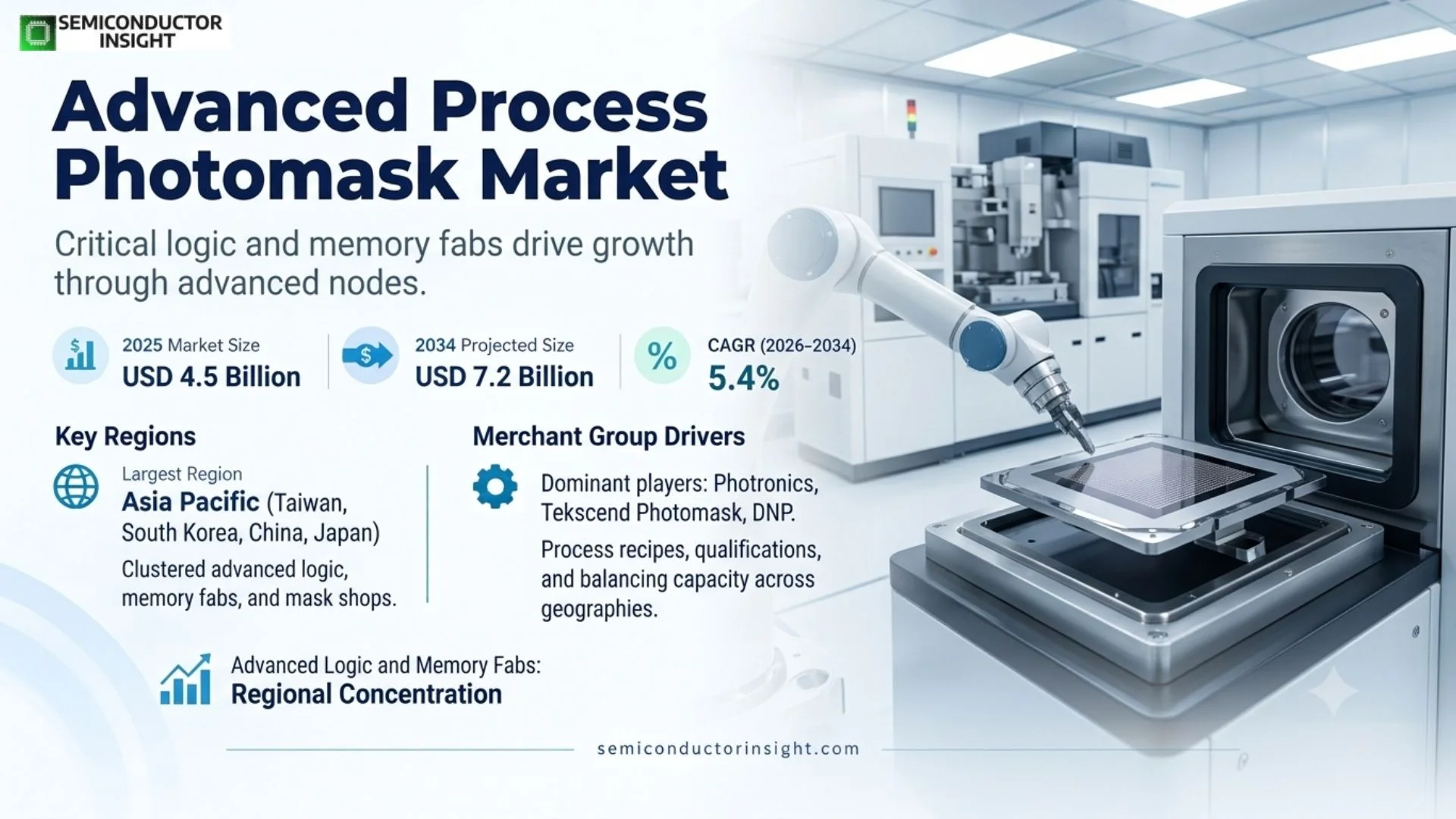
Advanced Process Photomask Market was valued at USD 4.5 billion in 2025 and is projected to reach USD 7.2 billion by 2034, expanding at a 5.4% over 2026–2034. The 2026 market value is USD 4.74 billion. Asia Pacific represents the largest market in 2025, supported by the concentration of advanced logic and memory fabs, foundry capacity, merchant mask shops and leading-edge lithography investment across Taiwan, South Korea, China and Japan.
Advanced process photomasks are high-precision reticles used to transfer circuit patterns during semiconductor lithography. At leading nodes, the mask is not a passive commodity: pattern fidelity, defectivity, pellicle performance, mask data preparation and inspection directly influence wafer yield. The market includes optical and EUV masks used by foundries and integrated device manufacturers, plus specialized photomasks for advanced packaging and other high-complexity patterning requirements.
The demand base is expanding with the semiconductor industry’s transition toward 7nm, 5nm, 2nm and other advanced processes. SEMI reported that advanced nodes at 7nm and below were expected to add more than 300,000 wafers per month of capacity in 2025, reaching 2.2 million wafers per month. Every new process platform requires mask development, qualification and recurring replacements, while more complex patterning can raise the number and value of masks associated with a single chip design.
Capacity is geographically close to major wafer fabs because mask turnaround time, engineering interaction and intellectual-property control matter. Asia Pacific therefore benefits from the density of foundries and IDMs, while North America and Europe are investing in local semiconductor ecosystems. Merchant suppliers compete with captive mask shops, and the leading-edge market rewards organizations able to combine advanced writers, inspection, cleaning, repair, pellicle integration and secure data handling.
Segment Analysis: By Type
By type, the source defines 14nm Nodes, 7nm Nodes, 5nm Nodes and Others. The 7nm segment is the key established advanced-node category because it supports high-volume leading logic and performance devices, while 5nm and the source-defined Others category capture the migration toward still finer processes where EUV masks, tighter defect specifications and more sophisticated correction become indispensable.
| Type | Technical / commercial role | Market position and purchasing logic |
|---|---|---|
| 14nm Nodes | A mature advanced-node class served predominantly through optical lithography with established mask-writing, inspection and repair infrastructure. It remains important for automotive, networking, industrial and cost-sensitive high-performance devices where process maturity and long lifecycle matter. | A stable revenue pool with lower technology risk than EUV nodes. Customers emphasize consistent turnaround, repeatability, secure data handling and long-term mask-set support. Price competition is stronger because more suppliers possess the required tooling and process knowledge. |
| 7nm Nodes | A high-complexity node family that uses advanced optical patterning and EUV depending on the process. Mask error budgets tighten substantially, and inspection, repair and process correction become central to wafer yield. | Key source-defined type. The segment combines meaningful production scale with premium mask requirements. Foundry and IDM customers value defect control, fast design-to-mask cycle time and proven interaction with leading lithography flows, making qualification a significant competitive barrier. |
| 5nm Nodes | A leading-edge category where EUV use expands and mask requirements become more demanding. Pattern placement, multilayer mask quality, pellicle behavior and defect inspection have a direct effect on wafer economics because a mask defect can propagate across high-value wafers. | A high-value growth category tied to AI accelerators, advanced mobile processors and leading foundry capacity. Suppliers need capital-intensive writers and inspection systems, so the competitive field narrows as node requirements advance. |
| Others | The source-defined category captures node generations outside 14nm, 7nm and 5nm, including finer emerging processes and specialized advanced patterning. Commercial requirements vary, but the most advanced work pushes mask shops toward EUV, multi-beam writing, computational correction and next-generation pellicles. | The fastest technology frontier sits within this category as 3nm, 2nm and later processes move toward volume. Revenue per mask can rise with complexity, but so can cycle time, inspection burden and capital requirements. |
Why advanced-node masks command a premium
Photomask economics depend on the number of writing and inspection steps, writer utilization, defect specifications, mask materials and turnaround commitments. A leading-edge mask set can consume scarce e-beam or multi-beam writer capacity and require repeated metrology and repair loops. The commercial premium therefore reflects both technical difficulty and opportunity cost: every hour used on a complex mask displaces capacity that could serve another design.
Segment Analysis: By Application
By application, the source-defined market includes Logic Devices, Memory Devices, Foundry Services and Others. Foundry services are the key demand channel because a single leading foundry supports many fabless customers and frequent tape-outs, while logic and memory IDMs generate recurring internal demand for process-development masks, production mask sets and replacements.
| Application | Demand characteristics |
|---|---|
| Logic Devices | Leading logic creates the most aggressive dimensional and defect requirements because processors and AI accelerators migrate rapidly to advanced nodes. A new architecture can require multiple mask revisions during development, so mask shops compete on data preparation, write accuracy, inspection sensitivity and cycle time as well as final reticle quality. |
| Memory Devices | DRAM and NAND manufacturers use photomasks across repeated process layers and technology migrations. Memory demand can be cyclical, but process transitions create intensive mask-development work. The purchase decision emphasizes pattern fidelity, stable repeatability and support for high-volume fabs where a small yield change can have large financial impact. |
| Foundry Services | Key application segment. Foundries aggregate tape-outs from many fabless customers and therefore require both high-end capability and operational scale. Suppliers must support secure design data, rapid mask-set completion and consistent quality across multiple process platforms. Proximity to foundry clusters shortens engineering loops and reduces logistics risk. |
| Others | Specialty devices, compound-semiconductor-related patterning, MEMS, power devices and advanced packaging use a broad range of masks. These applications can be less node-driven but still require customized materials, larger pattern formats or unique defect standards, creating defensible niches for specialized merchant mask suppliers. |
Additional segmentation dimensions
| Axis | Source-defined segments | Commercial interpretation |
|---|---|---|
| By End User | IDMs (Integrated Device Manufacturers); Foundries; OSATs (Outsourced Semiconductor Assembly and Test) | IDMs control proprietary process flows and may combine captive and merchant mask capacity. Foundries demand large, diverse mask volumes across many fabless customers. OSATs become more relevant as advanced packaging requires finer redistribution, bump and substrate patterning. |
| By Technology | Optical Lithography; EUV Lithography; Advanced Packaging | Optical masks retain broad volume across mature and advanced nodes, but EUV represents the most strategic value pool at 7nm and below. Advanced packaging widens mask demand beyond front-end transistor patterning as package interconnect density increases. |
| By Material | Quartz; Soda-Lime Glass; Advanced Substrates | Quartz is the established high-quality base for semiconductor masks, while soda-lime glass serves less demanding applications. Advanced substrates and multilayer structures are essential where EUV optical behavior, thermal stability and defect control exceed conventional mask requirements. |
Regional Analysis
Asia Pacific is the largest advanced process photomask market because advanced semiconductor wafer capacity and major merchant or captive mask operations are clustered in Taiwan, South Korea, China and Japan. North America retains strength in design, equipment and domestic-fab expansion, while Europe combines specialty photomask capacity with automotive, industrial and sovereignty-driven semiconductor investment.
Why does advanced wafer capacity translate directly into regional photomask demand?
A photomask is consumed close to the point of wafer-process development because design changes, defect review and replacement cycles require fast interaction between the mask shop and the fab. SEMI projected Korea, China, Taiwan and Japan to account for 80% of global 300 mm front-end capacity in 2025. The same association reported 18 new fab construction projects starting in 2025, including four each in the Americas and Japan, three each in China and Europe & Middle East, two in Taiwan and one in Korea, creating new mask demand in multiple regions.
| Region | Position | Growth outlook | Demand profile | What decides supplier selection |
|---|---|---|---|---|
| Asia Pacific | Largest | Strongest advanced-node pull | Fab and foundry led | Writer capability, defect control, proximity, IP security |
| North America | Strategic growth market | High | Design + new fab led | Leading-edge capability, secure turnaround, domestic capacity |
| Europe | Specialized | Moderate–high | Automotive, industrial, sovereignty led | Quality, local support, specialty process breadth |
| South America | Niche | Gradual | Mature-node and design support | Cost, turnaround, regional service |
| Middle East & Africa | Emerging | Project-led | New semiconductor ecosystem led | Technology transfer, qualification, supply continuity |
Key Advanced Process Photomask Manufacturers and Competitive Landscape
Competition is split between global merchant photomask suppliers, captive mask shops inside large IDMs or foundries, and equipment or technology companies that support mask production without selling masks as their primary product. The strongest merchant positions depend on a global fab network, advanced writers, inspection and repair tools, secure design-data handling and long-standing qualification with major wafer manufacturers.
Photronics, Tekscend Photomask and DNP form the most defensible global merchant group within the profiled list. Their advantage is not only equipment ownership but accumulated process recipes, customer qualification and the ability to balance writer capacity across geographies. At advanced nodes, a customer may remain with an incumbent because changing mask suppliers adds process and yield risk.
Captive capability changes market structure. Large IDMs and foundries may produce strategic masks internally while buying overflow, mature-node or specialized work from merchant suppliers. This creates a hybrid market in which merchant demand depends on customer capacity, technology confidentiality, turnaround requirements and the relative economics of internal versus external mask production.
The source report also profiles Applied Materials, KLA, SK hynix, Samsung and other organizations whose primary roles are equipment supply or semiconductor manufacturing rather than merchant photomask sales. They remain relevant to the ecosystem, but the tier table distinguishes their function so the competitive landscape does not imply every profiled organization competes for the same photomask revenue.
Tier structure
| Competitive tier | Representative companies | How competition works |
|---|---|---|
| Global merchant photomask suppliers | Photronics Inc.; Tekscend Photomask; Dai Nippon Printing (DNP); HOYA; Compugraphics; Taiwan Mask | Compete through writer and inspection capability, global manufacturing footprint, customer qualification, turnaround and defect performance. Leading-edge capital intensity narrows the supplier base and raises utilization risk for each new tool. |
| Regional / captive mask operations | SMIC Mask Service; Advanced Mask Technology Center (AMTC); Nanya-related mask capability; other captive shops | Serve internal or regional wafer-fab requirements and can protect process IP or shorten cycle time. Merchant purchases still arise when internal capacity is constrained or a specialized process is not available in-house. |
| Equipment, IDM and ecosystem participants | Applied Materials; KLA Corporation; SK hynix; Samsung Electronics; Powerchip; ULVAC | Influence mask demand through equipment, inspection, wafer-process development or captive use rather than competing uniformly as merchant photomask vendors. Their technology decisions can materially alter specifications and required mask quality. |
Key companies profiled
The source report profiles the following organizations: Photronics Inc.; Toppan Photomasks; Dai Nippon Printing Co., Ltd. (DNP); SMIC Mask Service (Shanghai); Hoya Corporation; Compugraphics Photomask Solutions; Nanya Technology Corporation; Powerchip Semiconductor Manufacturing Corp; Taiwan Mask Corporation; ULVAC Technologies; Advanced Mask Technology Center (AMTC); Applied Materials; KLA Corporation; SK Hynix; Samsung Electronics.
Advanced Process Photomask Production Capacity Analysis
Photomask capacity is constrained by qualified writing and inspection throughput rather than wafer starts alone. Advanced e-beam and multi-beam writers are expensive, long-lead tools, and a complex mask can occupy scarce writing time for many hours. Defect inspection, repair, cleaning, pellicle integration and final qualification must then keep pace, so a bottleneck at any stage limits effective output.
Geography matters because mask cycle time is part of semiconductor development velocity. Asia Pacific has the strongest installed customer base because it contains the largest concentration of advanced wafer fabs. Merchant suppliers maintain regional shops near those clusters to reduce logistics time, improve engineering interaction and satisfy data-security requirements. North American and European capacity additions are increasingly justified by the same resilience logic.
Advanced-node capacity is not fungible with mature-node capacity. A shop that can produce large volumes of optical masks may not possess the writer, metrology or defect-control capability required for EUV. The shift toward 2nm and later therefore creates a premium for qualified leading-edge tools even if total mask-unit volumes do not rise at the same rate as market value.
SEMI projected 18 new fab construction starts in 2025, with 15 using 300 mm wafers. Each new fab creates a development pipeline for process masks before volume production and recurring demand after ramp. The capacity implication for mask suppliers is forward-looking: investment has to occur before customers need production sets, but premature tool purchases can depress utilization if fab schedules move.
Advanced Process Photomask Market Dynamics: Drivers, Restraints and Opportunities
Advanced photomask demand grows with wafer-fab capacity, node migration and the number of new chip designs entering production. EUV raises technical complexity and average value, while foundry business models increase tape-out frequency. Offsetting those drivers are extreme capital intensity, writer bottlenecks, defect risk and customer concentration, which make utilization and qualification discipline central to supplier returns.
MARKET DRIVERS
Drivers Impact Analysis*
| Driver | Impact | Time horizon | Commercial effect |
|---|---|---|---|
| Leading-edge node migration | High | 2026–2034 | Raises mask complexity, inspection burden and value per qualified set. |
| Foundry and fabless tape-out growth | High | 2026–2034 | Creates recurring mask-set demand across many customers and process platforms. |
| EUV adoption | High | 2026–2034 | Requires specialized multilayer masks, pellicles, defect control and secure leading-edge capacity. |
| Regional fab construction | Medium–High | 2026–2034 | Creates local development and replacement demand before and after new fabs enter production. |
Advanced nodes increase mask value per design
As semiconductor processes move to 7nm, 5nm, 2nm and later, the mask error budget shrinks and the cost of a printable defect increases. Suppliers respond with more advanced writers, tighter metrology, computational correction and more inspection steps. The result is a higher-value service even when the number of physical reticles grows more slowly than the technical content.
Foundry business models multiply tape-outs
A leading foundry supports hundreds of customers, each with independent design schedules and mask revisions. This creates a diverse stream of new mask sets, engineering changes and replacements. Merchant suppliers near major foundry clusters can improve turnaround and capture overflow demand when captive mask shops are constrained.
EUV expands the technology moat
EUV photomasks require multilayer reflective structures, stringent defect control and compatible pellicle solutions. DNP’s 2026 Rapidus investment links photomask development directly to 2nm volume-readiness, showing that mask capability is a gating element of the lithography ecosystem rather than a commodity input.
Fab regionalization creates new local demand
SEMI identified 18 new fab construction starts in 2025 across the Americas, Japan, China, Europe & Middle East, Taiwan, Korea and Southeast Asia. New facilities need masks during process qualification before high-volume ramp, giving merchant suppliers a reason to add capacity closer to emerging manufacturing clusters.
MARKET RESTRAINTS
Restraints Impact Analysis*
| Restraint | Impact | Time horizon | Commercial effect |
|---|---|---|---|
| Advanced writer and inspection capital intensity | High | Ongoing | Raises fixed cost and makes utilization critical to return on invested capital. |
| Defectivity and yield risk | High | 2026–2034 | A mask defect can impact many high-value wafers, increasing inspection and qualification burden. |
| Customer concentration and captive capacity | Medium–High | Ongoing | Large foundries and IDMs can internalize strategic mask production or negotiate aggressively with merchant suppliers. |
| Long tool lead times and qualification cycles | Medium | 2026–2034 | Can create mismatches between installed capacity and actual customer ramp schedules. |
Writer economics create a high fixed-cost base
Leading-edge mask writers and inspection platforms require large capital commitments and specialized infrastructure. Revenue depends on keeping those assets productively loaded, but customer tape-outs can shift with semiconductor cycles or fab delays. Underutilization can therefore pressure margins even when long-term node migration remains favorable.
Defect risk rises as features shrink
A reticle defect can print repeatedly across many wafers, so advanced-node customers impose extremely tight inspection and repair requirements. Each additional inspection or rework loop consumes tool time and extends cycle time. Suppliers have to invest in defect prevention and metrology while still meeting aggressive delivery schedules.
Captive mask shops limit merchant addressability
Some large IDMs and foundries operate internal mask facilities for strategic processes, IP protection or rapid development. Merchant suppliers may receive overflow and selected technologies rather than the entire mask set. This hybrid structure limits how directly wafer-capacity growth translates into external photomask revenue.
Qualification makes capacity slow to substitute
A new mask tool or production site cannot immediately replace a qualified source. Customers need process correlation, defect qualification, data-security approval and repeated manufacturing evidence. This slows capacity transfers between regions and can make new investments take longer to reach targeted utilization.
MARKET OPPORTUNITIES
2nm and later EUV photomasks
The transition to 2nm-class production creates premium demand for suppliers that can demonstrate multilayer mask quality, advanced inspection, pellicle integration and rapid engineering support. DNP’s Rapidus partnership shows how photomask suppliers can become strategic development partners rather than transactional vendors.
Regional merchant capacity near new fabs
New fabs in the United States, Japan and Europe create opportunities for local or nearby mask capacity that reduces logistics and supports secure design-data handling. A regional site can begin with mature or specialty masks and expand toward more advanced capability as the customer base justifies additional writers.
Advanced packaging patterning
Chiplets, fine-pitch redistribution and heterogeneous integration expand patterning demand beyond front-end transistor lithography. Suppliers that adapt mask formats, substrates and process support to packaging customers can diversify away from purely node-driven front-end cycles and participate in another high-growth semiconductor capital stream.
AI-enabled inspection and computational correction
Mask data volumes and defect requirements are increasing faster than manual engineering can scale. Software that improves pattern correction, defect classification, writer utilization and predictive maintenance can shorten cycle time and improve yield, creating differentiation for suppliers that integrate digital process control into their manufacturing flow.
Advanced Process Photomask Supply Chain Analysis
Blank quality sets the defect floor
Photomask production begins with a substrate and films that must meet exceptionally low defect levels. EUV adds multilayer reflective structures and different inspection challenges, increasing the strategic value of blank suppliers. A defect embedded in the blank can consume expensive downstream writer and inspection time before it is detected.
Writing is the principal capacity bottleneck
Advanced patterns require sophisticated data preparation and long write times on scarce equipment. Multi-beam and high-end e-beam writers improve throughput and pattern capability, but they also require major capital and skilled operation. Capacity planning therefore focuses on qualified writer-hours by technology, not simply the number of reticles a facility can physically handle.
Inspection protects wafer economics
A defect that escapes mask inspection can print across many wafers and generate losses far larger than the mask price. Inspection, repair and cleaning are therefore integral value-creation steps. Leading suppliers differentiate through sensitivity, false-defect control, repair capability and the ability to return a mask to the customer within a predictable cycle time.
Customer qualification locks in supply relationships
Once a mask shop is qualified for a process, switching is disruptive because pattern correlation, data security, logistics and defect performance must be revalidated. This creates customer stickiness but also raises entry barriers for new regional facilities. Strategic customers may dual-source to improve resilience, creating opportunities for qualified second suppliers.
Recent Developments in the Advanced Process Photomask
August 2026 – Photronics reports record high-end IC mix
Photronics reported fiscal Q3 2026 revenue of USD 216.0 million and IC photomask revenue of USD 154.7 million. High-end IC products reached 44% of total IC revenue, a record share, while the company said U.S. and Korea investments remained on track. The result indicates continuing node migration within merchant-mask demand. Source
February 2026 – DNP invests in Rapidus to support 2nm EUV photomasks
DNP announced an investment in Rapidus and said it would accelerate development and mass production of EUV photomasks for 2nm and later semiconductor generations. The move links photomask capacity directly to Japan’s leading-edge wafer roadmap and strengthens domestic supply-chain integration. Source
December 2025 – DNP demonstrates EUV photomasks with CNT pellicles
DNP presented EUV photomasks equipped with carbon-nanotube pellicles at SEMICON Japan 2025. Pellicle transmission and contamination protection are critical to EUV productivity, so the development extends competition beyond pattern writing into complete reticle readiness for advanced lithography. Source
July 2025 – Tekscend expands European writing capacity
Tekscend Photomask installed a Mycronic SLX1 writer at its Corbeil, France facility, the first European deployment of the system. The investment was intended to improve productivity and diversify locally produced masks, strengthening Europe’s merchant photomask infrastructure. Source
REPORT SCOPE & SEGMENTATION
| Attribute | Scope |
|---|---|
| Report title | Advanced Process Photomask Market Size, Share & Industry Analysis, By Type (14nm Nodes, 7nm Nodes, 5nm Nodes, Others), By Application (Logic Devices, Memory Devices, Foundry Services, Others), By End User (IDMs (Integrated Device Manufacturers), Foundries, OSATs (Outsourced Semiconductor Assembly and Test)), By Technology (Optical Lithography, EUV Lithography, Advanced Packaging), By Material (Quartz, Soda-Lime Glass, Advanced Substrates), and Regional Forecast, 2026-2034 |
| Market definition | High-precision semiconductor photomasks used for advanced process pattern transfer, covering source-defined node classes, applications, end users, lithography technologies and mask-material categories. The scope includes merchant and relevant captive photomask activity, not the entire lithography-equipment, wafer-fab or semiconductor-design markets. |
| Base / estimate / forecast | 2025: USD 4.5 billion; 2026: USD 4.74 billion; 2034: USD 7.2 billion; CAGR 2026–2034: 5.4%. |
| Geographic coverage | North America; Europe; Asia Pacific; South America; Middle East & Africa. |
| By Type | 14nm Nodes; 7nm Nodes; 5nm Nodes; Others |
| By Application | Logic Devices; Memory Devices; Foundry Services; Others |
| By End User | IDMs (Integrated Device Manufacturers); Foundries; OSATs (Outsourced Semiconductor Assembly and Test) |
| By Technology | Optical Lithography; EUV Lithography; Advanced Packaging |
| By Material | Quartz; Soda-Lime Glass; Advanced Substrates |
| Companies profiled | Photronics Inc.; Toppan Photomasks; Dai Nippon Printing Co., Ltd. (DNP); SMIC Mask Service (Shanghai); Hoya Corporation; Compugraphics Photomask Solutions; Nanya Technology Corporation; Powerchip Semiconductor Manufacturing Corp; Taiwan Mask Corporation; ULVAC Technologies; Advanced Mask Technology Center (AMTC); Applied Materials; KLA Corporation; SK Hynix; Samsung Electronics |
Frequently Asked Questions
What is the 2025 size of the advanced process photomask market?
The global advanced process photomask market is valued at USD 4.5 billion in 2025. The anchor-consistent series places the 2026 value at USD 4.74 billion and the 2034 market at USD 7.2 billion, representing a 5.4% CAGR over 2026–2034.
What is the forecast CAGR for 2026–2034?
The market is projected to grow at a 5.4% CAGR over 2026–2034. Expansion is driven by advanced-node wafer capacity, foundry tape-outs, EUV adoption and regional fab construction, while high capital intensity and long qualification cycles constrain how quickly new photomask capacity can be added.
Which type is most important in the current market?
The source identifies 7nm-node photomasks as the key type segment. They sit at the intersection of meaningful production scale and high technical complexity, requiring advanced writing, inspection and process correction. The 5nm and other finer-node categories provide the strongest technology-upgrade opportunity as EUV use expands.
Which application is the key demand channel?
Foundry services are the key application channel because large foundries aggregate designs from many fabless customers. Each new tape-out can require a complete mask set plus revisions and replacements, creating recurring demand for merchant and captive mask capacity with fast turnaround and secure data handling.
Which region is the largest market?
Asia Pacific is the largest market in 2025. SEMI projected Korea, China, Taiwan and Japan to account for 80% of global 300 mm front-end capacity, concentrating advanced foundries, memory fabs and mask shops in the same region and supporting shorter design-to-mask engineering cycles.
Why is EUV important to photomask suppliers?
EUV lithography uses specialized reflective masks with demanding multilayer, defect and pellicle requirements. As semiconductor production moves deeper into sub-7nm processes, suppliers need EUV-specific writing, inspection and cleaning capability. That raises capital barriers but also increases the strategic value and revenue potential of qualified high-end capacity.
What limits advanced photomask capacity?
The main bottlenecks are qualified e-beam or multi-beam writer time, high-sensitivity inspection, repair capability, pellicle integration and long customer qualification cycles. Cleanroom floor space alone does not create leading-edge output; every critical tool and process step must be qualified for the target node.
How do captive mask shops affect competition?
Large IDMs and foundries can produce strategic masks internally, particularly during process development or where intellectual-property control is critical. Merchant suppliers still serve overflow, specialized technologies and regional capacity needs. Competition therefore depends on the customer’s internal capacity as well as the external supplier’s technology and turnaround.
Which companies are central to merchant competition?
Within the source-profiled list, Photronics, Toppan Photomasks now operating as Tekscend Photomask, DNP, Hoya, Compugraphics and Taiwan Mask are the most direct merchant photomask competitors. Other profiled organizations participate as captive mask users, semiconductor manufacturers, equipment suppliers or regional ecosystem partners.
What is the 2034 outlook?
The market is projected to reach USD 7.2 billion by 2034. Growth will be concentrated in EUV and advanced-node photomasks, regional capacity close to new fabs, tighter inspection and defect-control services, and packaging-related patterning, while mature optical masks continue to provide a stable base of recurring demand.
Research Sources & Evidence Base
View research sources used for this overview.
- SEMI. Eighteen New Semiconductor Fabs to Start Construction in 2025, fab construction counts, advanced-node capacity and regional manufacturing context.
- SEMI. Global 300mm Semiconductor Fab Capacity Projected to Reach New High in 2025, regional 300 mm capacity concentration used in the regional analysis.
- Photronics. Photronics Reports Third Quarter 2026 Results, high-end IC photomask mix, IC revenue and U.S./Korea investment status, August 2026.
- Dai Nippon Printing. Investment in Rapidus to Support Next-Generation Semiconductor Mass Production, EUV photomask development and 2nm manufacturing support, February 2026.
- Dai Nippon Printing. SEMICON Japan 2025 Exhibition, EUV photomasks with carbon-nanotube pellicles and related advanced semiconductor products, December 2025.
- Tekscend Photomask. Tekscend Photomask Expands Production Capacity in Europe with Strategic Photomask Writing Investment, SLX1 writer installation at Corbeil, France and European capacity expansion, July 2025.
- Semiconductor Industry Association. Global Annual Semiconductor Sales Increase 25.6% to $791.7 Billion in 2025, industry demand context for logic and memory semiconductor growth.

Get Sample Report PDF for Exclusive Insights
Report Sample Includes
- Table of Contents
- List of Tables & Figures
- Charts, Research Methodology, and more...
 Download Sample Report PDF