SEMICONDUCTOR INSIGHT
MARKET RESEARCH REPORT

DBA (Direct Bonded Aluminum) Substrate Market

2026 to 2034
MARKET INTELLIGENCE
ACROSS KEY REGIONS
2026 EDITION
DIELECTRIC MATERIALS Semiconductor Market Research

DBA (Direct Bonded Aluminum) Substrate Market Size, Share & Industry Analysis, By Type (0.32mm, Other Thicknesses), By Application (New Energy Vehicles, Electric Trains, Industrial Machinery, Others), By End User (Automotive, Power Electronics, Industrial Manufacturing, Aerospace & Defense, Others), By Ceramic Base (Alumina, Aluminum Nitride, Silicon Nitride), and Regional Forecast, 2026-2034

◷
UPDATED 01 October 2026
▤
REPORT LENGTH Detailed Report
▣
REPORT CODE 988c85c3aed9
▯
FORMATS PDF

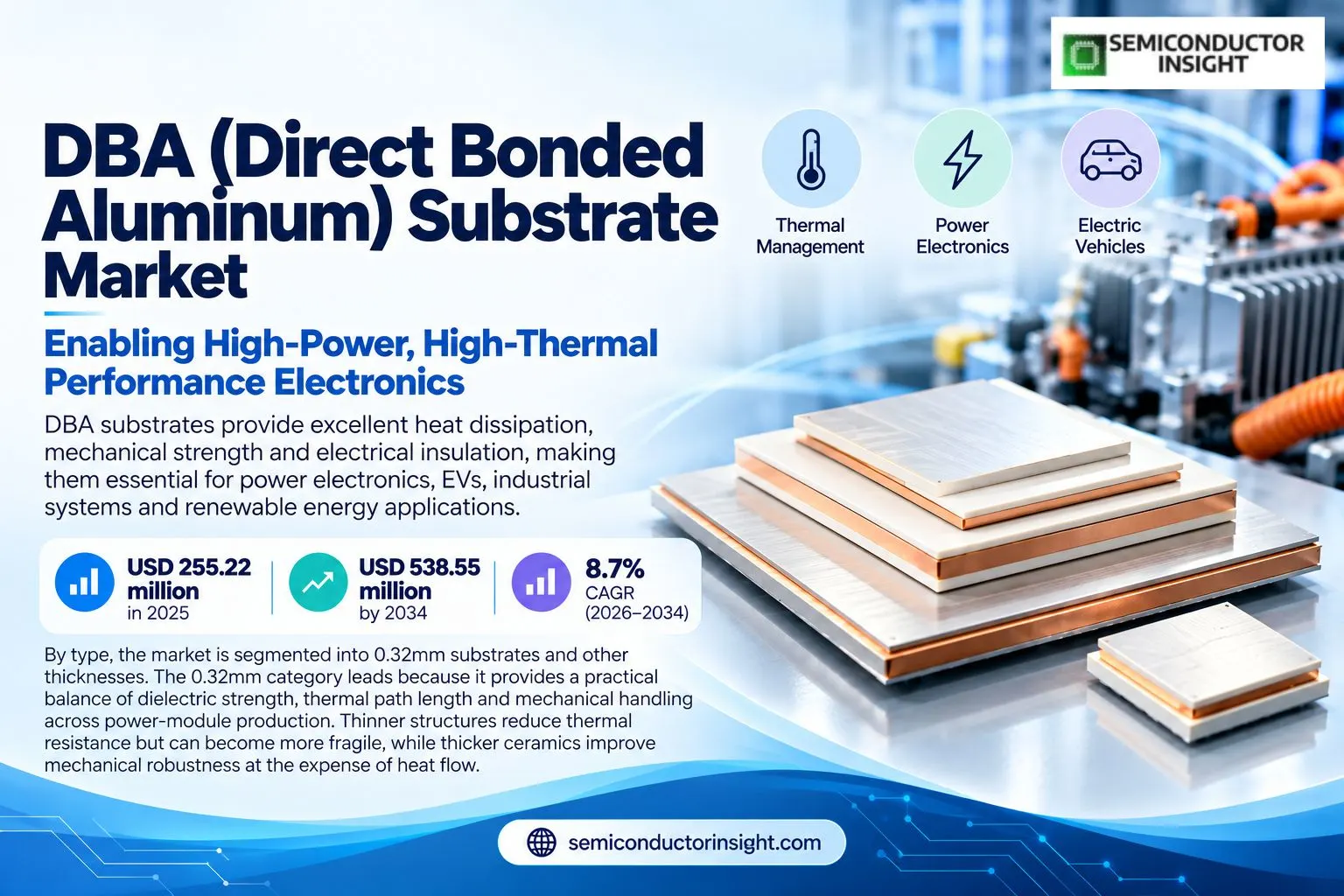
DBA direct bonded aluminum substrate market is valued at USD 255.22 million in 2025 and is projected to reach USD 538.55 million by 2034, expanding at a 8.7% CAGR during 2026–2034. The 2026 market level is USD 277.30 million. Asia Pacific leads because the region combines EV manufacturing, power-semiconductor production and established ceramic-substrate suppliers.

Get the sample PDF with study scope, segmentation and methodology details.


Key Statistics

2025 Market Size
USD 255.22 million
2034 Projected Market Size
USD 538.55 million
CAGR (2026–2034)
8.7%
Largest Market in 2025
Asia Pacific

Key Takeaways

  • Market size: The market is valued at USD 255.22 million in 2025 and is projected to reach USD 538.55 million by 2034, representing a 8.7% CAGR during 2026–2034.
  • New energy vehicles are the largest application, reflecting heavy use of power modules in traction inverters, onboard chargers and auxiliary conversion.
  • Asia Pacific leads demand, with China representing more than 60% of regional consumption in the underlying market evidence and Japan and South Korea contributing advanced substrate production.
  • 0.32mm substrates are the leading thickness category, balancing thermal performance, electrical insulation and mechanical handling for power modules.
  • SiC and GaN adoption expands the addressable market because higher junction temperatures and switching frequencies increase the value of low-thermal-resistance insulated substrates.

DBA (Direct Bonded Aluminum) Substrate Market Overview

DBA direct bonded aluminum substrate market is valued at USD 255.22 million in 2025 and is projected to reach USD 538.55 million by 2034, expanding at a 8.7% CAGR during 2026–2034. The 2026 market level is USD 277.30 million. Asia Pacific leads because the region combines EV manufacturing, power-semiconductor production and established ceramic-substrate suppliers. DBA remains attractive where aluminum metallization and ceramic insulation must handle high current and repeated thermal cycling.

Base year: 2025 · Estimated year: 2026 · Forecast period: 2026–2034 · Values stated in U.S. dollars

Direct bonded aluminum substrates join aluminum conductor layers directly to an insulating ceramic, creating a thermally conductive and electrically isolated platform for power semiconductor modules. The construction is used in traction inverters, industrial drives, renewable-energy converters and other high-power assemblies. Compared with conventional PCB materials, DBA offers much lower thermal resistance and stronger high-temperature capability, while aluminum reduces weight and can improve thermal-cycling behavior in selected package designs.

Commercial DBA structures use alumina, aluminum nitride or silicon nitride ceramic bases depending on thermal conductivity, mechanical strength and cost. Aluminum nitride supports high heat flux, while silicon nitride offers strong fracture toughness for severe power-cycling applications. Aluminum metallization can be patterned for high-current interconnect and bonded to semiconductor devices or baseplates using solder, sinter or other advanced attachment processes.

Demand is increasingly linked to electric vehicles and wide-bandgap power semiconductors. SiC modules operate at higher temperatures and switching frequencies than conventional silicon, making substrate thermal conductivity and coefficient-of-expansion matching more important. Suppliers therefore compete not only on ceramic quality but on metallization thickness, bond integrity, flatness, patterning precision and long-term thermal-cycling reliability.

Segment Analysis: By Type

By type, the market is segmented into 0.32mm substrates and other thicknesses. The 0.32mm category leads because it provides a practical balance of dielectric strength, thermal path length and mechanical handling across power-module production. Thinner structures reduce thermal resistance but can become more fragile, while thicker ceramics improve mechanical robustness at the expense of heat flow.

Type Commercial role
0.32mm Leading mainstream thickness for power modules requiring balanced thermal and mechanical performance.
Other Thicknesses 0.25mm, 0.38mm and customized structures for application-specific power density and reliability.

Additional Segmentation: By End User

End-user demand is led by automotive and power electronics, followed by industrial manufacturing and aerospace or defense. Automotive customers emphasize thermal cycling and long qualification cycles, industrial customers prioritize uptime and cost, and aerospace applications require rugged performance under wide temperature ranges. These differences shape ceramic choice, metal thickness and reliability testing.

End User Demand characteristics
Automotive Traction inverter, onboard charger, DC/DC and other electrified-vehicle power modules.
Power Electronics General high-power modules, converters and power semiconductor packaging.
Industrial Manufacturing Motor drives, robotics, welding and industrial power-control equipment.
Aerospace & Defense High-reliability power conversion and harsh-environment electronics.
Others Renewables, telecom and specialized high-power systems.

Segment Analysis: By Application

By application, new energy vehicles are the largest segment, with electric trains and industrial machinery providing additional high-value demand. Renewable-energy and telecom applications are included within other uses. The common requirement is efficient heat spreading and electrical isolation around high-current power semiconductor devices, especially where repeated thermal cycling can fatigue conventional interconnect structures.

Application Demand characteristics
New Energy Vehicles Traction inverters, onboard chargers, DC/DC converters and battery-related power electronics.
Electric Trains Traction converters and high-reliability railway power modules.
Industrial Machinery Motor drives, servo systems and heavy industrial conversion equipment.
Others Renewable energy, telecom, aerospace and specialized power systems.

Additional Segmentation: By Ceramic Base

Ceramic base material determines thermal conductivity, mechanical toughness and cost. Alumina is widely available and cost-effective, aluminum nitride provides higher thermal conductivity, and silicon nitride offers strong fracture toughness for severe automotive power-cycling. The ceramic selection is therefore closely linked to semiconductor technology, module power density and lifetime requirements. Commercial decisions in the DBA (Direct Bonded Aluminum) Substrate market also depend on qualification history, integration effort, operating reliability, lifecycle support and measurable system-level value.

Ceramic Base Commercial relevance
Alumina Cost-effective mainstream ceramic for industrial and general power modules.
Aluminum Nitride Higher thermal conductivity for power-dense modules.
Silicon Nitride High fracture toughness and thermal-cycle durability for demanding automotive applications.

Regional Analysis

Asia Pacific leads overall demand and production through China, Japan, South Korea and Taiwan. North America and Europe remain important high-value automotive and industrial markets, while other regions rely more heavily on imported modules and substrates. Commercial decisions in the DBA (Direct Bonded Aluminum) Substrate market also depend on qualification history, integration effort, operating reliability, lifecycle support and measurable system-level value.

Why does regional demand differ across the DBA (Direct Bonded Aluminum) Substrate market?

Regional demand reflects EV production, semiconductor packaging and industrial power-electronics manufacturing. Asia Pacific has the strongest combined supply-and-demand ecosystem, Europe has premium automotive and industrial applications, and North America benefits from EV, renewable and high-power electronics investment. Supplier localization matters because automotive qualification makes switching sources slow. Commercial decisions in the DBA (Direct Bonded Aluminum) Substrate market also depend on qualification history, integration effort, operating reliability, lifecycle support and measurable system-level value.

Region Position Demand profile Supplier-selection factor
Asia Pacific Largest / fastest EVs, power modules, substrate manufacturing Scale and local supply
North America High-value EV, industrial, renewables Qualification and reliability
Europe Strategic Automotive, rail, industrial Thermal cycling and standards
South America Emerging Industrial and automotive Imported substrate dependence
Middle East & Africa Emerging Renewables and industrial Project-led demand
Asia Pacific LARGEST

How does Asia Pacific participate in the DBA (Direct Bonded Aluminum) Substrate market?

Asia Pacific leads because China, Japan, South Korea and Taiwan combine EV manufacturing, power semiconductor production and ceramic-substrate expertise. The underlying market evidence indicates China represents more than 60% of regional demand, while Japanese suppliers remain important technology leaders. Commercial decisions in the DBA (Direct Bonded Aluminum) Substrate market also depend on qualification history, integration effort, operating reliability, lifecycle support and measurable system-level value.

Country / cluster Commercial logic
China Large EV and industrial power-electronics demand.
Japan / South Korea / Taiwan Advanced substrates, semiconductors and module assembly.

Market instances

  • China accounts for more than 60% of regional demand in the underlying evidence.
  • Japanese materials companies are prominent DBA suppliers.
  • EV and renewable manufacturing support regional growth.
North America STRATEGIC

How does North America participate in the DBA (Direct Bonded Aluminum) Substrate market?

North America is a major high-value market for EVs, renewable-energy converters, industrial drives and aerospace power systems. Customers emphasize reliability validation and domestic supply continuity, creating opportunities for qualified substrate and module suppliers. Commercial decisions in the DBA (Direct Bonded Aluminum) Substrate market also depend on qualification history, integration effort, operating reliability, lifecycle support and measurable system-level value.

Country / cluster Commercial logic
United States EV, renewable, industrial and defense power electronics.
Mexico / Canada Automotive manufacturing and industrial applications.

Market instances

  • Automotive programs require long qualification cycles.
  • Renewable-energy projects create inverter demand.
  • Wide-bandgap power modules raise substrate performance requirements.
Europe STRATEGIC

How does Europe participate in the DBA (Direct Bonded Aluminum) Substrate market?

Europe has strong demand from automotive electrification, railway systems and industrial machinery. Germany is the largest national market within the region in the underlying evidence, reflecting its vehicle and power-electronics base. Commercial decisions in the DBA (Direct Bonded Aluminum) Substrate market also depend on qualification history, integration effort, operating reliability, lifecycle support and measurable system-level value.

Country / cluster Commercial logic
Germany Automotive, industrial and power semiconductor demand.
France / Italy Rail, industrial and energy electronics.

Market instances

  • Germany represents a significant share of European demand in the source evidence.
  • Rail and EV applications value thermal cycling.
  • Energy efficiency supports advanced power-module adoption.
South America STRATEGIC

How does South America participate in the DBA (Direct Bonded Aluminum) Substrate market?

South America is an emerging market led by Brazil and Argentina. Industrial automation and automotive production create substrate demand, but most high-performance DBA material is imported through global power-module supply chains. Commercial decisions in the DBA (Direct Bonded Aluminum) Substrate market also depend on qualification history, integration effort, operating reliability, lifecycle support and measurable system-level value.

Country / cluster Commercial logic
Brazil Automotive and industrial power electronics.
Argentina Smaller vehicle and industrial market.

Market instances

  • Automotive accounts for much of regional substrate demand in the source evidence.
  • Local advanced substrate manufacturing is limited.
  • Import logistics affect lead times.
Middle East & Africa STRATEGIC

How does Middle East & Africa participate in the DBA (Direct Bonded Aluminum) Substrate market?

The region remains smaller but offers project-based demand from renewable energy, oil and gas and industrial infrastructure. Gulf investment in electrification and South African industrial activity provide the strongest near-term opportunities. Commercial decisions in the DBA (Direct Bonded Aluminum) Substrate market also depend on qualification history, integration effort, operating reliability, lifecycle support and measurable system-level value.

Country / cluster Commercial logic
UAE / Saudi Arabia Renewables, industrial and infrastructure power electronics.
South Africa Industrial and energy systems.

Market instances

  • Renewable projects create inverter demand.
  • Most substrates are imported.
  • Greenfield infrastructure can adopt advanced power modules directly.

Competitive Landscape

Mitsubishi Materials, DENKA, DOWA METALTECH, Ferrotec and Littelfuse IXYS are among the principal suppliers identified in the market. Competition centers on ceramic quality, aluminum bond integrity, patterning precision, thermal-cycle reliability and the ability to support automotive qualification. Commercial decisions in the DBA (Direct Bonded Aluminum) Substrate market also depend on qualification history, integration effort, operating reliability, lifecycle support and measurable system-level value.

Japanese materials companies retain strong technical positions because ceramic processing and direct bonding require specialized know-how. Regional competitors in Taiwan, Korea and China add cost and proximity advantages, especially for Asian power-module manufacturing. Commercial decisions in the DBA (Direct Bonded Aluminum) Substrate market also depend on qualification history, integration effort, operating reliability, lifecycle support and measurable system-level value.

Automotive qualification creates durable supplier relationships. Once a DBA structure is validated within a power module, changes to ceramic, metal thickness or supplier can trigger renewed reliability testing, which raises switching costs and rewards consistent quality. Commercial decisions in the DBA (Direct Bonded Aluminum) Substrate market also depend on qualification history, integration effort, operating reliability, lifecycle support and measurable system-level value.

Competitive tier Representative companies Primary differentiation
Materials leaders Mitsubishi Materials, DENKA, DOWA METALTECH Ceramic science, direct bonding and automotive-grade quality.
Power-module specialists Ferrotec, Littelfuse IXYS Customized substrates and close integration with power modules.
Regional Asian suppliers Taiwanese, Korean and Chinese substrate makers Cost, local supply and high-volume electronics access.

Key companies profiled

Mitsubishi Materials, DENKA, DOWA METALTECH, Littelfuse IXYS, Ferrotec, Rogers, KCC, Tong Hsing and other ceramic-metal substrate suppliers are included in the competitive scope. Their market positions differ by ceramic material, thickness range, patterning capability and automotive qualification. Commercial decisions in the DBA (Direct Bonded Aluminum) Substrate market also depend on qualification history, integration effort, operating reliability, lifecycle support and measurable system-level value.

Production Capacity Analysis

DBA capacity depends on ceramic-sheet production, surface preparation, aluminum bonding, patterning, cleaning, inspection and reliability testing. Ceramic quality and metallization adhesion must remain uniform across production lots because hidden bond defects can emerge during thermal cycling. Commercial decisions in the DBA (Direct Bonded Aluminum) Substrate market also depend on qualification history, integration effort, operating reliability, lifecycle support and measurable system-level value.

Automotive growth raises the importance of qualified capacity rather than nominal factory output. New lines require process validation, customer audits and long reliability tests before shipment into traction modules, making effective capacity expansion slower than equipment installation alone. Commercial decisions in the DBA (Direct Bonded Aluminum) Substrate market also depend on qualification history, integration effort, operating reliability, lifecycle support and measurable system-level value.

Market Dynamics

The market is driven by EV power modules, renewable energy, industrial automation and wide-bandgap semiconductors. Growth is restrained by specialized manufacturing cost, raw-material exposure and competition from DBC or AMB alternatives. Higher-reliability SiC modules and thinner, more precisely patterned substrates offer the strongest opportunities. Commercial decisions in the DBA (Direct Bonded Aluminum) Substrate market also depend on qualification history, integration effort, operating reliability, lifecycle support and measurable system-level value.

Market Drivers

Driver Impact Commercial mechanism
EV power modules High Traction inverters require thermally efficient insulated substrates.
Wide-bandgap semiconductors High SiC and GaN operate at higher temperature and frequency.
Renewable energy Medium-High Solar and wind converters need durable high-power modules.
Industrial automation Medium Motor drives and power conversion require compact thermal management.

EV power modules

EVs increase the number and power density of semiconductor modules. DBA provides a low-resistance thermal path while electrically isolating the device from the cooling structure. Commercial decisions in the DBA (Direct Bonded Aluminum) Substrate market also depend on qualification history, integration effort, operating reliability, lifecycle support and measurable system-level value.

Wide-bandgap semiconductors

Higher junction temperatures place more stress on package materials, increasing the value of substrates with reliable thermal cycling and controlled expansion. Commercial decisions in the DBA (Direct Bonded Aluminum) Substrate market also depend on qualification history, integration effort, operating reliability, lifecycle support and measurable system-level value. Buyers therefore evaluate technical performance together with manufacturability, supply continuity and the cost of maintaining the solution across its intended service life.

Renewable energy

Inverters operate for long periods under varying load and ambient conditions. Reliable ceramic-metal substrates help maintain thermal performance over project lifetimes. Commercial decisions in the DBA (Direct Bonded Aluminum) Substrate market also depend on qualification history, integration effort, operating reliability, lifecycle support and measurable system-level value. Buyers therefore evaluate technical performance together with manufacturability, supply continuity and the cost of maintaining the solution across its intended service life.

Industrial automation

Factories use increasing numbers of high-efficiency drives and converters. DBA supports smaller power modules with higher current density. Commercial decisions in the DBA (Direct Bonded Aluminum) Substrate market also depend on qualification history, integration effort, operating reliability, lifecycle support and measurable system-level value. Buyers therefore evaluate technical performance together with manufacturability, supply continuity and the cost of maintaining the solution across its intended service life.

Market Restraints

Restraint Impact Commercial consequence
Production cost High Direct bonding and precision ceramic processing are capital intensive.
Raw-material volatility Medium-High High-purity aluminum and ceramics influence pricing.
Alternative substrates Medium DBC and AMB technologies compete in overlapping power modules.
Qualification time Medium Automotive and aerospace programs require lengthy validation.

Production cost

DBA substrates cost more than conventional PCB materials, limiting adoption to applications where thermal and reliability benefits justify the premium. Commercial decisions in the DBA (Direct Bonded Aluminum) Substrate market also depend on qualification history, integration effort, operating reliability, lifecycle support and measurable system-level value. Buyers therefore evaluate technical performance together with manufacturability, supply continuity and the cost of maintaining the solution across its intended service life.

Raw-material volatility

Energy-intensive ceramic and metal production can expose suppliers to input-cost swings, especially under long-term automotive contracts. Commercial decisions in the DBA (Direct Bonded Aluminum) Substrate market also depend on qualification history, integration effort, operating reliability, lifecycle support and measurable system-level value. Buyers therefore evaluate technical performance together with manufacturability, supply continuity and the cost of maintaining the solution across its intended service life.

Alternative substrates

Customers select between substrate systems based on thermal performance, mechanical stress, metal type and package process. No single architecture dominates every application. Commercial decisions in the DBA (Direct Bonded Aluminum) Substrate market also depend on qualification history, integration effort, operating reliability, lifecycle support and measurable system-level value. Buyers therefore evaluate technical performance together with manufacturability, supply continuity and the cost of maintaining the solution across its intended service life.

Qualification time

New substrate designs may need months of power-cycling and environmental testing before production approval, slowing market entry for new suppliers. Commercial decisions in the DBA (Direct Bonded Aluminum) Substrate market also depend on qualification history, integration effort, operating reliability, lifecycle support and measurable system-level value. Buyers therefore evaluate technical performance together with manufacturability, supply continuity and the cost of maintaining the solution across its intended service life.

Market Opportunities

SiC traction modules

Higher-temperature SiC modules create premium demand for robust ceramic-metal substrates with improved thermal cycling. Commercial decisions in the DBA (Direct Bonded Aluminum) Substrate market also depend on qualification history, integration effort, operating reliability, lifecycle support and measurable system-level value. Buyers therefore evaluate technical performance together with manufacturability, supply continuity and the cost of maintaining the solution across its intended service life.

Thinner DBA structures

Improved process control can reduce ceramic thickness and thermal resistance without sacrificing handling yield. Commercial decisions in the DBA (Direct Bonded Aluminum) Substrate market also depend on qualification history, integration effort, operating reliability, lifecycle support and measurable system-level value. Buyers therefore evaluate technical performance together with manufacturability, supply continuity and the cost of maintaining the solution across its intended service life.

Renewable inverters

Solar and storage growth expands demand for durable power substrates beyond automotive. Commercial decisions in the DBA (Direct Bonded Aluminum) Substrate market also depend on qualification history, integration effort, operating reliability, lifecycle support and measurable system-level value. Buyers therefore evaluate technical performance together with manufacturability, supply continuity and the cost of maintaining the solution across its intended service life.

Localized supply

Regional substrate production can reduce lead times and supply risk for automotive and industrial customers. Commercial decisions in the DBA (Direct Bonded Aluminum) Substrate market also depend on qualification history, integration effort, operating reliability, lifecycle support and measurable system-level value. Buyers therefore evaluate technical performance together with manufacturability, supply continuity and the cost of maintaining the solution across its intended service life.

Supply Chain Analysis

High-purity aluminum & ceramics
Direct bonding & patterning
Power-module assembly
EV, rail, industrial and renewable deployment

Materials. Alumina, aluminum nitride or silicon nitride ceramic sheets are combined with high-purity aluminum. Ceramic flatness and surface condition are critical to bond quality. Commercial decisions in the DBA (Direct Bonded Aluminum) Substrate market also depend on qualification history, integration effort, operating reliability, lifecycle support and measurable system-level value. Buyers therefore evaluate technical performance together with manufacturability, supply continuity and the cost of maintaining the solution across its intended service life.

Bonding. Aluminum is bonded directly to the ceramic under controlled thermal conditions. The metal is then patterned to create current paths and device-attach areas. Commercial decisions in the DBA (Direct Bonded Aluminum) Substrate market also depend on qualification history, integration effort, operating reliability, lifecycle support and measurable system-level value. Buyers therefore evaluate technical performance together with manufacturability, supply continuity and the cost of maintaining the solution across its intended service life.

Module assembly. Power semiconductors are attached to the DBA substrate and interconnected using wire bonds, clips or advanced sintering. The substrate transfers heat toward the baseplate or cooler. Commercial decisions in the DBA (Direct Bonded Aluminum) Substrate market also depend on qualification history, integration effort, operating reliability, lifecycle support and measurable system-level value.

Deployment. Finished modules operate in vehicles, trains, industrial drives and energy converters. Long-term thermal cycling determines whether the substrate maintains bond integrity. Commercial decisions in the DBA (Direct Bonded Aluminum) Substrate market also depend on qualification history, integration effort, operating reliability, lifecycle support and measurable system-level value. Buyers therefore evaluate technical performance together with manufacturability, supply continuity and the cost of maintaining the solution across its intended service life.

Recent Developments in the DBA (Direct Bonded Aluminum) Substrate Market

Developments tracked through September 2026 and limited to events that materially affect technology, capacity, adoption or competition.

  • 2026 Product Portfolio
    Mitsubishi Materials continues to market advanced materials and components for power electronics, including ceramic-related thermal-management solutions serving automotive and industrial applications. Source
  • 2026 Materials Portfolio
    DENKA continues to supply advanced ceramic and thermal-management materials used in high-performance electronics and power modules. Source
  • 2025–2026 Market Expansion
    Power-module suppliers continue adopting higher-performance ceramic-metal substrates as SiC devices expand in EV traction, charging and industrial conversion. Source

Report Scope & Segmentation

Attribute Scope
Base year 2025
Estimated year 2026
Forecast period 2026–2034
2025 market size USD 255.22 million
2026 estimated size USD 277.30 million
2034 projected size USD 538.55 million
CAGR (2026–2034) 8.7%
Largest market in 2025 Asia Pacific
By Type 0.32mm; Other Thicknesses
By Application New Energy Vehicles; Electric Trains; Industrial Machinery; Others
By End User Automotive; Power Electronics; Industrial Manufacturing; Aerospace & Defense; Others
By Ceramic Base Alumina; Aluminum Nitride; Silicon Nitride
Companies profiled Mitsubishi Materials; DENKA; DOWA METALTECH; Littelfuse IXYS; Ferrotec; Rogers; KCC; Tong Hsing

Frequently Asked Questions

What is the DBA substrate market size in 2025?

The global DBA substrate market is valued at USD 255.22 million in 2025.

What is the market forecast for 2034?

The market is projected to reach USD 538.55 million by 2034, representing an 8.7% CAGR during 2026–2034. The 2026 market level is USD 277.30 million.

Which region leads the market?

Asia Pacific leads overall demand, supported by China, Japan, South Korea and Taiwan.

Which application is largest?

New energy vehicles are the largest application because traction inverters and other power modules require strong thermal management.

Which thickness is most important?

0.32mm is the leading thickness category in the underlying market segmentation.

Why are DBA substrates used?

They combine electrical insulation with efficient heat spreading and high-current aluminum metallization for power semiconductor modules.

Who are the major suppliers?

Mitsubishi Materials, DENKA, DOWA METALTECH, Littelfuse IXYS and Ferrotec are important participants.

How does SiC affect demand?

SiC raises operating temperature and power density, increasing the value of reliable low-thermal-resistance substrates.

What limits growth?

Production cost, raw-material volatility, alternative substrate technologies and long qualification cycles are the main restraints.

What will drive growth through 2034?

EVs, wide-bandgap semiconductors, renewable inverters and localized power-module supply will support expansion.

Research Sources & Evidence Base

View research sources used in this market overview
  1. Mitsubishi Materials — Corporate Materials & Components Portfolio. Current materials and electronics business context.
  2. DENKA — Product Portfolio. Advanced ceramic and thermal-management materials context.
DBA (Direct Bonded Aluminum) Substrate Market Size, Share & Industry Analysis, By Type (0.32mm, Other Thicknesses), By Application (New Energy Vehicles, Electric Trains, Industrial Machinery, Others), By End User (Automotive, Power Electronics, Industrial Manufacturing, Aerospace & Defense, Others), By Ceramic Base (Alumina, Aluminum Nitride, Silicon Nitride), and Regional Forecast, 2026-2034

Get Sample Report PDF for Exclusive Insights

Report Sample Includes

  • Table of Contents
  • List of Tables & Figures
  • Charts, Research Methodology, and more...

PDF Icon Download Sample Report PDF

Download Sample Report

Table of Content

Table of Contents
1 Research Methodology and Statistical Scope
1.1 Market Definition and Statistical Scope of DBA (Direct Bonded Aluminum) Substrate
1.2 Key Market Segments
1.2.1 DBA (Direct Bonded Aluminum) Substrate Segment by Type
1.2.2 DBA (Direct Bonded Aluminum) Substrate Segment by Application
1.3 Methodology & Sources of Information
1.3.1 Research Methodology
1.3.2 Research Process
1.3.3 Market Breakdown and Data Triangulation
1.3.4 Base Year
1.3.5 Report Assumptions & Caveats
2 DBA (Direct Bonded Aluminum) Substrate Market Overview
2.1 Global Market Overview
2.1.1 Global DBA (Direct Bonded Aluminum) Substrate Market Size (M USD) Estimates and Forecasts (2026-2034)
2.1.2 Global DBA (Direct Bonded Aluminum) Substrate Sales Estimates and Forecasts (2026-2034)
2.2 Market Segment Executive Summary
2.3 Global Market Size by Region
3 DBA (Direct Bonded Aluminum) Substrate Market Competitive Landscape
3.1 Global DBA (Direct Bonded Aluminum) Substrate Sales by Manufacturers (2019-2025)
3.2 Global DBA (Direct Bonded Aluminum) Substrate Revenue Market Share by Manufacturers (2019-2025)
3.3 DBA (Direct Bonded Aluminum) Substrate Market Share by Company Type (Tier 1, Tier 2, and Tier 3)
3.4 Global DBA (Direct Bonded Aluminum) Substrate Average Price by Manufacturers (2019-2025)
3.5 Manufacturers DBA (Direct Bonded Aluminum) Substrate Sales Sites, Area Served, Product Type
3.6 DBA (Direct Bonded Aluminum) Substrate Market Competitive Situation and Trends
3.6.1 DBA (Direct Bonded Aluminum) Substrate Market Concentration Rate
3.6.2 Global 5 and 10 Largest DBA (Direct Bonded Aluminum) Substrate Players Market Share by Revenue
3.6.3 Mergers & Acquisitions, Expansion
4 DBA (Direct Bonded Aluminum) Substrate Industry Chain Analysis
4.1 DBA (Direct Bonded Aluminum) Substrate Industry Chain Analysis
4.2 Market Overview of Key Raw Materials
4.3 Midstream Market Analysis
4.4 Downstream Customer Analysis
5 The Development and Dynamics of DBA (Direct Bonded Aluminum) Substrate Market
5.1 Key Development Trends
5.2 Driving Factors
5.3 Market Challenges
5.4 Market Restraints
5.5 Industry News
5.5.1 New Product Developments
5.5.2 Mergers & Acquisitions
5.5.3 Expansions
5.5.4 Collaboration/Supply Contracts
5.6 Industry Policies
6 DBA (Direct Bonded Aluminum) Substrate Market Segmentation by Type
6.1 Evaluation Matrix of Segment Market Development Potential (Type)
6.2 Global DBA (Direct Bonded Aluminum) Substrate Sales Market Share by Type (2019-2025)
6.3 Global DBA (Direct Bonded Aluminum) Substrate Market Size Market Share by Type (2019-2025)
6.4 Global DBA (Direct Bonded Aluminum) Substrate Price by Type (2019-2025)
7 DBA (Direct Bonded Aluminum) Substrate Market Segmentation by Application
7.1 Evaluation Matrix of Segment Market Development Potential (Application)
7.2 Global DBA (Direct Bonded Aluminum) Substrate Market Sales by Application (2019-2025)
7.3 Global DBA (Direct Bonded Aluminum) Substrate Market Size (M USD) by Application (2019-2025)
7.4 Global DBA (Direct Bonded Aluminum) Substrate Sales Growth Rate by Application (2019-2025)
8 DBA (Direct Bonded Aluminum) Substrate Market Segmentation by Region
8.1 Global DBA (Direct Bonded Aluminum) Substrate Sales by Region
8.1.1 Global DBA (Direct Bonded Aluminum) Substrate Sales by Region
8.1.2 Global DBA (Direct Bonded Aluminum) Substrate Sales Market Share by Region
8.2 North America
8.2.1 North America DBA (Direct Bonded Aluminum) Substrate Sales by Country
8.2.2 U.S.
8.2.3 Canada
8.2.4 Mexico
8.3 Europe
8.3.1 Europe DBA (Direct Bonded Aluminum) Substrate Sales by Country
8.3.2 Germany
8.3.3 France
8.3.4 U.K.
8.3.5 Italy
8.3.6 Russia
8.4 Asia Pacific
8.4.1 Asia Pacific DBA (Direct Bonded Aluminum) Substrate Sales by Region
8.4.2 China
8.4.3 Japan
8.4.4 South Korea
8.4.5 India
8.4.6 Southeast Asia
8.5 South America
8.5.1 South America DBA (Direct Bonded Aluminum) Substrate Sales by Country
8.5.2 Brazil
8.5.3 Argentina
8.5.4 Columbia
8.6 Middle East and Africa
8.6.1 Middle East and Africa DBA (Direct Bonded Aluminum) Substrate Sales by Region
8.6.2 Saudi Arabia
8.6.3 UAE
8.6.4 Egypt
8.6.5 Nigeria
8.6.6 South Africa
9 Key Companies Profile
9.1 Mitsubishi Materials
9.1.1 Mitsubishi Materials DBA (Direct Bonded Aluminum) Substrate Basic Information
9.1.2 Mitsubishi Materials DBA (Direct Bonded Aluminum) Substrate Product Overview
9.1.3 Mitsubishi Materials DBA (Direct Bonded Aluminum) Substrate Product Market Performance
9.1.4 Mitsubishi Materials Business Overview
9.1.5 Mitsubishi Materials DBA (Direct Bonded Aluminum) Substrate SWOT Analysis
9.1.6 Mitsubishi Materials Recent Developments
9.2 DENKA
9.2.1 DENKA DBA (Direct Bonded Aluminum) Substrate Basic Information
9.2.2 DENKA DBA (Direct Bonded Aluminum) Substrate Product Overview
9.2.3 DENKA DBA (Direct Bonded Aluminum) Substrate Product Market Performance
9.2.4 DENKA Business Overview
9.2.5 DENKA DBA (Direct Bonded Aluminum) Substrate SWOT Analysis
9.2.6 DENKA Recent Developments
9.3 DOWA METALTECH
9.3.1 DOWA METALTECH DBA (Direct Bonded Aluminum) Substrate Basic Information
9.3.2 DOWA METALTECH DBA (Direct Bonded Aluminum) Substrate Product Overview
9.3.3 DOWA METALTECH DBA (Direct Bonded Aluminum) Substrate Product Market Performance
9.3.4 DOWA METALTECH DBA (Direct Bonded Aluminum) Substrate SWOT Analysis
9.3.5 DOWA METALTECH Business Overview
9.3.6 DOWA METALTECH Recent Developments
9.4 Littelfuse IXYS
9.4.1 Littelfuse IXYS DBA (Direct Bonded Aluminum) Substrate Basic Information
9.4.2 Littelfuse IXYS DBA (Direct Bonded Aluminum) Substrate Product Overview
9.4.3 Littelfuse IXYS DBA (Direct Bonded Aluminum) Substrate Product Market Performance
9.4.4 Littelfuse IXYS Business Overview
9.4.5 Littelfuse IXYS Recent Developments
9.5 Ferrotec
9.5.1 Ferrotec DBA (Direct Bonded Aluminum) Substrate Basic Information
9.5.2 Ferrotec DBA (Direct Bonded Aluminum) Substrate Product Overview
9.5.3 Ferrotec DBA (Direct Bonded Aluminum) Substrate Product Market Performance
9.5.4 Ferrotec Business Overview
9.5.5 Ferrotec Recent Developments
10 DBA (Direct Bonded Aluminum) Substrate Market Forecast by Region
10.1 Global DBA (Direct Bonded Aluminum) Substrate Market Size Forecast
10.2 Global DBA (Direct Bonded Aluminum) Substrate Market Forecast by Region
10.2.1 North America Market Size Forecast by Country
10.2.2 Europe DBA (Direct Bonded Aluminum) Substrate Market Size Forecast by Country
10.2.3 Asia Pacific DBA (Direct Bonded Aluminum) Substrate Market Size Forecast by Region
10.2.4 South America DBA (Direct Bonded Aluminum) Substrate Market Size Forecast by Country
10.2.5 Middle East and Africa Forecasted Consumption of DBA (Direct Bonded Aluminum) Substrate by Country
11 Forecast Market by Type and by Application (2025-2032)
11.1 Global DBA (Direct Bonded Aluminum) Substrate Market Forecast by Type (2025-2032)
11.1.1 Global Forecasted Sales of DBA (Direct Bonded Aluminum) Substrate by Type (2025-2032)
11.1.2 Global DBA (Direct Bonded Aluminum) Substrate Market Size Forecast by Type (2025-2032)
11.1.3 Global Forecasted Price of DBA (Direct Bonded Aluminum) Substrate by Type (2025-2032)
11.2 Global DBA (Direct Bonded Aluminum) Substrate Market Forecast by Application (2025-2032)
11.2.1 Global DBA (Direct Bonded Aluminum) Substrate Sales (K Units) Forecast by Application
11.2.2 Global DBA (Direct Bonded Aluminum) Substrate Market Size (M USD) Forecast by Application (2025-2032)
12 Conclusion and Key FindingsList of Tables
Table 1. Introduction of the Type
Table 2. Introduction of the Application
Table 3. Market Size (M USD) Segment Executive Summary
Table 4. DBA (Direct Bonded Aluminum) Substrate Market Size Comparison by Region (M USD)
Table 5. Global DBA (Direct Bonded Aluminum) Substrate Sales (K Units) by Manufacturers (2019-2025)
Table 6. Global DBA (Direct Bonded Aluminum) Substrate Sales Market Share by Manufacturers (2019-2025)
Table 7. Global DBA (Direct Bonded Aluminum) Substrate Revenue (M USD) by Manufacturers (2019-2025)
Table 8. Global DBA (Direct Bonded Aluminum) Substrate Revenue Share by Manufacturers (2019-2025)
Table 9. Company Type (Tier 1, Tier 2, and Tier 3) & (based on the Revenue in DBA (Direct Bonded Aluminum) Substrate as of 2022)
Table 10. Global Market DBA (Direct Bonded Aluminum) Substrate Average Price (USD/Unit) of Key Manufacturers (2019-2025)
Table 11. Manufacturers DBA (Direct Bonded Aluminum) Substrate Sales Sites and Area Served
Table 12. Manufacturers DBA (Direct Bonded Aluminum) Substrate Product Type
Table 13. Global DBA (Direct Bonded Aluminum) Substrate Manufacturers Market Concentration Ratio (CR5 and HHI)
Table 14. Mergers & Acquisitions, Expansion Plans
Table 15. Industry Chain Map of DBA (Direct Bonded Aluminum) Substrate
Table 16. Market Overview of Key Raw Materials
Table 17. Midstream Market Analysis
Table 18. Downstream Customer Analysis
Table 19. Key Development Trends
Table 20. Driving Factors
Table 21. DBA (Direct Bonded Aluminum) Substrate Market Challenges
Table 22. Global DBA (Direct Bonded Aluminum) Substrate Sales by Type (K Units)
Table 23. Global DBA (Direct Bonded Aluminum) Substrate Market Size by Type (M USD)
Table 24. Global DBA (Direct Bonded Aluminum) Substrate Sales (K Units) by Type (2019-2025)
Table 25. Global DBA (Direct Bonded Aluminum) Substrate Sales Market Share by Type (2019-2025)
Table 26. Global DBA (Direct Bonded Aluminum) Substrate Market Size (M USD) by Type (2019-2025)
Table 27. Global DBA (Direct Bonded Aluminum) Substrate Market Size Share by Type (2019-2025)
Table 28. Global DBA (Direct Bonded Aluminum) Substrate Price (USD/Unit) by Type (2019-2025)
Table 29. Global DBA (Direct Bonded Aluminum) Substrate Sales (K Units) by Application
Table 30. Global DBA (Direct Bonded Aluminum) Substrate Market Size by Application
Table 31. Global DBA (Direct Bonded Aluminum) Substrate Sales by Application (2019-2025) & (K Units)
Table 32. Global DBA (Direct Bonded Aluminum) Substrate Sales Market Share by Application (2019-2025)
Table 33. Global DBA (Direct Bonded Aluminum) Substrate Sales by Application (2019-2025) & (M USD)
Table 34. Global DBA (Direct Bonded Aluminum) Substrate Market Share by Application (2019-2025)
Table 35. Global DBA (Direct Bonded Aluminum) Substrate Sales Growth Rate by Application (2019-2025)
Table 36. Global DBA (Direct Bonded Aluminum) Substrate Sales by Region (2019-2025) & (K Units)
Table 37. Global DBA (Direct Bonded Aluminum) Substrate Sales Market Share by Region (2019-2025)
Table 38. North America DBA (Direct Bonded Aluminum) Substrate Sales by Country (2019-2025) & (K Units)
Table 39. Europe DBA (Direct Bonded Aluminum) Substrate Sales by Country (2019-2025) & (K Units)
Table 40. Asia Pacific DBA (Direct Bonded Aluminum) Substrate Sales by Region (2019-2025) & (K Units)
Table 41. South America DBA (Direct Bonded Aluminum) Substrate Sales by Country (2019-2025) & (K Units)
Table 42. Middle East and Africa DBA (Direct Bonded Aluminum) Substrate Sales by Region (2019-2025) & (K Units)
Table 43. Mitsubishi Materials DBA (Direct Bonded Aluminum) Substrate Basic Information
Table 44. Mitsubishi Materials DBA (Direct Bonded Aluminum) Substrate Product Overview
Table 45. Mitsubishi Materials DBA (Direct Bonded Aluminum) Substrate Sales (K Units), Revenue (M USD), Price (USD/Unit) and Gross Margin (2019-2025)
Table 46. Mitsubishi Materials Business Overview
Table 47. Mitsubishi Materials DBA (Direct Bonded Aluminum) Substrate SWOT Analysis
Table 48. Mitsubishi Materials Recent Developments
Table 49. DENKA DBA (Direct Bonded Aluminum) Substrate Basic Information
Table 50. DENKA DBA (Direct Bonded Aluminum) Substrate Product Overview
Table 51. DENKA DBA (Direct Bonded Aluminum) Substrate Sales (K Units), Revenue (M USD), Price (USD/Unit) and Gross Margin (2019-2025)
Table 52. DENKA Business Overview
Table 53. DENKA DBA (Direct Bonded Aluminum) Substrate SWOT Analysis
Table 54. DENKA Recent Developments
Table 55. DOWA METALTECH DBA (Direct Bonded Aluminum) Substrate Basic Information
Table 56. DOWA METALTECH DBA (Direct Bonded Aluminum) Substrate Product Overview
Table 57. DOWA METALTECH DBA (Direct Bonded Aluminum) Substrate Sales (K Units), Revenue (M USD), Price (USD/Unit) and Gross Margin (2019-2025)
Table 58. DOWA METALTECH DBA (Direct Bonded Aluminum) Substrate SWOT Analysis
Table 59. DOWA METALTECH Business Overview
Table 60. DOWA METALTECH Recent Developments
Table 61. Littelfuse IXYS DBA (Direct Bonded Aluminum) Substrate Basic Information
Table 62. Littelfuse IXYS DBA (Direct Bonded Aluminum) Substrate Product Overview
Table 63. Littelfuse IXYS DBA (Direct Bonded Aluminum) Substrate Sales (K Units), Revenue (M USD), Price (USD/Unit) and Gross Margin (2019-2025)
Table 64. Littelfuse IXYS Business Overview
Table 65. Littelfuse IXYS Recent Developments
Table 66. Ferrotec DBA (Direct Bonded Aluminum) Substrate Basic Information
Table 67. Ferrotec DBA (Direct Bonded Aluminum) Substrate Product Overview
Table 68. Ferrotec DBA (Direct Bonded Aluminum) Substrate Sales (K Units), Revenue (M USD), Price (USD/Unit) and Gross Margin (2019-2025)
Table 69. Ferrotec Business Overview
Table 70. Ferrotec Recent Developments
Table 71. Global DBA (Direct Bonded Aluminum) Substrate Sales Forecast by Region (2025-2032) & (K Units)
Table 72. Global DBA (Direct Bonded Aluminum) Substrate Market Size Forecast by Region (2025-2032) & (M USD)
Table 73. North America DBA (Direct Bonded Aluminum) Substrate Sales Forecast by Country (2025-2032) & (K Units)
Table 74. North America DBA (Direct Bonded Aluminum) Substrate Market Size Forecast by Country (2025-2032) & (M USD)
Table 75. Europe DBA (Direct Bonded Aluminum) Substrate Sales Forecast by Country (2025-2032) & (K Units)
Table 76. Europe DBA (Direct Bonded Aluminum) Substrate Market Size Forecast by Country (2025-2032) & (M USD)
Table 77. Asia Pacific DBA (Direct Bonded Aluminum) Substrate Sales Forecast by Region (2025-2032) & (K Units)
Table 78. Asia Pacific DBA (Direct Bonded Aluminum) Substrate Market Size Forecast by Region (2025-2032) & (M USD)
Table 79. South America DBA (Direct Bonded Aluminum) Substrate Sales Forecast by Country (2025-2032) & (K Units)
Table 80. South America DBA (Direct Bonded Aluminum) Substrate Market Size Forecast by Country (2025-2032) & (M USD)
Table 81. Middle East and Africa DBA (Direct Bonded Aluminum) Substrate Consumption Forecast by Country (2025-2032) & (Units)
Table 82. Middle East and Africa DBA (Direct Bonded Aluminum) Substrate Market Size Forecast by Country (2025-2032) & (M USD)
Table 83. Global DBA (Direct Bonded Aluminum) Substrate Sales Forecast by Type (2025-2032) & (K Units)
Table 84. Global DBA (Direct Bonded Aluminum) Substrate Market Size Forecast by Type (2025-2032) & (M USD)
Table 85. Global DBA (Direct Bonded Aluminum) Substrate Price Forecast by Type (2025-2032) & (USD/Unit)
Table 86. Global DBA (Direct Bonded Aluminum) Substrate Sales (K Units) Forecast by Application (2025-2032)
Table 87. Global DBA (Direct Bonded Aluminum) Substrate Market Size Forecast by Application (2025-2032) & (M USD)
List of Figures
Figure 1. Product Picture of DBA (Direct Bonded Aluminum) Substrate
Figure 2. Data Triangulation
Figure 3. Key Caveats
Figure 4. Global DBA (Direct Bonded Aluminum) Substrate Market Size (M USD), 2026-2034
Figure 5. Global DBA (Direct Bonded Aluminum) Substrate Market Size (M USD) (2026-2034)
Figure 6. Global DBA (Direct Bonded Aluminum) Substrate Sales (K Units) & (2026-2034)
Figure 7. Evaluation Matrix of Segment Market Development Potential (Type)
Figure 8. Evaluation Matrix of Segment Market Development Potential (Application)
Figure 9. Evaluation Matrix of Regional Market Development Potential
Figure 10. DBA (Direct Bonded Aluminum) Substrate Market Size by Country (M USD)
Figure 11. DBA (Direct Bonded Aluminum) Substrate Sales Share by Manufacturers in 2023
Figure 12. Global DBA (Direct Bonded Aluminum) Substrate Revenue Share by Manufacturers in 2023
Figure 13. DBA (Direct Bonded Aluminum) Substrate Market Share by Company Type (Tier 1, Tier 2 and Tier 3): 2023
Figure 14. Global Market DBA (Direct Bonded Aluminum) Substrate Average Price (USD/Unit) of Key Manufacturers in 2023
Figure 15. The Global 5 and 10 Largest Players: Market Share by DBA (Direct Bonded Aluminum) Substrate Revenue in 2023
Figure 16. Evaluation Matrix of Segment Market Development Potential (Type)
Figure 17. Global DBA (Direct Bonded Aluminum) Substrate Market Share by Type
Figure 18. Sales Market Share of DBA (Direct Bonded Aluminum) Substrate by Type (2019-2025)
Figure 19. Sales Market Share of DBA (Direct Bonded Aluminum) Substrate by Type in 2023
Figure 20. Market Size Share of DBA (Direct Bonded Aluminum) Substrate by Type (2019-2025)
Figure 21. Market Size Market Share of DBA (Direct Bonded Aluminum) Substrate by Type in 2023
Figure 22. Evaluation Matrix of Segment Market Development Potential (Application)
Figure 23. Global DBA (Direct Bonded Aluminum) Substrate Market Share by Application
Figure 24. Global DBA (Direct Bonded Aluminum) Substrate Sales Market Share by Application (2019-2025)
Figure 25. Global DBA (Direct Bonded Aluminum) Substrate Sales Market Share by Application in 2023
Figure 26. Global DBA (Direct Bonded Aluminum) Substrate Market Share by Application (2019-2025)
Figure 27. Global DBA (Direct Bonded Aluminum) Substrate Market Share by Application in 2023
Figure 28. Global DBA (Direct Bonded Aluminum) Substrate Sales Growth Rate by Application (2019-2025)
Figure 29. Global DBA (Direct Bonded Aluminum) Substrate Sales Market Share by Region (2019-2025)
Figure 30. North America DBA (Direct Bonded Aluminum) Substrate Sales and Growth Rate (2019-2025) & (K Units)
Figure 31. North America DBA (Direct Bonded Aluminum) Substrate Sales Market Share by Country in 2023
Figure 32. U.S. DBA (Direct Bonded Aluminum) Substrate Sales and Growth Rate (2019-2025) & (K Units)
Figure 33. Canada DBA (Direct Bonded Aluminum) Substrate Sales (K Units) and Growth Rate (2019-2025)
Figure 34. Mexico DBA (Direct Bonded Aluminum) Substrate Sales (Units) and Growth Rate (2019-2025)
Figure 35. Europe DBA (Direct Bonded Aluminum) Substrate Sales and Growth Rate (2019-2025) & (K Units)
Figure 36. Europe DBA (Direct Bonded Aluminum) Substrate Sales Market Share by Country in 2023
Figure 37. Germany DBA (Direct Bonded Aluminum) Substrate Sales and Growth Rate (2019-2025) & (K Units)
Figure 38. France DBA (Direct Bonded Aluminum) Substrate Sales and Growth Rate (2019-2025) & (K Units)
Figure 39. U.K. DBA (Direct Bonded Aluminum) Substrate Sales and Growth Rate (2019-2025) & (K Units)
Figure 40. Italy DBA (Direct Bonded Aluminum) Substrate Sales and Growth Rate (2019-2025) & (K Units)
Figure 41. Russia DBA (Direct Bonded Aluminum) Substrate Sales and Growth Rate (2019-2025) & (K Units)
Figure 42. Asia Pacific DBA (Direct Bonded Aluminum) Substrate Sales and Growth Rate (K Units)
Figure 43. Asia Pacific DBA (Direct Bonded Aluminum) Substrate Sales Market Share by Region in 2023
Figure 44. China DBA (Direct Bonded Aluminum) Substrate Sales and Growth Rate (2019-2025) & (K Units)
Figure 45. Japan DBA (Direct Bonded Aluminum) Substrate Sales and Growth Rate (2019-2025) & (K Units)
Figure 46. South Korea DBA (Direct Bonded Aluminum) Substrate Sales and Growth Rate (2019-2025) & (K Units)
Figure 47. India DBA (Direct Bonded Aluminum) Substrate Sales and Growth Rate (2019-2025) & (K Units)
Figure 48. Southeast Asia DBA (Direct Bonded Aluminum) Substrate Sales and Growth Rate (2019-2025) & (K Units)
Figure 49. South America DBA (Direct Bonded Aluminum) Substrate Sales and Growth Rate (K Units)
Figure 50. South America DBA (Direct Bonded Aluminum) Substrate Sales Market Share by Country in 2023
Figure 51. Brazil DBA (Direct Bonded Aluminum) Substrate Sales and Growth Rate (2019-2025) & (K Units)
Figure 52. Argentina DBA (Direct Bonded Aluminum) Substrate Sales and Growth Rate (2019-2025) & (K Units)
Figure 53. Columbia DBA (Direct Bonded Aluminum) Substrate Sales and Growth Rate (2019-2025) & (K Units)
Figure 54. Middle East and Africa DBA (Direct Bonded Aluminum) Substrate Sales and Growth Rate (K Units)
Figure 55. Middle East and Africa DBA (Direct Bonded Aluminum) Substrate Sales Market Share by Region in 2023
Figure 56. Saudi Arabia DBA (Direct Bonded Aluminum) Substrate Sales and Growth Rate (2019-2025) & (K Units)
Figure 57. UAE DBA (Direct Bonded Aluminum) Substrate Sales and Growth Rate (2019-2025) & (K Units)
Figure 58. Egypt DBA (Direct Bonded Aluminum) Substrate Sales and Growth Rate (2019-2025) & (K Units)
Figure 59. Nigeria DBA (Direct Bonded Aluminum) Substrate Sales and Growth Rate (2019-2025) & (K Units)
Figure 60. South Africa DBA (Direct Bonded Aluminum) Substrate Sales and Growth Rate (2019-2025) & (K Units)
Figure 61. Global DBA (Direct Bonded Aluminum) Substrate Sales Forecast by Volume (2026-2034) & (K Units)
Figure 62. Global DBA (Direct Bonded Aluminum) Substrate Market Size Forecast by Value (2026-2034) & (M USD)
Figure 63. Global DBA (Direct Bonded Aluminum) Substrate Sales Market Share Forecast by Type (2025-2032)
Figure 64. Global DBA (Direct Bonded Aluminum) Substrate Market Share Forecast by Type (2025-2032)
Figure 65. Global DBA (Direct Bonded Aluminum) Substrate Sales Forecast by Application (2025-2032)
Figure 66. Global DBA (Direct Bonded Aluminum) Substrate Market Share Forecast by Application (2025-2032)