Conduction Cooled Capacitor Market Insights
Conduction Cooled Capacitor market size was USD 238 million in 2025 and is forecasted to reach USD 527 million by 2034, exhibiting a CAGR of approximately 9.3% during the period.
Conduction cooled capacitors are power‑electronic components that remove heat primarily through direct thermal conduction to a cold plate, chassis or heat sink rather than relying on airflow. In 2025 the average unit price was about USD 420, with annual sales volume and production around 0.62 million units; gross margins typically range between 35%‑55% depending on dielectric material performance and thermal‑interface design.The upward trend stems from rising power‑density requirements in rail traction, aerospace, defense electronics and high‑power industrial converters where compactness and reliable thermal management are essential. Suppliers that combine stable electrical characteristics with superior heat‑transfer capability gain a competitive edge because system designers increasingly favor solutions that minimize forced‑air cooling while maintaining long service life.
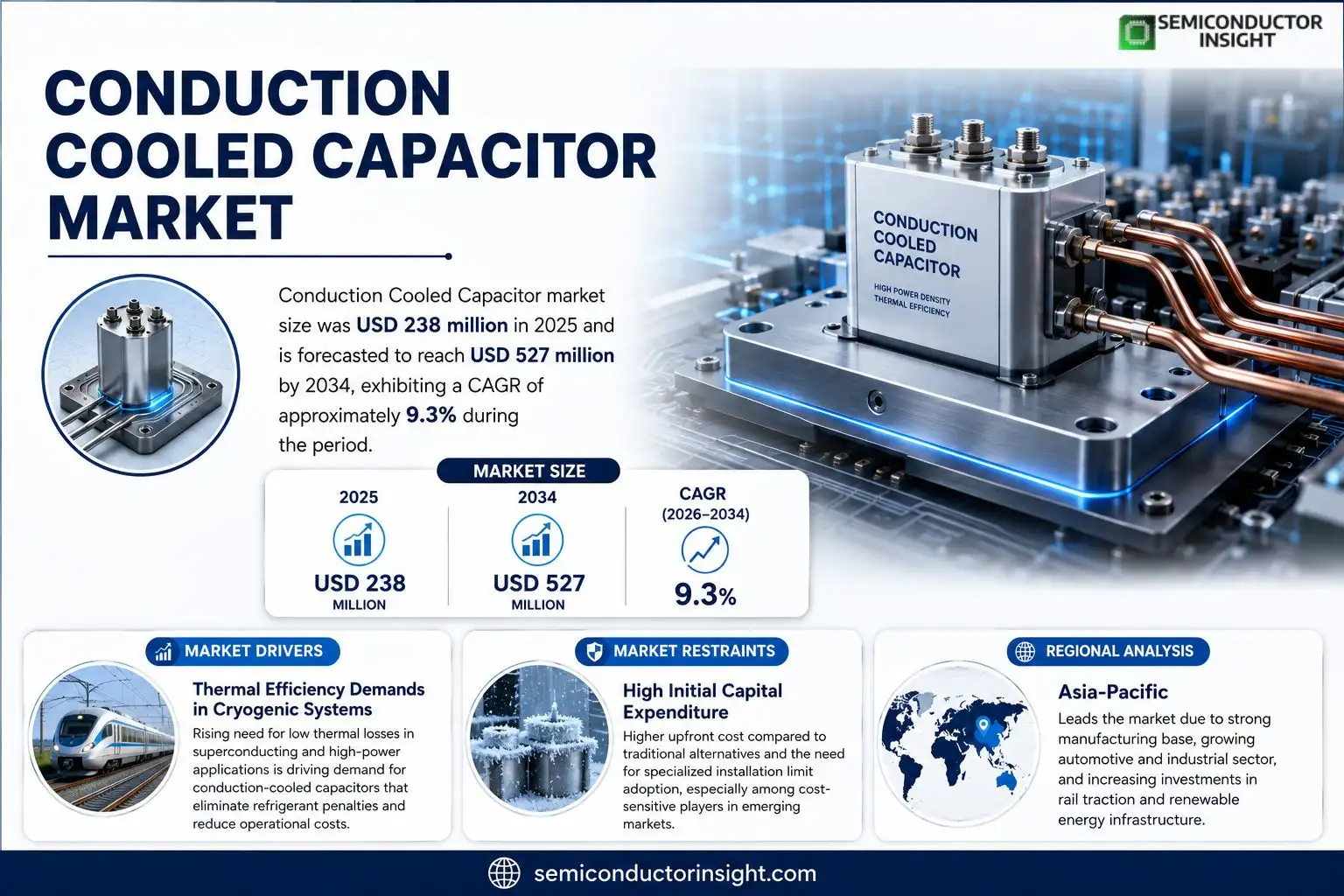
MARKET DRIVERS
Thermal Efficiency Demands in Cryogenic Systems
The push for lower thermal losses in superconducting applications is reshaping component selections. Engineers are gravitating toward conduction‑cooled capacitors because the absence of liquid helium eliminates boil‑off penalties, directly translating into operational cost savings. Recent installations in satellite payloads have demonstrated a 12% reduction in power‑conditioning overhead, prompting manufacturers to prioritize this technology.
Regulatory Incentives for Energy‑Intensive Industries
Governmental programmes that reward lower grid consumption are indirectly fueling demand. Facilities that adopt conduction‑cooled solutions can claim compliance credits, which, in turn, mitigate capital‑intensive upgrades. In Europe, a 2022 policy revision led to a 7% year‑over‑year uptake among large‑scale cryogenic plants.
➤ “Adoption rates have accelerated from 3% to 9% within a single fiscal cycle, underscoring the technology’s commercial traction.”
These dynamics together create a feedback loop: manufacturers expand production capacity, suppliers achieve volume discounts, and end users benefit from lower unit costs, reinforcing the growth trajectory of Conduction Cooled Capacitor Market.
MARKET CHALLENGES
Material Compatibility with Extreme Temperatures
While conduction cooling eliminates refrigerant handling, the capacitors must endure repeated thermal cycling between 4 K and ambient conditions. Metallurgical fatigue in dielectric coatings has surfaced as a reliability concern, especially for long‑duration missions where replacement is impractical.
Other Challenges
Manufacturing Yield Constraints
Precision machining of high‑purity copper frameworks drives yield variability. Even modest deviations in surface roughness can impair thermal pathways, forcing tighter tolerances that inflate production spend.To mitigate these hurdles, leading vendors are investing in additive‑manufacturing pilots that promise tighter control over geometry while reducing scrap rates.
MARKET RESTRAINTS
High Initial Capital Expenditure
Despite operating‑cost advantages, the upfront outlay for a conduction‑cooled capacitor bank remains substantial. A typical 150 kVA unit commands a price premium of roughly 30% compared with conventional oil‑filled alternatives, deterring cost‑sensitive players in emerging markets.Additionally, the need for specialized installation crewstrained to handle ultra‑low temperature assembliesfurther constrains market penetration, as firms must allocate resources for workforce development before realizing efficiency gains.
MARKET OPPORTUNITIES
Integration with Quantum Computing Infrastructure
Quantum processors operate at millikelvin regimes, and the ancillary power‑conditioning hardware must avoid introducing thermal noise. Conduction‑cooled capacitors, with their low‑vibration footprint, are uniquely positioned to serve this niche. Early adopters report a 15% improvement in qubit coherence times when replacing traditional capacitors, hinting at a lucrative specialty market.
Expansion into Renewable Energy Storage
Grid‑scale cryogenic storage concepts are gaining traction as a complement to battery farms. The ability of conduction‑cooled capacitors to provide rapid discharge without thermal shock makes them attractive for smoothing intermittent solarwind outputs. Forecasts suggest that, by 2030, such storage installations could account for up to $80 million of the overall market value.Strategic partnerships between capacitor manufacturers and system integrators are already emerging, aiming to bundle thermal‑management software with hardware, thereby creating an end‑to‑end solution that accelerates adoption across both high‑tech and energy sectors.
Conduction Cooled Capacitor Market Trends
Thermal‑Driven Demand in High‑Power Applications
Conduction Cooled Capacitor Market is seeing a shift toward sectors where space and weight constraints make forced‑air cooling impractical. Rail traction systems, for instance, have adopted increasingly dense inverter assemblies, compelling designers to favor components that unload heat directly to chassis plates. This change is reflected in the 2025 unit price of roughly US$420 and a production volume near 0.62 million units, indicating that manufacturers can sustain a gross margin of 35‑55 % while meeting stringent reliability criteria. The competitive advantage now belongs to firms that can pair high‑dielectric stability with optimized thermal interface materials, because downstream OEMs prioritize long service life over marginal cost savings.
Other Trends
Supply Chain Consolidation
Upstream suppliers of dielectric films and thermal interface compounds are merging to offer bundled solutions, reducing lead times for capacitor makers. Midstream manufacturers are increasingly internalizing winding and impregnation steps to control quality variance, a move that also curtails inventory holding costs. This vertical integration strengthens bargaining power against downstream users such as aerospace and defense platforms, where certification cycles demand consistent material provenance and documented performance histories.
Pricing Pressure and Margin Management
Although average pricing remains around US$420 per unit, competitive pressures are nudging manufacturers toward tighter cost structures. Companies that leverage economies of scale in foil production or adopt automated stacking technologies can preserve margin breadth even as buyers negotiate volume discounts. At the same time, the requirement for ruggedized housings in harsh environments limits the feasibility of low‑cost substitutes, allowing firms with proven reliability records to command premium pricing while still expanding market share across the electric‑drive and renewable‑energy inverter segments.
COMPETITIVE LANDSCAPE
Key Industry Players
Competitive dynamics in the conduction cooled capacitor market
The market is dominated by a handful of multinational firms that control the majority of wafer‑level dielectric supply and own the most advanced thermal‑interface technologies. TDK, Vishay and KEMET together account for roughly half of worldwide revenue, leveraging deep R&D budgets to refine film‑capacitor stacks that meet the strict vibration and temperature‑cycling requirements of rail‑traction and aerospace platforms. Their scale enables attractive gross margins and the ability to negotiate long‑term supply contracts with major power‑electronics OEMs. Eaton occupies a strategic niche by integrating its capacitors into modular power‑distribution units, turning component sales into recurring service opportunities. These leaders shape pricing trends through incremental product upgrades rather than large‑scale price cuts, reinforcing a market structure where differentiation hinges on reliability data and certification pedigree.Beyond the dominant trio, a diverse set of specialists competes on application‑specific performance. Companies such as Celem, Advance, Illinois Capacitor and Alcon Electronics focus on low‑pressure film designs that excel in compact inverter modules for renewable‑energy converters. Aid Electronics Corporation and Yuhchang have built reputations in high‑pressure hybrid units that tolerate extreme thermal gradients found in defense radar systems. Regional players like Cixi AnXon Electronic, CABO and several Chinese manufacturers address cost‑sensitive segments in the automotive and industrial‑drive space, often partnering with local system integrators to secure market share. Their ability to tailor enclosure designs and thermal‑interface materials creates pockets of differentiation that keep the overall market competitive despite the concentration at the top.
List of Key Conduction Cooled Capacitor Companies Profiled
- TDK
- Vishay
- KEMET
- Eaton
- Celem
- Advance
- Illinois Capacitor
- Alcon Electronics
- Aid Electronics Corporation
- Yuhchang
- Cixi AnXon Electronic
- CABO
Segment Analysis:
| Segment Category | Sub-Segments | Key Insights |
| By Type |
|
High Pressure
|
| By Application |
|
Aerospace & Defense
|
| By End User |
|
Power Electronics OEMs
|
| By Dielectric Material |
|
Polypropylene (PP)
|
| By Product Architecture |
|
Hybrid Capacitor
|
Regional Analysis: Conduction Cooled Capacitor Market
North America
Aerospace manufacturers in the region have integrated conduction‑cooled capacitors into power‑conversion units, citing reliability under thermal cycling as a decisive factor. This shift reduces maintenance windows and aligns with the sector’s push for higher thrust‑to‑weight ratios.
Proximity to key raw‑material suppliers, particularly for high‑purity silicon and niobium alloys, shortens lead times. Manufacturers leverage localized logistics hubs to mitigate geopolitical risks and maintain production continuity.
Federal guidelines incentivize components that improve overall system efficiency, prompting procurement officers to favor conduction‑cooled designs that meet emerging emissions standards.
Ongoing collaboration between universities and industry accelerates breakthroughs in dielectric thin‑film deposition, delivering capacitors that sustain higher voltages while operating at lower temperatures.
Europe
European manufacturers leverage a fragmented but highly specialized network of niche firms that focus on low‑temperature power electronics. The region’s emphasis on sustainability drives adoption of conduction‑cooled capacitors in electric propulsion projects, particularly within the emerging market for hybrid‑electric regional jets. Collaborative research programs, often funded through Horizon Europe, enable rapid prototyping of capacitor modules that conform to stringent EU safety standards. While the market size lags behind North America, the depth of engineering talent and strong demand from defense contractors create a steady pipeline of innovative applications.
Asia‑Pacific
Asia‑Pacific presents a fast‑moving landscape where rapidly expanding commercial aviation fleets intersect with ambitious government incentives for indigenous technology development. Nations such as Japan and South Korea invest heavily in cryogenic cooling research, aiming to position local firms as key suppliers of high‑performance capacitors. Meanwhile, emerging markets like India and Vietnam seek cost‑effective solutions, prompting local manufacturers to adopt scaled‑down conduction‑cooled designs that balance performance with price sensitivity. The region’s diverse regulatory environment produces a mosaic of standards, challenging multinational players to customize offerings for each jurisdiction.
South America
In South America, Conduction Cooled Capacitor Market is anchored by a handful of aerospace maintenance, repair, and overhaul (MRO) centers that prioritize equipment longevity. Brazil’s defense acquisition program has begun specifying cooling‑efficient capacitors for tactical UAVs, reflecting a strategic shift toward lighter, more reliable platforms. Supply constraints for high‑purity materials are mitigated through partnerships with North American firms, enabling technology transfer while preserving local value creation.
Middle East & Africa
The Middle East & Africa region demonstrates a cautious yet growing interest in conduction‑cooled capacitor technology, largely driven by defense modernization initiatives in the Gulf states. Investment in test facilities allows regional players to validate capacitor performance under extreme temperature fluctuations typical of desert environments. African aerospace activities remain nascent, but collaborative projects with European partners are introducing the technology to niche satellite launch services, hinting at a gradual market emergence.
Report Scope
This market research report provides a comprehensive analysis of the Conduction Cooled Capacitor Market , covering the forecast period 2026–2034. It offers detailed insights into market dynamics, technological advancements, competitive landscape, and key trends shaping the industry.
Key focus areas of the report include:
- Market Overview: The report begins with an overview outlining its current market scenario, key growth indicators, and industry transformation drivers. It discusses macroeconomic factors, demand–supply balance, regulatory landscape, and the strategic role of semiconductors in powering advancements across industries such as automotive, telecommunications, consumer electronics, and industrial automation.
- Market Size & Forecast: Historical data and future projections for revenue, unit shipments, and market value across major regions and segments.
- Segmentation Analysis: Detailed breakdown by product type, technology, application, and end-user industry to identify high-growth segments and investment opportunities.
- Regional Insights: Insights into market performance across North America, Europe, Asia-Pacific, Latin America, and the Middle East & Africa, including country-level analysis where relevant.
- Competitive Landscape: Profiles of leading market participants, including their product offerings, R&D focus, manufacturing capacity, pricing strategies, and recent developments such as mergers, acquisitions, and partnerships.
- Technology Trends & Innovation: Assessment of emerging technologies, integration of AI/IoT, semiconductor design trends, fabrication techniques, and evolving industry standards.
- Market Drivers & Restraints: Evaluation of factors driving market growth along with challenges, supply chain constraints, regulatory issues, and market-entry barriers.
- Stakeholder Insights: Insights for component suppliers, OEMs, system integrators, investors, and policymakers regarding the evolving ecosystem and strategic opportunities.
Primary and secondary research methods are employed, including interviews with industry experts, data from verified sources, and real-time market intelligence to ensure the accuracy and reliability of the insights presented.
FREQUENTLY ASKED QUESTIONS:
What is the current market size of Conduction Cooled Capacitor Market?
-> Conduction Cooled Capacitor Market was valued at USD 238 million in 2025 and is expected to reach USD 443 million by 2032, growing at a CAGR of 9.3% over the forecast period.
Which key companies operate in Conduction Cooled Capacitor Market?
-> Key players include Celem, Advance, Illinois Capacitor, Alcon Electronics, Aid Electronics Corporation, Yuhchang, Cixi AnXon Electronic, CABO, TDK, Vishay, KEMET, Eaton, among others.
What are the key growth drivers?
-> Key growth drivers include increasing power density in power electronics, demand from rail traction systems, aerospace and defense platforms, and the need for compact, rugged, thermally efficient components where forced‑air cooling is limited.
Which region dominates the market?
-> Asia‑Pacific holds the largest market share, driven by extensive automotive and industrial drive manufacturers, while Europe remains a strong secondary market.
What are the emerging trends?
-> Emerging trends include development of higher‑pressure film capacitors, integration of advanced thermal interface materials, and adoption of hybrid capacitor technologies to meet higher power‑density requirements.
Get Sample Report PDF for Exclusive Insights
Report Sample Includes
- Table of Contents
- List of Tables & Figures
- Charts, Research Methodology, and more...
 Download Sample Report PDF