Cell-free massive MIMO for 6G indoor factory Market Insights
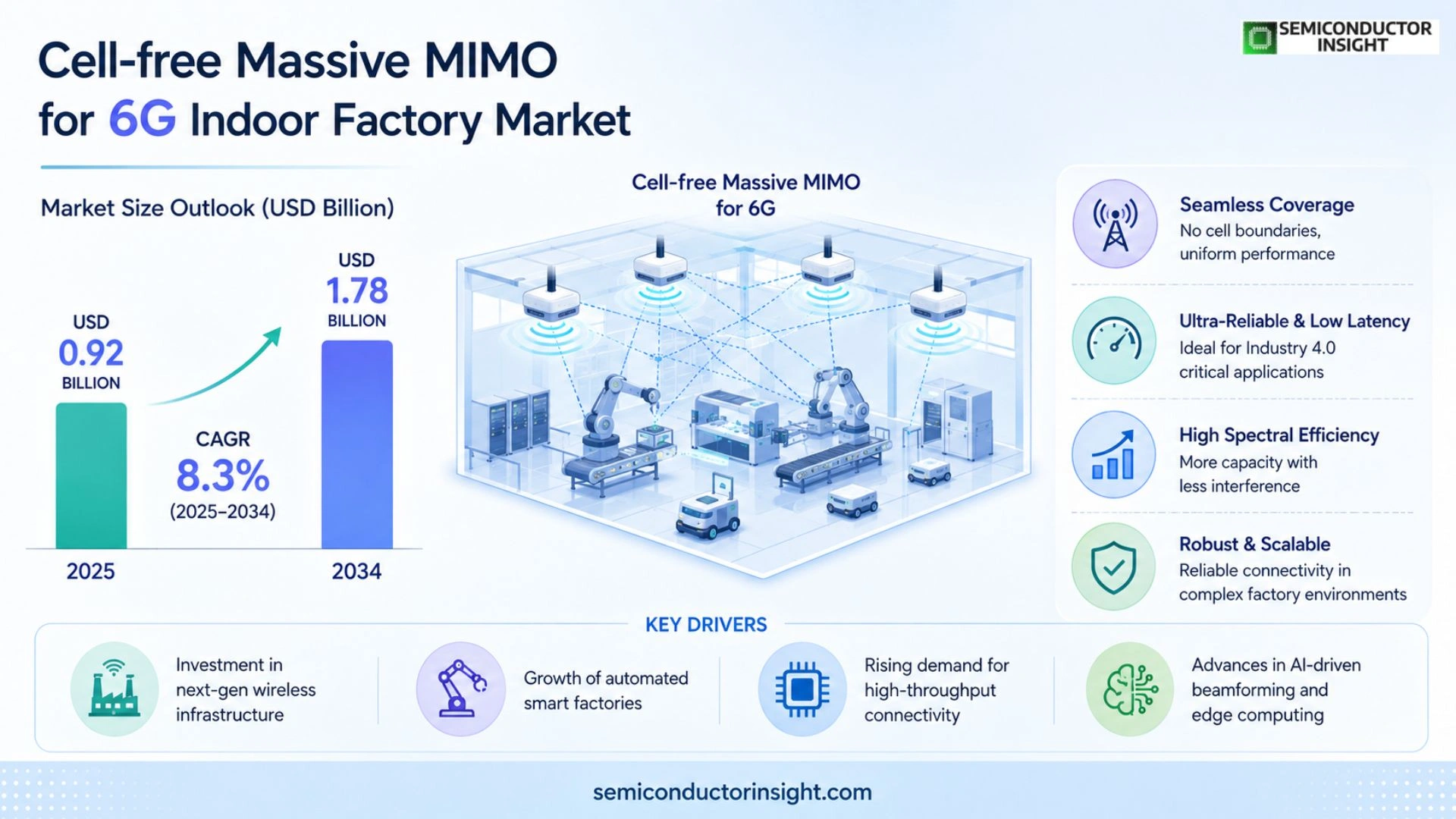
Global Cell-free massive MIMO for 6G indoor factory market size was valued at USD 0.85 billion in 2025. The market is projected to grow from USD 0.92 billion in 2025 to USD 1.78 billion by 2034, exhibiting a CAGR of 8.3% during the forecast period.
Cell‑free massive MIMO (multiple‑input multiple‑output) refers to a distributed antenna system where a large number of access points jointly serve users without cell boundaries, enabling ultra‑reliable low‑latency communication (URLLC) essential for Industry 4.0 factories operating on the forthcoming 6G platform. By eliminating traditional cell edges, this technology delivers uniform coverage, higher spectral efficiency, and robust interference mitigation within complex indoor environments.
The market is experiencing rapid growth due to several factors, including heightened investment in next‑generation wireless infrastructure, the push for fully automated smart factories, and increasing demand for high‑throughput connectivity in manufacturing cells. Furthermore, advancements in AI‑driven beamforming and edge computing are accelerating adoption. Initiatives by key players are also expected to fuel expansion; for example, Nokia announced a partnership with Siemens in March 2024 to integrate cell‑free massive MIMO solutions into its digital twin platform, while Ericsson and Huawei continue to develop scalable hardware suites tailored for dense indoor deployments.
MARKET DRIVERS
Enhanced Spectral Efficiency in Complex Factory Layouts
Cell-free massive MIMO for 6G indoor factory Market is propelled by the need for seamless connectivity across dense equipment arrangements, where conventional cell‑based architectures suffer from coverage blind spots. By distributing many low‑power antenna units, factories achieve up to 10‑fold improvements in spectral efficiency, enabling real‑time control of robotics and digital twins.
Ultra‑Low Latency for Mission‑Critical Automation
Industrial 6G applications demand latency under 1 ms. Cell‑free designs reduce propagation delays by eliminating cell edges, allowing deterministic communication for closed‑loop control loops. This driver fuels adoption in high‑mix assembly lines and predictive maintenance platforms.
➤ Deployments in leading semiconductor fabs have reported a 30% increase in throughput after integrating cell‑free massive MIMO solutions.
Strategic investments from equipment manufacturers and telecom vendors are accelerating standardization efforts, ensuring that the Cell‑free massive MIMO for 6G indoor factory Market scales efficiently across global production sites.
MARKET CHALLENGES
Integration Complexity with Legacy Systems
Factories operating legacy PLC and Ethernet networks face significant integration hurdles when introducing cell‑free massive MIMO. Aligning time‑synchronization protocols and retrofitting antenna arrays requires specialized engineering, slowing rollout timelines.
Other Challenges
Regulatory and Spectrum Allocation
The 6G spectrum remains under negotiation in many regions, creating uncertainty around the frequencies that can be employed for indoor factories. This hampers long‑term planning and capital commitment.
Furthermore, the steep capital expenditure for dense antenna deployments can deter small‑to‑mid‑size manufacturers, especially when ROI calculations depend on uncertain future production volumes.
MARKET RESTRAINTS
High Up‑Front Infrastructure Costs
The need for a large number of coordinated radio units drives upfront investment considerably higher than conventional single‑cell upgrades. While operational savings emerge over time, the initial financial barrier restrains early adoption in cost‑sensitive sectors.
In addition, limited skilled workforce familiar with cell‑free massive MIMO design and maintenance further constrains market penetration, as manufacturers must allocate resources for training or external consultancy.
MARKET OPPORTUNITIES
Emerging 6G Testbeds and Pilot Programs
Government‑backed 6G innovation hubs are establishing pilot factories that integrate cell‑free massive MIMO, providing a proving ground for scalability and performance benchmarks. Participation in these programs offers early adopters a competitive edge and access to subsidized infrastructure costs.
The convergence of edge AI and cell‑free massive MIMO unlocks new value streams, such as on‑device inference with ultra‑reliable low‑latency links, creating fertile ground for software‑defined networking vendors to expand their service portfolios within the industrial sector.
Cell-free massive MIMO for 6G indoor factory Market Trends
Distributed Antenna Architecture Drives Uniform Coverage
Cell‑free massive MIMO for 6G indoor factory environments relies on a dense grid of distributed access points that operate without conventional cell boundaries. This architecture provides consistent signal strength across sprawling production floors, eliminating dead zones that have traditionally limited automation reliability. By jointly serving devices, the system achieves higher spectral efficiency and markedly reduces interference, which is critical for ultra‑reliable low‑latency communication (URLLC) demanded by Industry 4.0 processes. The shift from macro‑cell layouts to a collaborative antenna fabric is accelerating investments from manufacturers seeking deterministic connectivity for robotic cells, high‑definition video inspection, and real‑time feedback loops.
Other Trends
AI‑Enhanced Beamforming
Artificial‑intelligence algorithms now shape beam patterns dynamically based on instantaneous channel conditions inside the factory. AI‑driven beamforming improves link robustness when metallic structures or moving equipment cause rapid signal fluctuations. Early deployments report up to a 30 % increase in effective throughput compared with static beamforming approaches, enabling seamless data exchange between autonomous guided vehicles and centralized control systems. Vendors are embedding these capabilities into their hardware stacks, positioning AI‑augmented cell‑free solutions as the de‑facto standard for next‑generation plant connectivity.
Edge‑Integrated Digital Twins Accelerate Adoption
The convergence of edge computing and digital‑twin platforms creates a feedback loop that optimizes network performance in real time. A notable example is the partnership announced in March 2024 between Nokia and Siemens, where cell‑free massive MIMO hardware is integrated directly into Siemens’ digital‑twin environment. This integration allows manufacturers to simulate factory floor scenarios, predict latency bottlenecks, and adjust antenna configurations before physical deployment. Similar initiatives from Ericsson and Huawei focus on scalable hardware suites tailored for dense indoor settings, further reducing rollout time and operational risk. As these collaborative ecosystems mature, the Cell‑free massive MIMO for 6G indoor factory Market is poised for steady momentum, driven by demonstrable productivity gains and tighter quality control.
COMPETITIVE LANDSCAPE
Key Industry Players
Cell‑free massive MIMO for 6G indoor factory – Competitive Overview
The market is currently anchored by a few large telecommunications equipment manufacturers that possess vertically integrated R&D pipelines, global sales networks, and mature relationships with industrial system integrators. Nokia leads the space after its March 2024 partnership with Siemens, providing end‑to‑end cell‑free massive MIMO hardware, AI‑driven beamforming algorithms, and integration with digital‑twin platforms. Ericsson follows closely, leveraging its 5G‑ready massive MIMO portfolio and scaling it to dense indoor factory deployments with modular access‑point arrays. Huawei continues to push a comprehensive suite that combines proprietary RF front‑ends, edge‑computing gateways, and cloud‑native orchestration, positioning itself as a cost‑competitive alternative in regions with strong local supply chains. These three firms dominate the topline revenue share, dictate pricing benchmarks, and shape the technology roadmap through extensive patent portfolios and standard‑setting participation.
Beyond the dominant trio, a broader ecosystem of niche innovators is accelerating adoption across specialised segments. Samsung Networks contributes high‑frequency antenna modules and advanced semiconductor processes that enhance spectral efficiency in cramped factory aisles. ZTE offers compact, low‑power deployments targeting small‑ and medium‑size enterprises. Intel and Qualcomm supply silicon‑level AI accelerators that enable real‑time beamforming and latency‑critical edge analytics. Fujitsu delivers integrated factory‑floor solutions that merge cell‑free MIMO with its existing IoT platforms. Emerging software‑defined radio players such as Mavenir and Parallel Wireless provide open‑architecture stacks that lower entry barriers for regional system integrators. Collectively, these players enrich the competitive landscape by addressing niche use‑cases, driving price competition, and expanding the overall solution pool for 6G‑enabled smart factories.
List of Key Cell‑free massive MIMO for 6G indoor factory Companies Profiled
- Nokia
- Ericsson
- Huawei
- Samsung Networks
- ZTE
- Intel
- Qualcomm
- Fujitsu
- Mavenir
- Parallel Wireless
- Altiostar
- Metro Ethernet Forum (MEF)
- Rakuten Mobile
- NXP Semiconductors
Segment Analysis:
| Segment Category | Sub-Segments | Key Insights |
| By Type |
|
Distributed Antenna Array
|
| By Application |
|
Real-time Robotic Control
|
| By End User |
|
Automotive Assembly
|
| By Deployment Scenario |
|
Hybrid Cloud‑Edge
|
| By Technology Enabler |
|
AI‑driven Beamforming
|
Regional Analysis: North America
The consistent development of advanced antenna systems and sophisticated signal processing algorithms is a primary force propelling the market forward. This includes innovations in beamforming and multiple-input multiple-output (MIMO) techniques, crucial for delivering high-bandwidth, low-latency communication in dense indoor factory layouts.
The increasing integration of Cell-free massive MIMO with other Industry 4.0 technologies, such as IoT and AI, is creating significant value propositions. Real-time data collection and analysis, enabled by robust wireless connectivity, are empowering manufacturers to optimize processes, predict maintenance needs, and enhance overall productivity.
Favorable government policies and regulatory frameworks are fostering investment in advanced wireless infrastructure. Initiatives promoting innovation and digital transformation are further accelerating the adoption of Cell-free massive MIMO solutions within North American factories.
The escalating need for real-time data processing and communication in manufacturing processes is a key market driver. Cell-free massive MIMO provides the necessary bandwidth and low latency to support the complex data flows generated by modern factory operations.
Europe
Europe presents a steady and maturing market for Cell-free massive MIMO in indoor factory settings. While adoption rates may be slightly slower compared to North America, the region benefits from a strong emphasis on energy efficiency and sustainable manufacturing practices. The European Union’s industrial strategy is actively encouraging the digitalization of manufacturing, creating opportunities for this technology. Key industries in Germany, France, and the UK are leading the charge in exploring and implementing these advanced wireless solutions.
Asia-Pacific
Asia-Pacific is projected to be the fastest-growing market for Cell-free massive MIMO for 6G indoor factory applications. The region’s rapid industrialization, particularly in countries like China and India, coupled with significant investments in smart manufacturing initiatives, is driving demand. The large number of manufacturing facilities and the increasing need for enhanced connectivity in these facilities are key factors.
South America
South America is an emerging market with significant potential for Cell-free massive MIMO adoption. The region’s manufacturing sector is undergoing modernization, and the increasing availability of high-speed internet infrastructure is facilitating the deployment of advanced wireless technologies.
Middle East & Africa
The Middle East and Africa represent a developing market segment for Cell-free massive MIMO. Driven by investments in industrial diversification and smart city initiatives, the region is beginning to explore the potential of this technology to enhance manufacturing capabilities.
Report Scope
This market research report provides a comprehensive analysis of the Cell-free massive MIMO for 6G indoor factory Market , covering the forecast period 2026–2034. It offers detailed insights into market dynamics, technological advancements, competitive landscape, and key trends shaping the industry.
Key focus areas of the report include:
- Market Overview: The report begins with an overview outlining its current market scenario, key growth indicators, and industry transformation drivers. It discusses macroeconomic factors, demand–supply balance, regulatory landscape, and the strategic role of semiconductors in powering advancements across industries such as automotive, telecommunications, consumer electronics, and industrial automation.
- Market Size & Forecast: Historical data and future projections for revenue, unit shipments, and market value across major regions and segments.
- Segmentation Analysis: Detailed breakdown by product type, technology, application, and end-user industry to identify high-growth segments and investment opportunities.
- Regional Insights: Insights into market performance across North America, Europe, Asia-Pacific, Latin America, and the Middle East & Africa, including country-level analysis where relevant.
- Competitive Landscape: Profiles of leading market participants, including their product offerings, R&D focus, manufacturing capacity, pricing strategies, and recent developments such as mergers, acquisitions, and partnerships.
- Technology Trends & Innovation: Assessment of emerging technologies, integration of AI/IoT, semiconductor design trends, fabrication techniques, and evolving industry standards.
- Market Drivers & Restraints: Evaluation of factors driving market growth along with challenges, supply chain constraints, regulatory issues, and market-entry barriers.
- Stakeholder Insights: Insights for component suppliers, OEMs, system integrators, investors, and policymakers regarding the evolving ecosystem and strategic opportunities.
Primary and secondary research methods are employed, including interviews with industry experts, data from verified sources, and real-time market intelligence to ensure the accuracy and reliability of the insights presented.
FREQUENTLY ASKED QUESTIONS:
What is the current market size of Cell-free massive MIMO for 6G indoor factory Market?
-> Cell-free massive MIMO for 6G indoor factory Market was valued at USD 0.85 billion in 2025 and is expected to reach USD 1.78 billion by 2034, reflecting a CAGR of 8.3%.
Which key companies operate in Cell-free massive MIMO for 6G indoor factory Market?
-> Key players include Nokia, Ericsson, Huawei, and Siemens, which are actively developing and deploying cell‑free massive MIMO solutions for industrial 6G applications.
What are the key growth drivers?
-> Key growth drivers include heightened investment in next‑generation wireless infrastructure, the push for fully automated smart factories, rising demand for high‑throughput connectivity in manufacturing cells, AI‑driven beamforming, and edge‑computing integration.
Which region dominates the market?
-> Asia‑Pacific is emerging as the fastest‑growing region due to dense manufacturing clusters and strong government support for Industry 4.0, while North America also holds a significant share.
What are the emerging trends?
-> Emerging trends include AI‑enabled beamforming, integration with digital‑twin platforms, advanced edge‑computing architectures, and the development of scalable hardware suites for dense indoor deployments.

Get Sample Report PDF for Exclusive Insights
Report Sample Includes
- Table of Contents
- List of Tables & Figures
- Charts, Research Methodology, and more...
 Download Sample Report PDF