Car Ambient Light Driver IC Market Insights
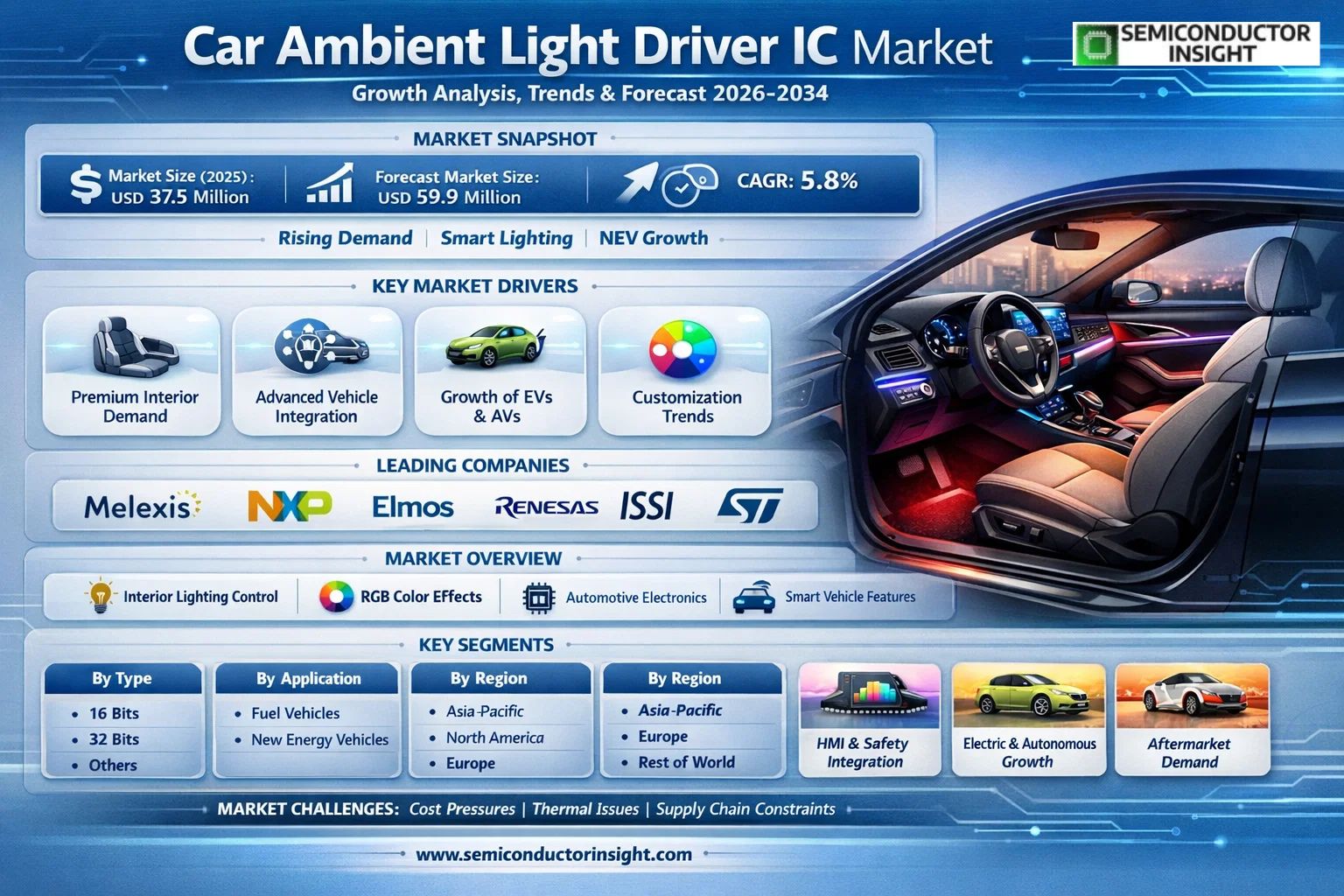
Global Car Ambient Light Driver IC market size was valued at USD 37.5 million in 2025. The market is projected to grow from USD 39.7 million in 2026 to USD 59.9 million by 2034, exhibiting a CAGR of 5.8% during the forecast period.
A Car Ambient Light Driver IC is an integrated circuit specifically designed to control and drive the LEDs used for ambient lighting in vehicles. These ICs manage the current, voltage, and color of the LEDs, enabling features like dimming, color changing (RGB), and dynamic lighting effects. They often incorporate features like pulse-width modulation (PWM) for precise brightness control, and communication interfaces (e.g., LIN, CAN) for integration with the vehicle’s electronic control unit (ECU). These ICs are crucial for creating customized and aesthetically pleasing interior lighting experiences.
The market is experiencing steady growth due to several factors, including increasing consumer demand for premium interior aesthetics and personalization in both fuel and new energy vehicles. Furthermore, the trend towards higher integration and smarter functionality is a key driver; modern driver ICs now incorporate advanced features like fault detection and sophisticated color management algorithms directly on-chip. This push for smarter systems enables dynamic effects synchronized with music or driving modes, which is becoming a significant differentiator for automakers. The rapid adoption in New Energy Vehicles (NEVs), where advanced interiors are a major selling point, provides a substantial growth avenue because these vehicles often prioritize high-tech cabin experiences.
MARKET DRIVERS
Increasing Demand for Premium Interior Aesthetics
The primary growth driver for the Car Ambient Light Driver IC Market is the automotive industry’s strategic shift towards enhancing cabin experience and perceived value. As vehicle electrification and shared platform strategies narrow performance differentiation, manufacturers leverage ambient lighting as a key differentiator for premium and mid-range models. Driver ICs are central to enabling this, as they provide the precise control for multi-zone, RGB, and dynamic lighting effects that modern designs require.
Integration with Advanced Vehicle Architectures
The evolution towards domain controllers and zonal electrical/electronic architectures creates a direct demand for more sophisticated and network-capable lighting control modules. Modern Car Ambient Light Driver ICs are increasingly designed to interface seamlessly with CAN FD, LIN, or Ethernet networks, allowing them to be orchestrated by central vehicle computers for synchronized themes with infotainment and advanced driver-assistance systems (ADAS).
➤ Standardization of safety-relevant signaling is a growing trend, where the Car Ambient Light Driver IC Market is seeing demand for ICs that can produce specific colors or patterns to indicate charging status, autonomous driving mode activation, or collision warnings.
Finally, stringent automotive reliability and quality standards push the adoption of application-specific driver ICs over generic solutions. These dedicated ICs for the Car Ambient Light Driver IC Market offer superior thermal management, electromagnetic compatibility, and functional safety features, which are critical for automotive-grade approval and long-term durability.
MARKET CHALLENGES
Cost Pressure and Supply Chain Complexity
Despite growing demand, a significant challenge in the Car Ambient Light Driver IC Market is intense cost pressure from automakers, particularly for volume segments. Integrating complex features like high-resolution PWM, diagnostics, and communication protocols increases IC complexity and die size, conflicting with demands for lower system BOM costs. Furthermore, the automotive semiconductor supply chain remains susceptible to disruptions, affecting the stable supply of essential components.
Other Challenges
Thermal Management in High-Density Applications
As ambient lighting systems incorporate more LEDs in tighter spaces, the thermal load on the Driver IC increases. Designing for efficient heat dissipation while maintaining a small form factor is a persistent engineering hurdle.
Software and Integration Overhead
The sophistication of lighting systems requires extensive software development for control algorithms and system integration, adding significant non-recurring engineering costs and project timeline complexity for Tier-1 suppliers and OEMs.
MARKET RESTRAINTS
Economic Sensitivity and Segment-Wide Adoption
The broader Car Ambient Light Driver IC Market growth is tempered by macroeconomic factors that affect automotive production volumes, such as inflationary pressures and fluctuating consumer demand. While premium segments widely adopt advanced systems, penetration into the high-volume economy car segment is slower. In these price-sensitive segments, ambient lighting is often a basic, single-color feature, utilizing simpler and cheaper driver solutions, which restrains the addressable market for advanced multi-channel driver ICs.
Consolidated Supplier Environment
The market is characterized by a relatively consolidated landscape of established semiconductor vendors with strong relationships with Tier-1 suppliers. This creates high barriers to entry for new players in the Car Ambient Light Driver IC Market, as achieving the necessary quality certifications (AEC-Q100) and securing design-wins involves long qualification cycles and significant upfront investment, potentially limiting innovation and price competition.
MARKET OPPORTUNITIES
Expansion into Functional and Human-Machine Interface Roles
The most significant opportunity lies in evolving ambient lighting from a purely aesthetic feature to a core component of the human-machine interface (HMI) and functional safety. The Car Ambient Light Driver IC Market is poised for growth as ICs enable lighting that communicates vehicle status, navigational cues, or ADAS alerts, enhancing situational awareness and reducing driver cognitive load.
Growth of Electric and Autonomous Vehicle Segments
The rapid growth of battery electric vehicles (BEVs) and the development of autonomous driving cabins represent a major greenfield opportunity. These vehicles prioritize innovative interior design and user experience, creating a premium environment for highly sophisticated, brand-defining ambient lighting systems that rely on advanced driver ICs for seamless and responsive control.
Aftermarket and Personalization Trends
Beyond OEM fitment, a growing trend of vehicle personalization opens a parallel aftermarket channel. Demand for customizable lighting kits creates opportunities for driver ICs designed for retrofit applications, requiring robust designs that can interface with diverse vehicle electrical systems while offering user-friendly configurability.
Trends
Prioritizing Advanced Color and Dynamic Control
Evolution of the Car Ambient Light Driver IC Market is primarily defined by a shift towards sophisticated customization. A core trend is the demand for advanced color control, moving beyond basic RGB functionality to enable wider color gamuts and more precise color mixing. This necessitates driver ICs with more refined PWM controllers and integrated color management algorithms. Concurrently, the market shows a strong trend toward enabling smarter, dynamic lighting effects. Modern driver ICs, through advanced communication interfaces like LIN and CAN FD, facilitate synchronized lighting patterns that react to music, driving modes, or personalized driver profiles, transforming the vehicle interior into a dynamic experience hub.
Other Trends
Integration and Functional Consolidation
There is an accelerating push for higher integration within the Car Ambient Light Driver IC Market. Manufacturers are designing ICs that incorporate multiple functions such as constant current regulation, comprehensive fault detection, and communication protocols into a single chip. This consolidation reduces the need for external components, simplifies the PCB design for Tier-1 suppliers, lowers overall system cost, and enhances reliability, which are critical factors for automotive applications.
Emphasis on Efficiency and Robust System Design
Alignment with broader automotive imperatives is driving a focus on energy efficiency and thermal performance in Car Ambient Light Driver ICs. Newer ICs are engineered for lower quiescent current and higher conversion efficiency to minimize power drain on the vehicle’s electrical system. Improved thermal management designs are equally crucial, ensuring stable operation under the wide temperature ranges and harsh environments inherent to automotive use. This trend underscores the industry’s commitment to meeting stringent automotive-grade requirements while enhancing the personalized in-cabin experience.
COMPETITIVE LANDSCAPE
Key Industry Players
A Market Evolving from Functional Illumination to Smart, Personalized Experiences
Global Car Ambient Light Driver IC market is characterized by a mix of established automotive semiconductor suppliers and specialized analog/mixed-signal IC companies, with a high degree of technical expertise forming a significant barrier to entry. The landscape is moderately consolidated, with leading players like Melexis, NXP Semiconductors, STMicroelectronics, and Renesas holding considerable market share due to their deep-rooted relationships with tier-1 automotive suppliers and OEMs, comprehensive product portfolios, and robust quality management systems meeting stringent AEC-Q100 standards. Competition is intensifying around the integration of advanced features such as high-precision PWM control for sophisticated color mixing, integrated communication interfaces (LIN, CAN, CAN FD), and diagnostic functionalities, which are becoming critical differentiators in premium and new energy vehicle segments.
Beyond the major broad-line semiconductor vendors, several key players have carved out strong positions by focusing on niche technological expertise. Companies such as Elmos and Indie Micro are recognized for their system-level understanding and specialized driver IC solutions that enable complex, dynamic lighting scenarios. Meanwhile, suppliers like ISSI and Silergy Corporation compete effectively by offering highly integrated and cost-optimized solutions, addressing the growing demand in mid-range vehicle segments. The competitive dynamic is further shaped by the industry’s shift towards software-defined features and personalized cabin environments, pushing all players to invest heavily in R&D for smarter, more efficient, and thermally robust ICs that support over-the-air update capabilities and seamless integration with broader vehicle electronic architectures.
List of Key Car Ambient Light Driver IC Companies Profiled
- Melexis
- NXP Semiconductors
- Elmos Semiconductor SE
- Indie Micro
- Renesas Electronics Corporation
- ISSI (Integrated Silicon Solution, Inc.)
- STMicroelectronics
- Silergy Corporation
- Texas Instruments
- Infineon Technologies
- ON Semiconductor
- ROHM Semiconductor
- Monolithic Power Systems (MPS)
- Analog Devices, Inc.
- Maxim Integrated (now part of Analog Devices)
Segment Analysis:
| Segment Category | Sub-Segments | Key Insights |
| By Type |
|
32 Bits represents a leading trend, driven by the industry’s demand for higher performance and smarter features. Its adoption is accelerating due to several distinct advantages: the superior processing power enables more complex and dynamic lighting patterns, including sophisticated color mixing and effects synchronized with infotainment systems. Furthermore, these ICs offer enhanced integration capabilities, facilitating communication with advanced vehicle networks and supporting future software upgrades for personalized cabin experiences, making them a cornerstone for next-generation automotive interiors. |
| By Application |
|
New Energy Vehicle is the predominant growth application, acting as a key driver for advanced ambient lighting technology. This segment’s leadership is characterized by a strong emphasis on high-tech user experience and digital cabin integration. Automakers in this space extensively utilize ambient lighting as a premium differentiator, often pairing it with larger digital displays for cohesive thematic designs. The inherent focus on software-defined features and personalized comfort in electric and hybrid vehicles creates a natural and expansive platform for sophisticated driver ICs that support dynamic, multi-zone, and intelligent lighting scenarios. |
| By End User |
|
Premium/Luxury OEMs have established the benchmark for adoption, consistently driving innovation and specification requirements for these integrated circuits. This segment prioritizes exclusive, brand-defining lighting experiences that utilize the full capabilities of advanced driver ICs, such as intricate color palettes and reactive lighting tied to vehicle dynamics. Their projects often set the technological trends that eventually trickle down to the broader market, influencing IC development towards higher integration and smarter control interfaces to meet demands for bespoke, high-fidelity ambient environments. |
| By Communication Protocol |
|
CAN FD and Other Advanced Protocols are emerging as the critical enabling technology for future lighting systems. The transition to these higher-bandwidth protocols is a definitive trend, as they are essential for managing the increased data flow required for complex, real-time lighting effects and seamless integration with other vehicle domains. This shift supports scalable architectures where lighting is no longer a static feature but an interactive element, allowing for synchronized patterns, over-the-air updates, and deeply integrated user personalization, thereby redefining the role of ambient lighting in the digital cockpit. |
| By Integration Level |
|
Highly Integrated System-on-Chip (SoC) represents a dominant design direction, fueled by the automotive industry’s relentless pursuit of space savings, reliability, and cost efficiency. These all-in-one ICs consolidate functions like constant current regulation, fault diagnostics, and communication interfaces, significantly reducing the bill of materials and simplifying PCB design. This integration is crucial for meeting stringent automotive quality standards while enabling more compact and robust lighting modules, which is particularly important as ambient lighting expands to more zones within the vehicle interior, from footwells and door panels to speaker grilles and dashboards. |
Regional Analysis: Global Car Ambient Light Driver IC Market
Asia-Pacific
The region’s concentration of automotive assembly plants and semiconductor fabs creates a tightly integrated ecosystem for the Car Ambient Light Driver IC market. This proximity reduces lead times and costs, allowing for rapid iteration and scaling of new driver IC designs to meet specific OEM requirements. It fosters close collaboration between designers and manufacturers.
A strong appetite for vehicle personalization and premium interior features, even in non-luxury segments, drives widespread adoption. The Car Ambient Light Driver IC is viewed as a key enabler of brand differentiation and enhanced user experience, leading to its fast penetration across most new vehicle models launched in the region.
Asia-Pacific automakers are pioneers in integrating ambient light control with advanced driver-assistance systems and biometric sensors. The Car Ambient Light Driver IC market here is characterized by demand for multi-zone, adaptive lighting solutions that react to driving mode or cabin occupancy, requiring more complex and intelligent IC architectures.
Favorable policies supporting electric and smart vehicle development indirectly boost the Car Ambient Light Driver IC market, as these vehicles emphasize high-tech interiors. Local IC designers aggressively innovate on efficiency and miniaturization to meet the space and power constraints of next-generation vehicle platforms.
North America
The North American market for Car Ambient Light Driver ICs is defined by a strong emphasis on premium vehicles, trucks, and SUVs, where ambient lighting is a staple feature. Consumer expectations align with high levels of customization, multi-color options, and synchronization with audio systems, demanding robust and versatile driver IC solutions. The region is also a center for automotive software innovation, leading to trends where ambient light control is deeply embedded into proprietary vehicle operating systems. Strategic partnerships between Detroit-based automakers and Silicon Valley tech firms influence the Car Ambient Light Driver IC market by pushing for higher levels of integration, smart adaptive features, and over-the-air update capabilities for lighting profiles. Safety-oriented applications, such as using lighting for alerts, are a growing area of interest.
Europe
Europe’s Car Ambient Light Driver IC market is driven by the region’s legacy of premium and luxury automotive brands, for whom interior ambiance is a critical brand signature. The demand is centered on high-quality, precision-controlled lighting with a focus on subtlety, material integration, and “human-centric” lighting concepts that adjust color temperature. Strict European automotive regulations and a strong push towards electric mobility create a specific demand environment. Car Ambient Light Driver ICs in this market must meet rigorous electromagnetic compatibility standards and support sustainable, low-power operation to not compromise electric vehicle range. Collaboration between German automakers and specialized European semiconductor houses often yields bespoke, high-performance driver ICs tailored for flagship models.
South America
The South American Car Ambient Light Driver IC market is in a developing phase, characterized by growth that is currently concentrated in the premium import vehicle segment and a few domestic high-end models. Economic factors influence the pace of adoption, with cost sensitivity being a primary consideration. However, as global platforms from multinational automakers penetrate the region, they bring standardized electronic architectures that include ambient lighting systems, thereby gradually expanding the market. The focus for driver ICs here tends to be on cost-effective, reliable solutions for single-color or basic multi-color implementations. Growth is tied to the overall economic recovery and stabilization of the automotive industry in key countries like Brazil and Argentina.
Middle East & Africa
This region presents a bifurcated market for Car Ambient Light Driver ICs. In the high-income Gulf Cooperation Council countries, there is significant demand aligned with the luxury and high-performance vehicle segments, where opulent and customizable interior lighting is a desired feature. In contrast, the broader African market remains nascent, with adoption primarily limited to the aftermarket and new luxury imports. The challenging climatic conditions, including extreme heat, place additional durability requirements on electronic components like driver ICs. Long-term growth in the Car Ambient Light Driver IC market across the region will depend on economic diversification efforts and the gradual introduction of more feature-rich vehicles by price-conscious automakers looking to expand their presence.
Report Scope
This market research report provides a comprehensive analysis of the Car Ambient Light Driver IC Market , covering the forecast period 2026–2034. It offers detailed insights into market dynamics, technological advancements, competitive landscape, and key trends shaping the industry.
Key focus areas of the report include:
- Market Overview: The report begins with an overview outlining its current market scenario, key growth indicators, and industry transformation drivers. It discusses macroeconomic factors, demand–supply balance, regulatory landscape, and the strategic role of semiconductors in powering advancements across industries such as automotive, telecommunications, consumer electronics, and industrial automation.
- Market Size & Forecast: Historical data and future projections for revenue, unit shipments, and market value across major regions and segments.
- Segmentation Analysis: Detailed breakdown by product type, technology, application, and end-user industry to identify high-growth segments and investment opportunities.
- Regional Insights: Insights into market performance across North America, Europe, Asia-Pacific, Latin America, and the Middle East & Africa, including country-level analysis where relevant.
- Competitive Landscape: Profiles of leading market participants, including their product offerings, R&D focus, manufacturing capacity, pricing strategies, and recent developments such as mergers, acquisitions, and partnerships.
- Technology Trends & Innovation: Assessment of emerging technologies, integration of AI/IoT, semiconductor design trends, fabrication techniques, and evolving industry standards.
- Market Drivers & Restraints: Evaluation of factors driving market growth along with challenges, supply chain constraints, regulatory issues, and market-entry barriers.
- Stakeholder Insights: Insights for component suppliers, OEMs, system integrators, investors, and policymakers regarding the evolving ecosystem and strategic opportunities.
Primary and secondary research methods are employed, including interviews with industry experts, data from verified sources, and real-time market intelligence to ensure the accuracy and reliability of the insights presented.
FREQUENTLY ASKED QUESTIONS:
What is the current market size of Car Ambient Light Driver IC Market?
-> Global Car Ambient Light Driver IC Market was valued at USD 37.5 million in 2025 and is projected to reach USD 59.9 million by 2034, growing at a CAGR of 5.8% during the forecast period.
What is a Car Ambient Light Driver IC?
-> A Car Ambient Light Driver IC is an integrated circuit specifically designed to control and drive the LEDs used for ambient lighting in vehicles. It manages current, voltage, and color, enabling features like dimming, RGB color changing, and dynamic effects. These ICs incorporate technologies like PWM for precise control and communication interfaces (e.g., LIN, CAN) for integration with the vehicle’s ECU, crucial for creating customized interior lighting.
What are the key industry trends?
-> Key trends include growing demand for advanced color control and wider color gamuts, a push for higher integration (combining constant current regulation, fault detection, and communication interfaces), the development of smarter and more dynamic lighting effects synchronized with driving modes or music, and a strong focus on energy efficiency and improved thermal management to meet automotive standards.
What are the major market segments?
-> The market is segmented by type, primarily 16 Bits, 32 Bits, and Others. By application, it is segmented into Fuel Vehicle and New Energy Vehicle. Geographically, it covers North America, Europe, Asia, South America, and the Middle East & Africa.
Which key companies operate in this market?
-> Key players include Melexis, NXP Semiconductors, Elmos, Indie Micro, Renesas, ISSI, STMicroelectronics, and Silergy Corporation, among others.

Get Sample Report PDF for Exclusive Insights
Report Sample Includes
- Table of Contents
- List of Tables & Figures
- Charts, Research Methodology, and more...
 Download Sample Report PDF