PWM Intelligent Dimming Chip Market Insights
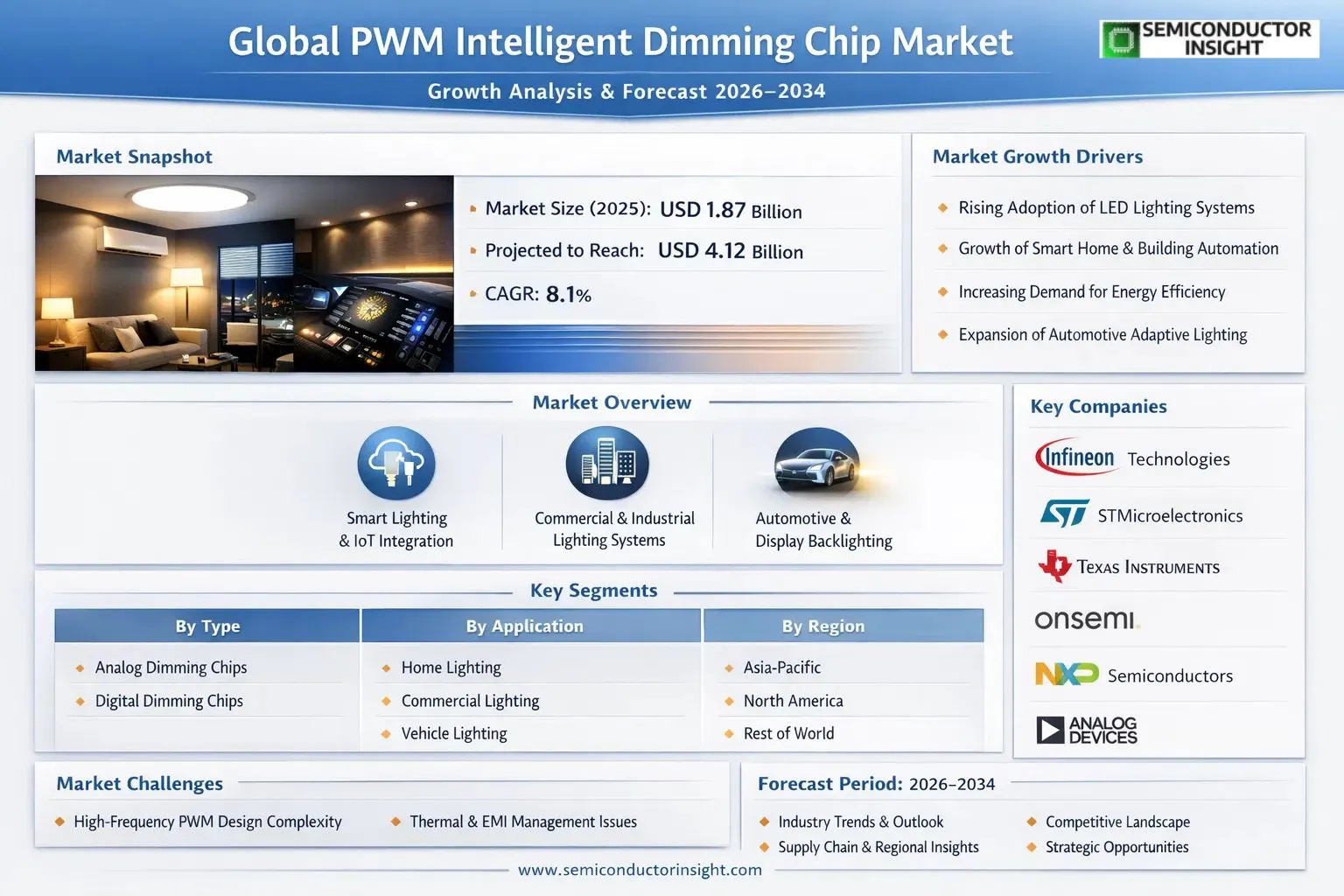
Global PWM Intelligent Dimming Chip market size was valued at USD 1.87 billion in 2025. The market is projected to grow from USD 2.04 billion in 2026 to USD 4.12 billion by 2034, exhibiting a CAGR of 8.1% during the forecast period.
A PWM intelligent dimming chip is an integrated circuit used to adjust the brightness of LED lighting systems and achieve intelligent dimming through pulse width modulation (PWM) technology. PWM dimming works by rapidly switching the LED power supply on and off, controlling the ratio of “on” to “off” states to regulate average brightness without altering the current. The intelligent dimming chip combines this core PWM dimming function with advanced control algorithms, enabling the chip to dynamically adjust light output in response to ambient light conditions, user-defined settings, or remote control instructions , delivering an energy-efficient and visually comfortable lighting experience across diverse applications.
The market is gaining strong momentum driven by the accelerating global transition toward LED-based lighting solutions, the proliferation of smart home and building automation systems, and tightening energy efficiency regulations across major economies. Furthermore, rapid growth in the automotive sector , particularly in electric vehicles requiring sophisticated adaptive lighting systems , is expanding demand considerably. Key manufacturers actively shaping the competitive landscape include Infineon Technologies, STMicroelectronics, Texas Instruments, Onsemi, NXP Semiconductors, and Analog Devices, alongside emerging Chinese semiconductor developers such as Jingfeng Mingyuan Semi-Conductor and Huihai Semiconductor, which are increasingly capturing market share through cost-competitive and application-specific product offerings.
MARKET DRIVERS
Rising Demand for Energy-Efficient Lighting Solutions
Global push toward energy conservation and sustainability has emerged as one of the most significant forces propelling PWM intelligent dimming chip market forward. Governments across North America, Europe, and Asia-Pacific have enacted stringent energy efficiency standards and building codes that mandate the adoption of advanced lighting control systems. PWM-based dimming technology, by its very nature, enables precise control over light output while minimizing power consumption, making it a preferred solution for commercial, industrial, and residential applications. The transition from conventional incandescent and halogen lighting to LED-based systems has further amplified the relevance of PWM intelligent dimming chips, as LEDs are inherently compatible with pulse-width modulation control architectures.
Rapid Expansion of Smart Building and IoT Infrastructure
The accelerating deployment of smart building infrastructure globally has created a robust ecosystem for intelligent lighting control, directly benefiting the PWM dimming chip market. As building automation systems become more sophisticated, the integration of dimming controls with IoT-enabled platforms, occupancy sensors, and daylight harvesting systems has become increasingly standard. PWM intelligent dimming chips serve as a foundational component in these architectures, enabling seamless interoperability with protocols such as DALI, Zigbee, Z-Wave, and Wi-Fi-based control systems. The commercial real estate sector, in particular, is investing heavily in retrofitting existing structures with intelligent lighting controls to reduce operational costs and meet corporate sustainability targets.
➤ The integration of PWM intelligent dimming chips within smart building ecosystems is enabling energy savings of up to 60–75% compared to conventional fixed-output lighting systems, positioning this technology as a cornerstone of modern energy management strategies.
The consumer electronics and automotive sectors are also contributing meaningfully to market growth. In automotive applications, PWM intelligent dimming chips are widely deployed in adaptive headlamp systems, ambient interior lighting, and instrument cluster displays, where precise brightness control and flicker-free performance are critical. The proliferation of ultra-thin LED backlighting in televisions, monitors, laptops, and smartphones further expands the addressable market, as OEMs increasingly prioritize high-frequency PWM dimming solutions that eliminate visual fatigue and enhance display quality.
MARKET CHALLENGES
Technical Complexity in High-Frequency PWM Implementation
Despite its widespread adoption, PWM intelligent dimming chip market faces notable technical challenges that can impede seamless deployment. At higher switching frequencies, electromagnetic interference (EMI) management becomes a critical concern, as PWM signals can introduce noise into adjacent circuits and compromise system performance. Engineers designing lighting control systems must invest significantly in EMI shielding, layout optimization, and filtering components, which can increase overall system cost and design cycle time. Additionally, achieving consistent dimming linearity across a wide range , particularly at very low brightness levels , remains a persistent challenge, as non-linearity can result in perceptible flickering or abrupt brightness transitions that degrade user experience.
Other Challenges
Thermal Management Concerns
High-frequency PWM switching generates heat that must be efficiently dissipated to ensure long-term reliability of the dimming chip and associated LED drivers. In compact form-factor applications such as downlights, panel lights, and automotive modules, space constraints limit the use of conventional heat sinking solutions, necessitating advanced thermal design strategies and materials. Inadequate thermal management can lead to accelerated component aging, reduced luminaire lifespan, and potential safety issues, all of which pose challenges for manufacturers operating in the PWM intelligent dimming chip space.
Interoperability and Standardization Gaps
The absence of universally adopted standards governing PWM dimming protocols and communication interfaces creates fragmentation across the supply chain. Lighting manufacturers, system integrators, and end users often encounter compatibility issues when combining dimming chips from different vendors with third-party drivers, sensors, and control systems. This lack of harmonization increases integration complexity and can deter adoption, particularly in large-scale commercial and industrial projects where multi-vendor environments are the norm. Addressing these interoperability challenges requires coordinated industry efforts and continued investment in standards development.
MARKET RESTRAINTS
Cost Pressures and Price Sensitivity in Emerging Markets
One of the primary restraints affecting PWM intelligent dimming chip market is the persistent price sensitivity observed across emerging economies in Asia, Latin America, Africa, and the Middle East. While the long-term energy savings associated with intelligent dimming technology are well-documented, the higher upfront cost of PWM-based control systems relative to conventional on/off switching solutions remains a significant barrier to adoption among cost-conscious buyers. In residential and small commercial segments particularly, procurement decisions are often driven by initial capital expenditure rather than lifecycle cost considerations, limiting market penetration in price-sensitive geographies.
Supply Chain Vulnerabilities and Semiconductor Component Shortages
PWM intelligent dimming chip market is not immune to the broader semiconductor supply chain disruptions that have characterized Global electronics industry in recent years. Dependence on a concentrated base of wafer fabrication facilities, coupled with geopolitical trade tensions affecting cross-border semiconductor flows, has exposed manufacturers to lead time volatility and component allocation challenges. These supply chain vulnerabilities can delay product launches, constrain production volumes, and erode profit margins as manufacturers are forced to source components at premium prices. Smaller and mid-tier dimming chip vendors, lacking the procurement leverage of large semiconductor conglomerates, are disproportionately affected by these dynamics, which may lead to market consolidation over the medium term.
Regulatory compliance requirements also represent a restraint on market agility. As international standards bodies continue to update electromagnetic compatibility (EMC), photobiological safety, and energy efficiency regulations, manufacturers of PWM intelligent dimming chips must invest continuously in re-testing, re-certification, and product redesign to maintain market access. The associated costs and timelines can be particularly burdensome for companies with broad regional footprints, where compliance obligations vary significantly across jurisdictions.
MARKET OPPORTUNITIES
Growing Adoption of Human-Centric Lighting and Circadian Rhythm Applications
The emerging field of human-centric lighting (HCL) presents a compelling growth avenue for PWM intelligent dimming chip market. Research into the biological and psychological effects of light on human health has spurred demand for dynamic lighting systems capable of continuously adjusting both intensity and color temperature throughout the day to align with natural circadian rhythms. PWM intelligent dimming chips, with their ability to deliver precise, flicker-free dimming across a wide range of outputs, are ideally positioned to support HCL applications in healthcare facilities, educational institutions, corporate offices, and residential environments. This segment is expected to see sustained investment as awareness of light’s impact on productivity, sleep quality, and wellbeing continues to grow among architects, facility managers, and end users.
Expansion into Horticultural Lighting and Controlled Environment Agriculture
Controlled environment agriculture (CEA) and vertical farming represent high-growth application areas that are driving demand for advanced lighting control technologies, including PWM intelligent dimming chips. LED grow light systems deployed in indoor farming facilities require highly precise spectral and intensity management across multiple growth zones, and PWM-based dimming solutions offer the granular control needed to optimize photosynthetic efficiency and crop yield. As global food security concerns intensify and urban farming initiatives expand across North America, Europe, and East Asia, investment in sophisticated horticultural lighting systems is accelerating, creating a sizeable incremental demand opportunity for PWM dimming chip manufacturers.
The ongoing rollout of fifth-generation (5G) wireless networks and edge computing infrastructure also opens new opportunities for PWM intelligent dimming chip market. Streetlight networks equipped with intelligent dimming controls are increasingly being repurposed as nodes within smart city communication grids, integrating environmental sensors, traffic monitoring systems, and public Wi-Fi hotspots. This convergence of lighting and telecommunications infrastructure elevates the functional and economic value of PWM-based dimming solutions in urban outdoor lighting deployments, encouraging municipal governments and utility operators to accelerate the upgrade of legacy street lighting assets with intelligent, network-connected alternatives that leverage advanced PWM control architectures.
PWM Intelligent Dimming Chip Market () Trends
Rising Demand for Energy-Efficient Lighting Driving PWM intelligent dimming chip market
PWM intelligent dimming chip market is witnessing significant momentum driven by Global push toward energy-efficient lighting solutions. As governments and organizations worldwide enforce stricter energy consumption standards, LED lighting systems integrated with PWM intelligent dimming chips have emerged as a preferred technology. These chips, which leverage pulse width modulation to precisely control the on/off cycle of LED power supplies, enable substantial reductions in energy usage without compromising lighting quality. The increasing penetration of smart building infrastructure and automated lighting controls across commercial and residential sectors continues to reinforce this demand trajectory.
Other Trends
Expansion Across Commercial and Vehicle Lighting Applications
Application diversity is broadening the scope of PWM intelligent dimming chip market. Commercial lighting remains one of the most active segments, with enterprises upgrading to intelligent dimming systems to reduce operational energy costs and meet sustainability benchmarks. Simultaneously, vehicle lighting has emerged as a high-growth application area, as automotive manufacturers increasingly adopt adaptive and dynamic LED lighting systems that rely on PWM dimming technology. The ability of intelligent dimming chips to respond to ambient light conditions and driver-defined settings makes them particularly well-suited for modern automotive lighting architectures.
Integration of Intelligent Control Algorithms Enhancing Product Capabilities
A notable trend shaping PWM intelligent dimming chip market is the incorporation of advanced intelligent control algorithms within chip designs. Beyond basic PWM dimming, manufacturers are embedding features such as ambient light sensing, remote control compatibility, and user-programmable brightness schedules into a single integrated circuit. This convergence of dimming and intelligence capabilities supports a more seamless and adaptive lighting experience, catering to both home and commercial lighting users who prioritize comfort alongside efficiency. Leading players including Infineon, Texas Instruments, STMicroelectronics, and NXP Semiconductors are actively investing in such next-generation chip architectures.
Asia-Pacific Emerging as a Key Production and Consumption Hub
Geographically, Asia , particularly China , is playing a pivotal role in shaping the competitive dynamics of PWM intelligent dimming chip market. The region hosts a significant concentration of both chip manufacturers and end-use industries, supported by robust electronics manufacturing ecosystems. Domestic players such as Jingfeng Mingyuan Semi-Conductor, Zhengmingke Electronics, and Huihai Semiconductor are strengthening their market presence alongside global semiconductor leaders, intensifying competition and accelerating innovation cycles within the region.
Digital Dimming Chips Gaining Traction Over Analog Counterparts
Within the product type landscape of PWM intelligent dimming chip market, digital dimming chips are increasingly favored over analog alternatives due to their superior precision, programmability, and compatibility with smart control systems. While analog dimming chips continue to serve cost-sensitive applications, the overall market trajectory reflects a gradual shift toward digital solutions as smart home adoption expands and IoT-connected lighting ecosystems become more mainstream. This transition is expected to influence product development priorities among key manufacturers through the coming years.
COMPETITIVE LANDSCAPE
Key Industry Players
PWM Intelligent Dimming Chip Market , Competitive Dynamics, Strategic Positioning & Leading Manufacturer Profiles
Global PWM Intelligent Dimming Chip market is characterized by intense competition among a blend of multinational semiconductor giants and specialized regional manufacturers. Infineon Technologies leads the competitive landscape with its robust portfolio of LED driver ICs and PWM dimming solutions tailored for automotive, industrial, and smart building applications. The company leverages advanced power management architectures and a wide distribution network to maintain a dominant revenue share. STMicroelectronics and Texas Instruments closely follow, offering highly integrated digital and analog dimming chips with intelligent control algorithms that respond dynamically to ambient light conditions and user-defined parameters. NXP Semiconductors and Onsemi (formerly ON Semiconductor) further strengthen the competitive tier through their focus on vehicle lighting and commercial-grade dimming platforms, where precision PWM frequency control and thermal efficiency are paramount. Analog Devices distinguishes itself through high-resolution dimming accuracy and mixed-signal integration, catering to premium smart lighting OEMs. In 2025, Global top five players collectively accounted for a significant share of total market revenue, underscoring the oligopolistic nature of the upper market tier.
Beyond Global leaders, a growing cohort of specialized and regionally prominent players is reshaping the PWM Intelligent Dimming Chip competitive environment, particularly within the Asia-Pacific corridor. Maxic Technology and Sunmoon Microelectronics have emerged as formidable Chinese domestic suppliers, offering cost-competitive analog and digital dimming chip solutions optimized for home lighting and commercial LED retrofit markets. Jingfeng Mingyuan Semi-Conductor and Zhengmingke Electronics cater to mid-tier LED driver manufacturers across Southeast Asia, while Huihai Semiconductor and Legend-Si Semiconductor focus on scalable PWM controller designs for smart city infrastructure and IoT-connected luminaires. These companies are actively investing in R&D to close the technology gap with Western counterparts, particularly in the areas of intelligent dimming algorithms, wireless protocol integration (Zigbee, Bluetooth Mesh), and miniaturized SoC (System-on-Chip) architectures. The competitive intensity is expected to escalate through the forecast period as demand from vehicle lighting, commercial smart lighting, and energy-efficient residential applications continues to accelerate globally.
List of Key PWM Intelligent Dimming Chip Companies Profiled
- Infineon Technologies
- STMicroelectronics
- Texas Instruments
- Onsemi
- NXP Semiconductors
- Analog Devices
- Maxic Technology
- Jingfeng Mingyuan Semi-Conductor
- Zhengmingke Electronics
- Huihai Semiconductor
- Sunmoon Microelectronics
- Legend-Si Semiconductor
Segment Analysis:
| Segment Category | Sub-Segments | Key Insights |
| By Type |
|
Digital Dimming Chip is rapidly emerging as the leading segment in PWM intelligent dimming chip market, driven by its superior compatibility with smart lighting ecosystems and IoT-enabled platforms.
|
| By Application |
|
Commercial Lighting stands as the dominant application segment for PWM Intelligent Dimming Chips, propelled by the widespread adoption of smart lighting solutions across office buildings, retail environments, hospitality venues, and industrial facilities.
|
| By End User |
|
Commercial & Industrial End Users represent the most influential end-user segment in PWM intelligent dimming chip market, underpinned by large-scale infrastructure deployments and the accelerating transition toward smart, connected lighting ecosystems.
|
| By Technology Integration |
|
IoT-Integrated Dimming Chips are gaining strong traction as the leading technology integration sub-segment, reflecting the broader industry shift toward networked, remotely managed lighting infrastructure across residential, commercial, and industrial settings.
|
| By Output Power Rating |
|
Medium Power PWM Dimming Chips constitute the leading output power sub-segment, serving as the most versatile category across the broadest range of real-world lighting applications including general commercial illumination, office environments, hospitality lighting, and mid-range automotive interior systems.
|
Regional Analysis: PWM Intelligent Dimming Chip Market
Asia-Pacific
Asia-Pacific hosts a deeply integrated supply chain for PWM intelligent dimming chip market, spanning raw semiconductor materials, wafer fabrication, chip packaging, and final assembly. This vertical integration reduces production costs and lead times, giving regional manufacturers a significant competitive edge over counterparts in other geographies. China’s extensive electronics manufacturing ecosystem serves as a critical foundation for sustained regional leadership.
Supportive regulatory frameworks across the region are actively accelerating the uptake of PWM intelligent dimming chip technologies. Governments have introduced energy efficiency standards, green building codes, and smart city blueprints that mandate or incentivize intelligent lighting controls. These policy-driven demand signals are compelling both domestic and multinational players to expand their PWM dimming chip portfolios and invest in localized product development.
Leading semiconductor firms and research institutes across Japan, South Korea, and China are channeling substantial investment into next-generation PWM intelligent dimming chip architectures. Focus areas include higher switching frequency, improved thermal management, multi-channel control, and seamless integration with IoT platforms. This innovation momentum is enabling Asia-Pacific companies to move up the value chain and compete on design sophistication rather than cost alone.
Rapid urban expansion across Southeast Asia and continued infrastructure modernization in China and India are generating robust demand for intelligent lighting systems powered by PWM dimming chips. Smart commercial buildings, transit hubs, hospitality venues, and public lighting networks are among the fastest-growing application segments. This structural urbanization trend is expected to sustain strong consumption of PWM intelligent dimming chip solutions well into the next decade.
North America
North America represents one of the most technologically advanced and value-driven regions in PWM intelligent dimming chip market. The United States anchors regional demand through its well-established commercial real estate sector, thriving consumer electronics industry, and a robust ecosystem of smart home and building automation solution providers. Stringent federal and state-level energy efficiency regulations, including standards set by the Department of Energy, have accelerated the transition toward intelligent lighting control systems embedded with PWM dimming chip technology. Canada contributes meaningfully through its growing smart city initiatives and sustainability-focused construction projects. The region is characterized by high average selling prices and premium product expectations, incentivizing chip developers to deliver highly integrated, feature-rich solutions. Strategic collaborations between semiconductor designers and lighting system integrators are a hallmark of North America’s PWM intelligent dimming chip landscape, fostering a cycle of continuous product refinement and application expansion across commercial, healthcare, and hospitality verticals.
Europe
Europe occupies a prominent position in PWM intelligent dimming chip market, underpinned by the region’s longstanding commitment to energy conservation, sustainability, and smart infrastructure development. The European Union’s stringent directives on energy performance of buildings and the phased elimination of inefficient light sources have created compelling regulatory tailwinds for PWM intelligent dimming chip adoption. Germany, the Netherlands, France, and the Nordic countries are at the forefront of deploying intelligent lighting systems in both public and private sectors. European end-users place significant emphasis on product quality, electromagnetic compatibility compliance, and long operational lifespans, which has driven regional chipmakers and their global partners to elevate design standards. The region’s active pursuit of carbon neutrality targets further amplifies the relevance of energy-efficient dimming technologies. Europe also benefits from a thriving ecosystem of smart building technology integrators and lighting control software developers that accelerate the commercialization of PWM intelligent dimming chip solutions across diverse application environments.
South America
South America is gradually emerging as a developing opportunity within Global PWM intelligent dimming chip market, with Brazil and Argentina serving as the primary demand centers. The region’s market trajectory is being shaped by increasing awareness of energy efficiency, rising electricity costs, and the gradual modernization of urban infrastructure. Government programs aimed at reducing national energy consumption are encouraging commercial and industrial facility operators to transition toward intelligent lighting solutions incorporating PWM dimming chips. While economic volatility and currency fluctuation present challenges to market growth, improving access to international supply chains and growing foreign direct investment in local manufacturing are helping to stabilize the environment. The hospitality, retail, and office segments are among the most receptive to smart lighting adoption in South America, as facility managers seek long-term operational cost reductions achievable through PWM intelligent dimming chip-enabled control systems.
Middle East & Africa
The Middle East and Africa region represents a nascent but increasingly promising frontier for PWM intelligent dimming chip market. In the Middle East, rapid economic diversification efforts , particularly within Gulf Cooperation Council nations such as the UAE, Saudi Arabia, and Qatar , are driving ambitious smart city and sustainable infrastructure projects where intelligent lighting plays a central role. Landmark developments including smart urban districts and large-scale commercial complexes are specifying advanced lighting control technologies, creating targeted demand for PWM intelligent dimming chip solutions. Africa’s market remains in an early development phase, though rising electrification rates, expanding urban centers, and international development funding for energy-efficient infrastructure present medium-to-long-term growth prospects. The region as a whole is expected to benefit progressively from technology transfer, global supply chain accessibility improvements, and heightened awareness of the economic and environmental benefits associated with intelligent dimming technologies throughout the 2026 to 2034 forecast period.
Report Scope
This market research report provides a comprehensive analysis of PWM intelligent dimming chip market, covering the forecast period 2026–2034. It offers detailed insights into market dynamics, technological advancements, competitive landscape, and key trends shaping the industry.
Key focus areas of the report include:
- Market Overview: The report begins with an overview outlining its current market scenario, key growth indicators, and industry transformation drivers. It discusses macroeconomic factors, demand–supply balance, regulatory landscape, and the strategic role of semiconductors in powering advancements across industries such as automotive, telecommunications, consumer electronics, and industrial automation.
- Market Size & Forecast: Historical data and future projections for revenue, unit shipments, and market value across major regions and segments.
- Segmentation Analysis: Detailed breakdown by product type, technology, application, and end-user industry to identify high-growth segments and investment opportunities.
- Regional Insights: Insights into market performance across North America, Europe, Asia-Pacific, Latin America, and the Middle East & Africa, including country-level analysis where relevant.
- Competitive Landscape: Profiles of leading market participants, including their product offerings, R&D focus, manufacturing capacity, pricing strategies, and recent developments such as mergers, acquisitions, and partnerships.
- Technology Trends & Innovation: Assessment of emerging technologies, integration of AI/IoT, semiconductor design trends, fabrication techniques, and evolving industry standards.
- Market Drivers & Restraints: Evaluation of factors driving market growth along with challenges, supply chain constraints, regulatory issues, and market-entry barriers.
- Stakeholder Insights: Insights for component suppliers, OEMs, system integrators, investors, and policymakers regarding the evolving ecosystem and strategic opportunities.
Primary and secondary research methods are employed, including interviews with industry experts, data from verified sources, and real-time market intelligence to ensure the accuracy and reliability of the insights presented.
FREQUENTLY ASKED QUESTIONS:
What is the current market size of PWM Intelligent Dimming Chip Market?
-> Global PWM Intelligent Dimming Chip Market was valued atUSD 1.87 billion in 2025 and is expected to reach USD 4.12 billion by 2034 growing at a CAGR of 8.1% during the forecast period 2026–2034.
Which key companies operate in PWM intelligent dimming chip market?
-> Key players include Infineon, STMicroelectronics, Texas Instruments, Onsemi, NXP Semiconductors, Analog Devices, Maxic Technology, Jingfeng Mingyuan Semi-Conductor, Zhengmingke Electronics, Huihai Semiconductor, Sunmoon Microelectronics, and Legend-Si Semiconductor, among others. In 2025, Global top five players held approximately % of the market in terms of revenue.
What are the key growth drivers?
-> Key growth drivers include rising adoption of LED lighting systems, growing demand for energy-efficient lighting solutions, integration of intelligent control algorithms with PWM dimming technology, increasing smart home and commercial lighting deployments, and expanding vehicle lighting applications. The ability of PWM intelligent dimming chips to flexibly adjust brightness based on ambient light, user settings, or remote control instructions further accelerates market demand.
Which region dominates PWM intelligent dimming chip market?
-> Asia is a dominant region in PWM intelligent dimming chip market, with China projected to reach USD million by 2025. North America, led by the U.S. market estimated at USD million in 2025, also represents a significant share of global revenue.
What are the emerging trends in PWM intelligent dimming chip market?
-> Emerging trends include integration of AI-driven intelligent control algorithms, adoption of IoT-enabled smart lighting systems, growth of digital dimming chip technology alongside analog dimming chips, increasing use in vehicle lighting applications, and expansion into commercial and home lighting segments. The Analog Dimming Chip segment is projected to reach USD million by 2034, registering a % CAGR over the next six years.

Get Sample Report PDF for Exclusive Insights
Report Sample Includes
- Table of Contents
- List of Tables & Figures
- Charts, Research Methodology, and more...
 Download Sample Report PDF