Market Insights
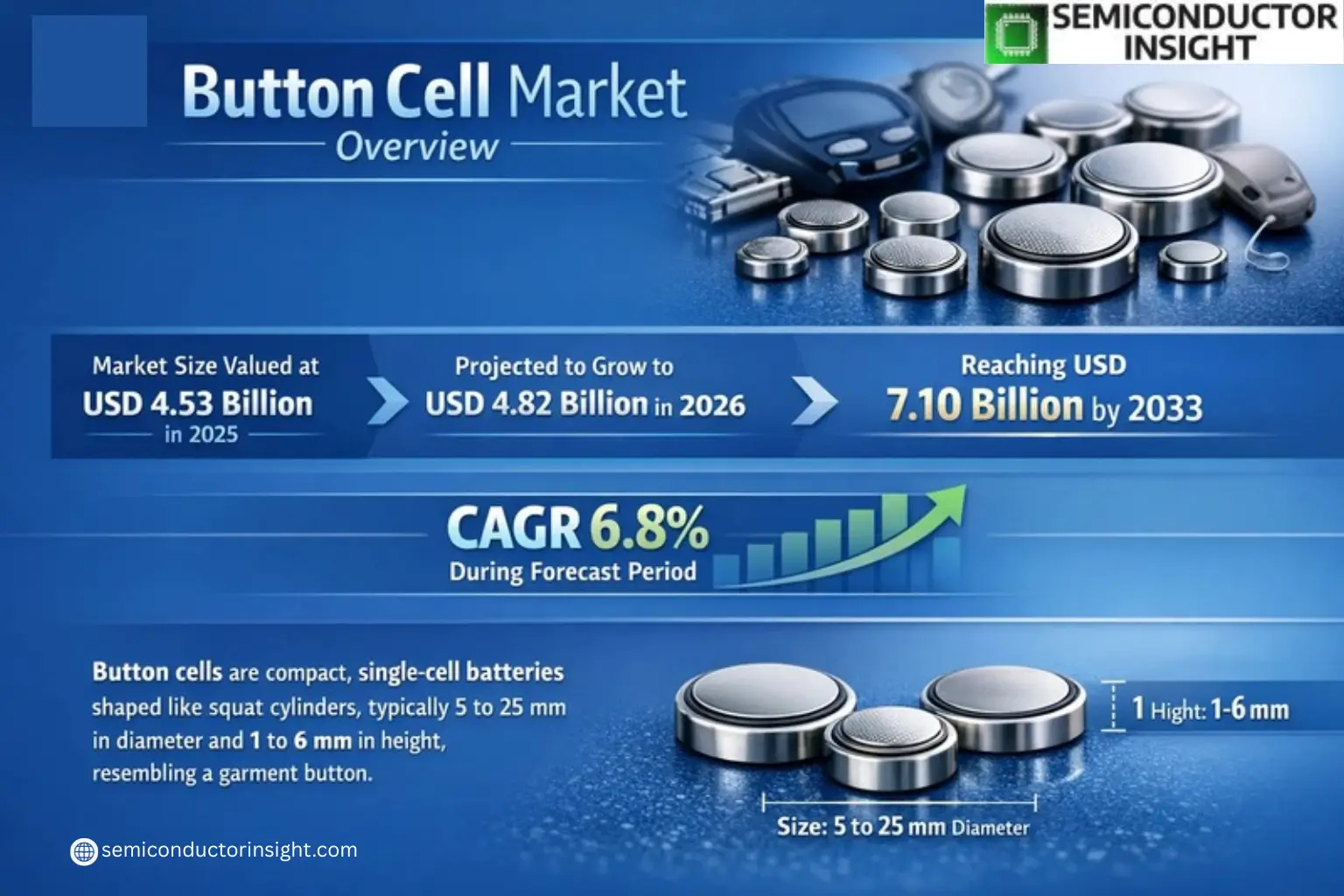
Global Button Cell Market size was valued at USD 4.53 billion in 2025 and is projected to grow from USD 4.82 billion in 2026 to USD 7.10 billion by 2033, exhibiting a CAGR of 6.8% during the forecast period.
Button cells are compact, single-cell batteries shaped like squat cylinders, typically measuring between 5 to 25 mm in diameter and 1 to 6 mm in height resembling a garment button, hence the name. These batteries consist of a metal can that serves as the bottom body and positive terminal, while an insulated top cap acts as the negative terminal. They are widely used in small portable electronic devices such as wristwatches, calculators, hearing aids, and wireless earbuds.
The market is witnessing steady growth due to increasing demand for miniaturized electronics and advancements in wearable technology. Lithium button cell batteries (CR) dominate the market with a share of approximately 45%, driven by their high energy density and long shelf life. The Asia Pacific region leads globally with over 45% market share, followed by North America (25%) and Europe (20%). Key players such as Varta Microbattery, Panasonic, Murata, Energizer (Rayovac), and EVE Energy collectively hold around half of the global market share.
MARKET DRIVERS
Growing Demand for Compact Power Sources
Button Cell Market is experiencing steady growth due to increasing demand for compact, long-lasting power sources in wearable devices, medical implants, and small electronics. With over 5 billion button cells manufactured annually, these power solutions remain essential for applications requiring high energy density in minimal space.
Expansion of IoT and Smart Devices
The proliferation of IoT devices and smart technologies significantly contributes to Button Cell Market growth. Tiny sensors and connected devices rely heavily on button cell batteries for reliable, maintenance-free power. The market is projected to grow at 3.5% CAGR as smart home adoption increases globally.
Advanced lithium-based button cells are gaining traction in electronics, offering superior shelf life and performance in extreme temperatures.
MARKET CHALLENGES
Environmental Regulations and Material Restrictions
Stringent regulations on mercury and heavy metal content in button cells present manufacturing challenges. Button Cell Market faces pressure to develop eco-friendly alternatives while maintaining performance standards, with compliance costs increasing production expenses by 12-15%.
Other Challenges
Competition from Rechargeable Alternatives
Thin-film batteries and micro-supercapacitors are emerging as potential substitutes in some applications, though they currently lack the energy density of traditional button cells.
MARKET RESTRAINTS
Price Sensitivity in Consumer Electronics
The commoditization of zinc-air and alkaline button cells creates price pressure, with profit margins declining to 8-10% in standard consumer applications. Manufacturers must balance cost reduction with quality to remain competitive in this segment of the Button Cell Market.
MARKET OPPORTUNITIES
Medical and Industrial Applications
High-value applications in medical devices and industrial sensors offer premium opportunities for the Button Cell Market. These sectors prioritize reliability over cost, with specialized batteries commanding 40-60% higher margins than consumer versions. Miniaturization trends in hearing aids and implantable devices continue to drive innovation.
Button Cell Market Trends
Steady Growth Driven by Portable Electronics Demand
Global Button Cell Market, valued at USD 4.5 billion in 2025, is projected to grow at 6.8% CAGR, reaching USD 7.1 billion by 2033. This growth is fueled by increasing adoption in wearable devices, IoT applications, and medical equipment. Lithium Button Cell Batteries dominate the market with 45% share due to their high energy density and long shelf life.
Other Trends
Asia Pacific Leads Regional Market Share
Asia Pacific holds over 45% of the global Button Cell Market, supported by strong electronics manufacturing in China, Japan, and South Korea. The region’s growth outpaces North America (25% share) and Europe (20% share) due to lower production costs and expanding consumer electronics markets.
Application-Specific Market Expansion
TWS Bluetooth headsets currently account for 18% of Button Cell applications, with wearables and medical devices showing fastest growth. The increasing miniaturization of electronics continues to drive demand for compact power solutions. Major manufacturers are focusing on developing higher capacity cells for emerging applications in smart packaging and industrial IoT sensors.
Competitive Landscape Evolution
The top 5 players including Varta, Panasonic, and Murata control approximately 50% market share. Recent developments include investments in mercury-free alternatives and renewable materials to meet evolving environmental regulations. Price competition remains intense in the traditional watch battery segment, while premium applications show higher margins.
Technological Advancements Shape Future Trends
Emerging innovations focus on improving energy density and cycle life, with zinc-air and solid-state variants gaining traction. The market sees growing demand for rechargeable button cells in high-drain applications. Manufacturers are expanding production capacity in Southeast Asia to meet these evolving requirements while maintaining cost competitiveness.
COMPETITIVE LANDSCAPE
Key Industry Players
Major Players Dominate 50% of Global Button Cell Market
Button Cell Market is moderately consolidated, with the top 5 players holding approximately 50% market share. VARTA Microbattery leads the sector with its premium German-engineered batteries for medical devices and wearables. Panasonic and Murata follow closely, leveraging their established electronics supply chains. Energizer (Rayovac) and EVE Energy complete the top tier, with EVE showing rapid growth in Asian markets. These leaders compete on technological innovation in lithium and silver oxide chemistries, particularly for IoT and hearables applications.
Niche specialists like Renata Batteries (Swatch Group) dominate the watch battery segment, while Maxell and Toshiba focus on high-drain applications. Chinese manufacturers including Ganfeng LiEnergy and Guangzhou Great Power Energy are gaining traction through cost-competitive alkaline and zinc-air solutions. Emerging players like Power Glory Battery Tech are targeting regional automotive and medical device markets with customized form factors.
List of Key Button Cell Companies Profiled
- VARTA Microbattery
- Panasonic
- Murata Manufacturing
- Energizer (Rayovac)
- EVE Energy
- Maxell (Hitachi)
- Toshiba
- Duracell
- Renata Batteries (Swatch Group)
- Ganfeng LiEnergy
- GP Batteries
- Guangzhou Great Power Energy
- Seiko Instruments
- Philips
- Power Glory Battery Tech
Segment Analysis:
| Segment Category | Sub-Segments | Key Insights |
| By Type |
|
Lithium Button Cell Batteries dominate due to:
|
| By Application |
|
TWS Bluetooth Headset segment shows remarkable growth potential because:
|
| By End User |
|
Consumer Electronics remains the primary driver due to:
|
| By Technology |
|
Primary Button Cells maintain market leadership owing to:
|
| By Sales Channel |
|
Retail Channels show significant influence as:
|
Regional Analysis: Global Button Cell Market
Asia-Pacific hosts the world’s most concentrated button cell production network, with specialized facilities in Japan and South Korea producing high-precision components. China’s mass production capabilities ensure competitive pricing for standard models.
Japanese companies pioneer silver oxide and lithium button cell advancements, while South Korean firms lead in thin-film battery integration. Regional R&D focuses on extending battery life and improving energy density for compact devices.
Expanding middle-class populations and smart device penetration drive replacement cycles. India and Southeast Asia emerge as key growth markets for basic button cells in toys and basic electronics.
Stricter environmental policies in Japan and South Korea accelerate shift toward eco-friendly chemistries. China’s battery standards influence regional product specifications and export requirements.
North America
The North American Button Cell Market benefits from strong medical device and premium electronics demand. U.S.-based companies focus on high-reliability applications including military and aerospace uses. Stringent safety regulations shape product development, with emphasis on leak-proof designs. The region sees growing adoption in smart packaging and pharmaceutical applications. Local manufacturers differentiate through patented technologies and specialized coatings.
Europe
European markets prioritize environmentally sustainable button cells with advanced recycling systems. Germany and Switzerland lead in precision medical and industrial applications. EU battery directives drive mercury-free alternatives development. The automotive sector demands high-performance cells for keyless entry systems. Niche applications in luxury watches and specialty electronics maintain premium segment growth.
South America
Button cell demand in South America centers on Brazil’s consumer electronics sector and Argentina’s medical device industry. Market growth is constrained by import dependency for advanced models. Price sensitivity favors basic zinc-air and alkaline variants. Emerging applications include electronic payment cards and IoT devices in agricultural monitoring systems.
Middle East & Africa
The region shows growing button cell adoption in basic electronic devices and automotive applications. UAE and South Africa serve as regional distribution hubs. Market development is slowed by counterfeit battery proliferation. Specialized applications include oil field monitoring equipment and high-temperature resistant variants for desert conditions.
Report Scope
This market research report provides a comprehensive analysis of the Button Cell Market, covering the forecast period 2026–2033. It offers detailed insights into market dynamics, technological advancements, competitive landscape, and key trends shaping the industry.
Key focus areas of the report include:
- Market Overview: The report begins with an overview outlining its current market scenario, key growth indicators, and industry transformation drivers. It discusses macroeconomic factors, demand–supply balance, regulatory landscape, and the strategic role of Button Cells in powering advancements across industries such as consumer electronics, medical devices, IoT, and automotive.
- Market Size & Forecast: Historical data and future projections for revenue, unit shipments, and market value across major regions and segments.
- Segmentation Analysis: Detailed breakdown by product type, technology, application, and end-user industry to identify high-growth segments and investment opportunities.
- Regional Insights: Insights into market performance across North America, Europe, Asia-Pacific, Latin America, and the Middle East & Africa, including country-level analysis where relevant.
- Competitive Landscape: Profiles of leading market participants, including their product offerings, R&D focus, manufacturing capacity, pricing strategies, and recent developments such as mergers, acquisitions, and partnerships.
- Technology Trends & Innovation: Assessment of emerging technologies, integration of AI/IoT, battery efficiency trends, and evolving industry standards.
- Market Drivers & Restraints: Evaluation of factors driving market growth along with challenges, supply chain constraints, regulatory issues, and market-entry barriers.
- Stakeholder Insights: Insights for component suppliers, OEMs, system integrators, investors, and policymakers regarding the evolving ecosystem and strategic opportunities.
Primary and secondary research methods are employed, including interviews with industry experts, data from verified sources, and real-time market intelligence to ensure the accuracy and reliability of the insights presented.
FREQUENTLY ASKED QUESTIONS:
What is the current market size of Button Cell Market?
-> Button Cell Market size was valued at USD 4.53 billion in 2025 and is projected to grow from USD 4.82 billion in 2026 to USD 7.10 billion by 2033, exhibiting a CAGR of 6.8% during the forecast period.
Which key companies operate in Button Cell Market?
-> Key players include Varta Microbattery, Panasonic, Murata, Energizer (Rayovac), and EVE Energy. The top 5 players occupy about 50% shares of the global market.
What are the key growth drivers?
-> Key growth drivers include rising demand from consumer electronics (especially TWS Bluetooth headsets), increasing adoption in medical devices, and expansion of IoT applications.
Which region dominates the market?
-> Asia-Pacific is the largest market, with a share over 45%, followed by North America (25%) and Europe (20%).
What are the main application segments?
-> The main applications are TWS Bluetooth Headset (18% share), Traditional Watch and Calculators, Hearing Aid, and Wearable Devices.

Get Sample Report PDF for Exclusive Insights
Report Sample Includes
- Table of Contents
- List of Tables & Figures
- Charts, Research Methodology, and more...
 Download Sample Report PDF