Global Battery Market Research Report
MARKET INSIGHTS
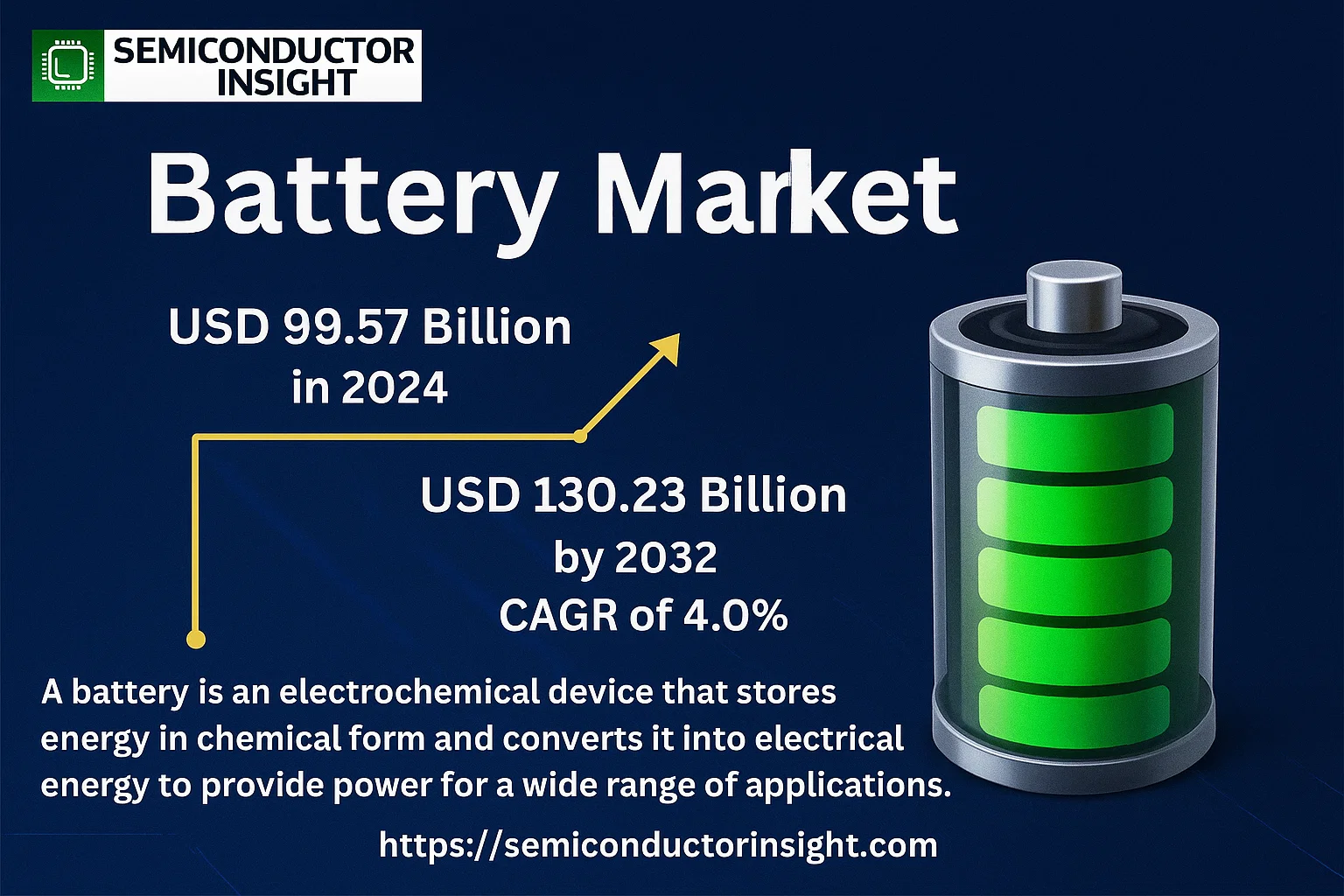
Global Battery Market size was valued at USD 99.57 billion in 2024 to USD 130.23 billion by 2032, exhibiting a CAGR of 4.0% during the forecast period.
A battery is an electrochemical device that stores energy in chemical form and converts it into electrical energy to provide power for a wide range of applications. These devices consist of one or more cells, each containing an anode, a cathode, and an electrolyte, which facilitate the flow of electrons. Batteries are broadly categorized into primary (single-use) and secondary (rechargeable) types, with key chemistries including Lead-Acid, Lithium-Ion, Nickel-Metal Hydride (NiMH), and others.
The Market growth is primarily driven by the accelerating global transition to electric vehicles (EVs), which creates massive demand for high-performance lithium-ion batteries. Furthermore, the rapid expansion of renewable energy installations is fueling the need for large-scale battery energy storage systems (BESS) to manage grid stability and store intermittent power from sources like solar and wind. However, supply chain constraints for critical raw materials such as lithium and cobalt present significant challenges to sustained growth. Key players are actively expanding production capacity and forming strategic partnerships; for instance, major manufacturers like Panasonic and LG Chem have announced multi-billion dollar investments in new gigafactories across North America and Europe to meet rising demand from automotive OEMs.
MARKET DRIVERS
Accelerating Global Shift to Electric Vehicles
The primary driver for the battery Market is the rapid global transition to electric mobility. Governments worldwide are implementing stringent emissions regulations and offering purchase incentives, compelling automotive manufacturers to accelerate their EV production plans. This has created unprecedented demand for high-capacity lithium-ion batteries, which form the core of modern electric vehicles.
Expansion of Renewable Energy Storage
Growth in solar and wind power generation is fueling demand for large-scale battery energy storage systems (BESS). These systems are critical for stabilizing grids, managing intermittent renewable supply, and ensuring energy reliability. The need for efficient energy storage solutions is a major catalyst for innovation and capacity expansion in the battery sector.
➤ Consumer electronics remain a bedrock, with demand for longer-lasting, faster-charging batteries in smartphones, laptops, and wearables continuously pushing technological boundaries.
Furthermore, significant investment in research and development is leading to improvements in energy density, safety, and cost-effectiveness. These advancements are broadening the application scope of batteries beyond traditional uses.
MARKET CHALLENGES
Supply Chain Vulnerabilities and Raw Material Sourcing
A significant challenge is the concentrated and often volatile supply chain for critical raw materials like lithium, cobalt, and nickel. Geopolitical tensions, mining restrictions, and logistical bottlenecks can lead to price spikes and supply shortages, directly impacting battery manufacturing costs and timelines.
Other Challenges
High Initial Costs and Manufacturing Scale-Up
While costs are falling, the capital expenditure for establishing gigafactories and advanced production lines remains substantial. Scaling manufacturing to meet demand while maintaining quality and safety standards is a complex and capital-intensive process.
Safety and Performance Concerns
Issues such as thermal runaway in lithium-ion batteries and the degradation of battery life over time pose significant technical and reputational risks. Ensuring safety across millions of units and managing end-of-life recycling present ongoing hurdles.
MARKET RESTRAINTS
High Upfront Cost of Advanced Battery Systems
Despite declining prices, the initial cost of advanced battery packs, particularly for electric vehicles and large-scale energy storage, remains a barrier to mass adoption for many consumers and businesses. This economic factor can slow down the penetration rate in price-sensitive Markets.
Environmental and Regulatory Hurdles
The environmental impact of battery production and disposal is under increasing scrutiny. Strict regulations concerning mining, manufacturing emissions, and end-of-life recycling requirements can increase compliance costs and delay project approvals, acting as a restraint on Market growth.
MARKET OPPORTUNITIES
Emergence of Next-Generation Battery Chemistries
There is immense opportunity in the development and commercialization of next-generation batteries, such as solid-state, lithium-sulfur, and sodium-ion. These technologies promise higher energy densities, improved safety profiles, and reduced reliance on scarce materials, potentially unlocking new Markets and applications.
Growth in Grid-Scale and Residential Energy Storage
Global push for energy independence and grid modernization creates a massive opportunity for battery storage solutions. Both utility-scale projects and behind-the-meter residential storage systems are expected to see exponential growth, driven by falling costs and supportive policies.
Battery Market Trends
Sustained Global Growth and Regional Dominance
Global Battery Market is on a consistent growth trajectory, with its valuation projected to increase from a significant base of USD 99,570 million in 2024 to an estimated USD 130,230 million by 2032, reflecting a compound annual growth rate (CAGR) of 4.0%. This expansion is underpinned by increasing demand across diverse applications, from consumer electronics to large-scale energy storage systems. Asia-Pacific stands as the dominant force in this Market, accounting for over 40% of the global share. This regional concentration is closely followed by the combined Markets of Europe and North America, which together represent approximately 45% of the global Market, highlighting a concentrated but competitive global landscape.
Other Trends
Product Segment Leadership
Lead-acid batteries continue to be the workhorse of the industry, constituting the largest product segment with a substantial share of about 55%. This enduring dominance is attributed to their cost-effectiveness, reliability, and well-established recycling infrastructure, particularly in applications like automotive starting, lighting, and ignition (SLI) and uninterruptible power supplies (UPS). However, the segment comprising lithium-ion and nickel-metal hydride batteries is witnessing accelerated growth, driven by the electrification of transportation and the portable electronics sector.
Application Diversification and Market Drivers
Commercial applications currently represent the largest end-use segment for batteries, with home use following closely. The demand in the commercial sector is fueled by the need for backup power, telecommunications, and data center infrastructure. Meanwhile, the home use segment is experiencing growth due to the proliferation of portable devices, residential energy storage systems paired with solar panels, and a wide array of household gadgets. Key Market players, including Johnson Controls, LG Chem, and Panasonic, who collectively hold about a 20% Market share, are continuously innovating to meet the evolving demands of these applications.
Competitive Landscape and Strategic Developments
The competitive environment is characterized by the presence of established global players and aggressive expansion strategies. Key companies are heavily investing in research and development to enhance battery energy density, reduce charging times, and improve overall lifecycle. Strategic developments such as mergers, acquisitions, and partnerships are common as companies seek to consolidate Market position and expand their technological portfolios. The industry faces challenges including raw material price volatility and stringent environmental regulations, but these are counterbalanced by significant opportunities in emerging technologies like electric vehicles and grid-scale storage, which are poised to be major growth drivers in the coming years.
COMPETITIVE LANDSCAPE
Key Industry Players
A Market Characterized by Global Giants and Regional Specialists
Global Battery Market is moderately concentrated, with the top three manufacturers—Johnson Controls, LG Chem, and Panasonic—collectively holding approximately 20% of the Market share. This structure is indicative of an industry dominated by well-established multinational corporations that possess significant scale, extensive R&D capabilities, and global supply chains. These leaders compete intensely across major battery chemistries, including lead-acid and the rapidly growing lithium-ion segment, catering to diverse applications from automotive to industrial energy storage. The competitive dynamics are heavily influenced by technological innovation, production costs, and strategic partnerships with automotive OEMs and electronics manufacturers, particularly in the key Asia-Pacific region which accounts for over 40% of the global Market.
Beyond the top tier, a substantial number of other significant players carve out strong positions through specialization and regional dominance. Companies like GS Yuasa and Exide hold considerable sway in the lead-acid battery sector, especially for automotive and uninterruptible power supply (UPS) applications. Meanwhile, Asian manufacturers such as BYD, ATL, and SAMSUNG are formidable competitors in the lithium-ion space, driven by the electric vehicle and consumer electronics booms. Niche players and regional champions, including EnerSys in industrial batteries and East Penn in the North American afterMarket, contribute to a fragmented yet highly competitive lower tier of the Market, often focusing on specific applications or geographies to secure their Market position.
List of Key Battery Companies Profiled
- Johnson Controls
- LG Chem
- Panasonic
- SAMSUNG
- GS Yuasa
- Exide
- EnerSys
- East Penn
- BYD
- ATL
- Duracell
- Energizer
- BAK
- Tianjin Lishen
- SONY
Segment Analysis:
| Segment Category | Sub-Segments | Key Insights |
| By Type |
|
Lead Acid remains the dominant battery type, prized for its cost-effectiveness, high reliability, and well-established recycling infrastructure, making it particularly suitable for automotive starter-lighting-ignition applications, uninterruptible power supplies, and other high-power, stationary uses. The technology’s maturity ensures consistent performance in demanding conditions. Conversely, Lithium Ion technology is experiencing vigorous growth driven by its superior energy density, lightweight properties, and rapid charging capabilities, which are critically important for consumer electronics and the accelerating electric vehicle revolution. Nickel Metal Hydride batteries continue to find a stable niche, offering a good balance of performance and safety in specific applications like hybrid electric vehicles and certain medical devices. |
| By Application |
|
Commercial Use represents the largest application segment, encompassing a vast range of uses from data center backup power and telecommunications infrastructure to point-of-sale systems and commercial security, where reliability is paramount. The Home Use segment is consistently strong, driven by the proliferation of portable electronics, power tools, and the growing adoption of small-scale solar energy storage systems. The Automotive/Transportation segment is the epicenter of the most dynamic growth, fueled by the global transition to electric vehicles, which is creating unprecedented demand for high-performance battery packs. Furthermore, Industrial Use, including applications in material handling equipment like forklifts and large-scale grid storage, provides a stable and essential Market underpinned by the need for robust and durable energy solutions. |
| By End User |
|
Automotive OEMs are rapidly becoming the most influential end-user group, as their strategic pivots towards electrification dictate the scale and technological direction of battery production and innovation. They are forming deep partnerships with battery manufacturers to secure supply and co-develop next-generation cells. Consumer Electronics Manufacturers represent a historically dominant segment with a constant demand for smaller, more powerful, and longer-lasting batteries for smartphones, laptops, and wearables. Industrial & Energy Companies procure large-scale battery systems for renewable energy integration and grid stabilization, while Telecom & Data Center Operators are critical end-users whose need for absolutely reliable backup power ensures a consistent, high-value Market for robust stationary battery systems to prevent service disruptions. |
| By Technology Maturity |
|
Established Growth Technologies such as Lithium Ion currently define the Market’s evolution, characterized by rapid innovation cycles, significant capital investment for scaling production, and intense competition to improve energy density and reduce costs. Mature Technologies, exemplified by Lead Acid, maintain a stronghold due to their unparalleled cost advantage and proven reliability in well-defined applications, with a focus on incremental improvements and optimizing recycling ecosystems. The Emerging & Next-Generation Technologies segment is the focal point of intense research and development, with solid-state batteries promising a leap in safety and energy density, potentially unlocking new applications and reshaping the competitive landscape in the long term, though they currently face significant manufacturing and scaling challenges. |
| By Sales Channel |
|
Direct Sales (OEM) is the leading channel for high-volume, application-specific battery integrations, particularly in the automotive and consumer electronics industries, where manufacturers require close collaboration and custom specifications. This channel is characterized by long-term supply agreements and deep technical partnerships. Distributors & Wholesalers play a vital role in serving the fragmented industrial, commercial, and replacement Markets, providing logistical efficiency and local inventory for a wide array of standard battery products. The Retail & AfterMarket channel caters primarily to individual consumers and small businesses for replacement batteries, portable power packs, and specialty cells, driven by brand recognition, accessibility, and immediate availability, making it highly competitive on price and convenience. |
Regional Analysis: Battery Market
Asia-Pacific
Asia-Pacific hosts the world’s largest concentration of battery cell manufacturing capacity, with China accounting for a overwhelming majority of global production. The region benefits from established supply chains for key materials like lithium, cobalt, and graphite, and highly developed infrastructure for producing anodes, cathodes, and electrolytes. This integrated ecosystem allows for significant economies of scale and cost competitiveness that underpin its global Market leadership.
The explosive growth of the electric vehicle Market in China, coupled with strong adoption in South Korea and Japan, provides a massive and guaranteed demand base for advanced batteries. Domestic automakers and global brands manufacturing locally create a vibrant and competitive landscape that drives continuous innovation and rapid deployment of new battery technologies, from LFP to high-nickel NMC chemistries.
Government initiatives are a critical enabler. China’s long-term strategic plans explicitly support the new energy vehicle and battery sectors through subsidies, research grants, and favorable regulations. South Korea and Japan have also launched ambitious national strategies with significant public and private funding aimed at maintaining their technological edge and securing a stable supply of raw materials amidst growing global competition.
Beyond current lithium-ion technology, the region is heavily invested in developing future battery solutions. Research into solid-state batteries is particularly strong in Japan and South Korea, with major automakers and battery firms collaborating to overcome technical hurdles. There is also significant focus on sodium-ion and other alternative chemistries to reduce dependency on critical minerals and lower costs further.
North America
North America is experiencing rapid growth, fueled primarily by ambitious policy frameworks like the US Inflation Reduction Act, which provides substantial incentives for domestic battery manufacturing and EV adoption. This has triggered a wave of investments in new gigafactories from both domestic startups and partnerships with Asian and European battery giants. The region benefits from strong technological innovation, particularly in Silicon Valley, focused on battery management systems, software, and novel chemistries. A key challenge remains building a secure and resilient supply chain for critical minerals, leading to increased focus on domestic mining and recycling initiatives. The integration of battery storage with renewable energy projects is also a significant growth driver, supported by federal and state-level clean energy targets.
Europe
Europe has established itself as a major player with a clear strategic goal of creating a self-sufficient battery ecosystem to support its automotive industry’s transition to electric mobility. The European Battery Alliance coordinates massive cross-border investments in gigafactories from companies like Northvolt and ACC. Strict regulatory standards push for high performance, safety, and sustainability, including stringent carbon footprint requirements for batteries. The region is a leader in advancing circular economy principles, with strong emphasis on battery recycling and second-life applications. While dependent on imported cells and materials initially, there is a concerted effort to develop local raw material processing and component manufacturing capabilities to reduce external reliance.
South America
South America’s role in the battery Market is fundamentally shaped by its vast reserves of critical raw materials, particularly lithium in the “Lithium Triangle” spanning Argentina, Bolivia, and Chile. The region is increasingly moving beyond simply exporting raw lithium carbonate to establishing local value-added processing and potentially cathode active material production. Governments are crafting policies to attract investment in downstream industries while ensuring national benefits from their natural resources. The domestic EV Market is still nascent but growing, and large-scale battery storage for renewable energy integration presents a significant future opportunity, leveraging the region’s abundant solar and wind resources.
Middle East & Africa
The Middle East & Africa region is an emerging force, strategically leveraging its financial resources and solar energy potential. Gulf nations, particularly Saudi Arabia and the UAE, are making large-scale investments in battery technology as part of broader economic diversification plans away from hydrocarbons, including building domestic EV manufacturing and grid-scale storage projects. Africa holds immense potential due to its large deposits of critical minerals like cobalt, graphite, and manganese, but faces challenges in infrastructure and investment needed to develop a full value chain. The region also represents a substantial future Market for both small-scale solar-plus-storage systems and large-scale applications as electrification rates increase.
Report Scope
This Market research report provides a comprehensive analysis of the Battery Market, covering the forecast period 2025–2032. It offers detailed insights into Market dynamics, technological advancements, competitive landscape, and key trends shaping the industry.
Key focus areas of the report include:
- Market Overview: The report begins with an overview outlining its current Market scenario, key growth indicators, and industry transformation drivers. It discusses macroeconomic factors, demand–supply balance, regulatory landscape, and the strategic role of batteries in powering advancements across industries such as automotive, telecommunications, consumer electronics, and industrial automation.
- Market Size & Forecast: Historical data and future projections for revenue, unit shipments, and Market value across major regions and segments.
- Segmentation Analysis: Detailed breakdown by product type, technology, application, and end-user industry to identify high-growth segments and investment opportunities.
- Regional Insights: Insights into Market performance across North America, Europe, Asia-Pacific, Latin America, and the Middle East & Africa, including country-level analysis where relevant.
- Competitive Landscape: Profiles of leading Market participants, including their product offerings, R&D focus, manufacturing capacity, pricing strategies, and recent developments such as mergers, acquisitions, and partnerships.
- Technology Trends & Innovation: Assessment of emerging technologies, integration of AI/IoT, battery design trends, fabrication techniques, and evolving industry standards.
- Market Drivers & Restraints: Evaluation of factors driving Market growth along with challenges, supply chain constraints, regulatory issues, and Market-entry barriers.
- Stakeholder Insights: Insights for component suppliers, OEMs, system integrators, investors, and policymakers regarding the evolving ecosystem and strategic opportunities.
Primary and secondary research methods are employed, including interviews with industry experts, data from verified sources, and real-time Market intelligence to ensure the accuracy and reliability of the insights presented.
FREQUENTLY ASKED QUESTIONS:
What is the current Market size of Battery Market?
-> Battery Market size was valued at USD 99.57 billion in 2024 to USD 130.23 billion by 2032, exhibiting a CAGR of 4.0% during the forecast period.
Which key companies operate in Battery Market?
-> Key players include Johnson Controls, LG Chem, Panasonic, SAMSUNG, and GS Yuasa, among others. The top three manufacturers hold a share of about 20%.
What are the key growth drivers?
-> Key growth drivers include rising demand from automotive and consumer electronics sectors, government policies supporting energy storage, and technological innovation in battery chemistry and capacity.
Which region dominates the Market?
-> Asia-Pacific is the largest Market, with a share over 40%, followed by Europe and North America.
What are the emerging trends?
-> Emerging trends include advancements in lithium-ion and solid-state batteries, increased adoption for renewable energy storage, and the development of sustainable and high-density power solutions.

Get Sample Report PDF for Exclusive Insights
Report Sample Includes
- Table of Contents
- List of Tables & Figures
- Charts, Research Methodology, and more...
 Download Sample Report PDF