Automotive Pyro Switch Market Insights
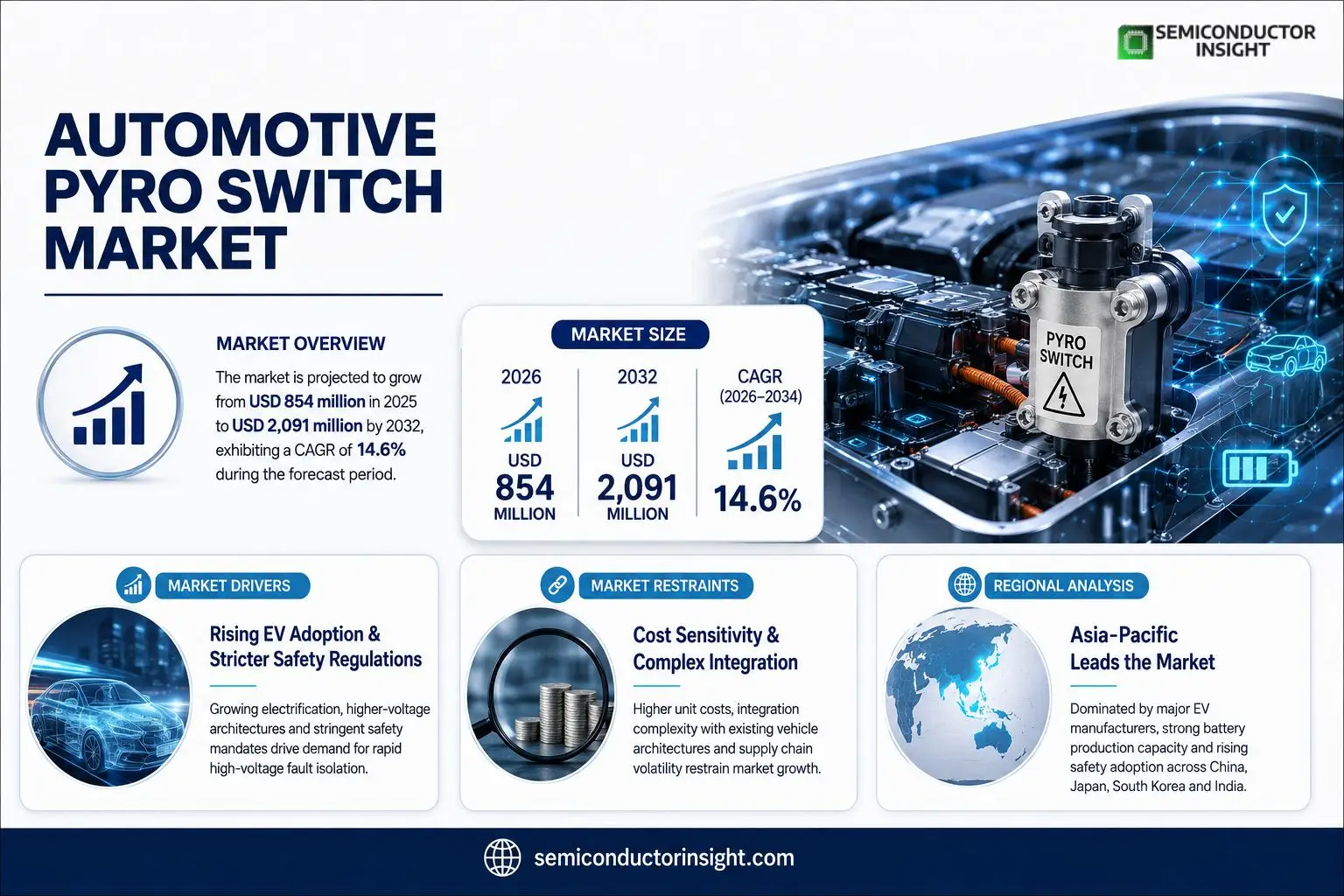
Automotive Pyro Switch market size was valued at USD 854 million in 2025. The market is projected to grow from USD 854 million in 2025 to USD 2091 million by 2032, exhibiting a CAGR of 14.6% during the forecast period.
Automotive Pyro Switch is a safety device installed in high‑voltage traction battery systems. It provides millisecond‑level physical disconnection when collisions, thermal‑runaway events or severe electrical faults occur, delivering fast response, reliable isolation and redundant protection for vehicle and battery operation.Growth is fueled by rising EV adoption, higher voltage architectures and stricter safety regulations that demand rapid fault isolation. Production reached roughly 42.5 million units in 2025 at an average price of USD 22 per unit, while capacity utilization stood at 85 % and gross margins averaged 43 %. Key upstream suppliers such as Mitsubishi Shindoh, Nexans, GE and Denso deliver melt materials, busbars and control electronics; downstream adopters include Tesla, Volkswagen, BYD and SAIC Motor building high‑voltage protection systems.
MARKET DRIVERS
Regulatory Pressure for Safer Ignition Systems
The tightening of safety regulations in North America and Europe has forced OEMs to replace traditional mechanical igniters with electronic pyro switches. Compliance cost now weighs heavily on design decisions, prompting a shift toward devices that can be calibrated to meet fire‑safety thresholds without extensive hardware redesign.
Electrification of Powertrains and Fire‑Safety Requirements
As hybrid and electric vehicles proliferate, the high‑voltage architecture creates new ignition challenges. Automotive Pyro Switch Market participants that can guarantee reliable activation under elevated voltage conditions are gaining preference, because system reliability directly influences warranty claims and brand reputation.
➤ Analysts observe that manufacturers opting for solid‑state pyro switches report up to a 15 % reduction in assembly time, translating into measurable cost efficiencies.
Finally, the rise of aftermarket retrofits for classic cars provides a niche revenue stream. Enthusiasts demand modern safety components that preserve original aesthetics, and pyro switches satisfy both safety compliance and vintage authenticity.
MARKET CHALLENGES
Cost Sensitivity in Volume Production
While electronic pyro switches deliver performance advantages, their unit price remains higher than legacy mechanical counterparts. Price pressure is especially acute in emerging markets where profit margins are thin, forcing suppliers to balance between advanced functionality and affordable pricing.
Other Challenges
Supply‑Chain Volatility
The semiconductor shortage that began in 2020 continues to ripple through the automotive sector, limiting the availability of critical components such as MOSFETs and capacitors required for pyro‑switch assemblies. Manufacturers must negotiate longer lead times or seek alternative sourcing strategies.In addition, the lack of standardized testing protocols across regions creates certification bottlenecks. Companies that invest in cross‑regional compliance labs gain a competitive edge, but the upfront expense can deter smaller players.
MARKET RESTRAINTS
Complex Integration with Existing Vehicle Architectures
Retrofitting a modern pyro switch into platforms originally designed for mechanical igniters often requires extensive rewiring and software updates. Engineering effort escalates quickly, discouraging OEMs from undertaking large‑scale redesigns without clear ROI.Moreover, the perceived reliability of electronic solutions is still under scrutiny in markets where harsh temperature swings are common. Field failures, even if isolated, can erode confidence and slow adoption rates.Lastly, intellectual‑property disputes around proprietary fire‑safety algorithms have introduced legal uncertainties. Companies wary of litigation may postpone investment until clearer licensing frameworks emerge.
MARKET OPPORTUNITIES
Integration with Advanced Driver‑Assistance Systems (ADAS)
Linking pyro switches to ADAS enables predictive fire‑suppression actions based on sensor data, opening a premium segment for safety‑focused vehicles. Early adopters can differentiate their brand by offering smart‑fire‑management features that communicate directly with vehicle diagnostics.Another avenue lies in the burgeoning market for high‑performance sports cars, where owners prioritize both performance and safety. Customized pyro‑switch solutions that support rapid ignition cycles while maintaining fire‑risk mitigation present a lucrative niche.Finally, partnerships with electronics manufacturers developing next‑generation power‑module designs could embed pyro‑switch functionality at the silicon level, reducing bill‑of‑materials cost and simplifying assembly lines. Such collaboration promises a cost‑effective pathway for scaling Automotive Pyro Switch Market ly.
Automotive Pyro Switch Market Trends
Shift Toward Higher‑Voltage Architectures
The transition of battery electric and hybrid platforms to voltage levels above 700 V is reshaping component priorities. A millisecond‑level physical disconnect becomes indispensable when fault energies rise, because electronic safeguards alone cannot guarantee isolation before a thermal runaway propagates. In 2025 the sector shipped roughly 42.5 million units, an output sustained by an 85 % capacity utilization rate and an average selling price near USD 22. The robust gross margin of 43 % signals that manufacturers are capturing premium value from safety‑critical performance, suggesting that OEMs will increasingly specify dedicated pyro‑switch modules as a non‑negotiable line‑item rather than an optional add‑on.
Other Trends
Supply‑Chain Consolidation
Upstream, the market relies heavily on a narrow set of specialty inputsmelt alloys, busbar assemblies, high‑temperature insulation, and electronic control units. Suppliers such as Mitsubishi Shindoh, Nexans, GE and Denso dominate the material pool, enabling tier‑1 assemblers to negotiate tighter tolerances and streamline validation cycles. The 85 % capacity utilization reported in 2025 reflects a balance between demand pressure and the limited number of qualified producers, prompting strategic partnerships and joint‑venture arrangements that lock in volume commitments while preserving the 43 % margin profile.
Integration with Multi‑Layer Safety Systems
Regulatory bodies across Europe, North America and Asia have tightened crash‑validation standards, demanding documented physical isolation alongside software‑based fault detection. As a result, manufacturers are embedding pyro‑switches within broader safety architectures that combine BMS‑triggered logic, airbag‑ECU activation, and redundancy checks. This layered approach not only shortens response times but also creates cross‑functional value: system‑level validation becomes more predictable, and downstream OEMs such as Tesla, Volkswagen, BYD and SAIC can certify vehicles with fewer redesign iterations. The practical implication for suppliers is a shift from pure component sales to integrated safety solutions, where engineering services and after‑sales support become additional revenue streams.
COMPETITIVE LANDSCAPE
Key Industry Players
Automotive Pyro Switch Competitive Overview
The market is dominated by a handful of large safety‑system manufacturers that have leveraged long‑standing relationships with major OEMs. Autoliv, with a footprint in passive safety, commands roughly a third of total shipments by integrating its pyro‑switch modules directly into the high‑voltage architectures of Tier‑1 automotive groups. Daicel, known for its polymer‑based actuation components, differentiates through a proprietary melt‑link design that shortens activation time and reduces unit cost, allowing it to capture a significant share of the mid‑voltage segment. Littelfuse, backed by an extensive electronic‑components portfolio, has accelerated its growth by bundling pyro switches with isolation circuitry, a strategy that deepens its presence in both BEV and HEV platforms. Mersen, a specialist in high‑performance conductive materials, supplies the busbar and contact elements that underpin the reliability of many competing switches, positioning it as a strategic upstream partner. Eaton’s power‑management expertise and Denso’s extensive ECU integration capabilities create a convergent ecosystem where each player contributes a distinct value chain lever, reinforcing a competitive structure that rewards both scale and technological nuance.Beyond the tier‑one giants, a cluster of niche firms sustains market vitality through focused innovation. Pacific Engineering Corporation exploits a vertically integrated approach, producing everything from the ceramic housing to the trigger electronics, which gives it agility in customized orders for emerging Chinese EV manufacturers. Miba AG leverages its precision‑machining heritage to deliver ultra‑compact units for space‑constrained platforms, attracting niche adopters in premium electric sedans. MTA Group, Xi’an Sinofuse Electric, and Hangzhou Superfuse represent a wave of Chinese entrants that benefit from lower material costs and rapid prototyping cycles, enabling them to target volume‑driven domestic brands such as BYD and SAIC Motor. These players often collaborate with upstream material suppliersMitsubishi Shindoh, Nexans, and GEto secure high‑purity melt alloys and advanced insulation, ensuring compliance with UN R100 and ISO 6469 standards while keeping margins healthy. The collective effect is a market where large incumbents secure high‑value contracts and niche firms capture fast‑growth segments through cost‑effective, application‑specific solutions.
List of Key Automotive Pyro Switch Companies Profiled
- Autoliv
- Littelfuse
- Daicel
- Mersen
- Eaton
- Pacific Engineering Corporation
- Miba AG
- MTA Group
- Xi’an Sinofuse Electric
- Hangzhou Superfuse
- Denso Corporation
- GE Aviation
Segment Analysis:
| Segment Category | Sub-Segments | Key Insights |
| By Type |
|
High Voltage segment is considered pivotal because:
|
| By Application |
|
Battery Electric Vehicles dominate the application landscape because:
|
| By End User |
|
OEMs lead this segment because:
|
| By Voltage Level |
|
Ultra‑High Voltage is emerging as a focus because:
|
| By Trigger Mechanism |
|
Airbag ECU Triggered remains dominant because:
|
Regional Analysis: Automotive Pyro Switch Market
Recent revisions to the EU Crash Safety Annex emphasize rapid fire suppression, prompting manufacturers to integrate pyro switches with tighter tolerance windows. The shift has led to collaborative testing programs where OEMs and component vendors share data, accelerating the adoption of next‑generation compounds while maintaining compliance credibility.
A legacy of precision engineering firms across Germany and Italy provides a resilient base for raw‑material sourcing. Recent strategic alliances between alloy producers and switch assemblers have shortened lead times, allowing quicker response to OEM design cycles without sacrificing quality.
Fleet managers across the continent prioritize reliability metrics that translate directly into lower downtime. This mindset translates into a willingness to pay a modest premium for switches that demonstrate extended burn‑through life, reinforcing a market tilt toward durable, low‑maintenance solutions.
Venture capital activity in automotive safety components has risen, attracted by the EU’s Horizon funding schemes. Emerging start‑ups focused on nanostructured pyrotechnic films are receiving seed rounds, indicating a growing appetite for technology that can fine‑tune ignition timing.
North America
The North American scene for Automotive Pyro Switch Market is defined by a strong emphasis on performance testing and a fragmented supplier base. U.S. regulators maintain a rigorous certification pathway, which fosters a culture of thorough validation before market entry. Meanwhile, Canada’s quieter adoption curve reflects a preference for proven solutions rather than early‑stage innovations. OEMs in the United States leverage a wide array of contract manufacturers, creating opportunities for cost arbitrage but also necessitating tighter quality oversight. The regional narrative is shaped by a blend of high‑performance vehicle demand and a cautious approach to integrating new ignition technologies, resulting in a market that values both speed of adoption and long‑term reliability.
Asia‑Pacific
In Asia‑Pacific, rapid expansion of vehicle production capacity drives Automotive Pyro Switch Market toward scale‑focused strategies. Countries such as China and India prioritize volume output, which encourages manufacturers to standardize components to reduce complexity. However, local safety mandates differ widely, leading to a patchwork of certification requirements. This diversity pushes regional players to develop adaptable designs that can be tuned for varying regulatory thresholds. Additionally, emerging electric‑vehicle programs are prompting a reevaluation of traditional pyro‑based ignition, hinting at a gradual shift toward alternative thermal management solutions within the broader market context.
South America
South American automotive producers adopt a pragmatic stance, looking to balance cost constraints with emerging safety expectations. Brazil’s growing middle class fuels demand for affordable vehicles, which in turn pressures component suppliers to offer competitive pricing without compromising baseline reliability. Regulatory evolution is slower than in other regions, but recent updates to fire‑safety codes have begun to influence purchasing decisions. As a result, the market sees incremental upgrades to existing switch designs rather than wholesale technology overhauls, reflecting a measured response to both fiscal and safety considerations.
Middle East & Africa
The Middle East & Africa region presents a heterogeneous picture for Automotive Pyro Switch Market. Wealthier Gulf states invest heavily in high‑end vehicle fleets, where premium ignition solutions are valued for their durability under extreme temperature swings. Conversely, many African markets prioritize ruggedness and low maintenance, leading to a preference for simpler, proven switch architectures. Limited local production capability means most components are imported, creating a reliance on supply chains. This dynamic encourages regional distributors to act as value‑add partners, offering technical support that bridges the gap between overseas manufacturers and end‑users seeking reliable fire‑safety performance.
Report Scope
This market research report provides a comprehensive analysis of the Automotive Pyro Switch Market , covering the forecast period 2026–2034. It offers detailed insights into market dynamics, technological advancements, competitive landscape, and key trends shaping the industry.
Key focus areas of the report include:
- Market Overview: The report begins with an overview outlining its current market scenario, key growth indicators, and industry transformation drivers. It discusses macroeconomic factors, demand–supply balance, regulatory landscape, and the strategic role of semiconductors in powering advancements across industries such as automotive, telecommunications, consumer electronics, and industrial automation.
- Market Size & Forecast: Historical data and future projections for revenue, unit shipments, and market value across major regions and segments.
- Segmentation Analysis: Detailed breakdown by product type, technology, application, and end-user industry to identify high-growth segments and investment opportunities.
- Regional Insights: Insights into market performance across North America, Europe, Asia-Pacific, Latin America, and the Middle East & Africa, including country-level analysis where relevant.
- Competitive Landscape: Profiles of leading market participants, including their product offerings, R&D focus, manufacturing capacity, pricing strategies, and recent developments such as mergers, acquisitions, and partnerships.
- Technology Trends & Innovation: Assessment of emerging technologies, integration of AI/IoT, semiconductor design trends, fabrication techniques, and evolving industry standards.
- Market Drivers & Restraints: Evaluation of factors driving market growth along with challenges, supply chain constraints, regulatory issues, and market-entry barriers.
- Stakeholder Insights: Insights for component suppliers, OEMs, system integrators, investors, and policymakers regarding the evolving ecosystem and strategic opportunities.
Primary and secondary research methods are employed, including interviews with industry experts, data from verified sources, and real-time market intelligence to ensure the accuracy and reliability of the insights presented.
FREQUENTLY ASKED QUESTIONS:
What is the current market size of Automotive Pyro Switch Market?
->Automotive Pyro Switch Market was valued at USD 854 million in 2025 and is expected to reach USD 2091 million by 2032.
What is the projected CAGR for Automotive Pyro Switch Market?
-> The market is projected to grow at a compound annual growth rate (CAGR) of 14.6% over the forecast period.
Which key companies operate in Automotive Pyro Switch Market?
-> Key players include Autoliv, Daicel, Pacific Engineering Corporation, Littelfuse, Mersen, Eaton, Miba AG, MTA Group, Xi’an Sinofuse Electric, and Hangzhou Superfuse, among others.
What are the key growth drivers?
-> Key growth drivers include increasing electrification of vehicles, higher‑voltage battery architectures, stricter safety regulations, and rising demand for rapid high‑voltage fault isolation in BEVs and HEVs.
Which region dominates the market?
-> Asia‑Pacific is the largest and fastest‑growing region, driven by major EV manufacturers and extensive battery production capacity.
What are the emerging trends?
-> Emerging trends include integration of pyro‑switches with advanced vehicle safety systems, standardization of multi‑layer safety architectures, and development of higher‑voltage capable devices for next‑generation EVs.

Get Sample Report PDF for Exclusive Insights
Report Sample Includes
- Table of Contents
- List of Tables & Figures
- Charts, Research Methodology, and more...
 Download Sample Report PDF