Market Insights
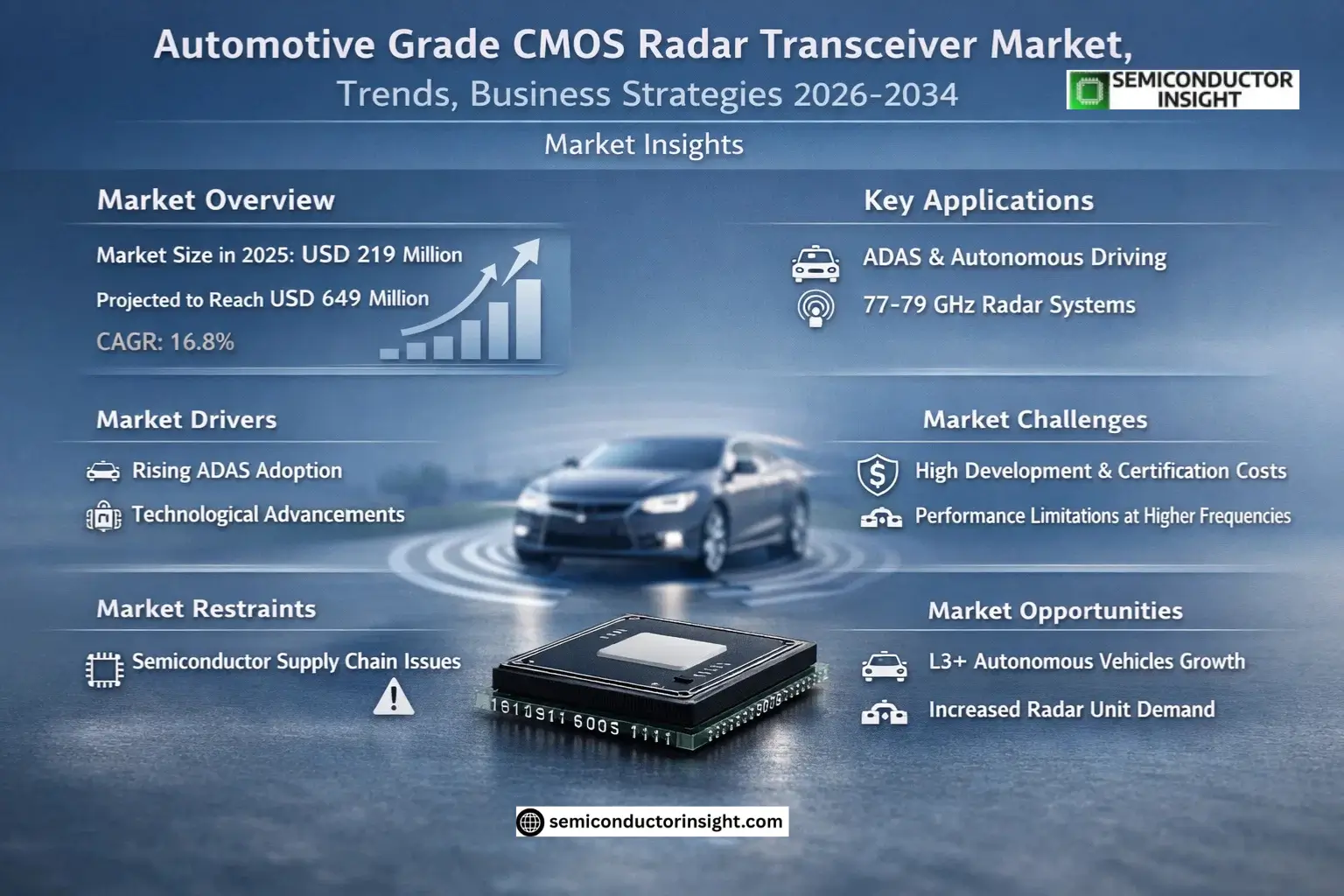
Global Automotive Grade CMOS Radar Transceiver Market size was valued at USD 219 million in 2025. The market is projected to grow from USD 256 million in 2026 to USD 649 million by 2032, exhibiting a CAGR of 16.8% during the forecast period.
Automotive Grade CMOS Radar Transceivers are highly integrated millimeter-wave devices designed for advanced driver-assistance systems (ADAS) and autonomous driving applications. These transceivers leverage CMOS technology to deliver stable RF performance, low power consumption, and high reliability required for automotive sensing systems with stringent accuracy and cost requirements. Key configurations include multi-channel designs such as 3Tx/4Rx and 2Tx/3Rx architectures, which enable precise object detection and ranging capabilities.
The market growth is driven by increasing ADAS adoption mandates worldwide and the automotive industry’s transition toward higher levels of vehicle automation. Semiconductor process advancements, particularly in 28nm and 45nm nodes, are enabling more cost-effective solutions while meeting automotive-grade reliability standards. Leading suppliers including NXP Semiconductors, Texas Instruments, and Infineon Technologies are expanding production capacity to meet growing demand from tier-1 automotive radar manufacturers.
MARKET DRIVERS
Growing Demand for Advanced Driver Assistance Systems (ADAS)
Automotive Grade CMOS Radar Transceiver Market is experiencing significant growth due to increasing adoption of ADAS features in modern vehicles. Major automakers are integrating radar-based safety systems such as adaptive cruise control and collision avoidance, which rely heavily on high-performance CMOS radar transceivers. The global ADAS penetration rate is expected to exceed 60% in new vehicles by 2026.
Technological Advancements in Automotive Radar
Recent innovations in CMOS radar technology have enabled smaller form factors, lower power consumption, and improved resolution at competitive price points. The development of 77-79 GHz radar transceivers has been particularly impactful, offering superior performance for autonomous driving applications.
Stringent government regulations across North America and Europe are accelerating adoption, with new safety standards requiring radar-based collision warning systems as standard equipment in passenger vehicles.
MARKET CHALLENGES
High Development and Certification Costs
Automotive Grade CMOS Radar Transceiver Market faces significant barriers due to rigorous automotive qualification processes and extensive testing requirements. Achieving ASIL-D safety certification can increase development timelines by 18-24 months and add substantial costs to product development.
Other Challenges
Performance Limitations at Higher Frequencies
While 77-79 GHz CMOS radar transceivers offer advantages, they still face challenges in maintaining signal integrity and noise performance compared to traditional SiGe-based solutions, particularly in harsh automotive environments.
MARKET RESTRAINTS
Supply Chain Constraints for Automotive Semiconductors
Automotive Grade CMOS Radar Transceiver Market continues to face supply chain disruptions affecting semiconductor availability. Lead times for automotive-grade components remain extended, with some manufacturers reporting 40-50 week wait periods for certain CMOS radar chips.
MARKET OPPORTUNITIES
Emerging Markets for L3+ Autonomous Vehicles
The transition to higher levels of vehicle automation creates substantial growth potential for the Automotive Grade CMOS Radar Transceiver Market. Industry analysts predict L3 autonomous systems will require 5-8 radar units per vehicle, compared to 1-3 in current ADAS configurations.
Automotive Grade CMOS Radar Transceiver Market Trends
Growth in Autonomous Vehicle Adoption Driving Demand
The increasing integration of autonomous driving features is accelerating demand for Automotive Grade CMOS Radar Transceivers. These components are critical in angle radar and forward radar systems, providing precise object detection for advanced driver assistance systems (ADAS). Major automotive suppliers are adopting CMOS technology due to its balance of performance and cost efficiency in radar applications.
Other Trends
Semiconductor Process Node Advancements
Leading manufacturers are transitioning to more advanced process nodes, with 28nm technology gaining traction for improved power efficiency and signal integrity. This shift enables higher integration levels while maintaining automotive-grade reliability standards for radar transceiver performance.
Increasing Competition Among Key Players
The market sees intensified competition between semiconductor giants as NXP, Texas Instruments, and Infineon Technologies expand CMOS radar solutions. This competition drives innovation in transceiver architectures while maintaining strict compliance with automotive safety regulations. The top five players collectively hold significant market share through technological differentiation.
Regional Manufacturing Capacity Expansion
Asia-Pacific production facilities are increasing capacity utilization for CMOS radar transceivers to meet growing regional demand. China’s automotive sector shows particularly strong adoption rates as local vehicle manufacturers implement more ADAS features in mass-market models.
Packaging Innovation for Enhanced Performance
FOWLP (Fan-Out Wafer Level Packaging) is emerging as a preferred solution for Automotive Grade CMOS Radar Transceivers. This packaging approach addresses thermal management challenges while maintaining the compact form factors required by modern radar systems. The technology is gaining adoption for its reliability in harsh automotive environments.
COMPETITIVE LANDSCAPE
Key Industry Players
Strategic Positioning in the Automotive CMOS Radar Transceiver Sector
Automotive Grade CMOS Radar Transceiver Market is dominated by semiconductor giants NXP Semiconductors, Texas Instruments, and Infineon Technologies, which collectively held over 60% market share in 2025. These leaders leverage advanced 28nm and 45nm process nodes to deliver high-performance 3Tx/4Rx solutions for autonomous driving applications. The competitive landscape shows increasing vertical integration, with Tier 1 suppliers like Bosch and Continental developing in-house CMOS radar capabilities to secure supply chains.
Emerging players such as Arbe Robotics and Uhnder are disrupting the sector with digital modulation technologies, while Asian manufacturers like Renesas Electronics and STMicroelectronics are gaining traction through cost-optimized solutions. The market also features specialized RFIC developers like Silicon Radar GmbH and Vayyar Imaging focusing on 4D imaging radars, creating differentiated offerings in the crowded competitive space.
List of Key Automotive Grade CMOS Radar Transceiver Companies Profiled
- NXP Semiconductors
- Texas Instruments
- Infineon Technologies
- Bosch
- Continental AG
- Aptiv
- Valeo
- Denso Corporation
- ZF Friedrichshafen
- Renesas Electronics
- STMicroelectronics
- Arbe Robotics
- Uhnder
- Silicon Radar GmbH
- Vayyar Imaging
Segment Analysis:
| Segment Category | Sub-Segments | Key Insights |
| By Type |
|
3Tx/4Rx dominates as the preferred configuration due to:
|
| By Application |
|
Front Radar holds the dominant position because:
|
| By End User |
|
Tier 1 Suppliers represent the largest procurement channel due to:
|
| By Package Type |
|
FOWLP packaging is gaining traction because:
|
| By Process Node |
|
28nm process technology dominates due to:
|
Regional Analysis: Automotive Grade CMOS Radar Transceiver Market
North American semiconductor firms lead in developing high-frequency CMOS radar transceivers with improved resolution and miniaturization, specifically optimized for automotive applications. The region’s strong IP protection environment fosters continued innovation.
NHTSA mandates and IIHS safety ratings strongly influence OEM specifications, making automotive-grade CMOS radar solutions mandatory across most vehicle classes. California’s autonomous vehicle policies create additional demand for high-performance radar systems.
Well-established semiconductor fabrication facilities and automotive supply chains enable rapid scaling of CMOS radar production. Strategic partnerships between Detroit automakers and West Coast tech firms drive vertical integration of radar components.
CMOS radar transceivers have achieved over 80% adoption in premium segments and are rapidly penetrating mid-range vehicles. Fleet operators increasingly specify radar-equipped vehicles, creating sustained aftermarket demand for upgrades and replacements.
Europe
The European Automotive Grade CMOS Radar Transceiver Market demonstrates robust growth driven by EU safety regulations mandating advanced driver assistance systems. German automakers lead in integrating CMOS radar solutions with other ADAS components, while stringent emissions standards accelerate adoption in electric vehicles. The region benefits from strong academic-industry collaborations in radar technology development, particularly in millimeter-wave applications. Challenges include complex certification processes and competition from alternative sensing technologies favored by some premium brands.
Asia-Pacific
Asia-Pacific emerges as the fastest-growing market for Automotive CMOS Radar Transceivers, with China, Japan and South Korea as key contributors. Chinese automakers are aggressively adopting cost-effective CMOS solutions to meet domestic safety standards, while Japanese manufacturers focus on miniaturization for compact vehicles. The region benefits from concentrated semiconductor manufacturing capabilities and government support for autonomous vehicle infrastructure development. Price sensitivity remains a challenge for premium radar feature adoption in emerging markets.
South America
The South American market shows moderate but steady growth for Automotive Grade CMOS Radar Transceivers, primarily driven by safety-conscious consumers in Brazil and Argentina. Economic volatility impacts luxury vehicle sales containing advanced radar systems, but increasing mid-range vehicle safety requirements create opportunities. Local assembly plants gradually incorporate basic radar functionalities, supported by technology transfers from global OEMs establishing regional production bases.
Middle East & Africa
CMOS Radar Transceiver adoption in Middle Eastern luxury vehicle fleets drives market growth, particularly in GCC countries with harsh driving conditions requiring robust collision detection. African markets remain nascent but show potential as safety regulations develop. The region benefits from high SUV penetration where radar systems provide particular value, though aftermarket installations currently dominate over factory-fit solutions.
Report Scope
This market research report provides a comprehensive analysis of the Automotive Grade CMOS Radar Transceiver Market, covering the forecast period 2025–2032. It offers detailed insights into market dynamics, technological advancements, competitive landscape, and key trends shaping the industry.
Key focus areas of the report include:
- Market Overview: The report begins with an overview outlining its current market scenario, key growth indicators, and industry transformation drivers. It discusses macroeconomic factors, demand–supply balance, regulatory landscape, and the strategic role of semiconductors in powering advancements across industries such as automotive, telecommunications, consumer electronics, and industrial automation.
- Market Size & Forecast: Historical data and future projections for revenue, unit shipments, and market value across major regions and segments.
- Segmentation Analysis: Detailed breakdown by product type, technology, application, and end-user industry to identify high-growth segments and investment opportunities.
- Regional Insights: Insights into market performance across North America, Europe, Asia-Pacific, Latin America, and the Middle East & Africa, including country-level analysis where relevant.
- Competitive Landscape: Profiles of leading market participants, including their product offerings, R&D focus, manufacturing capacity, pricing strategies, and recent developments such as mergers, acquisitions, and partnerships.
- Technology Trends & Innovation: Assessment of emerging technologies, integration of AI/IoT, semiconductor design trends, fabrication techniques, and evolving industry standards.
- Market Drivers & Restraints: Evaluation of factors driving market growth along with challenges, supply chain constraints, regulatory issues, and market-entry barriers.
- Stakeholder Insights: Insights for component suppliers, OEMs, system integrators, investors, and policymakers regarding the evolving ecosystem and strategic opportunities.
Primary and secondary research methods are employed, including interviews with industry experts, data from verified sources, and real-time market intelligence to ensure the accuracy and reliability of the insights presented.
FREQUENTLY ASKED QUESTIONS:
What is the current market size of Automotive Grade CMOS Radar Transceiver Market?
-> Automotive Grade CMOS Radar Transceiver Market size was valued at USD 219 million in 2025. The market is projected to grow from USD 256 million in 2026 to USD 649 million by 2032, exhibiting a CAGR of 16.8% during the forecast period.
What is the growth rate of Automotive Grade CMOS Radar Transceiver Market?
-> The market is expected to grow at a CAGR of 16.8% during 2025-2032.
Which key companies operate in Automotive Grade CMOS Radar Transceiver Market?
-> Key players include NXP Semiconductors, Texas Instruments, Infineon Technologies, among others. These companies held approximately % market share by revenue in 2025.
What are the key applications of Automotive Grade CMOS Radar Transceivers?
-> Key applications include Corner Radar (%), Front Radar (%), and Others (%) as of 2025.
What was the production volume in 2025?
-> Approximately 16 million units were produced in 2025, with an average price of USD 15 per unit.
What are the major regional markets?
-> Key regions include North America (US market valued at USD million in 2025), Asia (China projected to reach USD million), and Europe.

Get Sample Report PDF for Exclusive Insights
Report Sample Includes
- Table of Contents
- List of Tables & Figures
- Charts, Research Methodology, and more...
 Download Sample Report PDF