Key Statistics
Key Takeaways
- Multi-frequency GNSS modules are the fastest-advancing type because dual- and multi-band reception improves urban accuracy, multipath resistance and positioning continuity for connected and safety-related vehicle functions.
- Passenger vehicles remain the largest vehicle segment because navigation, telematics and connected-services hardware is deployed across high annual production volumes, while commercial vehicles add strong fleet-management demand.
- Asia Pacific is the largest regional market in the source page, reflecting the scale of vehicle production and electronics integration in China, Japan and South Korea.
- Europe has a strong regulatory demand floor because 112-based eCall requirements apply to new M1 and N1 vehicle types and require compatibility with Galileo and EGNOS positioning services.
- Sensor fusion is reshaping competition: automotive buyers increasingly evaluate GNSS together with inertial dead reckoning, cellular connectivity, map correction and vehicle-domain integration rather than as a stand-alone navigation receiver.
Automotive GNSS Modules Market Overview
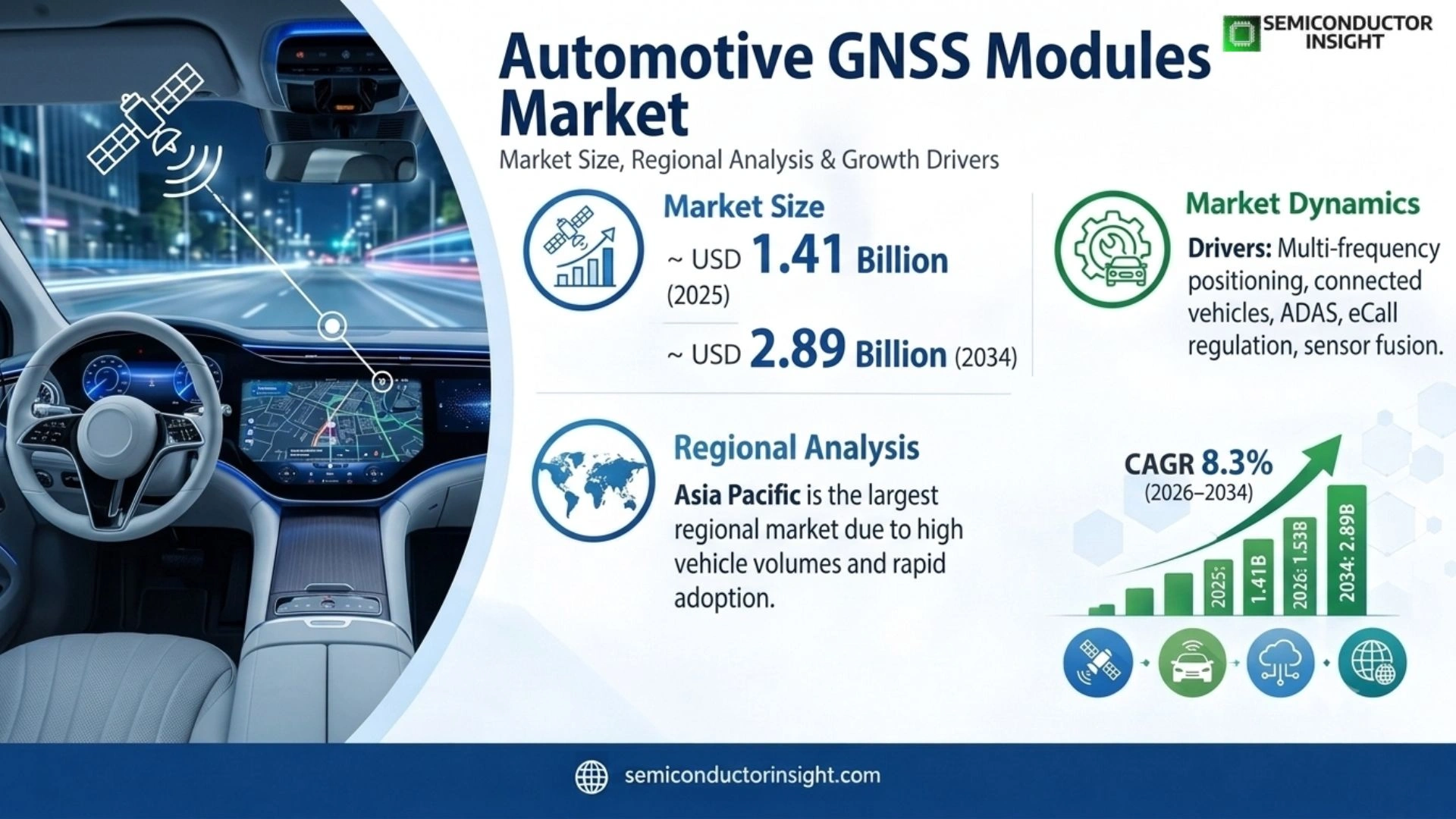
Automotive GNSS modules market is rebased to USD 1.41 billion in 2025, rises to an estimated USD 1.53 billion in 2026, and is projected to reach USD 2.89 billion by 2034, representing an anchor-derived CAGR of 8.3% during 2026–2034. Asia Pacific is the largest market in 2025, while the growth pattern is being reshaped by multi-frequency positioning, connected vehicles, ADAS, emergency-call regulation and the migration toward sensor-fused high-integrity navigation.
Automotive GNSS modules combine satellite-signal reception, positioning engines, RF front ends and interfaces suitable for vehicle electronics. They receive signals from systems such as GPS, Galileo, GLONASS, BeiDou and QZSS and convert them into position, velocity and timing information used by navigation, telematics, emergency calling, advanced driver-assistance systems, fleet management and increasingly automated-driving functions.
The automotive requirement is more demanding than basic consumer navigation because a vehicle must continue to estimate position in urban canyons, parking structures, tunnels and other environments where satellite visibility degrades. This pushes suppliers toward multi-frequency and multi-constellation GNSS, dead reckoning, inertial fusion, correction services and automotive-grade qualification. Qualcomm’s automotive platform, for example, combines multi-frequency multi-constellation GNSS with dead-reckoning and precise-positioning functions as part of a broader modem-RF system.
Regulation creates a baseline market that is independent of premium navigation adoption. The European Union requires 112-based eCall in-vehicle systems for new M1 and N1 vehicle types and specifies compatibility with Galileo and EGNOS positioning services. Updated European rules are also moving eCall toward packet-switched 4G/5G networks, reinforcing the integration of positioning, cellular connectivity and emergency-service functionality inside automotive communication modules.
Segment Analysis: By Type
By type, the source page segments the market into Single-frequency GNSS Modules and Multi-frequency GNSS Modules. Single-frequency products remain cost-effective for mainstream navigation and tracking, while multi-frequency modules are gaining strategic importance because higher-integrity positioning is required for ADAS, connected vehicles and automated-driving functions operating in challenging signal environments.
| Type | Technical / commercial role | Market position |
|---|---|---|
| Single-frequency GNSS Modules | These modules typically receive one primary frequency band from one or more satellite constellations. They are sufficient for standard navigation, telematics and location services where meter-level positioning and low module cost are more important than lane-level accuracy. Automotive qualification, antenna design and integration with cellular telematics remain essential even when positioning architecture is comparatively simple. | Large installed base in cost-sensitive and mainstream applications. Growth is steadier than in multi-frequency products because higher-end vehicles increasingly require improved urban accuracy and integrity. Suppliers compete through price, power consumption, automotive qualification, software maturity and ease of integration into telematics control units. |
| Multi-frequency GNSS Modules | Multi-frequency designs receive multiple GNSS bands and often multiple constellations, enabling ionospheric-error correction, improved convergence and better resilience to multipath and obstructed sky conditions. Automotive implementations increasingly combine these receivers with dead reckoning, inertial sensors and correction services to maintain positioning continuity when satellites alone are insufficient. | Fastest-advancing segment and the strategic focus for ADAS and automated-driving architectures. The commercial premium is justified when positioning accuracy and integrity affect safety or advanced functions. Supplier differentiation therefore shifts from raw receiver sensitivity toward fusion algorithms, correction-service compatibility, automotive cybersecurity and long-term software support. |
Why is multi-frequency positioning becoming more valuable in vehicles?
Vehicles operate in dynamic environments where buildings, trees, overpasses and tunnels can block or reflect satellite signals. Multi-frequency reception improves the receiver’s ability to correct atmospheric effects and reject multipath, but automotive-grade performance increasingly depends on the entire positioning stack. Buyers therefore combine GNSS with wheel-speed input, inertial sensors, map data, cellular assistance and correction services, turning the module from a stand-alone locator into one component of a high-integrity localization system.
Segment Analysis: By Application
The source page’s application structure includes Fuel Vehicle and Electric Vehicle in its formal table of contents, while its broader scope also identifies navigation and infotainment, ADAS, telematics, autonomous driving, V2X and emergency systems as major functional uses. Passenger vehicles form the largest end-user volume base, and electric vehicles are among the fastest-growing vehicle categories because they typically carry richer connected and driver-assistance electronics.
| Application | Demand characteristics |
|---|---|
| Fuel Vehicles | Conventional internal-combustion vehicles continue to generate substantial GNSS demand through factory navigation, telematics, eCall, fleet tracking and ADAS. The purchasing trigger is usually integration into a telematics control unit or infotainment platform, where automotive qualification, cellular coexistence, antenna performance and long software support matter more than positioning accuracy alone. |
| Electric Vehicles | Electric vehicles often adopt connected services, advanced displays, route planning, charging-location services and ADAS at higher rates than entry-level conventional vehicles. Precise positioning supports range-aware navigation and charging decisions, while premium EV platforms increasingly combine GNSS with inertial and map-based localization. This makes EV growth an important accelerator for higher-value multi-frequency modules. |
| ADAS & Automated Driving | ADAS requires reliable vehicle localization to complement cameras, radar and other sensors. GNSS alone is not sufficient for safety-critical autonomy, but multi-band positioning combined with RTK, PPP or correction services can provide absolute position and heading references. The module therefore becomes part of a fused localization architecture whose commercial value rises with vehicle automation level. |
| Telematics, eCall & Fleet Management | Telematics systems use GNSS for vehicle location, route history, emergency response, insurance services and fleet optimization. Regulatory eCall creates a mandatory positioning function in Europe, while commercial fleets use continuous location data to manage utilization and safety. These applications favor integrated GNSS-plus-cellular platforms that reduce component count and simplify vehicle certification. |
Regional Analysis
The source page identifies Asia Pacific as the largest regional market because it combines the world’s highest vehicle production volumes with rapid adoption of connected-car electronics. Europe has a particularly strong regulatory demand floor through eCall and Galileo/EGNOS compatibility, while North America is an important market for premium vehicles, telematics, fleet systems and advanced-driving development.
How do regulation, vehicle production and positioning technology shape regional demand?
Automotive GNSS demand follows both the number of vehicles produced and the electronic content installed per vehicle. Asia Pacific leads on scale. Europe adds a regulatory baseline because emergency-call systems require satellite positioning. North America emphasizes connected services, fleet telematics and premium ADAS. Emerging regions grow with vehicle parc modernization and imported telematics, but lower vehicle electronics content can limit module value per car.
| Region | Position | Growth outlook | Demand profile | What decides supplier selection |
|---|---|---|---|---|
| Asia Pacific | Largest | High | Vehicle-production and connected-car led | Automotive qualification, local OEM integration, cost and multi-constellation support |
| Europe | Major | High | Regulation and premium-ADAS led | eCall compliance, Galileo/EGNOS compatibility, automotive safety and cybersecurity |
| North America | Major | Moderate to high | Telematics, fleet and premium-ADAS led | Integration, software support, cellular coexistence and correction services |
| South & Central America | Smaller | Moderate | Fleet, navigation and safety-service led | Cost, coverage, importer/OEM channels and robust telematics |
| Middle East & Africa | Emerging | Moderate from small base | Fleet and connected-mobility led | Coverage, heat/environmental robustness and system integration |
Competitive Landscape
Competition spans semiconductor platform suppliers, GNSS specialists and regional navigation-chip companies. The source page profiles Qualcomm, Broadcom, MediaTek, u-blox, STM, Intel, Furuno Electric and several Chinese suppliers. The market is shifting from stand-alone receivers toward integrated automotive connectivity and positioning platforms, which changes the basis of competition from chip sensitivity alone to software, sensor fusion, correction services and vehicle-domain integration.
Qualcomm and other large semiconductor vendors benefit when GNSS is integrated with cellular modem, application processing and C-V2X functions. Their advantage is platform breadth and established automotive qualification. Specialized providers such as u-blox compete through positioning expertise, modules, dead reckoning and long product support, while regional Chinese suppliers can address domestic BeiDou-oriented requirements and price-sensitive vehicle platforms.
Automotive design cycles create durable positions because an approved component may remain in production for many years. Suppliers must therefore maintain functional safety processes, quality systems, cybersecurity support and long-term availability. A technically superior receiver can still lose a program if the supplier cannot commit to automotive lifecycle requirements or provide stable firmware across vehicle platforms.
The most valuable competitive layer is moving upward into localization software. High-precision GNSS requires correction data, inertial fusion and algorithms that detect poor satellite geometry or spoofing. This creates partnerships among module suppliers, correction-service providers, map companies and automotive Tier 1 integrators. The winning supplier is increasingly the one that reduces integration risk for the OEM rather than the one with the lowest receiver price.
| Competitive tier | Companies | Why they matter |
|---|---|---|
| Integrated semiconductor platforms | Qualcomm; Broadcom; MediaTek; STM; Intel | These companies can integrate GNSS into broader connectivity or processing platforms, reducing component count and enabling coordinated cellular, C-V2X and location functions. Their automotive advantage depends on qualification, software stacks, modem integration and OEM relationships rather than GNSS receiver performance alone. |
| Specialist positioning suppliers | u-blox; Furuno Electric | Specialists differentiate through GNSS expertise, modules, dead reckoning, correction-service compatibility and long product lifecycles. They are attractive when an OEM or Tier 1 wants a dedicated positioning subsystem with transparent interfaces and strong technical support rather than a deeply integrated modem platform. |
| Regional / China-focused suppliers | Mengxin Technology; ALLYSTAR Technology; HangZhou ZhongKe Microelectronics; Techtotop Microelectronecs Technology; Chongqing Southwest Integrated Circuit Design; Beijing Ziguang Zhanrui Technology | Regional suppliers participate through local OEM relationships, BeiDou support, cost optimization and domestic semiconductor strategies. Their growth opportunity increases as Chinese vehicle platforms adopt more connected and automated functions, although automotive qualification and long-term software support remain critical barriers to broader international expansion. |
Companies profiled in the report
The source page profiles Qualcomm, Broadcom, Mediatek, U-blox, STM, Intel, Furuno Electric, Mengxin Technology, ALLYSTAR Technology, HangZhou ZhongKe Microelectronics, Techtotop Microelectronecs Technology, Chongqing Southwest Integrated Circuit Design, and Beijing Ziguang Zhanrui Technology. This list is retained as the report scope, while competitive analysis distinguishes integrated semiconductor platforms from specialist GNSS suppliers and regional participants.
Production Capacity Analysis
Automotive GNSS module supply is constrained less by raw manufacturing capacity than by automotive qualification, RF integration, firmware maturity and long lifecycle support. Semiconductor dies can be fabricated at scale, but a module must also combine antennas or RF interfaces, filtering, timing, memory, firmware and vehicle-grade packaging, then pass environmental, EMC, quality and OEM validation before it can enter serial production.
The upstream semiconductor stage includes GNSS baseband, RF front-end and, in integrated platforms, cellular modem and application-processing functions. Automotive products require qualified process nodes and stable supply over long vehicle lifecycles. This favors vendors with established automotive quality systems and foundry relationships because vehicle programs can remain in production long after consumer chip generations have changed.
Module assembly adds shielding, oscillators, passives, memory and interfaces, but the key constraint is validation. Temperature cycling, vibration, RF coexistence, antenna performance, startup behavior and software robustness all matter. An OEM or Tier 1 may require years of design, verification and field testing before launch, so nominal manufacturing capacity cannot be converted quickly into qualified automotive revenue.
The transition to multi-frequency and sensor-fused positioning increases software content. Suppliers must maintain GNSS firmware, dead-reckoning algorithms, correction-service interfaces and diagnostic functions across changing satellite constellations and cellular generations. This creates recurring engineering obligations and makes technical support capacity almost as important as physical module production.
Market Dynamics
Growth is supported by connected vehicles, ADAS, eCall regulation, multi-frequency technology and EV electronics content, but the market faces signal-interference limits, high integration complexity and long automotive qualification cycles. GNSS is increasingly necessary but rarely sufficient on its own, so commercial value shifts toward platforms that combine satellite positioning with inertial, cellular and map-based localization.
Market Drivers
| Driver | Directional impact* | Commercial mechanism |
|---|---|---|
| Connected vehicle penetration | High | Navigation, telematics, remote services, emergency calling and fleet functions all require reliable location. As connectivity becomes standard across more vehicle trims, GNSS moves from a premium feature toward baseline electronic content, expanding unit demand even before higher-precision automation functions are considered. |
| ADAS and automated driving | High | Higher automation levels need absolute vehicle position to complement cameras, radar and inertial sensors. This supports multi-frequency GNSS, dead reckoning and correction services, raising average module value and software content. |
| eCall and safety regulation | Medium to High | European eCall requirements create a mandated location function for new M1 and N1 vehicle types and require compatibility with Galileo and EGNOS. Regulatory modernization toward 4G/5G eCall further supports integrated communication-and-positioning platforms. |
| EV electronics content | Medium | Electric vehicles commonly ship with richer connectivity, route planning, charging-location and ADAS features. Higher electronic content per vehicle increases the likelihood of multi-band GNSS and integrated telematics adoption. |
Connected services turn location into baseline vehicle data
Modern vehicles use position for navigation, remote diagnostics, stolen-vehicle tracking, usage-based insurance, fleet operations and emergency services. As these services become standard, GNSS is embedded in telematics control units across a broader range of vehicle trims. The commercial implication is sustained unit growth even in vehicles that do not require centimeter-level precision.
ADAS increases the value of positioning integrity
ADAS and automated-driving systems need to know not only where the vehicle is but also how confident the system should be in that estimate. Multi-frequency GNSS, inertial fusion and correction services improve accuracy and continuity, especially in urban environments. This shifts demand toward higher-value modules and software stacks with integrity monitoring rather than low-cost stand-alone receivers.
European eCall creates a regulation-backed demand floor
EU rules require new M1 and N1 vehicle types to include 112-based eCall systems and specify compatibility with Galileo and EGNOS. The regulatory framework reduces dependence on consumer willingness to pay because satellite positioning is part of a type-approval requirement. As eCall migrates toward packet-switched 4G/5G networks, integrated connectivity-and-positioning platforms become more attractive to OEMs.
EV platforms accelerate electronics integration
Electric vehicles often use centralized computing, connected infotainment, smartphone integration and advanced driver assistance as core product differentiators. GNSS supports route planning, charging-location services and connected mobility, while higher-end EVs increasingly use precise positioning for driver-assistance functions. This raises the average positioning content per vehicle and supports multi-frequency module adoption.
Market Restraints
| Restraint | Directional impact* | Commercial mechanism |
|---|---|---|
| Urban signal degradation | High | Buildings, tunnels, trees and multipath can reduce GNSS accuracy or availability. Safety-related applications therefore require inertial, map or other sensor support, increasing system cost and reducing the value of a receiver-only solution. |
| Automotive qualification cost | Medium to High | Modules must pass temperature, vibration, EMC, quality and OEM validation, and suppliers must support long vehicle lifecycles. These requirements slow new-product commercialization and create barriers for consumer-focused GNSS vendors. |
| Sensor-fusion complexity | Medium | High-integrity positioning requires data from GNSS, IMU, wheel speed, maps and sometimes vision. Integrating and validating these signals increases software development cost and can shift value away from the module itself toward system-level localization. |
| Price pressure in mainstream vehicles | Medium | Entry and mid-range vehicle platforms remain cost sensitive. OEMs may prefer GNSS integrated into cellular or infotainment silicon rather than a dedicated premium module, limiting standalone hardware pricing even as total positioning functionality increases. |
Satellite signals remain vulnerable in difficult environments
GNSS performance degrades in tunnels, underground parking, dense urban canyons and areas with strong multipath or interference. Automotive systems cannot assume continuous clear-sky reception, so suppliers must add dead reckoning, inertial fusion and other sensors. These measures improve resilience but increase bill of materials, software complexity and validation effort, restraining rapid adoption of high-precision solutions in cost-sensitive vehicles.
Automotive product cycles are long and expensive
A new automotive GNSS platform may require years of qualification before serial production and then remain supported for a decade or more. Suppliers must maintain quality documentation, cybersecurity responses, firmware compatibility and manufacturing continuity throughout that lifecycle. This raises the fixed cost of entering the market and makes rapid product turnover, common in consumer electronics, unsuitable for many vehicle programs.
High precision requires more than a GNSS module
Centimeter-level or lane-level positioning generally depends on correction data, inertial sensors, antenna quality and map or vehicle-motion inputs. The module can therefore become only one element of a larger localization stack. This limits the amount of value a stand-alone GNSS supplier can capture unless it also provides software, correction services or strong integration support.
Integrated platforms intensify price competition
Cellular modem and infotainment processors increasingly include GNSS, allowing OEMs to reduce dedicated hardware. This can commoditize standard-precision receiver functions. Specialist suppliers must therefore defend their role through accuracy, dead reckoning, functional safety, correction-service integration and long lifecycle support rather than competing solely on basic positioning capability.
Market Opportunities
Multi-frequency GNSS for lane-level and resilient positioning
The migration from single-band navigation to multi-frequency positioning creates a higher-value module opportunity. Dual- and multi-band receivers can improve accuracy and convergence while reducing some ionospheric and multipath errors. Suppliers that combine this capability with automotive dead reckoning and integrity monitoring can address ADAS and automated-driving programs where standard navigation receivers are insufficient.
4G/5G eCall and integrated telematics platforms
European eCall modernization toward packet-switched cellular networks encourages OEMs to refresh telematics control units. Integrating GNSS, cellular connectivity, emergency-call support and diagnostics into a common automotive platform can reduce component count and simplify certification. Semiconductor vendors and module suppliers that provide coordinated hardware and software are well positioned to win these redesign cycles.
Correction services and software recurring value
High-accuracy positioning can use RTK, PPP or related correction services delivered through cellular or satellite channels. This creates recurring software and service revenue beyond one-time module sales. GNSS suppliers that offer correction-data compatibility, cloud APIs and fleet management integration can capture more lifetime value and become harder for OEMs to replace.
China and regional BeiDou automotive ecosystems
China’s large vehicle market and BeiDou infrastructure create opportunities for domestic and international suppliers with strong multi-constellation support. Local EV and smart-vehicle manufacturers are adopting richer connectivity and ADAS features rapidly. Suppliers that combine BeiDou expertise, automotive qualification, local engineering and competitive pricing can gain programs that may later scale into export vehicle platforms.
Supply Chain Analysis
GNSS / connectivity semiconductor
Automotive module integration
Localization software & correction
Tier 1 / OEM vehicle integration
GNSS / connectivity semiconductor
Baseband, RF and integrated automotive modem silicon provide the core signal-processing capability. The value is concentrated in RF performance, multi-constellation algorithms, power efficiency, automotive process qualification and integration with cellular or application-processing functions. Stable foundry supply and long lifecycle management are essential because vehicle programs outlive consumer chip cycles.
Automotive module integration
Module makers combine the semiconductor with oscillators, passives, shielding, memory and interfaces suitable for telematics or infotainment systems. Mechanical, thermal and EMC design matter because a vehicle environment is harsher than consumer electronics. Module-level qualification and consistent manufacturing translate chip capability into an OEM-usable component.
Localization software & correction
Dead reckoning, inertial fusion, RTK/PPP corrections, integrity monitoring and map interfaces turn raw satellite observations into reliable vehicle position. This stage is capturing increasing value because higher-level driving functions depend on continuity and confidence rather than a simple latitude-longitude output. Software updates and correction services can also create recurring revenue.
Tier 1 / OEM vehicle integration
Automotive Tier 1 suppliers and OEMs integrate GNSS into telematics control units, infotainment, ADAS domain controllers and emergency systems. They validate antennas, RF coexistence, cybersecurity, diagnostics and long-term performance at vehicle level. Successful suppliers must support this integration throughout design, launch and years of production.
Recent Developments
Recent developments emphasize regulation, multi-frequency technology and integrated connectivity. They show that automotive GNSS is no longer a stand-alone navigation component: the positioning function is becoming part of emergency-call compliance, 5G telematics and high-integrity localization architectures.
2026 — EU eCall moves further into packet-switched 4G/5G operation
European Commission materials for the 2026 eCall standardization plan state that new M1 and N1 vehicle types need packet-switched eCall support from January 2026. For GNSS suppliers, this matters because emergency-call positioning becomes increasingly integrated with modern cellular telematics, favoring platforms that coordinate location, modem and vehicle-diagnostic functions under a common automotive qualification framework.
October 2025 — the EU updated eCall technical requirements
Commission Delegated Regulation (EU) 2025/1871 amended the eCall framework and associated technical requirements. The regulatory update reinforces the continuing type-approval role of emergency communication and positioning systems in new vehicles, supporting a baseline market for qualified GNSS-capable telematics hardware even when consumer navigation features vary by vehicle trim.
2025–2026 — Galileo High Accuracy Service performance reporting continues
The European GNSS Service Centre continues publishing quarterly Galileo High Accuracy Service performance reports, including 2025 and 2026 periods. The service’s operational maturity is relevant to automotive high-precision positioning because it expands the correction and augmentation ecosystem available to receiver and localization developers beyond traditional standalone GNSS.
Current automotive platforms integrate GNSS with cellular and dead reckoning
Qualcomm’s Snapdragon Auto 5G Modem-RF supports concurrent multi-frequency, multi-constellation GNSS alongside cellular connectivity and automotive dead-reckoning functions. This platform architecture illustrates the broader competitive shift toward integrated telematics and positioning, reducing the attractiveness of isolated receiver functionality in higher-end connected vehicles.
Report Scope & Segmentation
| Attribute | Coverage |
|---|---|
| Market | Automotive GNSS Modules |
| Base Year | 2025 |
| Estimated Year | 2026 |
| Forecast Period | 2026–2034 |
| 2025 Market Size | USD 1.41 billion |
| 2034 Forecast Size | USD 2.89 billion |
| CAGR | 8.3% (2026–2034) |
| Largest Market in 2025 | Asia Pacific |
| By Type | Single-frequency GNSS Modules; Multi-frequency GNSS Modules |
| By Application | Fuel Vehicle; Electric Vehicle; Navigation and Infotainment Systems; ADAS; Telematics; Autonomous Driving; V2X Communication; Emergency and Safety Systems (eCall) |
| Regions | North America; Europe; Asia Pacific; South & Central America; Middle East & Africa |
| Companies Profiled | Qualcomm; Broadcom; Mediatek; U-blox; STM; Intel; Furuno Electric; Mengxin Technology; ALLYSTAR Technology; HangZhou ZhongKe Microelectronics; Techtotop Microelectronecs Technology; Chongqing Southwest Integrated Circuit Design; Beijing Ziguang Zhanrui Technology |
Frequently Asked Questions
What is the automotive GNSS modules market size in 2025?
Using the source page’s published anchors of USD 1.2 billion in 2023 and USD 2.1 billion in 2030, the market rebases to approximately USD 1.41 billion in 2025. Applying the same anchor-implied annual growth factor gives an estimated USD 1.53 billion in 2026 and a projected USD 2.89 billion in 2034.
What is the projected market size by 2034?
The rebased 2034 automotive GNSS modules market size is approximately USD 2.89 billion. This figure is calculated from the source page’s two market-size anchors using a constant compound growth factor, ensuring that the forecast endpoint is mathematically consistent with the underlying published values rather than simply extending the printed CAGR label.
What CAGR is used for 2026–2034?
The anchor-derived CAGR used for the 2026–2034 period is 8.3%. The source page states 8.2%, but its USD 1.2 billion 2023 value and USD 2.1 billion 2030 value imply an annual rate of about 8.32%. Under the defined workflow, the two size anchors control when the printed CAGR differs from their mathematics.
Which type of automotive GNSS module is growing fastest?
Multi-frequency GNSS modules are the fastest-advancing type because they improve positioning performance in challenging environments and support higher-integrity ADAS and automated-driving architectures. Their value rises further when combined with inertial dead reckoning, correction services and multi-constellation reception, allowing the vehicle to maintain a more reliable position estimate than a basic single-frequency receiver can provide.
Which vehicle segment is the largest?
Passenger vehicles form the largest end-user volume base because global passenger-car production is much larger than commercial-vehicle production and connected navigation, telematics and emergency-call functions are increasingly standard. Commercial vehicles remain important because fleet tracking and logistics create strong functional demand, while EVs are among the fastest-growing categories for advanced GNSS content.
Which region is the largest market?
The source page identifies Asia Pacific as the largest automotive GNSS modules market, supported by high vehicle production in China, Japan and South Korea and rapid adoption of connected-car electronics. The region also benefits from strong BeiDou, QZSS and multi-constellation use, creating demand for locally optimized GNSS platforms across both mass-market and premium vehicle programs.
How does eCall affect GNSS module demand in Europe?
European 112-based eCall rules require new M1 and N1 vehicle types to carry emergency-call systems and specify compatibility with Galileo and EGNOS positioning services. This creates a regulation-backed baseline for GNSS-capable telematics. The transition toward packet-switched 4G/5G eCall also encourages OEMs to redesign telematics systems around integrated cellular and positioning platforms.
Why is sensor fusion important for automotive GNSS?
GNSS signals can degrade in tunnels, dense cities, under overpasses or where interference is present. Automotive systems therefore combine satellite positioning with inertial sensors, wheel-speed data, maps and sometimes camera-derived localization. Fusion improves continuity and integrity, but it also increases software complexity and shifts competitive value from the receiver alone toward the full localization stack.
Who are the key companies profiled in the report?
The source page profiles Qualcomm, Broadcom, Mediatek, U-blox, STM, Intel, Furuno Electric, Mengxin Technology, ALLYSTAR Technology, HangZhou ZhongKe Microelectronics, Techtotop Microelectronecs Technology, Chongqing Southwest Integrated Circuit Design, and Beijing Ziguang Zhanrui Technology. The competitive roles differ between integrated semiconductor platforms, specialist GNSS suppliers and regional participants.
What is the most important strategic shift through 2034?
The most important shift is the move from stand-alone navigation receivers toward integrated, high-integrity localization platforms. GNSS increasingly operates with cellular connectivity, dead reckoning, inertial sensors, correction services and vehicle-domain software. Suppliers that reduce OEM integration risk and support long automotive lifecycles can capture more value than vendors competing only on basic receiver cost or sensitivity.
Get Sample Report PDF for Exclusive Insights
Report Sample Includes
- Table of Contents
- List of Tables & Figures
- Charts, Research Methodology, and more...
 Download Sample Report PDF