MARKET INSIGHTS
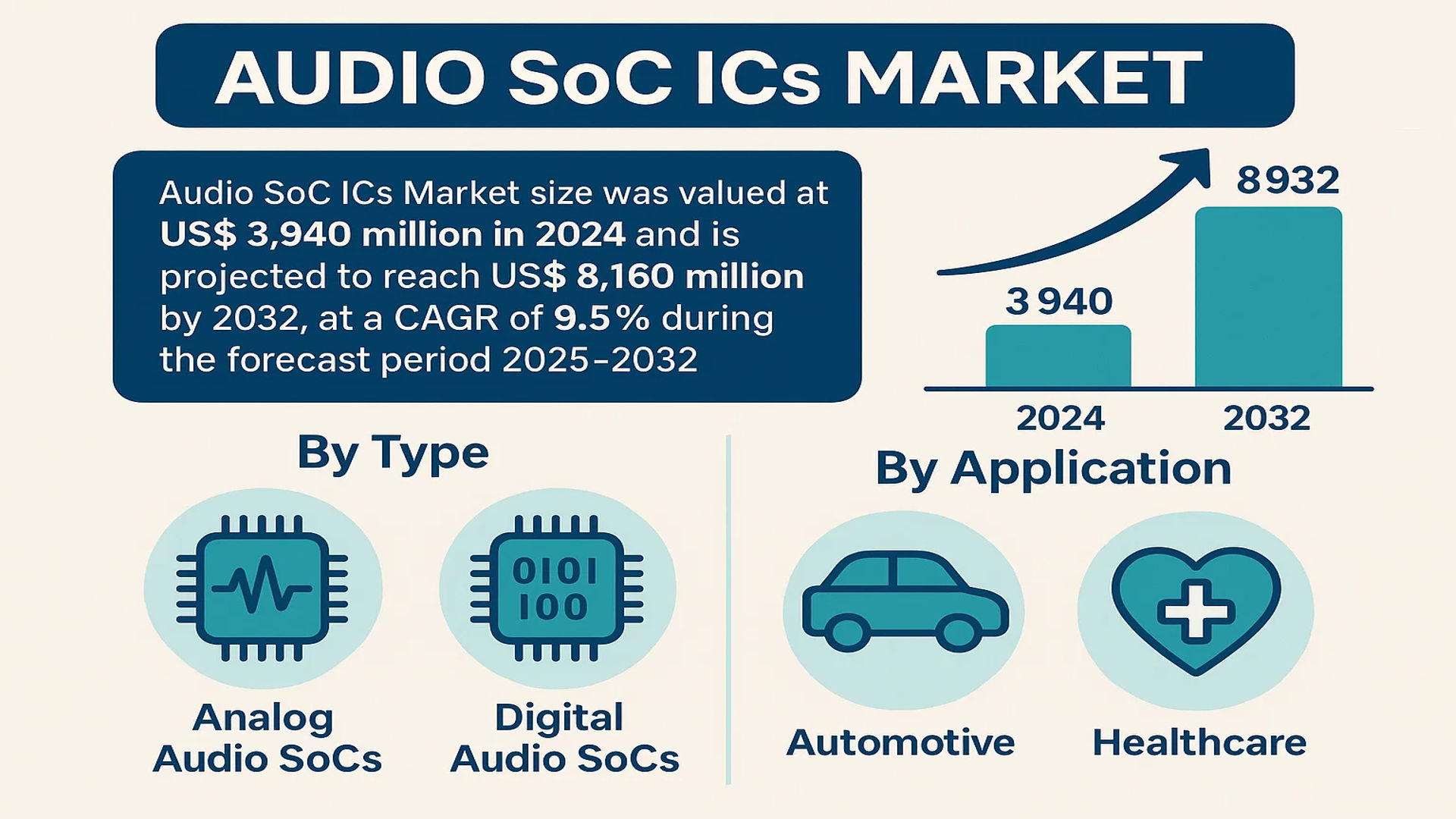
The global Audio SoC ICs Market size was valued at US$ 3,940 million in 2024 and is projected to reach US$ 8,160 million by 2032, at a CAGR of 9.5% during the forecast period 2025-2032. The market growth is driven by increasing demand for smart audio devices, advancements in wireless audio technologies, and rising adoption of AI-powered voice assistants.
Audio System-on-Chip (SoC) ICs are integrated circuits that combine multiple audio processing functions into a single chip, including digital signal processing, analog-to-digital conversion, and power management. These components are essential for high-quality audio reproduction in devices such as smartphones, wireless earbuds, smart speakers, automotive infotainment systems, and home entertainment equipment.
The market is witnessing significant expansion due to the proliferation of IoT devices and the growing popularity of wireless audio solutions like Bluetooth 5.0 and LE Audio. Key players are investing in developing energy-efficient chips with advanced features such as noise cancellation and spatial audio processing. For instance, in 2023, Qualcomm introduced its S5 Gen 2 Sound Platform with AI-enhanced processing for premium wireless audio experiences, while Cirrus Logic launched smart codecs with integrated machine learning capabilities for voice control applications.
MARKET DYNAMICS
MARKET DRIVERS
Rapid Growth of Smart Devices to Accelerate Audio SoC IC Adoption
The proliferation of smart devices globally is creating unprecedented demand for Audio SoC ICs. With over 1.5 billion smartphones shipped annually and smart speakers reaching nearly 150 million unit sales, these chips are becoming critical components for audio processing. The market is further driven by rising consumer expectations for high-quality audio experiences in compact form factors. As device manufacturers continue integrating advanced features like noise cancellation and spatial audio, Audio SoC solutions with superior processing capabilities and power efficiency are seeing increased adoption. The transformation from analog to digital signal processing has enabled significant advancements in audio quality while reducing system complexity.
Automotive Infotainment Evolution to Fuel Market Expansion
Modern vehicles are undergoing an audio revolution, with premium sound systems becoming standard even in mid-range models. The automotive audio SoC market is projected to grow at nearly 8% CAGR as manufacturers incorporate sophisticated infotainment systems. Features like in-car communication, voice assistants, and immersive audio experiences require specialized ICs that deliver high-fidelity output while withstanding automotive environmental conditions. The transition to electric vehicles is creating additional opportunities as automakers redesign cabin acoustics and audio experiences for quieter electric powertrains. This fundamental shift is causing ripple effects throughout the supply chain, with semiconductor manufacturers developing automotive-grade audio solutions.
AI-Powered Audio Processing to Drive Next Wave of Innovation
Artificial intelligence integration represents the next frontier for Audio SoC development. Modern chips are incorporating dedicated neural processing units to enable real-time audio enhancement, voice recognition, and adaptive noise suppression. The growing popularity of voice-controlled smart home devices and enterprise communication systems is accelerating this transition. Recent launches of AI-optimized audio processors demonstrate how machine learning capabilities are being embedded directly into silicon, reducing latency and power consumption while improving performance. This technological leap is creating new growth avenues as system architects balance performance requirements against thermal constraints in increasingly compact device designs.
➤ The consumer electronics sector alone accounts for over 60% of global Audio SoC IC demand, with professional audio and automotive applications representing the fastest growing segments.
MARKET RESTRAINTS
Semiconductor Supply Chain Constraints to Limit Market Potential
Despite strong demand, the Audio SoC market faces significant headwinds from ongoing semiconductor supply chain challenges. The global chip shortage has particularly impacted the availability of mature node semiconductors used in many audio applications. Lead times for certain audio ICs have extended beyond 50 weeks, forcing manufacturers to reevaluate their procurement strategies. This supply-demand imbalance has been exacerbated by the concentration of production capacity in limited geographic regions, creating bottlenecks for the entire industry. While investments in new fabrication facilities are underway, the lead time for bringing additional capacity online remains a limiting factor.
Design Complexity to Challenge Product Development Cycles
As audio processing requirements grow more sophisticated, the design complexity of SoC solutions presents another market restraint. Modern chips must integrate multiple functions including DSP cores, codecs, amplifiers, and wireless connectivity while meeting stringent power budgets. The development of such highly integrated solutions requires significant R&D investment and specialized engineering talent. Many manufacturers report challenges in optimizing performance across diverse audio applications, from ultra-low-power earbuds to high-performance soundbars. The need for extensive software development to support hardware features further extends time-to-market, making it difficult for companies to capitalize on emerging opportunities quickly.
MARKET CHALLENGES
Intense Cost Pressure to Affect Profit Margins
The audio IC market operates under intense cost pressure as consumer electronics manufacturers demand ever-lower pricing. With ASPs declining by approximately 5-7% annually, semiconductor companies must continuously improve manufacturing efficiency to maintain profitability. This pricing pressure is particularly acute in the entry-level and mid-range segments where competition is fiercest. Manufacturers must carefully balance feature integration against cost targets, often making difficult trade-offs between performance and bill-of-materials constraints. The commoditization of basic audio processing functionality has forced many vendors to differentiate through specialized features and software offerings.
Power Efficiency Requirements to Test Design Capabilities
Power consumption has become a critical differentiator in audio SoC designs, particularly for battery-powered devices. Market leaders are now delivering solutions that consume less than 1mW during always-on voice detection, setting new industry benchmarks. Achieving these ultra-low power levels while maintaining audio quality requires innovative circuit design and advanced process nodes, increasing development costs. The wireless earbud market exemplifies this challenge, where manufacturers must optimize every milliwatt to extend playback time in shrinking form factors. These power constraints are forcing radical architectural changes, including the adoption of heterogeneous processing and sophisticated power gating techniques.
MARKET OPPORTUNITIES
Rise of Spatial Audio to Create New Revenue Streams
The growing popularity of spatial and 3D audio formats presents significant opportunities for Audio SoC vendors. With leading technology companies pushing immersive audio experiences across headphones, smart speakers, and automotive systems, demand for specialized processing capabilities is rising. Implementing these features requires sophisticated algorithms running on optimized hardware architectures, creating opportunities for differentiation. The professional audio segment is also adopting these technologies for content creation and live sound applications, representing an adjacent market with strong growth potential. Vendors who can deliver complete solutions combining hardware acceleration with software ecosystems stand to benefit from this emerging trend.
Emerging IoT Applications to Drive Future Growth
The expansion of IoT applications incorporating audio functionality offers another promising avenue for market growth. Smart home devices, wearables, and industrial equipment increasingly incorporate voice interfaces and audio feedback mechanisms. These applications require ultra-low-power audio processing solutions with reliable wake-on-voice capabilities. The healthcare sector also presents opportunities as medical devices integrate audio diagnostics and communication features. With IoT device shipments expected to exceed 30 billion units annually, semiconductor companies are developing specialized Audio SoC variants to address these diverse use cases. The ability to support multiple microphones and handle challenging acoustic environments will be key differentiators in these emerging markets.
AUDIO SOC ICS MARKET TRENDS
Advancements in Smart Audio Technologies Drive Market Growth
The global Audio System-on-Chip (SoC) ICs market is experiencing robust growth, fueled by the increasing integration of smart audio solutions in consumer electronics and IoT devices. With the market valued at an estimated $1.2 billion in 2024, projections indicate a steady compound annual growth rate (CAGR) of approximately 7.5% through 2032. Key drivers include the rising adoption of voice recognition technologies, particularly AI-powered digital assistants like Alexa and Google Assistant, which now ship in over 300 million devices annually. Manufacturers are prioritizing low-power designs with enhanced processing capabilities to support always-on listening features in smartphones, smart speakers, and wearables. The shift toward Bluetooth 5.3 and LE Audio standards has further accelerated demand for advanced audio SoCs capable of delivering high-fidelity wireless audio with reduced latency.
Other Trends
Automotive Audio Systems Evolution
Automotive applications represent the fastest-growing segment for audio SoCs, with modern vehicles incorporating 6-20 separate audio processing chips per vehicle for infotainment, emergency call systems, and in-car communications. The trend toward electrification and autonomous driving is creating demand for sophisticated noise cancellation and beamforming technologies to combat cabin noise while enabling crystal-clear voice interfaces. Leading manufacturers are developing automotive-grade SoCs that meet stringent AEC-Q100 qualifications while delivering multi-core DSP performance for immersive 3D audio and personal sound zones in premium vehicles.
Edge AI Processing Reshapes Product Development
The integration of neural processing units (NPUs) into audio SoCs has emerged as a game-changing trend, enabling on-device machine learning for voice command processing and audio enhancement. Current-generation SoCs now incorporate dedicated AI accelerators capable of delivering 1-4 TOPS performance while operating at under 1W power—critical for battery-powered devices. This shift toward edge processing addresses growing privacy concerns by reducing reliance on cloud-based processing while improving response times for wake-word detection and audio scene analysis. Manufacturers are leveraging these capabilities to differentiate products in crowded markets, particularly in the rapidly expanding true wireless stereo (TWS) earbuds segment where shipments exceeded 300 million units in 2023.
Market Diversification Across Industry Verticals
While consumer electronics continue to dominate audio SoC demand, accounting for approximately 62% of revenue, emerging applications in healthcare and industrial sectors are creating new growth avenues. Medical-grade audio SoCs now facilitate advanced hearing aid technologies with adaptive noise reduction, while industrial applications leverage ultra-low-latency audio processing for machine condition monitoring and safety systems. The professional audio equipment segment is transitioning from discrete solutions to integrated SoCs offering studio-quality conversion at price points accessible to home recording studios, driving a projected 9.2% CAGR in this niche through 2030.
COMPETITIVE LANDSCAPE
Key Industry Players
Leading Companies Focus on Innovation and Strategic Collaborations to Capture Market Share
The global Audio SoC ICs market features a competitive environment with a mix of established semiconductor giants and specialized audio technology providers. The market remains highly dynamic, driven by rapid advancements in wireless audio, smart devices, and automotive infotainment systems. Qualcomm leads the market with its robust portfolio of audio processing solutions, particularly in Bluetooth SoCs for wireless earbuds and automotive audio applications. The company’s dominance stems from its integrated approach, combining DSP capabilities with low-power architectures.
Cirrus Logic and Texas Instruments maintain strong positions with their high-performance analog and mixed-signal audio SoCs, catering to premium audio brands and automotive OEMs. Meanwhile, Knowles Corporation leverages its expertise in MEMS microphones to deliver optimized audio solutions for AI-based voice recognition in smart devices. The convergence of advanced noise cancellation, voice assistant integration, and ultra-low-power consumption continues to shape product differentiation strategies.
Strategic acquisitions and partnerships characterize recent market movements. For instance, STMicroelectronics expanded its audio product line through collaborations with major headset manufacturers, while NXP Semiconductors strengthened its automotive audio offerings through chipset integration with leading infotainment system providers. These developments highlight the industry’s focus on delivering complete system solutions rather than discrete components.
Emerging opportunities in spatial audio, hearing augmentation devices, and intelligent edge processing are prompting increased R&D investments from all major players. Analog Devices and Infineon Technologies are particularly active in developing next-generation audio processing architectures that combine AI acceleration with traditional signal processing.
List of Key Audio SoC IC Companies Profiled
- Qualcomm (U.S.)
- Cirrus Logic (U.S.)
- Knowles (U.S.)
- STMicroelectronics (Switzerland)
- Texas Instruments (U.S.)
- Analog Devices (U.S.)
- onsemi (U.S.)
- Infineon Technologies (Germany)
- Rohm (Japan)
- NXP Semiconductors (Netherlands)
- Silicon Laboratories (U.S.)
- Renesas (Japan)
Segment Analysis:
By Type
Digital Audio SoCs Dominate the Market Owing to their High Adoption in Smart Devices and IoT Applications
The market is segmented based on type into:
- Analog Audio SoCs
- Digital Audio SoCs
By Application
Consumer Electronics Segment Leads Due to Rising Demand for Smart Audio Devices
The market is segmented based on application into:
- Consumer Electronics
- Subtypes: Smartphones, Tablets, Wearables, Smart Speakers, and others
- Automotive
- Healthcare
- Industrial & Retail
- Telecommunication
- Others
By Technology
AI-Powered Audio SoCs Gain Traction for Voice Recognition and Noise Cancellation Features
The market is segmented based on technology into:
- DSP-based
- AI-powered
- Bluetooth-enabled
- Others
By End User
OEMs Represent the Largest Segment Due to Mass Production of Consumer Electronics
The market is segmented based on end user into:
- Original Equipment Manufacturers (OEMs)
- Third-party Manufacturers
Regional Analysis: Audio SoC ICs Market
North America
The North American Audio SoC ICs market remains a key revenue contributor, driven by strong demand in automotive infotainment, smart home devices, and professional audio equipment. With major players like Qualcomm and Texas Instruments headquartered in the region, continuous R&D investments fuel innovation in low-power, high-performance audio processing solutions. Stringent power efficiency regulations and the rapid adoption of IoT-enabled audio devices further accelerate market expansion. However, the region faces pricing pressure due to competition from Asian manufacturers, though premium applications in automotive and enterprise verticals maintain healthy margins.
Europe
Europe demonstrates steady growth in Audio SoC IC adoption, particularly for automotive and healthcare applications where noise cancellation and high-fidelity audio are critical. Strict EU noise emission norms for vehicles and the increasing integration of voice assistants in smart devices propel demand. The presence of STMicroelectronics and Infineon Technologies strengthens local supply chains, though reliance on external foundries creates some vulnerability. Sustainability initiatives push development of energy-efficient audio SoCs, aligning with broader green technology trends in the region.
Asia-Pacific
As the dominant production and consumption hub, Asia-Pacific accounts for over 60% of global Audio SoC IC volume, led by China’s massive consumer electronics manufacturing base. While cost sensitivity remains high, rising disposable income drives demand for feature-rich audio products in smartphones, TWS earbuds, and smart TVs. Local players like Rohm and Renesas compete with international brands by offering customized solutions. The region benefits from complete semiconductor ecosystems in Taiwan, South Korea, and China, though geopolitical tensions and supply chain reconfiguration present ongoing challenges for market stability.
South America
The South American market shows moderate but consistent growth, primarily serving automotive OEMs and mid-range consumer electronics segments. Brazil and Argentina represent key markets where local assembly of audio equipment creates steady demand. Economic volatility affects premium audio adoption rates, favoring cost-optimized SoC solutions. While lacking major domestic semiconductor players, the region attracts attention as nearshoring trends gain momentum, with increasing investment in Mexico’s electronics manufacturing capabilities positively impacting the broader regional market.
Middle East & Africa
This emerging market demonstrates untapped potential, particularly in smartphone adoption and automotive audio systems. The UAE and Saudi Arabia lead demand for premium in-car entertainment systems, while South Africa serves as an assembly hub for consumer audio products. Limited local semiconductor infrastructure results in complete reliance on imports, creating opportunities for global manufacturers to establish distribution partnerships. Religious and cultural practices around call-to-prayer systems and audio broadcasting present unique regional applications driving specialized Audio SoC requirements.
Report Scope
This market research report provides a comprehensive analysis of the global and regional Audio SoC ICs markets, covering the forecast period 2025–2032. It offers detailed insights into market dynamics, technological advancements, competitive landscape, and key trends shaping the industry.
Key focus areas of the report include:
- Market Size & Forecast: Historical data and future projections for revenue, unit shipments, and market value across major regions and segments. The global Audio SoC ICs market was valued at US$ 3,940 million in 2024 and is projected to reach US$ 8,160 million by 2032, growing at a CAGR of 9.5% during the forecast period.
- Segmentation Analysis: Detailed breakdown by product type (Analog and Digital), application (Automotive, Healthcare, Industrial & Retail, Telecommunication, Consumer Electronics, and Others), and end-user industry to identify high-growth segments and investment opportunities.
- Regional Outlook: Insights into market performance across North America, Europe, Asia-Pacific, Latin America, and the Middle East & Africa, including country-level analysis where relevant. Asia-Pacific accounted for 42% of the global market share in 2024.
- Competitive Landscape: Profiles of leading market participants, including their product offerings, R&D focus, manufacturing capacity, pricing strategies, and recent developments such as mergers, acquisitions, and partnerships. The top five companies held 58% market share in 2024.
- Technology Trends & Innovation: Assessment of emerging technologies, integration of AI/IoT in audio processing, low-power design trends, advanced fabrication techniques, and evolving industry standards like Bluetooth 5.3 and LE Audio.
- Market Drivers & Restraints: Evaluation of factors driving market growth (increasing demand for smart audio devices, automotive infotainment systems) along with challenges (supply chain constraints, semiconductor shortages).
- Stakeholder Analysis: Insights for component suppliers, OEMs, system integrators, investors, and policymakers regarding the evolving ecosystem and strategic opportunities in the audio semiconductor space.
Primary and secondary research methods are employed, including interviews with industry experts, data from verified sources, and real-time market intelligence to ensure the accuracy and reliability of the insights presented.
FREQUENTLY ASKED QUESTIONS:
What is the current market size of Global Audio SoC ICs Market?
-> Audio SoC ICs Market size was valued at US$ 3,940 million in 2024 and is projected to reach US$ 8,160 million by 2032, at a CAGR of 9.5% during the forecast period 2025-2032.
Which key companies operate in Global Audio SoC ICs Market?
-> Key players include Qualcomm, Cirrus Logic, Knowles, STMicroelectronics, Texas Instruments, Analog Devices, onsemi, Infineon Technologies, Rohm, NXP Semiconductors, Silicon Laboratories, and Renesas, among others.
What are the key growth drivers?
-> Key growth drivers include rising demand for wireless audio devices, growth in smart home ecosystems, automotive infotainment systems, and increasing adoption of AI-powered voice assistants.
Which region dominates the market?
-> Asia-Pacific dominates the market with 42% share in 2024, driven by strong consumer electronics manufacturing in China, South Korea, and Taiwan.
What are the emerging trends?
-> Emerging trends include integration of AI/ML in audio processing, ultra-low power designs for wearables, spatial audio technologies, and advanced noise cancellation features.

Get Sample Report PDF for Exclusive Insights
Report Sample Includes
- Table of Contents
- List of Tables & Figures
- Charts, Research Methodology, and more...
 Download Sample Report PDF