Key Statistics
Key Takeaways
- Market size and growth: the market is estimated at USD 8.95 billion in 2026 and is projected to reach USD 45.90 billion by 2034, representing a 22.7% CAGR during 2026–2034.
- Optical see-through glasses are the leading type because transparent waveguides preserve direct real-world vision while overlaying digital information, which is essential for industrial and hands-free workflows.
- Enterprise collaboration and industrial maintenance remain the most proven applications, while consumer entertainment and AI-assisted everyday glasses are the largest long-term volume opportunity.
- North America leads through Meta, Microsoft, Apple, Qualcomm and a large software ecosystem, while China and other Asia Pacific markets are scaling optics, display and device manufacturing.
- Consumer smart glasses are broadening the market beyond immersive headsets, but privacy, battery life, display brightness and social acceptance remain critical design constraints.
AR Glasses Market Overview
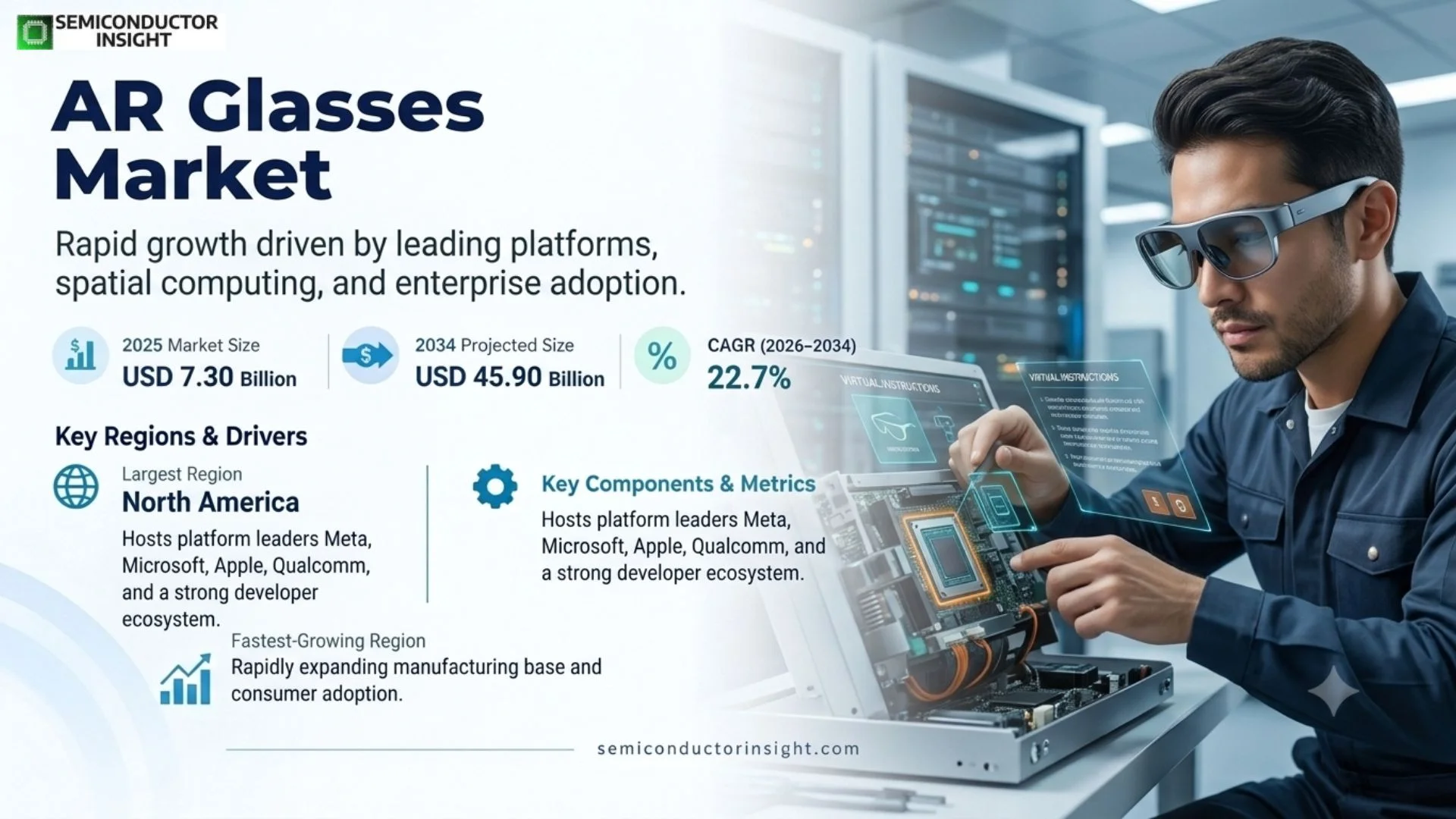
AR Glasses market was valued at USD 7.30 billion in 2025 and is estimated at USD 8.95 billion in 2026. The market is projected to reach USD 45.90 billion by 2034, representing a CAGR of 22.7% during 2026–2034. North America is the leading regional market through major platform companies, early enterprise adoption and a strong ecosystem for spatial-computing software, while Asia Pacific is the fastest-growing manufacturing and consumer region.
Base year: 2025 · Estimated year: 2026 · Forecast period: 2026–2034 · Values in USD million unless otherwise stated
AR glasses are wearable optical devices that overlay digital content onto the user’s view of the physical world. Systems combine displays or optical engines, waveguides or cameras, processors, sensors, audio, connectivity and spatial-computing software inside a glasses-like form factor. Optical see-through designs allow users to view the real environment directly through transparent optics, while video see-through systems capture the environment with cameras and reproduce it through displays. The market spans enterprise, industrial, healthcare and emerging consumer use cases.
Enterprise applications remain the most mature because hands-free instructions, remote assistance and visualization can improve worker productivity without requiring consumers to adopt a new everyday device habit. Industrial maintenance teams use AR to access schematics and expert guidance, while healthcare and training use spatial visualization. Consumer products are expanding from immersive mixed-reality headsets toward lighter smart glasses that combine cameras, audio, AI assistants and, increasingly, small displays for notifications and contextual information.
The technology challenge is integration. A useful AR product must balance field of view, brightness, optical efficiency, battery life, thermal performance, weight and appearance. High-performance displays and waveguides can increase power consumption, while larger batteries make the device heavier. This trade-off explains why the market contains multiple product categories, from lightweight AI glasses without full visual overlays to enterprise headsets with richer spatial displays. The largest opportunity comes from closing that gap with all-day wearable devices.
Segment Analysis: By Type
By type, the market is segmented into optical see-through and video see-through. Optical see-through leads glasses-style products because transparent optics preserve natural vision and lower visual latency, making them well suited to industrial, medical and consumer overlays. Video see-through provides greater control over the displayed scene and occlusion but requires cameras and displays to reproduce the environment, increasing power and potentially moving the form factor closer to a headset than conventional eyewear.
| Type | Technical / commercial role | Market position |
|---|---|---|
| Optical See-Through | Transparent waveguides or combiners overlay digital content while preserving direct real-world vision. | Leading glasses-style architecture; strongest fit for hands-free and all-day wear. |
| Video See-Through | Cameras capture the environment and displays reconstruct the real-world view with digital content. | Higher control over occlusion and rendering but greater power, latency and form-factor burden. |
Segment Analysis: By Application
Applications include enterprise collaboration, healthcare training, industrial maintenance and consumer entertainment. Enterprise and industrial use cases lead today because productivity improvements can justify premium device prices. Healthcare uses AR for training, visualization and selected procedural support, while consumer entertainment remains the largest long-term volume opportunity if devices become lighter, more fashionable and capable of everyday AI assistance. The application mix is therefore moving from specialized workflows toward broader personal computing.
| Application | Demand characteristics |
|---|---|
| Enterprise Collaboration | Remote assistance, design review and spatial collaboration across distributed teams. |
| Healthcare Training | Anatomical visualization, procedural training and contextual information. |
| Industrial Maintenance | Hands-free work instructions, equipment identification and remote expert support. |
| Consumer Entertainment | Gaming, media, navigation, AI assistance and social experiences. |
Segment Analysis: By End User
End users include large enterprises, small and medium-sized businesses and individual consumers. Large enterprises lead current deployments because they can integrate device management, security and workflow software across large workforces. SMEs adopt selectively where remote assistance or training provides a clear return. Individual consumers represent the largest future volume pool but require much lower prices, longer battery life, stronger privacy controls and a form factor that feels socially acceptable for everyday wear.
| End User | Demand logic |
|---|---|
| Large Enterprises | Largest current deployments with managed workflows, security and integration. |
| Small & Medium-Sized Enterprises | Selective adoption where training or remote support produces clear ROI. |
| Individual Consumers | Largest long-term volume opportunity but most sensitive to price, style and battery life. |
Segment Analysis: By Deployment Mode
Deployment mode separates head-mounted systems, clip-on modules and integrated-lens glasses. Head-mounted devices provide the most capability and sensor volume but can be heavy. Clip-on designs allow users to add AR functions to existing eyewear and can reduce replacement cost. Integrated-lens products have the strongest consumer potential because they can resemble normal glasses, but they require advanced waveguides, compact electronics and careful thermal design to deliver useful displays without compromising comfort.
| Deployment Mode | Market role |
|---|---|
| Head-Mounted | Highest capability for industrial and immersive enterprise workflows. |
| Clip-On | Modular option for adding displays or cameras to existing eyewear. |
| Integrated Lens | Strategic consumer growth format with strongest demand for thin waveguides and compact optics. |
Segment Analysis: By Software Ecosystem
Software ecosystem influences application availability, developer adoption and customer lock-in. Open XR platforms encourage cross-device compatibility and lower risk for enterprise buyers, while proprietary ecosystems can optimize hardware-software performance and monetize exclusive applications. Developer-community initiatives are important during early market formation because small software companies often create the specialized workflows that make hardware valuable. Platform success therefore depends on APIs, distribution, security and device management as much as optical hardware.
| Software Ecosystem | Commercial role |
|---|---|
| Open XR Platforms | Encourage portability and reduce customer concern about vendor lock-in. |
| Proprietary Platforms | Tighter hardware-software optimization and controlled application distribution. |
| Developer Community Initiatives | Expand specialized use cases and accelerate experimentation across new devices. |
Regional Analysis
North America is the leading regional market because it hosts Meta, Microsoft, Apple, Qualcomm and a large developer ecosystem, while enterprises in manufacturing, healthcare and field service were early AR adopters. Asia Pacific is the fastest-growing region through China’s consumer-electronics manufacturing and expanding local AR brands. Europe emphasizes industrial and research applications, while emerging regions adopt mainly through enterprise and specialty projects.
Regional AR demand depends on both platform innovation and hardware supply chains. North America captures software, semiconductor and platform value, while Asia Pacific manufactures displays, optics, batteries and finished devices. Europe has strong industrial customers and optical research but more cautious consumer adoption. Privacy rules also shape deployment because camera-equipped glasses raise concerns around recording and bystander consent. This can favor devices with visible recording indicators, stronger local processing or narrower enterprise use cases.
| Region | Position | Growth outlook | Demand profile | Supplier-selection factor |
|---|---|---|---|---|
| North America | Leading | Very high | Platforms, enterprise, consumer AI glasses | Ecosystem and user experience |
| Asia Pacific | Fastest growth | Very high | Manufacturing and consumer devices | Cost, optics and scale |
| Europe | Established | High | Industrial and research | Privacy, workflow integration |
| South America | Emerging | Moderate | Enterprise and consumer | Price |
| Middle East & Africa | Emerging | Moderate-High | Tourism, enterprise, smart-city | Imported devices and support |
Competitive Landscape
Competition in the AR Glasses market is shaped by technology performance, customer qualification, application engineering and continuity of supply. Leading companies use product breadth and global support to win large programs, while specialist suppliers can defend attractive niches through deeper technical performance in specific applications. As the market expands, customers increasingly evaluate total system value and lifecycle support rather than relying only on initial component price.
The leading suppliers compete through a combination of proprietary technology, manufacturing scale and customer relationships. In the AR Glasses market, design wins can remain in place for several product generations because switching suppliers often requires requalification, software changes or manufacturing adjustments. This creates durable revenue positions for vendors that deliver reliable performance and responsive technical support.
Regional suppliers can still gain share where local availability, cost and fast engineering response matter. Their strongest opportunities are generally in standardized or mature applications, while the highest-performance segments remain concentrated among companies with deeper intellectual property, process control and qualification histories. This creates a market structure with both global platform leaders and specialized regional competitors.
Competitive strategy is increasingly moving toward integrated solutions. Customers prefer suppliers that can combine the core product with software, interface components, testing, support or adjacent technologies because integration reduces project risk and development time. Companies able to solve a broader customer problem therefore have more pricing power than vendors competing only on a single specification.
| Competitive tier | Representative companies | Competitive basis |
|---|---|---|
| Global technology leaders | Meta, Microsoft, Apple, Vuzix | Scale, broad product portfolios, strong R&D and global customer support. |
| Established specialists | Lenovo, XREAL, RealWear, Magic Leap | Application-specific engineering and strong qualification in selected segments. |
| Regional / emerging suppliers | Epson, Snap, HTC, Sony, Qualcomm, Rokid | Local service, competitive pricing and focused customer relationships. |
Key Participants
The profiled competitive set includes Meta, Microsoft, Apple, Vuzix, Lenovo, XREAL, RealWear, Magic Leap, Epson, Snap, HTC, Sony, Qualcomm, Rokid. Supplier position depends on engineering performance, customer qualification, manufacturing continuity and the ability to support design changes over long product cycles. Larger vendors benefit from broad portfolios and application teams, while specialists can retain strong positions in narrow, technically demanding subsegments where historical qualification and process know-how create meaningful switching costs.
Production Capacity Analysis
Production capacity for AR Glasses is constrained by the combination of specialized equipment, qualified materials, process know-how and customer-specific validation. Nominal factory output can overstate commercial supply because a new line or material source must often demonstrate consistent performance before it can serve high-value customers. This makes qualified capacity more important than raw nameplate capacity.
Regional manufacturing and service capacity influence lead time and resilience. Customers increasingly prefer suppliers that can support major production clusters from more than one site, reducing exposure to logistics disruption and single-factory events. At the same time, duplicating specialized processes can be difficult because equipment recipes, trained engineers and quality systems must be transferred without changing product performance.
The strongest capacity investments are aligned with structural demand drivers rather than short-term cycles. Suppliers expanding around AI, advanced semiconductor manufacturing, automotive electronics or industrial automation seek to secure positions before customer volumes scale. Effective capacity therefore includes engineering resources, test capability and local technical support in addition to physical manufacturing equipment.
| Capacity factor | Market implication |
|---|---|
| Specialized manufacturing | Determines qualified output and technical performance. |
| Critical materials / components | Can constrain supply despite available factory floor space. |
| Qualification and test | Controls how quickly new capacity becomes usable by customers. |
| Regional support | Improves lead time, resilience and customer retention. |
Market Dynamics
The AR Glasses market is driven by higher system performance, automation, digitalization and expanding use in high-value applications. Growth is moderated by development cost, qualification requirements and supply-chain concentration. The strongest opportunities occur where new architectures or applications create a clear performance advantage and where suppliers can reduce integration complexity for customers.
MARKET DRIVERS
| Driver | Relative impact | Commercial mechanism |
|---|---|---|
| Structural end-market growth | High | Expanding deployments increase unit demand and installed-base requirements. |
| Technology upgrade cycle | High | Higher performance raises value per product and accelerates replacement. |
| Customer integration needs | Medium-High | Validated solutions reduce engineering time and project risk. |
| Regional capacity expansion | Medium | New manufacturing clusters create local supplier demand. |
Structural end-market expansion
Growth in the AR Glasses market is supported by rising deployment across its principal applications. Customers are investing because the technology improves performance, efficiency, automation or product capability in ways that are difficult to replicate with older approaches. This expands both new-system demand and the installed base that later requires replacement, upgrades or related services.
Higher technical requirements increase value per system
New product generations demand tighter performance, greater integration and better reliability. These requirements can increase selling prices even when unit volumes grow more slowly, because customers are willing to pay for solutions that protect yield, uptime or user experience. Suppliers with stronger engineering capability therefore benefit disproportionately from technology transitions.
Regional investment broadens customer access
Manufacturing and infrastructure investment in North America, Europe and Asia is creating additional customer clusters outside traditional centers. Local engineering support and shorter supply chains help suppliers qualify products earlier in new projects, creating an opportunity to win design positions before production reaches full scale.
MARKET RESTRAINTS
| Restraint | Relative impact | Commercial mechanism |
|---|---|---|
| Development and qualification cost | High | Raises barriers to entry and lengthens customer adoption. |
| Supply-chain concentration | Medium-High | Critical components or materials can limit output. |
| Price pressure | Medium | Customers seek lower total system cost as volumes increase. |
| Technology substitution | Medium | Alternative architectures can replace incumbent solutions in selected uses. |
Qualification slows supplier switching
Customers in technical markets cannot change suppliers based only on purchase price. New products must demonstrate performance, reliability and compatibility in the actual application, which can require months of engineering work. This limits the pace at which new entrants gain share and can delay commercialization of technically promising products.
Specialized inputs can constrain supply
Advanced products depend on a limited number of qualified materials, components or manufacturing tools. Shortages or long lead times at one upstream stage can restrict finished-product output even when downstream assembly capacity is available. Suppliers therefore carry strategic inventory or qualify alternate sources, but those actions increase cost.
Customer cost pressure remains persistent
As a technology becomes more widely adopted, customers expect lower unit costs and may redesign systems to use standardized components. Suppliers must offset this pressure through better performance, lower manufacturing cost and additional software or service value. Vendors that cannot maintain differentiation can face margin erosion even in a growing market.
MARKET OPPORTUNITIES
All-day consumer glasses
The largest long-term opportunity is a device that looks and feels close to normal eyewear while providing useful visual overlays, audio and AI assistance throughout the day. Achieving this requires major improvements in optical efficiency, battery density and thermal design. Companies that solve comfort without sacrificing useful display brightness can expand AR from specialized headsets into a mass personal-computing category.
Enterprise remote assistance
Field technicians, factory workers and medical or service teams can use AR to share a first-person view with remote experts while receiving annotated instructions. The business case is strongest when travel, downtime or mistakes are expensive. Subscription software, device management and workflow integration can generate recurring revenue beyond the original hardware sale.
AI-assisted contextual computing
On-device and cloud AI can interpret the user’s environment and provide navigation, translation, identification and task support. This creates a more natural reason to wear glasses even when a rich 3D display is not required. The opportunity favors platforms that integrate cameras, microphones, low-power processors and privacy controls without making the device bulky or socially intrusive.
Industrial digital workflows
Manufacturing, logistics and maintenance customers can use AR for work instructions, inspection, picking and training. These use cases already tolerate higher device prices because productivity improvements can be measured. Vendors can deepen value by connecting glasses to digital twins, enterprise asset systems and remote-support platforms rather than selling hardware as a standalone visualization device.
Supply Chain Analysis
Specialized materials and components
Core product manufacturing
Qualification and system integration
End-user deployment, service and replacement
The upstream supply chain provides the specialized materials, semiconductor devices, mechanical components or substrates that determine baseline product performance. Qualified inputs are important because changes in composition or manufacturing source can alter reliability, electrical behavior or process compatibility. Suppliers therefore maintain close technical relationships with upstream partners and often approve alternate sources before a disruption occurs.
Manufacturing converts these inputs into finished products using process-specific equipment, inspection and test. Quality systems are central because customers expect lot-to-lot consistency and traceability, particularly in semiconductor, automotive and industrial applications. High-value suppliers differentiate through process control rather than simple assembly scale, and they invest heavily in metrology or validation to protect yield.
Downstream value is created when the product is integrated into the customer system and validated under real operating conditions. Application engineers support installation, software, calibration or process optimization, while service teams maintain the installed base. This lifecycle relationship creates recurring revenue through replacement, updates, refurbishment or expansion and makes customer support an important part of the market structure.
Recent Developments
22 Sep 2026 – Privacy concerns intensify around AI-powered smart glasses
Reuters reported growing privacy scrutiny around camera-equipped smart glasses and AI wearables, highlighting recording transparency, local processing and user control as important adoption factors for the next generation of devices. Source
2026 – Consumer smart-glasses competition expands beyond audio-only designs
Major platform companies and startups are developing display-enabled, camera-free and AI-assisted glasses, increasing competition around battery life, privacy, weight and everyday wearability rather than only immersive AR performance. Source
2026 – XR platforms continue pushing lighter spatial-computing hardware
Semiconductor and software platforms continue improving low-power XR processing, sensor fusion and display support, enabling thinner devices and broader enterprise or consumer AR form factors. Source
REPORT SCOPE & SEGMENTATION
| Base Year | 2025 |
| Estimated Year | 2026 |
| Forecast Year | 2034 |
| 2025 Market Size | USD 7.30 billion |
| 2026 Market Size | USD 8.95 billion |
| 2034 Market Size | USD 45.90 billion |
| CAGR | 22.7% during 2026–2034 |
| Largest Market / Leading Geography | North America |
| By Type | Optical See-Through; Video See-Through |
| By Application | Enterprise Collaboration; Healthcare Training; Industrial Maintenance; Consumer Entertainment |
| By End User | Large Enterprises; Small & Medium-Sized Enterprises; Individual Consumers |
| By Deployment Mode | Head-Mounted; Clip-On; Integrated Lens |
| By Software Ecosystem | Open XR Platforms; Proprietary Platforms; Developer Community Initiatives |
Frequently Asked Questions
What is the size of the AR Glasses market?
The market is estimated at USD 8.95 billion in 2026 and is projected to reach USD 45.90 billion by 2034, representing a 22.7% CAGR during 2026–2034.
Which AR glasses type leads the market?
Optical see-through designs lead because they preserve direct real-world vision and fit hands-free industrial, healthcare and consumer overlay applications.
Which applications are most mature?
Enterprise collaboration and industrial maintenance are the most mature because productivity and remote-support gains can justify premium device prices.
Which region leads the market?
North America leads through major platform companies and early enterprise adoption, while Asia Pacific is the fastest-growing manufacturing and consumer region.
What are the main consumer growth drivers?
Lighter optics, better batteries, on-device AI, improved displays and more fashionable glasses-style designs are the main drivers.
What are the main restraints?
Privacy, social acceptance, battery life, optical brightness, thermal limits and device price are the principal barriers to mass adoption.
Research Sources & Evidence Base
Get Sample Report PDF for Exclusive Insights
Report Sample Includes
- Table of Contents
- List of Tables & Figures
- Charts, Research Methodology, and more...
 Download Sample Report PDF