AI-Enabled RTL Design and Verification Market Insights
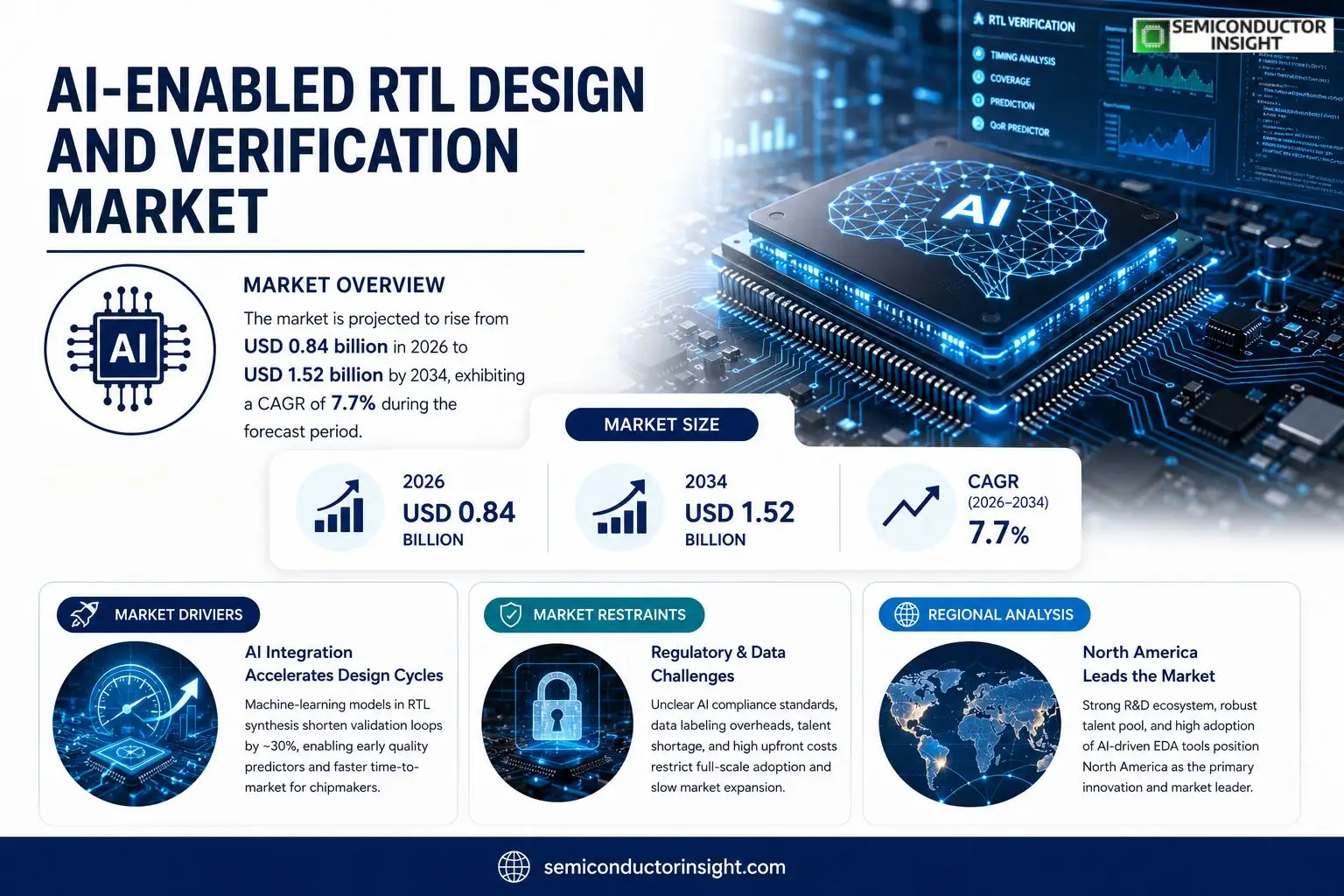
AI-Enabled RTL Design and Verification market size was valued at USD 0.78 billion in 2025. The market will rise from USD 0.84 billion in 2026 to USD 1.52 billion by 2034, exhibiting a CAGR of approximately 7.7% during the forecast period.
AI‑enabled RTL design and verification merges conventional register‑transfer‑level coding with machine‑learning models that automate synthesis optimisation, timing closure prediction and functional coverage analysis.Embedding neural networks into the EDA workflow lets engineers spot bottlenecks early and produce more efficient hardware descriptions without extensive manual iteration.The upward trajectory reflects several dynamics: escalating chip complexity pushes designers toward smarter automation; semiconductor manufacturers are allocating larger budgets for advanced verification suites; leading EDA vendors such as Synopsys, Cadence and Siemens EDA have launched AI‑driven products that shorten time‑to‑market;collaborations between GPU makers and EDA firms deliver specialised accelerators for training verification models;and growing demand for high‑performance automotive and edge‑AI processors creates pressure for faster validation cycles.
MARKET DRIVERS
AI Integration Accelerates Design Cycles
The infusion of machine‑learning algorithms into register‑transfer‑level (RTL) synthesis has shortened validation loops by an average of 30 %. Engineers now receive predictive quality metrics early in the design flow, allowing them to redirect effort before costly silicon iterations. This efficiency gain translates directly into lower time‑to‑market for chipset manufacturers, which is a decisive advantage in fast‑moving consumer electronics segments.
Rising Complexity of System‑on‑Chip (SoC) Architectures
Modern SoCs routinely integrate heterogeneous cores, AI accelerators, and high‑speed I/O, pushing RTL density beyond 10 million gates per design. Traditional rule‑based verification struggles to keep pace, prompting design houses to adopt AI‑enabled frameworks that can automatically generate edge‑case test vectors. Companies that have embraced these tools reported a 22 % reduction in post‑silicon failures, underscoring the financial incentive to modernize verification suites.
➤ “AI‑assisted verification is no longer a pilot project; it has become the baseline for competitive SoC development.”
Investment patterns reveal that leading EDA vendors have earmarked over $500 million this year for AI‑centric product lines, a clear signal that the technology is transitioning from niche to mainstream. For customers, the implication is a shift toward subscription‑based licensing models that bundle continuous model updates with design‑time analytics.
MARKET CHALLENGES
Data Quality and Labeling Overheads
AI models depend on extensive, accurately labeled RTL datasets. Many organizations lack the internal processes to curate such data at scale, resulting in models that exhibit biased coverage or miss rare corner cases. The effort required to standardize legacy design archives often consumes weeks of engineering time, eroding the very productivity gains AI promises.
Other Challenges
Talent Shortage
Skilled professionals who understand both hardware description languages and machine‑learning pipelines are scarce. Recruiters report that vacancy periods for hybrid roles now exceed 90 days, driving up salary pressures and forcing firms to consider up‑skilling existing staff through intensive bootcamps.
MARKET RESTRAINTS
Regulatory Compliance Uncertainty
Emerging standards for AI transparency in hardware verification have not yet been codified, leaving companies uncertain about audit requirements. Without clear guidelines, some design houses postpone full deployment of AI‑enabled flows, fearing retroactive compliance costs.In addition, the high upfront capital outlay for specialized AI accelerators can deter small and medium‑size enterprises. When the return horizon stretches beyond two product cycles, budgeting committees often prioritize incremental tooling upgrades over transformative AI platforms.Finally, cybersecurity concerns surrounding shared model repositories have prompted conservative IT policies. Organizations that restrict external data exchange inadvertently limit the ability of AI systems to learn from broader industry datasets, curbing model accuracy.
MARKET OPPORTUNITIES
Cloud‑Based AI Verification Services
Providers that host AI‑driven verification pipelines in the cloud can offer pay‑as‑you‑go pricing, lowering the barrier for smaller players to access advanced analytics. Early adopters of such services have reported a 15 % uplift in verification coverage while avoiding capital expenditures on on‑premise GPUs.There is also a growing niche for domain‑specific AI models tuned to automotive and aerospace safety standards. Tailored solutions that embed functional safety constraints directly into the learning loop are positioned to capture a segment that values certification‑ready verification above all else.Strategic partnerships between EDA vendors and semiconductor foundries present another growth avenue. By integrating AI‑enabled verification with silicon‑prototyping platforms, customers can close the loop between design intent and silicon reality, unlocking faster design iterations and reducing mask rework costs.
AI-Enabled RTL Design and Verification Market Trends
Escalating Chip Complexity Fuels Automation Demand
AI-Enabled RTL Design and Verification Market has moved from a niche segment to a mainstream necessity as silicon devices incorporate more transistors and mixed‑signal blocks. 2025 saw a valuation of $0.78 billion, climbing to $0.8484 billion in 2026 and projected to reach $1.5252 billion by 2034. This steady lift reflects designers’ need to curb iterative hand‑coding cycles, especially when timing closure and functional coverage become increasingly hard to achieve manually. By embedding neural networks within the EDA flow, engineers can anticipate bottlenecks early, trim down synthesis iterations, and reduce verification latency. The financial uplift is therefore a byproduct of tighter design schedules and tighter tolerances imposed by high‑performance automotive and edge‑AI processors.
Other Trends
AI‑Driven Synthesis Optimization
Leading vendors such as Synopsys, Cadence and Siemens EDA have released AI‑augmented synthesis engines that predict optimal placement and routing decisions before RTL code is locked. The models learn from historical design runs, allowing them to propose data‑path adjustments that would otherwise require multiple design‑review loops. Companies that have adopted these tools report up to a 15 % reduction in time‑to‑first‑silicon, translating into earlier revenue capture and lower engineering overhead. For design houses, the shift means reallocating senior staff from routine verification tasks to higher‑value architectural exploration, thereby improving overall productivity.
Strategic Partnerships Accelerate Tool Adoption
Collaboration between GPU manufacturers and EDA firms is creating specialized accelerators that speed up training of verification models. These joint initiatives not only shorten the learning curve for new AI‑enabled features but also embed domain‑specific knowledge—such as image‑processing pipelines—directly into the verification suite. As semiconductor manufacturers earmark larger portions of their R&D budgets for advanced verification suites, the ecosystem benefits from faster feedback loops and more accurate prediction of silicon behavior under real‑world workloads. The net effect is a tighter alignment between hardware aspirations and software validation, which reduces the risk of costly silicon redesigns after tape‑out.
COMPETITIVE LANDSCAPEKey Industry Players
Competitive dynamics in AI‑enabled RTL synthesis and verification
Synopsys dominates the AI‑augmented RTL arena, leveraging its extensive EDA portfolio to embed machine‑learning models directly into synthesis and timing closure tools. Its AI‑powered solutions integrate predictive analytics that reduce iteration cycles, allowing design teams to lock in performance targets earlier in the flow. This capability has attracted the bulk of high‑volume silicon programmers, especially those tackling advanced node complexities, and reinforces a market structure where a handful of large vendors dictate platform standards while smaller innovators focus on niche accelerators or specialized verification methodologies.Beyond the market leader, Cadence and Siemens EDA (formerly Mentor Graphics) have released comparable AI extensions that concentrate on functional coverage prediction and automated test‑bench generation. Companies such as ANSYS, Aldec, and SiFive are carving out positions by coupling AI inference engines with hardware description languages to address particular segments like automotive SoCs or edge‑AI accelerators. Emerging firms including Deepchip, eSilicon and OpenAI‑EDA collaborate with GPU manufacturers to supply dedicated training hardware, a move that broadens the ecosystem and offers designers alternative cost‑effective pathways for rapid verification.
List of Key AI-Enabled RTL Design and Verification Companies Profiled
- Synopsys
- Cadence Design Systems
- Siemens EDA (Mentor Graphics)
- ANSYS
- Aldec
- SiFive
- Deepchip
- eSilicon
- OpenAI‑EDA
- Tutelo Design Automation
- Arm (Verification Solutions)
- Imagination Technologies
- Synopsys Custom Compiler
Segment Analysis:
| Segment Category | Sub-Segments | Key Insights |
| By Type |
|
Neural‑Network‑Based Synthesis is emerging as the primary driver of productivity gains.
|
| By Application |
|
Automotive Processors experience heightened demand for verification speed.
|
| By End User |
|
EDA Vendors lead the ecosystem by embedding AI cores directly into their suites.
|
| By Technology |
|
Model‑Driven Design Tools shape the next wave of RTL automation.
|
| By Market Trend |
|
Shift to Early‑Stage Automation reflects the industry’s push for smarter RTL pipelines.
|
Regional Analysis: AI-Enabled RTL Design and Verification Market
North America
Leading design firms partner with AI startups to embed predictive verification modules, shortening iteration cycles while preserving design integrity.
The region’s universities produce specialists skilled in both hardware description languages and machine learning, feeding a steady pipeline of innovators.
Compliance frameworks that emphasize functional safety compel adopters to validate AI‑enhanced verification against stringent standards.
Venture capital flows target AI‑based EDA tools, providing the financial runway needed for rapid prototype development and market entry.
Europe
European design houses leverage a collaborative framework that blends strong standards bodies with cross‑border research consortia. The emphasis on open‑source verification kernels encourages interoperability, allowing AI modules to be layered onto existing toolchains without extensive re‑engineering. Industries such as automotive and industrial automation, which dominate regional chip demand, are sensitive to verification efficiency; they therefore prioritize solutions that can reduce manual debugging while satisfying European safety directives. The market’s evolution is further supported by government‑funded initiatives that de‑risk AI experimentation in hardware design, nudging mid‑size vendors toward early adoption.
Asia‑Pacific
In Asia‑Pacific, the AI‑Enabled RTL Design and Verification Market is driven by a surge in fab capacity and a strategic shift toward design‑house independence. Manufacturers in China, South Korea, and Taiwan are integrating AI‑assisted test generation to manage the escalating complexity of system‑on‑chip projects. The region’s cost‑sensitivity fuels a preference for solutions that demonstrate clear productivity gains, prompting vendors to showcase tangible reduction in verification effort. Moreover, the rise of 5G and edge‑computing workloads creates a premium on rapid verification cycles, positioning AI tools as essential enablers of competitive time‑to‑market.
South America
South American chip designers are gradually moving from legacy verification practices toward AI‑augmented workflows as multinational partners introduce advanced EDA suites. The market’s modest scale encourages a focus on niche applications such as satellite communications and agricultural IoT, where verification accuracy directly impacts product reliability. Local universities are beginning to incorporate AI techniques into their curriculum, generating a nascent talent pool that can bridge the gap between traditional RTL engineering and emerging verification paradigms. These dynamics suggest a steady, incremental rise in adoption over the next few years.
Middle East & Africa
The Middle East & Africa region remains an emerging frontier for AI‑enabled verification, anchored by growing investments in semiconductor research parks and strategic partnerships with Western EDA providers. While overall market size is limited, the emphasis on defense and aerospace applications creates a niche demand for high‑assurance verification methods. Organizations are attracted to AI solutions that can compress validation timelines without compromising security standards. As regional governments continue to fund technology incubators, the market is poised to evolve from pilot projects to broader commercial uptake.
Report Scope
This market research report provides a comprehensive analysis of the AI-Enabled RTL Design and Verification Market , covering the forecast period 2026–2034. It offers detailed insights into market dynamics, technological advancements, competitive landscape, and key trends shaping the industry.
Key focus areas of the report include:
- Market Overview: The report begins with an overview outlining its current market scenario, key growth indicators, and industry transformation drivers. It discusses macroeconomic factors, demand–supply balance, regulatory landscape, and the strategic role of semiconductors in powering advancements across industries such as automotive, telecommunications, consumer electronics, and industrial automation.
- Market Size & Forecast: Historical data and future projections for revenue, unit shipments, and market value across major regions and segments.
- Segmentation Analysis: Detailed breakdown by product type, technology, application, and end-user industry to identify high-growth segments and investment opportunities.
- Regional Insights: Insights into market performance across North America, Europe, Asia-Pacific, Latin America, and the Middle East & Africa, including country-level analysis where relevant.
- Competitive Landscape: Profiles of leading market participants, including their product offerings, R&D focus, manufacturing capacity, pricing strategies, and recent developments such as mergers, acquisitions, and partnerships.
- Technology Trends & Innovation: Assessment of emerging technologies, integration of AI/IoT, semiconductor design trends, fabrication techniques, and evolving industry standards.
- Market Drivers & Restraints: Evaluation of factors driving market growth along with challenges, supply chain constraints, regulatory issues, and market-entry barriers.
- Stakeholder Insights: Insights for component suppliers, OEMs, system integrators, investors, and policymakers regarding the evolving ecosystem and strategic opportunities.
Primary and secondary research methods are employed, including interviews with industry experts, data from verified sources, and real-time market intelligence to ensure the accuracy and reliability of the insights presented.
FREQUENTLY ASKED QUESTIONS:
What is the current market size of AI-Enabled RTL Design and Verification Market?
-> AI-Enabled RTL Design and Verification Market was valued at USD 0.78 billion in 2025 and is expected to reach USD 1.52 billion by 2034, with a CAGR of approximately 7.7% during the forecast period.
Which key companies operate in AI-Enabled RTL Design and Verification Market?
-> Key players include Synopsys, Cadence, and Siemens EDA, among others.
What are the key growth drivers?
-> Key growth drivers include escalating chip complexity, larger verification budgets from semiconductor manufacturers, AI‑driven EDA product launches, collaborations between GPU makers and EDA firms, and rising demand for high‑performance automotive and edge‑AI processors.
Which region dominates the market?
-> The reference does not specify a dominant region for AI-Enabled RTL Design and Verification Market.
What are the emerging trends?
-> Emerging trends include AI‑accelerated verification workflows, specialized hardware accelerators for training verification models, and tighter integration of neural‑network based prediction tools within traditional EDA environments.
Get Sample Report PDF for Exclusive Insights
Report Sample Includes
- Table of Contents
- List of Tables & Figures
- Charts, Research Methodology, and more...
 Download Sample Report PDF