AI Networking Semiconductor Market Insights
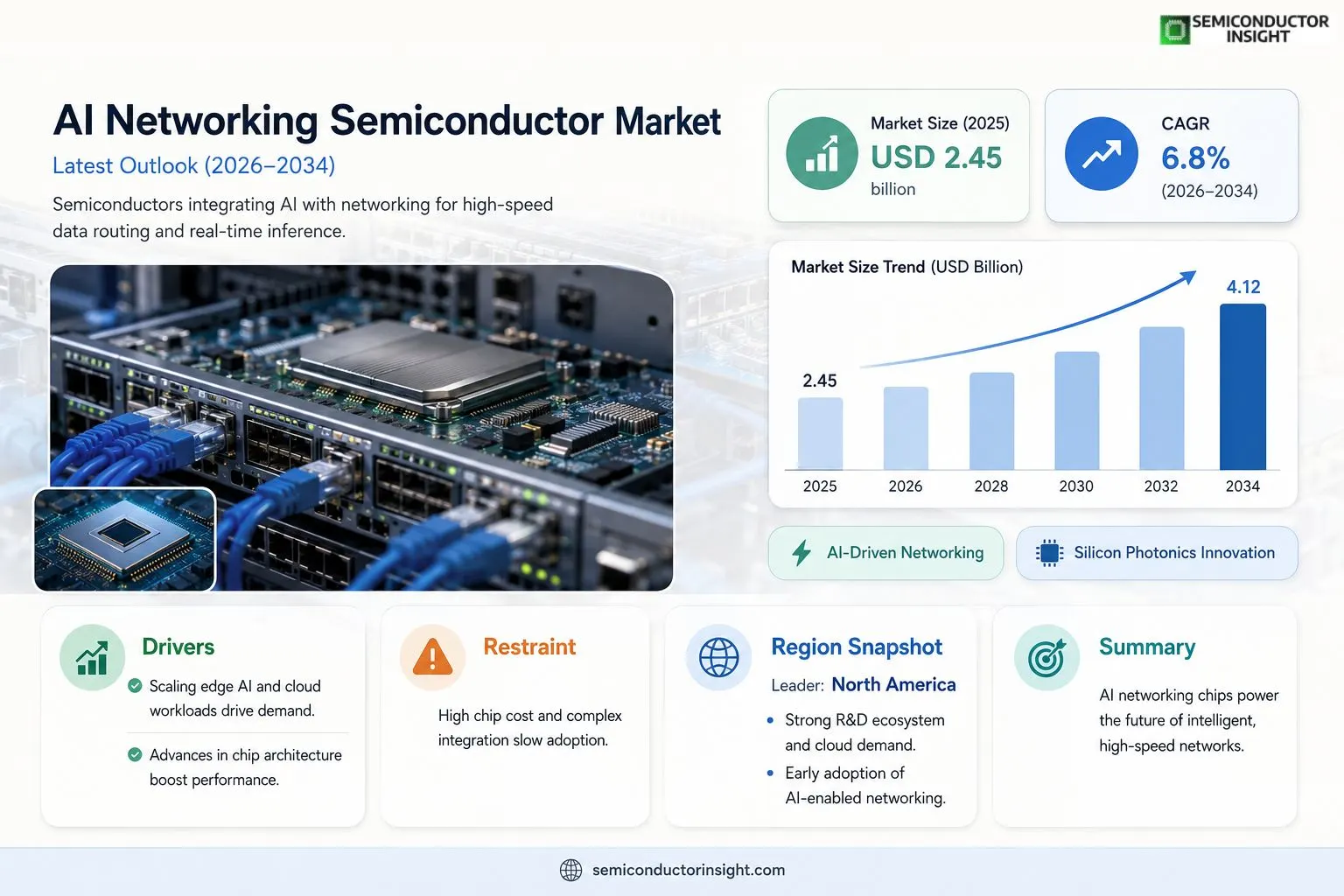
AI Networking Semiconductor Market size was valued at USD 2.45 billion in 2025. The market is projected to grow from USD 2.60 billion in 2026 to USD 4.12 billion by 2034, exhibiting a CAGR of 6.8% during the forecast period.
AI networking semiconductors are purpose‑built integrated circuits that enable high‑speed data routing, packet inspection, and on‑the‑fly artificial‑intelligence inference within network equipment such as switches, routers, and edge servers. These chips combine traditional networking functions with machine‑learning accelerators, supporting protocols like Ethernet 200 Gbps+, programmable pipelines, and low‑latency tensor processing.The market is experiencing rapid growth because enterprises are scaling edge computing workloads, cloud providers are expanding hyperscale data centers, and telecom operators are deploying 5G/6G infrastructure that demands intelligent traffic management. Furthermore, advancements in silicon photonics and heterogeneous integration are reducing power consumption while boosting throughput. Key players such as NVIDIA (with its Mellanox acquisition), Intel (Habana Labs), Broadcom (Pensando Systems), Marvell Technology Group, and Qualcomm are launching next‑generation AI‑enabled networking ASICs. For example, in March 2024 NVIDIA announced a strategic partnership with Cisco to embed its BlueField DPUs into Cisco’s Nexus series, accelerating adoption of AI‑driven network services.
MARKET DRIVERS
Rising Demand for Edge AI
AI Networking Semiconductor Market is being propelled by a surge in edge‑AI deployments that require low‑latency, high‑throughput processing. Enterprises are shifting workloads from centralized clouds to edge devices, creating a need for specialized semiconductors that can handle real‑time inference while maintaining power efficiency.
Advancements in Chip Architecture
Recent breakthroughs in heterogeneous integration and advanced packaging enable chips to combine AI accelerators with networking fabrics on a single die. This integration reduces data movement overhead and supports higher bandwidth, directly fueling growth across data‑center and telecom infrastructures.
➤ Industry analysts estimate that architectural innovation alone could boost AI Networking Semiconductor Market’s CAGR by nearly 12% over the next five years.
Combined with expanding 5G rollout and increasing cloud‑edge convergence, these drivers create a robust ecosystem where performance‑critical applications such as autonomous vehicles, smart factories, and immersive media continuously demand more capable networking semiconductors.
MARKET CHALLENGES
Cost and Integration Barriers
Despite rapid technical progress, the high cost of advanced AI‑enabled networking chips presents a barrier for mid‑size enterprises. Integration complexity, involving firmware, software stacks, and hardware co‑design, often extends time‑to‑market and escalates total ownership expenses.
Other Challenges
Supply Chain Volatility
Global component shortages and geopolitical tensions have exposed vulnerabilities in the semiconductor supply chain, leading to lead‑time extensions that can hinder timely deployment of AI networking solutions.
MARKET RESTRAINTS
Regulatory and Energy Efficiency Constraints
Stringent emissions standards and emerging data‑privacy regulations impose design constraints on AI networking chips. Manufacturers must balance performance gains with power‑budget limits, often requiring additional R&D investment to meet both compliance and efficiency targets.
MARKET OPPORTUNITIES
Emerging 5G and Data Center Expansion
The convergence of 5G connectivity and the ongoing expansion of hyperscale data centers opens new avenues for AI Networking Semiconductor Market. Enhanced backhaul requirements and the drive for real‑time analytics create a fertile ground for next‑generation networking chips that embed AI capabilities directly within the fabric.
AI Networking Semiconductor Market Trends
Edge Computing and 5G/6G Expansion Accelerate Demand
Enterprises are rapidly expanding edge‑computing workloads to reduce latency for AI services, while hyperscale cloud operators increase capacity in data‑center fabrics. This convergence pushes network equipment manufacturers to adopt AI‑focused semiconductors that can perform on‑the‑fly packet inspection and inference. The emergence of 5G and the early design work for 6G introduce tighter latency budgets, compelling operators to replace traditional ASICs with integrated AI networking chips. As a result, AI Networking Semiconductor Market is witnessing a shift toward higher‑bandwidth Ethernet standards (200 Gbps and beyond) and programmable pipelines that can adapt to evolving traffic patterns without hardware redesign. In addition, telecom operators deploying 5G core functions are integrating AI‑enabled ASICs to perform real‑time traffic shaping and anomaly detection, which reduces the need for separate security appliances. The combined effect of higher bandwidth and embedded intelligence is reshaping network architecture toward a more software‑defined, AI‑centric paradigm.
Other Trends
Silicon Photonics and Heterogeneous Integration
Advancements in silicon‑photonic interconnects are reducing the power envelope of high‑speed routing while maintaining signal integrity across multi‑terabit links. Heterogeneous integrationstacking logic, memory, and optical components in a single packageallows designers to meet the combined demands of AI inference and networking throughput within a constrained footprint. Early silicon‑photonic prototypes have demonstrated sub‑100 pJ/bit energy consumption, making them attractive for edge routers that must process AI‑augmented traffic 24 × 7. These technology strides are expected to drive broader adoption of AI‑enabled networking semiconductors in both carrier‑grade and enterprise environments. While the technology promises lower power per bit, initial silicon‑photonic modules still face yield challenges that drive early‑stage pricing higher than conventional copper solutions. Continued investment in foundry processes and design‑automation tools is expected to close the cost gap within the next two‑to‑three years.
Strategic Partnerships Speed AI‑Enabled ASIC Rollout
Major vendors are leveraging alliances to accelerate product timelines. In March 2024 NVIDIA announced a strategic partnership with Cisco to embed its BlueField data‑processing units within the Nexus series, delivering integrated AI acceleration for network telemetry and security functions. Intel’s Habana Labs and Broadcom’s Pensando Systems are similarly positioning AI‑centric ASICs for hyperscale cloud operators. Marvell Technology Group and Qualcomm have introduced heterogeneous AI networking solutions that combine traditional packet‑forwarding engines with dedicated tensor cores. These collaborations underline a market‑wide consensus that joint development reduces time‑to‑market and creates interoperable standards, reinforcing the momentum of AI Networking Semiconductor Market. Looking ahead, Qualcomm’s upcoming RF‑integrated AI networking chipset is slated for 2025 release, targeting mobile edge compute nodes that require both RF front‑end and AI inference capability. These roadmap announcements reinforce the belief that AI networking semiconductors will become a foundational component of future digital infrastructure.
COMPETITIVE LANDSCAPEKey Industry Players
AI Networking Semiconductor Market Competitive Analysis 2024‑2034
The AI networking semiconductor arena is dominated by a handful of integrated‑circuit powerhouses that combine high‑throughput packet processing with on‑chip AI inference engines. NVIDIA, leveraging its Mellanox acquisition, leads the segment through its BlueField DPUs that embed tensor cores for real‑time analytics in data‑center switches and edge routers. Intel follows closely with its Habana Labs‑derived AI‑optimized ASICs, while Broadcom’s Pensando Systems offers programmable SmartNICs that fuse networking stacks with machine‑learning acceleration. These three firms shape market structure by securing multi‑year supply contracts with hyperscale cloud providers and telecom operators, driving the projected CAGR of 6.8 % through 2034.Beyond the marquee players, a diverse set of niche innovators is expanding the ecosystem. Marvell Technology Group provides AI‑enhanced Ethernet chips that target 200 Gbps+ fabric interfaces, and Qualcomm’s Snapdragon‑based networking SoCs address 5G edge workloads. Xilinx (now part of AMD) supplies field‑programmable gate arrays (FPGAs) customized for AI traffic classification, while Samsung Electronics and TSMC contribute advanced silicon‑photonic processes that reduce power per bit. Regional challengers such as Huawei’s HiSilicon, MediaTek, and Google’s custom Tensor ASICs further enrich the competitive landscape, each focusing on specific verticals like telecom infrastructure, consumer‑grade edge devices, or AI‑driven cloud services.
List of Key AI Networking Semiconductor Companies Profiled
- NVIDIA
- Intel
- Broadcom
- Marvell Technology Group
- Qualcomm
- Xilinx (AMD)
- Samsung Electronics
- TSMC
- Huawei HiSilicon
- MediaTek
- Google Tensor ASIC
- Cisco Systems
Segment Analysis:
| Segment Category | Sub-Segments | Key Insights |
| By Type |
|
ASIC‑based AI networking chips are emerging as the dominant type because they deliver the highest throughput and deterministic latency required for hyperscale data‑center fabrics.
|
| By Application |
|
Data‑center switching and routing drives the most sophisticated AI networking semiconductor designs.
|
| By End User |
|
Cloud service providers are the primary catalyst for AI networking semiconductor innovation.
|
| By Architecture |
|
Chiplet‑based heterogeneous designs are gaining traction as they balance performance with power efficiency.
|
| By Integration |
|
Heterogeneous system‑in‑package (SiP) is becoming a strategic integration approach for AI networking semiconductors.
|
Regional Analysis: North America
United States
The data center sector is a major consumer of AI networking semiconductors, driving demand for high-performance processors and interconnect solutions. The need to handle massive datasets and complex AI models necessitates advanced chip architectures capable of delivering exceptional throughput and low latency. Focus is shifting toward energy-efficient designs to minimize operational costs and environmental impact within these facilities.
AI networking semiconductors are playing an increasingly critical role in the automotive industry, powering advanced driver-assistance systems (ADAS) and autonomous driving capabilities. The development of reliable and secure chipsets is essential for enabling real-time data processing and decision-making within vehicles. The integration of these chips necessitates stringent safety standards and robust cybersecurity measures to ensure passenger safety and prevent data breaches.
The continued expansion of cloud infrastructure is a key driver for AI networking semiconductor demand. Cloud providers are investing heavily in upgrading their data centers with advanced chipsets to meet the growing demands of AI workloads. This includes the adoption of specialized accelerators and high-bandwidth networking solutions to enhance computing performance and reduce latency. Scalability and efficiency are paramount considerations in this market segment.
AI networking semiconductors are facilitating advancements in industrial automation, enabling smarter and more efficient manufacturing processes. These chips support real-time monitoring, predictive maintenance, and optimized control systems, leading to increased productivity and reduced downtime. The integration of AI networking capabilities is driving the development of connected factories and intelligent industrial equipment.
Europe
Europe represents a significant and growing market for AI Networking Semiconductors, characterized by a strong emphasis on data privacy and security. The region’s proactive approach to data governance is influencing semiconductor design and deployment. The automotive and industrial sectors in Europe are key drivers of demand, leveraging AI networking technologies for applications ranging from autonomous vehicles to smart manufacturing. Government initiatives promoting digital transformation and technological innovation are further propelling market growth. Strategic collaborations between European semiconductor companies and research institutions are fostering a vibrant ecosystem of innovation. Challenges include navigating regulatory complexities and maintaining competitiveness against dominant US players. The focus is on developing energy-efficient and secure solutions.
Asia-Pacific
Asia-Pacific is emerging as the fastest-growing market for AI Networking Semiconductors, driven by rapid industrialization and increasing demand for digital technologies. China is a major consumer and producer of these chips, with significant investments in AI research and development. The region’s strong manufacturing base and large-scale infrastructure projects are creating substantial opportunities for semiconductor vendors. The demand for AI networking solutions is particularly high in the telecommunications and consumer electronics sectors. However, geopolitical tensions and supply chain disruptions pose challenges to market stability. Focus areas include 5G infrastructure development and the proliferation of smart devices. The integration of AI networking is expected to revolutionize industries across the region.
South America
South America is a developing market for AI Networking Semiconductors, with growing adoption in key sectors such as telecommunications and e-commerce. Investments in digital infrastructure are driving demand for advanced networking solutions. The region’s increasing focus on data analytics and cloud computing is creating new opportunities for semiconductor vendors. While the market is relatively small compared to North America and Asia-Pacific, it offers significant growth potential. Overcoming logistical challenges and building local expertise are crucial for success. The adoption of AI networking technologies in the agricultural sector is also gaining traction.
Middle East & Africa
The Middle East & Africa represents an emerging market for AI Networking Semiconductors, with increasing investments in smart city initiatives and digital transformation. Government priorities such as diversifying economies and improving infrastructure are driving demand for advanced technologies. The telecommunications sector is a key driver, with the rollout of 5G networks creating opportunities for AI networking chipsets. While the market is still in its early stages of development, it offers significant long-term growth potential. Challenges include limited local manufacturing capabilities and regulatory uncertainties. Focus is on building robust digital infrastructure and fostering innovation in AI networking applications.
Report Scope
This market research report provides a comprehensive analysis of the AI Networking Semiconductor Market , covering the forecast period 2026–2034. It offers detailed insights into market dynamics, technological advancements, competitive landscape, and key trends shaping the industry.
Key focus areas of the report include:
- Market Overview: The report begins with an overview outlining its current market scenario, key growth indicators, and industry transformation drivers. It discusses macroeconomic factors, demand–supply balance, regulatory landscape, and the strategic role of semiconductors in powering advancements across industries such as automotive, telecommunications, consumer electronics, and industrial automation.
- Market Size & Forecast: Historical data and future projections for revenue, unit shipments, and market value across major regions and segments.
- Segmentation Analysis: Detailed breakdown by product type, technology, application, and end-user industry to identify high-growth segments and investment opportunities.
- Regional Insights: Insights into market performance across North America, Europe, Asia-Pacific, Latin America, and the Middle East & Africa, including country-level analysis where relevant.
- Competitive Landscape: Profiles of leading market participants, including their product offerings, R&D focus, manufacturing capacity, pricing strategies, and recent developments such as mergers, acquisitions, and partnerships.
- Technology Trends & Innovation: Assessment of emerging technologies, integration of AI/IoT, semiconductor design trends, fabrication techniques, and evolving industry standards.
- Market Drivers & Restraints: Evaluation of factors driving market growth along with challenges, supply chain constraints, regulatory issues, and market-entry barriers.
- Stakeholder Insights: Insights for component suppliers, OEMs, system integrators, investors, and policymakers regarding the evolving ecosystem and strategic opportunities.
Primary and secondary research methods are employed, including interviews with industry experts, data from verified sources, and real-time market intelligence to ensure the accuracy and reliability of the insights presented.
FREQUENTLY ASKED QUESTIONS:
What is the current market size of AI Networking Semiconductor Market?
-> AI Networking Semiconductor Market was valued at USD 2.45 billion in 2025 and is expected to reach USD 4.12 billion by 2034, reflecting a CAGR of 6.8% over the forecast period.
Which key companies operate in AI Networking Semiconductor Market?
-> Key players include NVIDIA, Intel (Habana Labs), Broadcom (Pensando Systems), Marvell Technology Group, and Qualcomm, among others.
What are the key growth drivers?
-> Key growth drivers include scaling edge‑computing workloads, expansion of hyperscale data centers, deployment of 5G/6G infrastructure, and advancements in silicon photonics and heterogeneous integration.
Which region dominates the market?
-> The reference material does not single out a dominant region; growth is observed globally, driven by demand in North America, Europe, and Asia‑Pacific.
What are the emerging trends?
-> Emerging trends include AI‑enabled networking ASICs, integration of silicon photonics for low‑power high‑throughput, and heterogeneous chiplet architectures that combine networking and AI acceleration.

Get Sample Report PDF for Exclusive Insights
Report Sample Includes
- Table of Contents
- List of Tables & Figures
- Charts, Research Methodology, and more...
 Download Sample Report PDF