Aerosol Deposition Market Technology Adoption, AI Integration and Industry Outlook (2026-2034)

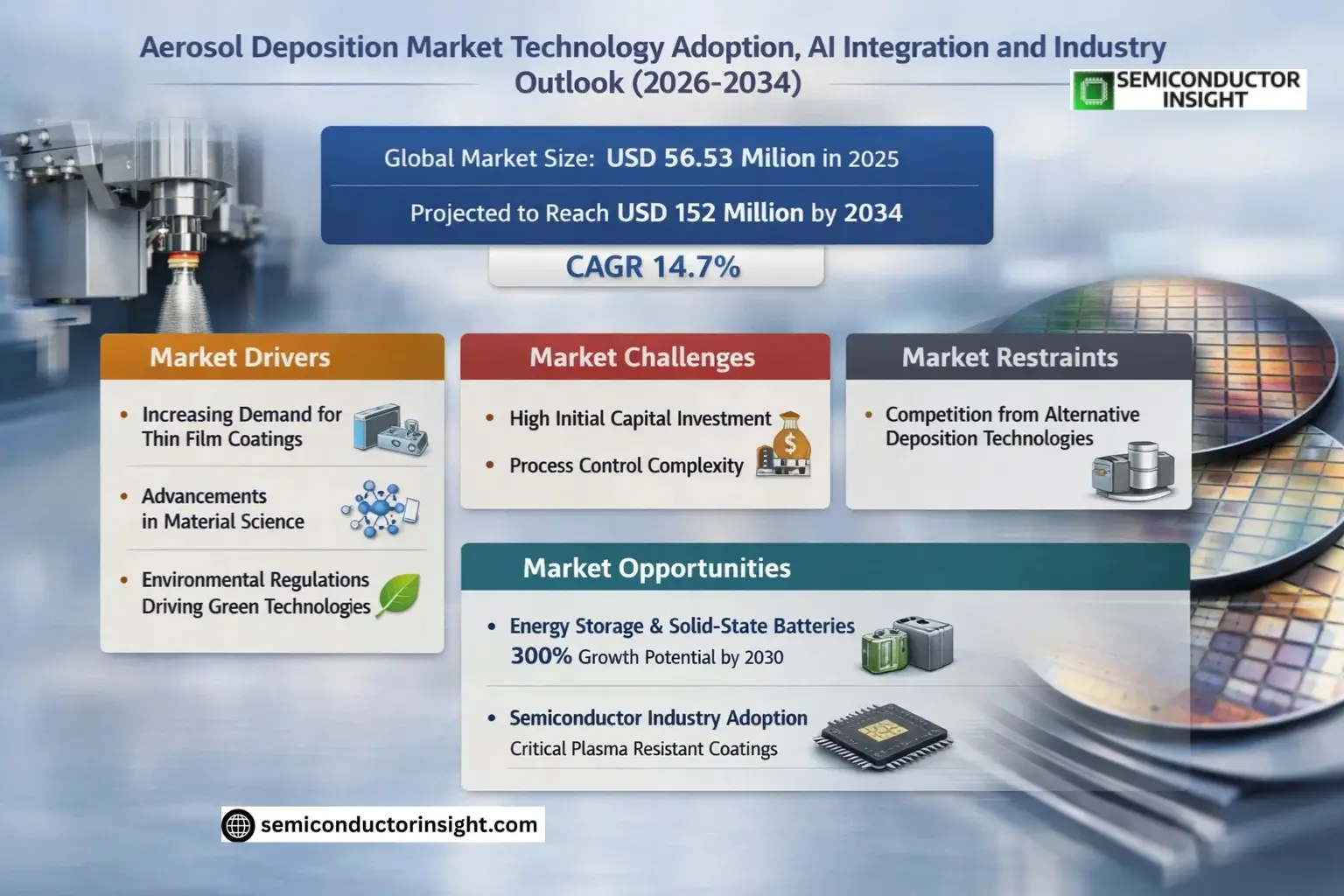
Aerosol Deposition Market size was valued at USD 56.53 million in 2025. The market is projected to grow from USD 64.8 million in 2026 to USD 152 million by 2034, exhibiting a CAGR of 14.7% during the forecast period.

PDF Icon Download Sample Report PDF
  • Quick Dispatch

    All Orders

  • Secure Payment

    100% Secure Payment

Price range: $1,500.00 through $4,250.00

Clear

Market Insights

Global Aerosol Deposition Market size was valued at USD 56.53 million in 2025. The market is projected to grow from USD 64.8 million in 2026 to USD 152 million by 2034, exhibiting a CAGR of 14.7% during the forecast period.

Aerosol Deposition (AD), also called Aerosol Deposition Method (ADM) or Powder Aerosol Deposition (PAD), is a room-temperature, low-vacuum coating process based on Room-Temperature Impact Consolidation (RTIC). Fine ceramic or metal powders are dispersed in a carrier gas to form an aerosol, accelerated through a nozzle, and impact-consolidated on a substrate to create dense films without high-temperature sintering. This method enables strong adhesion and high deposition rates while minimizing thermal distortion critical for temperature-sensitive applications.

The market growth is driven by increasing demand in semiconductor manufacturing, particularly for plasma-resistant coatings in etching chambers, where AD’s superior particle control extends equipment lifespan. Emerging applications in energy devices (e.g., solid-state batteries) and functional electronics further propel adoption. Key players like TOTO Advanced Ceramics and KoMiCo lead the market with specialized AD solutions, while technological advancements aim to expand material compatibility and deposition efficiency.
Aerosol Deposition Market Growth

MARKET DRIVERS

Increasing Demand for Thin Film Coatings

Aerosol Deposition Market is experiencing significant growth due to rising demand for thin film coatings across various industries. The technology’s ability to produce high-quality, uniform coatings at room temperature makes it ideal for applications in electronics, energy storage, and aerospace. Market analysis shows a 12% annual growth in thin film adoption specifically using aerosol deposition methods.

Advancements in Material Science

Recent breakthroughs in nanomaterial development have expanded the capabilities of aerosol deposition technology. The process now enables deposition of complex oxides, ceramics, and composite materials with enhanced functional properties, opening new application areas in photovoltaics and biomedical devices.

Regulatory support for environmentally friendly coating technologies further accelerates market growth, as aerosol deposition produces minimal waste compared to traditional methods.

MARKET CHALLENGES

High Initial Capital Investment

Aerosol Deposition Market faces adoption barriers due to significant equipment costs, with complete systems ranging from USD 200,000 to USD 1 million. This limits market penetration among small and medium-sized enterprises, particularly in developing regions.

Other Challenges

Process Control Complexity
Precise control of aerosol parameters (particle size, velocity, and concentration) requires specialized expertise, creating a skills gap in the workforce that slows commercial adoption.

MARKET RESTRAINTS

Competition from Alternative Deposition Technologies

Aerosol Deposition Market faces competition from established techniques like sputtering and CVD, which have broader process knowledge bases and lower per-unit costs for high-volume production. While aerosol deposition offers unique advantages for specialized applications, convincing manufacturers to switch remains challenging.

MARKET OPPORTUNITIES

Emerging Applications in Energy Storage

Aerosol Deposition Market has significant growth potential in solid-state battery production, where the technology enables precise electrolyte layer formation. Industry projections indicate a potential 300% increase in aerosol deposition adoption for battery manufacturing by 2030 as automakers accelerate EV development.

Aerosol Deposition Market Trends
Semiconductor Industry Dominates Aerosol Deposition Adoption

Aerosol Deposition has become a critical coating technology for semiconductor equipment, particularly in plasma etching chambers. The process’s ability to create dense ceramic films at room temperature enables superior plasma corrosion resistance while minimizing particle contamination. Leading semiconductor equipment manufacturers increasingly specify AD coatings for critical components to improve yield rates and reduce maintenance downtimes.

Other Trends

Expansion Beyond Yttria-Based Coatings

While yttria coatings dominate current industrial applications, development efforts are expanding to include fluorinated ceramics and multi-layer stacks. These advanced materials offer improved plasma resistance in next-generation semiconductor processes while maintaining the low-temperature processing advantages of AD technology.

Growing Adoption in Energy Storage Applications

Aerosol Deposition Market is seeing increased interest from the energy sector, particularly for solid-state battery components. AD’s capability to deposit dense ceramic electrolytes and protective layers without high-temperature processing makes it suitable for temperature-sensitive battery architectures. Several research institutions and battery manufacturers are actively evaluating AD for scalable production of advanced energy storage solutions.

Equipment Automation and Process Scaling

Leading AD equipment providers are developing higher throughput systems with improved uniformity for large-area depositions. Automated powder handling and integrated process monitoring systems are being implemented to enhance production reproducibility and meet the stringent quality requirements of semiconductor and electronics applications.

Regional Market Developments

Asia-Pacific remains the dominant region for Aerosol Deposition technology, driven by semiconductor manufacturing concentration in countries like South Korea, Taiwan, and Japan. However, increasing investment in European and North American semiconductor fabs is creating new growth opportunities for regional AD coating service providers and equipment suppliers.

COMPETITIVE LANDSCAPE

Key Industry Players

Aerosol Deposition Market Driven by Semiconductor and Advanced Ceramic Applications

Aerosol Deposition Market is dominated by specialized ceramic coating suppliers with strong semiconductor industry qualifications. TOTO Advanced Ceramics leads the sector with its proprietary AD Film technology, particularly for yttria-based plasma-resistant coatings in etch chambers. KoMiCo and Heraeus High Performance Coatings follow as established players offering advanced AD solutions for semiconductor equipment components, leveraging decades of materials expertise. The market structure remains concentrated, with top 5 players holding over 60% revenue share globally due to high technical barriers in powder conditioning, process control, and semiconductor-grade contamination management.

Emerging specialists like Innojet Technology are gaining traction by focusing on next-generation etch chamber components with multilayer AD coatings. Several industrial coating service providers in Europe and Asia are expanding into AD for energy applications (solid-state batteries) and industrial wear protection. Academic spin-offs are entering through partnerships with equipment OEMs, driving innovation in nozzle design and large-area deposition. Material suppliers like Tosoh Corporation and CeramTec play a critical upstream role by providing high-purity ceramic powders optimized for AD processes.

List of Key Aerosol Deposition Companies Profiled

  • TOTO Advanced Ceramics
  • KoMiCo
  • Heraeus High Performance Coatings
  • Innojet Technology
  • Fraunhofer IKTS
  • Tosoh Corporation
  • CeramTec
  • Miba Coatings Group
  • Praxair Surface Technologies
  • Surfx Technologies
  • Plasma Process Group
  • Impact Coatings AB
  • Richter Precision
  • Keronite
  • CemeCon AG

Segment Analysis:

Segment Category Sub-Segments Key Insights
By Type
  • Ceramic Material
  • Metals and Composites
Ceramic Material dominates due to superior plasma resistance and temperature stability. Key factors include:

  • Widespread adoption in semiconductor plasma etch chambers for yttria-based coatings
  • Growing exploration of fluorinated/oxyfluoride ceramics for enhanced performance
  • Superior adhesion properties at room temperature compared to thermal spray alternatives
By Application
  • Semiconductor Equipment
  • Energy Devices
  • Electronics
  • Others
Semiconductor Equipment leads due to critical performance requirements:

  • Essential for plasma etch chamber components where particle control impacts wafer yield
  • High switching costs due to rigorous qualification processes in semiconductor fabs
  • Emerging applications in advanced packaging and 3D NAND memory production
By End User
  • Semiconductor Equipment OEMs
  • Component Refurbishment Services
  • Research Institutions
Semiconductor Equipment OEMs represent the core market segment:

  • Require certified coating solutions for new equipment production
  • Drive innovation through specifications for advanced plasma-resistant materials
  • Increasing collaboration with AD specialists for proprietary coating formulations
By Material Formulation
  • Single-Layer Coatings
  • Multilayer Stacks
  • Graded Compositions
Multilayer Stacks are gaining traction for specialized applications:

  • Offer combined properties from different materials in a single coating system
  • Enable tailored solutions for complex semiconductor process requirements
  • Require advanced process control to maintain interfacial integrity
By Process Stage
  • New Component Coating
  • Refurbishment/Recoating
  • Prototype Development
Refurbishment/Recoating presents significant growth opportunities:

  • Extends lifespan of expensive semiconductor chamber components
  • Requires specialized surface preparation techniques for worn parts
  • Creates recurring revenue streams for coating service providers

Regional Analysis: Aerosol Deposition Market

Asia-Pacific

The Asia-Pacific region dominates the Aerosol Deposition Market with robust adoption across electronics and automotive sectors. Countries like Japan and South Korea lead in semiconductor thin-film applications, while China’s expanding renewable energy sector drives demand for aerosol-deposited coatings. Regional manufacturers benefit from strong government support for advanced manufacturing technologies, enabling rapid commercialization of deposition processes. The presence of key industrial clusters and R&D centers facilitates continuous innovation in precision coating techniques. Local supply chain advantages further position Asia-Pacific as the global hub for aerosol deposition technology development and deployment.

Technology Leadership
Japanese firms pioneer aerosol deposition equipment with proprietary nozzle designs achieving unmatched deposition uniformity for microelectronics applications.
Industrial Adoption
South Korean display manufacturers increasingly replace conventional sputtering with aerosol methods for OLED encapsulation layers, reducing production costs by 20-30%.
Research Ecosystem
China’s National Aerosol Technology Consortium coordinates 38 academic-industrial projects focused on next-gen deposition materials and process optimization.
Market Expansion
Southeast Asian nations emerge as new adoption hotspots with growing investments in semiconductor packaging and medical device coating applications.

North America
The North American Aerosol Deposition Market shows strong growth in aerospace and defense applications. US-based companies lead in developing ceramic coatings for turbine components, while Canadian research institutes advance biomedical coating technologies. Strict environmental regulations drive adoption of solvent-free deposition methods across industrial sectors.

Europe
Europe maintains technological leadership in precision optical coatings through aerosol deposition. German automotive manufacturers adopt the process for sensor coatings, while Swiss watchmakers utilize it for decorative finishes. The EU’s Horizon programs actively fund deposition technology development for sustainable manufacturing applications.

Middle East & Africa
The Middle East shows increasing interest in aerosol deposition for solar panel anti-reflective coatings and desalination equipment protection layers. African markets remain nascent but demonstrate potential in corrosion-resistant coatings for infrastructure projects.

South America
Brazil leads South America’s Aerosol Deposition Market with applications in aerospace and oil/gas equipment. Regional research focuses on adapting the technology for tropical climate conditions and developing local deposition material supply chains.

Report Scope

This market research report provides a comprehensive analysis of the Aerosol Deposition Market, covering the forecast period 2025–2034. It offers detailed insights into market dynamics, technological advancements, competitive landscape, and key trends shaping the industry.

Key focus areas of the report include:

  • Market Overview: The report begins with an overview outlining its current market scenario, key growth indicators, and industry transformation drivers. It discusses macroeconomic factors, demand-supply balance, regulatory landscape, and the strategic role of Aerosol Deposition in powering advancements across industries such as semiconductors, electronics, energy devices, and industrial applications.
  • Market Size & Forecast: Historical data and future projections for revenue, unit shipments, and market value across major regions and segments.
  • Segmentation Analysis: Detailed breakdown by material type, process, application, and end-user industry to identify high-growth segments and investment opportunities.
  • Regional Insights: Insights into market performance across North America, Europe, Asia-Pacific, Latin America, and the Middle East & Africa, including country-level analysis where relevant.
  • Competitive Landscape: Profiles of leading market participants, including their product offerings, R&D focus, manufacturing capacity, pricing strategies, and recent developments such as mergers, acquisitions, and partnerships.
  • Technology Trends & Innovation: Assessment of emerging technologies, integration of advanced materials, fabrication techniques, and evolving industry standards.
  • Market Drivers & Restraints: Evaluation of factors driving market growth along with challenges, supply chain constraints, regulatory issues, and market-entry barriers.
  • Stakeholder Insights: Insights for component suppliers, OEMs, system integrators, investors, and policymakers regarding the evolving ecosystem and strategic opportunities.

Primary and secondary research methods are employed, including interviews with industry experts, data from verified sources, and real-time market intelligence to ensure the accuracy and reliability of the insights presented.

FREQUENTLY ASKED QUESTIONS:

What is the current market size of Aerosol Deposition Market?

-> Aerosol Deposition Market size was valued at USD 56.53 million in 2025. The market is projected to grow from USD 64.8 million in 2026 to USD 152 million by 2034, exhibiting a CAGR of 14.7% during the forecast period.

What is the expected CAGR of the Aerosol Deposition Market?

-> The market is expected to grow at a CAGR of 14.7% during the forecast period (2025-2034).

Which key companies operate in Aerosol Deposition Market?

-> Key players include TOTO Advanced Ceramics, KoMiCo, Heraeus High Performance Coatings, and Innojet Technology, among others.

What are the key growth drivers?

-> Key growth drivers include rising demand for semiconductor equipment, growing adoption in electronics and energy devices, and increasing need for room-temperature deposition processes.

Which segment dominates the market by application?

-> The Semiconductor Equipment (like Plasma Etching Chamber) segment dominates the market by application.

Which region dominates the market?

-> Asia is the dominant region, with key markets in China, Japan, and South Korea.

What are the emerging trends?

-> Emerging trends include broader material applications, higher throughput systems, and expansion into new use cases enabled by room-temperature deposition.
Aerosol Deposition Market Technology Adoption, AI Integration and Industry Outlook (2026-2034)

Get Sample Report PDF for Exclusive Insights

Report Sample Includes

  • Table of Contents
  • List of Tables & Figures
  • Charts, Research Methodology, and more...

PDF Icon Download Sample Report PDF

Table of Content

1 Introduction to Research & Analysis Reports
1.1 Aerosol Deposition Market Definition
1.2 Market Segments
1.2.1 Segment by Material Type
1.2.2 Segment by Process
1.2.3 Segment by Application
1.3 Global Aerosol Deposition Market Overview
1.4 Features & Benefits of This Report
1.5 Methodology & Sources of Information
1.5.1 Research Methodology
1.5.2 Research Process
1.5.3 Base Year
1.5.4 Report Assumptions & Caveats
2 Global Aerosol Deposition Overall Market Size
2.1 Global Aerosol Deposition Market Size: 2025 VS 2034
2.2 Global Aerosol Deposition Market Size, Prospects & Forecasts: 2021-2034
2.3 Key Market Trends, Opportunity, Drivers and Restraints
2.3.1 Market Opportunities & Trends
2.3.2 Market Drivers
2.3.3 Market Restraints
3 Company Landscape
3.1 Top Aerosol Deposition Players in Global Market
3.2 Top Global Aerosol Deposition Companies Ranked by Revenue
3.3 Global Aerosol Deposition Revenue by Companies
3.4 Top 3 and Top 5 Aerosol Deposition Companies in Global Market, by Revenue in 2025
3.5 Global Companies Aerosol Deposition Product Type
3.6 Tier 1, Tier 2, and Tier 3 Aerosol Deposition Players in Global Market
3.6.1 List of Global Tier 1 Aerosol Deposition Companies
3.6.2 List of Global Tier 2 and Tier 3 Aerosol Deposition Companies
4 Sights by Material Type
4.1 Overview
4.1.1 Segmentation by Material Type – Global Aerosol Deposition Market Size Markets, 2025 & 2034
4.1.2 Ceramic Material
4.1.3 Metals and Composites
4.2 Segmentation by Material Type – Global Aerosol Deposition Revenue & Forecasts
4.2.1 Segmentation by Material Type – Global Aerosol Deposition Revenue, 2021-2026
4.2.2 Segmentation by Material Type – Global Aerosol Deposition Revenue, 2027-2034
4.2.3 Segmentation by Material Type – Global Aerosol Deposition Revenue Market Share, 2021-2034
5 Sights by Process
5.1 Overview
5.1.1 Segmentation by Process – Global Aerosol Deposition Market Size Markets, 2025 & 2034
5.1.2 Logic Process
5.1.3 Others
5.2 Segmentation by Process – Global Aerosol Deposition Revenue & Forecasts
5.2.1 Segmentation by Process – Global Aerosol Deposition Revenue, 2021-2026
5.2.2 Segmentation by Process – Global Aerosol Deposition Revenue, 2027-2034
5.2.3 Segmentation by Process – Global Aerosol Deposition Revenue Market Share, 2021-2034
6 Sights by Application
6.1 Overview
6.1.1 Segmentation by Application – Global Aerosol Deposition Market Size, 2025 & 2034
6.1.2 Semiconductor Equipment (like Plasma Etching Chamber)
6.1.3 Others
6.2 Segmentation by Application – Global Aerosol Deposition Revenue & Forecasts
6.2.1 Segmentation by Application – Global Aerosol Deposition Revenue, 2021-2026
6.2.2 Segmentation by Application – Global Aerosol Deposition Revenue, 2027-2034
6.2.3 Segmentation by Application – Global Aerosol Deposition Revenue Market Share, 2021-2034
7 Sights Region
7.1 By Region – Global Aerosol Deposition Market Size, 2025 & 2034
7.2 By Region – Global Aerosol Deposition Revenue & Forecasts
7.2.1 By Region – Global Aerosol Deposition Revenue, 2021-2026
7.2.2 By Region – Global Aerosol Deposition Revenue, 2027-2034
7.2.3 By Region – Global Aerosol Deposition Revenue Market Share, 2021-2034
7.3 North America
7.3.1 By Country – North America Aerosol Deposition Revenue, 2021-2034
7.3.2 United States Aerosol Deposition Market Size, 2021-2034
7.3.3 Canada Aerosol Deposition Market Size, 2021-2034
7.3.4 Mexico Aerosol Deposition Market Size, 2021-2034
7.4 Europe
7.4.1 By Country – Europe Aerosol Deposition Revenue, 2021-2034
7.4.2 Germany Aerosol Deposition Market Size, 2021-2034
7.4.3 France Aerosol Deposition Market Size, 2021-2034
7.4.4 U.K. Aerosol Deposition Market Size, 2021-2034
7.4.5 Italy Aerosol Deposition Market Size, 2021-2034
7.4.6 Russia Aerosol Deposition Market Size, 2021-2034
7.4.7 Nordic Countries Aerosol Deposition Market Size, 2021-2034
7.4.8 Benelux Aerosol Deposition Market Size, 2021-2034
7.5 Asia
7.5.1 By Region – Asia Aerosol Deposition Revenue, 2021-2034
7.5.2 China Aerosol Deposition Market Size, 2021-2034
7.5.3 Japan Aerosol Deposition Market Size, 2021-2034
7.5.4 South Korea Aerosol Deposition Market Size, 2021-2034
7.5.5 Southeast Asia Aerosol Deposition Market Size, 2021-2034
7.5.6 India Aerosol Deposition Market Size, 2021-2034
7.6 South America
7.6.1 By Country – South America Aerosol Deposition Revenue, 2021-2034
7.6.2 Brazil Aerosol Deposition Market Size, 2021-2034
7.6.3 Argentina Aerosol Deposition Market Size, 2021-2034
7.7 Middle East & Africa
7.7.1 By Country – Middle East & Africa Aerosol Deposition Revenue, 2021-2034
7.7.2 Turkey Aerosol Deposition Market Size, 2021-2034
7.7.3 Israel Aerosol Deposition Market Size, 2021-2034
7.7.4 Saudi Arabia Aerosol Deposition Market Size, 2021-2034
7.7.5 UAE Aerosol Deposition Market Size, 2021-2034
8 Companies Profiles
8.1 TOTO Advanced Ceramics
8.1.1 TOTO Advanced Ceramics Corporate Summary
8.1.2 TOTO Advanced Ceramics Business Overview
8.1.3 TOTO Advanced Ceramics Aerosol Deposition Major Product Offerings
8.1.4 TOTO Advanced Ceramics Aerosol Deposition Revenue in Global Market (2021-2026)
8.1.5 TOTO Advanced Ceramics Key News & Latest Developments
8.2 KoMiCo
8.2.1 KoMiCo Corporate Summary
8.2.2 KoMiCo Business Overview
8.2.3 KoMiCo Aerosol Deposition Major Product Offerings
8.2.4 KoMiCo Aerosol Deposition Revenue in Global Market (2021-2026)
8.2.5 KoMiCo Key News & Latest Developments
8.3 Heraeus High Performance Coatings
8.3.1 Heraeus High Performance Coatings Corporate Summary
8.3.2 Heraeus High Performance Coatings Business Overview
8.3.3 Heraeus High Performance Coatings Aerosol Deposition Major Product Offerings
8.3.4 Heraeus High Performance Coatings Aerosol Deposition Revenue in Global Market (2021-2026)
8.3.5 Heraeus High Performance Coatings Key News & Latest Developments
8.4 Innojet Technology
8.4.1 Innojet Technology Corporate Summary
8.4.2 Innojet Technology Business Overview
8.4.3 Innojet Technology Aerosol Deposition Major Product Offerings
8.4.4 Innojet Technology Aerosol Deposition Revenue in Global Market (2021-2026)
8.4.5 Innojet Technology Key News & Latest Developments
9 Conclusion
10 Appendix
10.1 Note
10.2 Examples of Clients
10.3 DisclaimerList of Tables
Table 1. Aerosol Deposition Market Opportunities & Trends in Global Market
Table 2. Aerosol Deposition Market Drivers in Global Market
Table 3. Aerosol Deposition Market Restraints in Global Market
Table 4. Key Players of Aerosol Deposition in Global Market
Table 5. Top Aerosol Deposition Players in Global Market, Ranking by Revenue (2025)
Table 6. Global Aerosol Deposition Revenue by Companies, (US$, Mn), 2021-2026
Table 7. Global Aerosol Deposition Revenue Share by Companies, 2021-2026
Table 8. Global Companies Aerosol Deposition Product Type
Table 9. List of Global Tier 1 Aerosol Deposition Companies, Revenue (US$, Mn) in 2025 and Market Share
Table 10. List of Global Tier 2 and Tier 3 Aerosol Deposition Companies, Revenue (US$, Mn) in 2025 and Market Share
Table 11. Segmentation by Material Type – Global Aerosol Deposition Revenue, (US$, Mn), 2025 & 2034
Table 12. Segmentation by Material Type – Global Aerosol Deposition Revenue (US$, Mn), 2021-2026
Table 13. Segmentation by Material Type – Global Aerosol Deposition Revenue (US$, Mn), 2027-2034
Table 14. Segmentation by Process – Global Aerosol Deposition Revenue, (US$, Mn), 2025 & 2034
Table 15. Segmentation by Process – Global Aerosol Deposition Revenue (US$, Mn), 2021-2026
Table 16. Segmentation by Process – Global Aerosol Deposition Revenue (US$, Mn), 2027-2034
Table 17. Segmentation by Application– Global Aerosol Deposition Revenue, (US$, Mn), 2025 & 2034
Table 18. Segmentation by Application – Global Aerosol Deposition Revenue, (US$, Mn), 2021-2026
Table 19. Segmentation by Application – Global Aerosol Deposition Revenue, (US$, Mn), 2027-2034
Table 20. By Region– Global Aerosol Deposition Revenue, (US$, Mn), 2025 & 2034
Table 21. By Region – Global Aerosol Deposition Revenue, (US$, Mn), 2021-2026
Table 22. By Region – Global Aerosol Deposition Revenue, (US$, Mn), 2027-2034
Table 23. By Country – North America Aerosol Deposition Revenue, (US$, Mn), 2021-2026
Table 24. By Country – North America Aerosol Deposition Revenue, (US$, Mn), 2027-2034
Table 25. By Country – Europe Aerosol Deposition Revenue, (US$, Mn), 2021-2026
Table 26. By Country – Europe Aerosol Deposition Revenue, (US$, Mn), 2027-2034
Table 27. By Region – Asia Aerosol Deposition Revenue, (US$, Mn), 2021-2026
Table 28. By Region – Asia Aerosol Deposition Revenue, (US$, Mn), 2027-2034
Table 29. By Country – South America Aerosol Deposition Revenue, (US$, Mn), 2021-2026
Table 30. By Country – South America Aerosol Deposition Revenue, (US$, Mn), 2027-2034
Table 31. By Country – Middle East & Africa Aerosol Deposition Revenue, (US$, Mn), 2021-2026
Table 32. By Country – Middle East & Africa Aerosol Deposition Revenue, (US$, Mn), 2027-2034
Table 33. TOTO Advanced Ceramics Corporate Summary
Table 34. TOTO Advanced Ceramics Aerosol Deposition Product Offerings
Table 35. TOTO Advanced Ceramics Aerosol Deposition Revenue (US$, Mn) & (2021-2026)
Table 36. TOTO Advanced Ceramics Key News & Latest Developments
Table 37. KoMiCo Corporate Summary
Table 38. KoMiCo Aerosol Deposition Product Offerings
Table 39. KoMiCo Aerosol Deposition Revenue (US$, Mn) & (2021-2026)
Table 40. KoMiCo Key News & Latest Developments
Table 41. Heraeus High Performance Coatings Corporate Summary
Table 42. Heraeus High Performance Coatings Aerosol Deposition Product Offerings
Table 43. Heraeus High Performance Coatings Aerosol Deposition Revenue (US$, Mn) & (2021-2026)
Table 44. Heraeus High Performance Coatings Key News & Latest Developments
Table 45. Innojet Technology Corporate Summary
Table 46. Innojet Technology Aerosol Deposition Product Offerings
Table 47. Innojet Technology Aerosol Deposition Revenue (US$, Mn) & (2021-2026)
Table 48. Innojet Technology Key News & Latest Developments

List of Figures
Figure 1. Aerosol Deposition Product Picture
Figure 2. Aerosol Deposition Segment by Material Type in 2025
Figure 3. Aerosol Deposition Segment by Process in 2025
Figure 4. Aerosol Deposition Segment by Application in 2025
Figure 5. Global Aerosol Deposition Market Overview: 2025
Figure 6. Key Caveats
Figure 7. Global Aerosol Deposition Market Size: 2025 VS 2034 (US$, Mn)
Figure 8. Global Aerosol Deposition Revenue: 2021-2034 (US$, Mn)
Figure 9. The Top 3 and 5 Players Market Share by Aerosol Deposition Revenue in 2025
Figure 10. Segmentation by Material Type – Global Aerosol Deposition Revenue, (US$, Mn), 2025 & 2034
Figure 11. Segmentation by Material Type – Global Aerosol Deposition Revenue Market Share, 2021-2034
Figure 12. Segmentation by Process – Global Aerosol Deposition Revenue, (US$, Mn), 2025 & 2034
Figure 13. Segmentation by Process – Global Aerosol Deposition Revenue Market Share, 2021-2034
Figure 14. Segmentation by Application – Global Aerosol Deposition Revenue, (US$, Mn), 2025 & 2034
Figure 15. Segmentation by Application – Global Aerosol Deposition Revenue Market Share, 2021-2034
Figure 16. By Region – Global Aerosol Deposition Revenue Market Share, 2021-2034
Figure 17. By Country – North America Aerosol Deposition Revenue Market Share, 2021-2034
Figure 18. United States Aerosol Deposition Revenue, (US$, Mn), 2021-2034
Figure 19. Canada Aerosol Deposition Revenue, (US$, Mn), 2021-2034
Figure 20. Mexico Aerosol Deposition Revenue, (US$, Mn), 2021-2034
Figure 21. By Country – Europe Aerosol Deposition Revenue Market Share, 2021-2034
Figure 22. Germany Aerosol Deposition Revenue, (US$, Mn), 2021-2034
Figure 23. France Aerosol Deposition Revenue, (US$, Mn), 2021-2034
Figure 24. U.K. Aerosol Deposition Revenue, (US$, Mn), 2021-2034
Figure 25. Italy Aerosol Deposition Revenue, (US$, Mn), 2021-2034
Figure 26. Russia Aerosol Deposition Revenue, (US$, Mn), 2021-2034
Figure 27. Nordic Countries Aerosol Deposition Revenue, (US$, Mn), 2021-2034
Figure 28. Benelux Aerosol Deposition Revenue, (US$, Mn), 2021-2034
Figure 29. By Region – Asia Aerosol Deposition Revenue Market Share, 2021-2034
Figure 30. China Aerosol Deposition Revenue, (US$, Mn), 2021-2034
Figure 31. Japan Aerosol Deposition Revenue, (US$, Mn), 2021-2034
Figure 32. South Korea Aerosol Deposition Revenue, (US$, Mn), 2021-2034
Figure 33. Southeast Asia Aerosol Deposition Revenue, (US$, Mn), 2021-2034
Figure 34. India Aerosol Deposition Revenue, (US$, Mn), 2021-2034
Figure 35. By Country – South America Aerosol Deposition Revenue Market Share, 2021-2034
Figure 36. Brazil Aerosol Deposition Revenue, (US$, Mn), 2021-2034
Figure 37. Argentina Aerosol Deposition Revenue, (US$, Mn), 2021-2034
Figure 38. By Country – Middle East & Africa Aerosol Deposition Revenue Market Share, 2021-2034
Figure 39. Turkey Aerosol Deposition Revenue, (US$, Mn), 2021-2034
Figure 40. Israel Aerosol Deposition Revenue, (US$, Mn), 2021-2034
Figure 41. Saudi Arabia Aerosol Deposition Revenue, (US$, Mn), 2021-2034
Figure 42. UAE Aerosol Deposition Revenue, (US$, Mn), 2021-2034
Figure 43. TOTO Advanced Ceramics Aerosol Deposition Revenue Year Over Year Growth (US$, Mn) & (2021-2026)
Figure 44. KoMiCo Aerosol Deposition Revenue Year Over Year Growth (US$, Mn) & (2021-2026)
Figure 45. Heraeus High Performance Coatings Aerosol Deposition Revenue Year Over Year Growth (US$, Mn) & (2021-2026)
Figure 46. Innojet Technology Aerosol Deposition Revenue Year Over Year Growth (US$, Mn) & (2021-2026)