Spherical Silica Market Insights
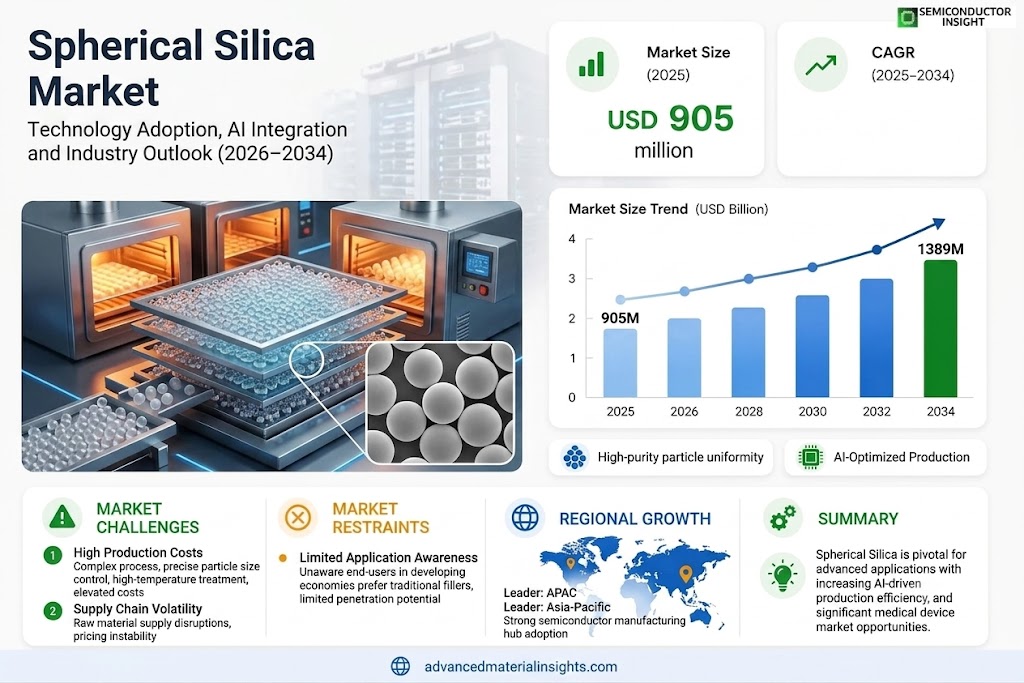
Global spherical silica market size was valued at USD 905 million in 2025. The market is projected to grow from USD 960 million in 2026 to USD 1,389 million by 2034, exhibiting a CAGR of 6.1% during the forecast period.
Spherical silica refers to engineered silicon dioxide (SiO₂) particles with a near-perfect spherical shape and tightly controlled particle size distribution, purity, and surface chemistry. These high-performance materials are critical for applications requiring precise rheological properties, thermal stability, and electrical insulation. Key specifications include low metallic ion content, minimal moisture absorption, and for semiconductor packaging ultra-low alpha particle emissions to prevent chip degradation.
Demand growth is driven by expanding electronics manufacturing, particularly epoxy molding compounds (EMCs) for advanced semiconductor packaging. The rise of high-bandwidth memory (HBM) and 3D IC packaging further amplifies the need for spherical silica with optimized particle size distributions. While flame spheroidization remains the dominant production method, sol-gel synthesis is gaining traction for monodisperse nanoparticles used in cutting-edge applications.
MARKET DRIVERS
Growing Demand in Electronics Industry
Spherical Silica Market is experiencing significant growth due to rising demand from the electronics sector. The material’s low thermal expansion and high purity make it ideal for semiconductor packaging and printed circuit boards, particularly in 5G technology applications.
Advancements in Coating Technologies
Innovation in spherical silica-based coatings for automotive and aerospace applications is driving market expansion. Manufacturers are increasingly adopting these materials for UV resistance and scratch prevention in high-performance coatings.
Global spherical silica market is projected to grow at 6.2% CAGR from 2023-2030, with Asia Pacific leading adoption.
Environmental regulations favoring low-VOC materials further bolster demand for spherical silica in green coating formulations.
MARKET CHALLENGES
High Production Costs
The complex manufacturing process of spherical silica, requiring precise particle size control and high-temperature treatment, results in elevated production costs compared to conventional silica products.
Other Challenges
Supply Chain Volatility
Disruptions in raw material supply for high-purity silicon tetrachloride, the primary precursor, create pricing instability in Spherical Silica Market.
MARKET RESTRAINTS
Limited Application Awareness
Despite superior properties, many end-users in developing economies remain unaware of spherical silica benefits, preferring traditional fillers. This knowledge gap significantly limits market penetration potential.
MARKET OPPORTUNITIES
Medical Device Applications
Spherical Silica Market stands to benefit from emerging applications in medical technology, particularly for drug delivery systems and dental composites, where its uniform particle size enables precise dosage control.
Renewable Energy Sector Growth
Increasing adoption in photovoltaic cells and wind turbine coatings presents significant growth potential, with spherical silica enhancing light diffusion and weather resistance in renewable energy infrastructure.
Spherical Silica Market Trends
Advanced Packaging Driving Demand for High-Precision Spherical Silica
Spherical Silica market is experiencing significant growth due to rising demand from the electronics sector, particularly for advanced packaging applications. The increasing complexity of semiconductor packaging, including high-bandwidth memory and 3D IC solutions, requires ultra-precise spherical silica with controlled particle size distribution and low thermal expansion properties.
Other Trends
Shift Toward Low-Alpha Grades
Semiconductor manufacturers are increasingly specifying low-alpha spherical silica to minimize soft errors in advanced logic and memory devices. This trend has driven suppliers to invest in specialized production processes and stringent quality control measures to meet purity requirements below 0.001 alpha counts per hour.
Regional Production Shifts and Supply Chain Dynamics
China’s domestic spherical silica production capacity has expanded notably, creating a more competitive landscape for standard industrial grades. However, Japanese suppliers continue to dominate the premium segment through proprietary spheroidization technologies and established relationships with multinational electronics manufacturers.
Surface Modification Innovations
Leading material developers are focusing on advanced surface treatments to improve interfacial adhesion in epoxy molding compounds. Silane coupling agent innovations allow higher filler loading while maintaining viscosity control, addressing the industry’s need for improved thermal and mechanical performance.
Thermal Management Solutions Integration
Spherical Silica market is seeing growing adoption in hybrid filler systems where it is combined with thermally conductive materials like spherical alumina. These engineered solutions offer balanced CTE control and heat dissipation properties for power electronics and high-performance computing applications.
COMPETITIVE LANDSCAPE
Key Industry Players
Global Spherical Silica Market Dominated by Specialized Material Suppliers
Global spherical silica market features concentrated competition among key Japanese and multinational material science companies, with NIPPON STEEL Chemical & Material and Denka holding significant market shares. These leaders have established strong positions through proprietary spheroidization technologies, contamination control systems for electronic-grade materials, and long-standing relationships with major semiconductor packaging material formulators. The market exhibits tiered competition where top players focus on high-value electronic applications while regional suppliers compete in industrial-grade segments.
Specialist manufacturers like Admatechs and Tatsumori differentiate through ultra-low alpha radiation grades for advanced packaging, while Chinese entrants such as Jiangsu Yoke Technology are gaining traction in mid-range particle size segments. Momentive Technologies and Imerys bring vertical integration advantages from quartz raw material processing, whereas Tokuyama and AGC-Si leverage chemical synthesis expertise for monodisperse spherical silica. Emerging competitors from South Korea and China are actively expanding capacities, particularly for standard-grade spherical silica used in epoxy molding compounds and printed circuit boards.
List of Key Spherical Silica Companies Profiled
- NIPPON STEEL Chemical & Material
- Denka Company Limited
- Tatsumori Ltd.
- Admatechs Company
- Tokuyama Corporation
- Imerys S.A.
- Momentive Technologies
- AGC Si-Tech (AGC-Si)
- Jiangsu Yoke Technology
- NOVORAY Corporation
- Triumph Technology Group
- Suzhou Ginet New Material
- Zhejiang Third Age Material Technology
- Sibelco Korea
Segment Analysis:
| Segment Category | Sub-Segments | Key Insights |
| By Type |
|
Low Alpha Spherical Silica dominates premium applications due to:
|
| By Application |
|
Epoxy Molding Compounds represent the most strategic application segment because:
|
| By End User |
|
Semiconductor Packaging Companies drive technology adoption through:
|
| By Production Process |
|
Flame Pelletizing remains the dominant production method due to:
|
| By Particle Size |
|
10μm-20μm represents the most versatile size range because:
|
Regional Analysis: Spherical Silica Market
Asia-Pacific
Technology Leadership
The region benefits from vertically integrated supply chains, with silica sand deposits, processing facilities and end-use manufacturers located in close proximity. This enables just-in-time delivery and cost efficiencies in spherical silica logistics.
Beyond electronics, spherical silica sees growing adoption in automotive coatings, pharmaceutical excipients, and 3D printing materials. Customized formulations are developed to meet specific regional industry requirements across multiple sectors.
Progressive regulations support spherical silica innovation while maintaining strict environmental standards. Regional trade agreements facilitate technology transfer and material standardization across key manufacturing economies.
North America
North America maintains technological sophistication in spherical silica applications, particularly in aerospace composites and specialty coatings. The region benefits from strong university-industry collaborations in nanomaterials research. Major electronics manufacturers are integrating advanced spherical silica grades into next-generation semiconductor packaging solutions. Stringent quality requirements drive premium product development, though this results in higher production costs compared to Asian suppliers.
Europe
Europe’s spherical silica market thrives on specialty applications in automotive and renewable energy sectors. German and French research institutions lead in developing eco-friendly production methods. The region shows strong adoption in photovoltaic cell manufacturing and high-performance paints. Circular economy initiatives are prompting innovations in spherical silica recycling processes, creating differentiation from other global suppliers.
Middle East & Africa
The Middle East is emerging as a strategic supplier of high-purity silica raw materials, with investments in value-added processing capabilities. Africa shows potential for spherical silica in construction materials, though infrastructure limitations currently constrain market growth. Regional partnerships with Asian technology providers are accelerating production capacity development.
South America
South America’s spherical silica market shows moderate growth, primarily serving local construction and coatings industries. Brazil leads in adopting spherical silica for industrial resin applications. The region faces challenges in scaling up production to meet quality standards required by global electronics manufacturers, creating import dependence for high-grade materials.
Report Scope
This market research report provides a comprehensive analysis of Spherical Silica Market, covering the forecast period 2025–2034. It offers detailed insights into market dynamics, technological advancements, competitive landscape, and key trends shaping the industry.
Key focus areas of the report include:
- Market Overview: The report begins with an overview outlining its current market scenario, key growth indicators, and industry transformation drivers. It discusses macroeconomic factors, demand–supply balance, regulatory landscape, and the strategic role of spherical silica in powering advancements across industries such as electronics, semiconductors, refractories, and cosmetics.
- Market Size & Forecast: Historical data and future projections for revenue, unit shipments, and market value across major regions and segments.
- Segmentation Analysis: Detailed breakdown by particle size, grade, process, and application to identify high-growth segments and investment opportunities.
- Regional Insights: Insights into market performance across North America, Europe, Asia, South America, and Middle East & Africa, including country-level analysis where relevant.
- Competitive Landscape: Profiles of leading market participants, including their product offerings, R&D focus, manufacturing capacity, pricing strategies, and recent developments such as mergers, acquisitions, and partnerships.
- Technology Trends & Innovation: Assessment of emerging technologies, advanced packaging solutions, and evolving industry standards.
- Market Drivers & Restraints: Evaluation of factors driving market growth along with challenges, supply chain constraints, regulatory issues, and market-entry barriers.
- Stakeholder Insights: Insights for suppliers, manufacturers, formulators, investors, and policymakers regarding the evolving ecosystem and strategic opportunities.
Primary and secondary research methods are employed, including interviews with industry experts, data from verified sources, and real-time market intelligence to ensure the accuracy and reliability of the insights presented.
FREQUENTLY ASKED QUESTIONS:
What is the current market size of Spherical Silica Market?
-> Spherical Silica Market was valued at USD 905 million in 2025 and is projected to reach USD 1389 million by 2034.
What is the growth rate of Spherical Silica Market?
-> The market is growing at a CAGR of 6.1% from 2025 to 2034.
Which key companies operate in Spherical Silica Market?
-> Key players include NIPPON STEEL Chemical & Material, Denka, Tatsumori, Admatechs, Tokuyama, Imerys, AGC-Si, Jiangsu Yoke Technology, and NOVORAY, among others.
What are the key growth drivers?
-> Key growth drivers include rising demand from semiconductor packaging, advanced electronic materials, and increasing use in epoxy molding compounds (EMC).
Which region dominates the market?
-> Asia is the dominant market, with major production and consumption in countries like China, Japan, and South Korea.
What are the emerging trends?
-> Emerging trends include development of low-alpha grades, multimodal particle size distribution blends, and increased focus on contamination control.

Get Sample Report PDF for Exclusive Insights
Report Sample Includes
- Table of Contents
- List of Tables & Figures
- Charts, Research Methodology, and more...