Key Statistics
Key Takeaways
- Market size: The market is valued at USD 7.75 billion in 2025 and is projected to reach USD 11.89 billion by 2034, representing a 4.9% CAGR during 2026–2034.
- Less-than-2kW motors are the largest volume category because compact robotics, electronics assembly, packaging and machine tools require high dynamic response without very high shaft power.
- Asia Pacific leads demand, supported by China, Japan and South Korea, which together account for the majority of global industrial robot installations and a large share of machine-building output.
- Robotics and semiconductor equipment are the fastest-value applications as factories invest in higher axis counts, tighter positioning accuracy and digitally connected motion systems.
- Servo platforms are becoming more software-defined, with high-resolution encoders, one-cable connections, virtual commissioning and data-driven tuning increasingly differentiating premium systems.
AC Servo Motor Market Overview
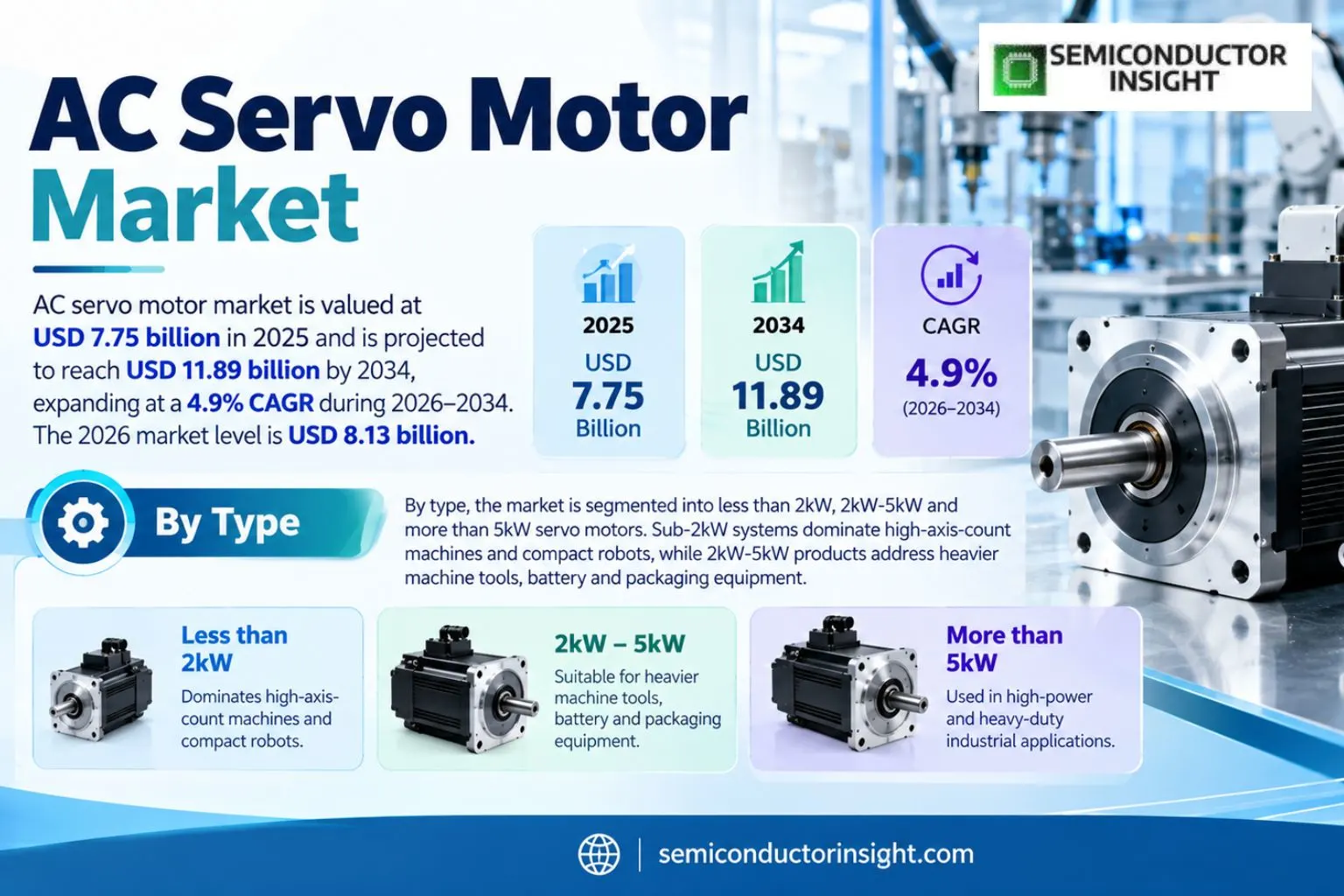
AC servo motor market is valued at USD 7.75 billion in 2025 and is projected to reach USD 11.89 billion by 2034, expanding at a 4.9% CAGR during 2026–2034. The 2026 market level is USD 8.13 billion. Asia Pacific leads the market through high robot density, machine-tool production, electronics assembly and semiconductor equipment demand. The installed global robot base reached 5 million units in 2025, reinforcing long-term demand for precise multi-axis motion.
AC servo motors are closed-loop electric motors designed for precise control of position, speed and torque. A complete servo axis combines the motor with an encoder or resolver, servo amplifier and motion controller. Compared with standard induction motors, servo systems deliver faster acceleration, lower inertia and tighter positioning, making them essential in robots, CNC machines, semiconductor tools, battery equipment and automated assembly where repeatability directly affects throughput and product quality.
The technology trend is toward higher encoder resolution, one-cable motor connections, faster control loops and software-assisted tuning. Yaskawa expanded its Sigma-X series with 400V-input models for larger equipment in 2025, while Siemens’ current SINAMICS S210 platform supports high-resolution feedback and modern industrial networking. Digital twins and virtual commissioning increasingly allow machine builders to size and validate servo axes before physical equipment is completed.
Commercial competition is based on total motion performance rather than motor hardware alone. Customers evaluate the matched motor-drive-controller platform, tuning tools, safety functions, network protocol, engineering software, local service and spare-parts continuity. Once a machine architecture is standardized around a servo family, switching cost becomes high because mechanical sizing, control code and commissioning processes are linked to the selected ecosystem.
Segment Analysis: By Type
By type, the market is segmented into less than 2kW, 2kW-5kW and more than 5kW servo motors. Sub-2kW systems dominate high-axis-count machines and compact robots, while 2kW-5kW products address heavier machine tools, battery and packaging equipment. Motors above 5kW are used where high torque and inertia must be controlled precisely in larger production equipment.
| Type | Commercial role |
|---|---|
| Less than 2KW | High-volume category for robotics, electronics assembly, packaging and compact machine tools. |
| 2KW-5KW | Mid-power axes for larger machine tools, battery equipment, printing and production machinery. |
| More than 5KW | High-torque precision motion for heavy machinery, large handling systems and specialized automation. |
Additional Segmentation: By End User
End-user demand is concentrated in automotive and EV manufacturing, electronics and semiconductor production, packaging and general machinery, and energy equipment. Each industry values different servo characteristics: automotive lines prioritize uptime and standardized platforms, semiconductor tools prioritize nanometer-class positioning and low vibration, while packaging machinery emphasizes very fast cycle rates and synchronized motion across multiple axes.
| End User | Demand characteristics |
|---|---|
| Automotive & EV Manufacturing | Body, battery, motor, welding and assembly automation with large robot fleets. |
| Electronics & Semiconductor | High-precision wafer handling, inspection, assembly and electronics production. |
| Packaging & General Machinery | High-speed synchronized axes, printing, labeling, pick-and-place and machine tools. |
| Energy Equipment | Solar, battery and power-equipment manufacturing requiring repeatable automated motion. |
Segment Analysis: By Application
By application, the market covers 3C machinery, machine tools, semiconductor manufacturing equipment, solar equipment, lithium-ion battery production, robots and other automation. Robots and semiconductor tools are the most strategic growth areas because they combine rising axis count with demanding response and precision. Battery and solar production add volume as new factories automate coating, handling, inspection and assembly processes.
| Application | Demand characteristics |
|---|---|
| 3C Machine | Consumer electronics assembly, dispensing, testing and precision handling. |
| Machine Tools | CNC feed axes, spindles and multi-axis machining centers. |
| Semiconductor Manufacturing Equipment | Wafer handling, lithography support, packaging, inspection and automation. |
| Solar Power Generation Equipment | Cell and module manufacturing machinery. |
| Lithium Ion Battery Manufacturing Equipment | Coating, winding, stacking, formation and pack-assembly automation. |
| Robots | Industrial, collaborative and specialized robots requiring precise joint control. |
| Others | Printing, textile, food, medical and general-purpose production machinery. |
Additional Segmentation: By Feedback Technology
Feedback technology directly affects servo accuracy, startup behavior and system cost. Incremental encoders remain cost-effective for many machine axes, absolute encoders retain position through power cycles and simplify homing, while resolvers and specialized feedback devices remain relevant in harsh environments. High-resolution absolute encoders are increasingly standard in premium servo platforms because they support better low-speed control and more accurate positioning.
| Feedback Technology | Commercial relevance |
|---|---|
| Incremental Encoder | Cost-effective position and speed feedback for mainstream automation. |
| Absolute Encoder | High-resolution single-turn or multi-turn feedback that retains axis position. |
| Resolver / Other Feedback | Robust feedback for harsh environments or specialized machine architectures. |
Regional Analysis
Asia Pacific is the largest and fastest-growth region because China, Japan and South Korea lead robot deployment, machine building and electronics production. Europe remains strong in premium machine tools and automotive automation, while North America is benefiting from reshoring, warehouse automation and semiconductor investment. Other regions expand through localized industrial modernization.
Why does regional demand differ across the AC Servo Motor market?
Regional demand closely tracks robot installations, machine-tool production and semiconductor equipment investment. IFR reported that Asia accounted for most global robot installations, with China alone representing a very large share. Europe remains engineering-intensive, while North America provides high-value automation demand linked to new factories and productivity investment. For commercial decisions in the AC Servo Motor market, buyers also weigh qualification evidence, integration effort, operating reliability, lifecycle support, supply continuity and measurable system-level value rather than a single specification.
| Region | Position | Demand profile | Supplier-selection factor |
|---|---|---|---|
| Asia Pacific | Largest / fastest | Robotics, electronics, machine tools | Scale and local machine builders |
| North America | High-value | Automotive, semiconductor, logistics | Reshoring and productivity investment |
| Europe | Strategic | Machine tools, automotive, packaging | Precision engineering and lifecycle |
| South America | Emerging | Automotive, food, mining | Capital spending and service |
| Middle East & Africa | Emerging | Packaging, logistics, industrial | Greenfield automation |
Competitive Landscape
Yaskawa, Mitsubishi Electric, FANUC, Siemens, Rockwell Automation, Panasonic, Delta, Inovance and other motion-control suppliers compete through motor-drive matching, encoder performance, controller integration and engineering software. Established leaders benefit from global service networks and installed-machine bases that create recurring demand for compatible replacement and expansion axes. For commercial decisions in the AC Servo Motor market, buyers also weigh qualification evidence, integration effort, operating reliability, lifecycle support, supply continuity and measurable system-level value rather than a single specification.
Yaskawa’s Sigma-X platform illustrates the shift toward higher motion performance and digital machine data, while Siemens combines servo hardware with TIA engineering and virtual commissioning. Chinese suppliers such as Inovance are strengthening their position by offering cost-competitive motion platforms backed by growing domestic automation demand. For commercial decisions in the AC Servo Motor market, buyers also weigh qualification evidence, integration effort, operating reliability, lifecycle support, supply continuity and measurable system-level value rather than a single specification.
The market is moderately consolidated at the top but fragmented across regional machine builders and specialty motion vendors. Competitive advantage increasingly depends on software, autotuning, safety, communication standards and engineering productivity rather than only torque density. This favors suppliers that can support the full automation architecture from controller through drive and motor.
| Competitive tier | Representative companies | Primary differentiation |
|---|---|---|
| Global motion-control leaders | Yaskawa, Mitsubishi Electric, Siemens, FANUC | Integrated servo platforms, controllers, engineering software and global support. |
| Automation platform suppliers | Rockwell Automation, Panasonic, Omron | Motion integrated with PLC, networking and machine automation ecosystems. |
| Asia growth challengers | Inovance, Delta, Estun and regional vendors | Cost-competitive servo systems and strong local machine-builder access. |
Key companies profiled
Yaskawa Electric, Mitsubishi Electric, FANUC, Siemens, Rockwell Automation, Panasonic, Omron, Delta Electronics, Inovance, Estun and other motion-control suppliers form the principal competitive set. Their positions vary by power range, controller ecosystem, geographic strength and application specialization, making machine-builder design wins a critical route to long-term market share. For commercial decisions in the AC Servo Motor market, buyers also weigh qualification evidence, integration effort, operating reliability, lifecycle support, supply continuity and measurable system-level value rather than a single specification.
Production Capacity Analysis
Servo production requires precision stator winding, permanent magnets, rotors, encoders, bearings, housings, power semiconductors and servo-drive electronics. Capacity can be constrained by magnets, semiconductor components or high-resolution encoder supply even when final assembly lines have headroom. Quality control must also maintain low vibration, electrical consistency and repeatable torque characteristics. For commercial decisions in the AC Servo Motor market, buyers also weigh qualification evidence, integration effort, operating reliability, lifecycle support, supply continuity and measurable system-level value rather than a single specification.
Production is increasingly regionalized because machine builders expect short lead times and technical support. Major suppliers operate factories and application centers across Asia, Europe and the Americas, while controller and drive electronics depend on global semiconductor supply. High-mix portfolios require flexible manufacturing because customers order many frame sizes, voltage classes, brakes, shafts and encoder options.
Market Dynamics
The market expands with industrial robots, smart factories, semiconductor equipment, battery manufacturing and high-speed machinery. Growth is restrained by capital-investment cycles, component supply risk and the cost of premium closed-loop motion. Digital twins, predictive maintenance, compact 400V systems and higher encoder resolution create the strongest opportunities for differentiated growth. For commercial decisions in the AC Servo Motor market, buyers also weigh qualification evidence, integration effort, operating reliability, lifecycle support, supply continuity and measurable system-level value rather than a single specification.
Market Drivers
| Driver | Impact | Commercial mechanism |
|---|---|---|
| Industrial robotics | High | Every robot joint requires precision closed-loop motion. |
| Semiconductor and electronics equipment | High | Precision tools require low vibration and exact positioning. |
| Battery and EV factories | Medium-High | New lines automate winding, stacking, assembly and vehicle production. |
| Software-defined motion | Medium | Virtual commissioning and data tools reduce machine engineering time. |
Industrial robotics
The global industrial robot base reached 5 million units in 2025. Each multi-axis robot contains several servo motors and drives, creating recurring demand for compact, high-response systems as robot installations grow and older fleets are upgraded. For commercial decisions in the AC Servo Motor market, buyers also weigh qualification evidence, integration effort, operating reliability, lifecycle support, supply continuity and measurable system-level value rather than a single specification.
Semiconductor and electronics equipment
Wafer handling, assembly and inspection require fast settling and repeatable position control. Rising semiconductor investment increases the installed base of high-value servo axes that often use absolute encoders and sophisticated tuning. For commercial decisions in the AC Servo Motor market, buyers also weigh qualification evidence, integration effort, operating reliability, lifecycle support, supply continuity and measurable system-level value rather than a single specification.
Battery and EV factories
Battery plants and EV factories use robots, conveyors, presses and synchronized machinery. Servo systems provide the precise acceleration and force control needed to raise throughput while maintaining process consistency. For commercial decisions in the AC Servo Motor market, buyers also weigh qualification evidence, integration effort, operating reliability, lifecycle support, supply continuity and measurable system-level value rather than a single specification.
Software-defined motion
Modern motion platforms expose diagnostics, digital twins and parameter data that allow machine builders to simulate, tune and maintain axes more efficiently. Engineering productivity becomes a measurable part of the servo-system value proposition. For commercial decisions in the AC Servo Motor market, buyers also weigh qualification evidence, integration effort, operating reliability, lifecycle support, supply continuity and measurable system-level value rather than a single specification.
Market Restraints
| Restraint | Impact | Commercial consequence |
|---|---|---|
| Capital spending cycles | High | Servo demand depends on new machinery and automation projects. |
| Component supply risk | Medium-High | Magnets, semiconductors and encoders can constrain deliveries. |
| Premium system cost | Medium | Closed-loop servo systems cost more than simple motors and drives. |
| Engineering lock-in | Medium | Changing servo platforms requires machine redesign and revalidation. |
Capital spending cycles
Machine builders and manufacturers delay automation investment during weak industrial cycles. Although replacement demand provides stability, large servo orders are still linked to factory expansions, robot installations and equipment spending. For commercial decisions in the AC Servo Motor market, buyers also weigh qualification evidence, integration effort, operating reliability, lifecycle support, supply continuity and measurable system-level value rather than a single specification.
Component supply risk
Servo systems depend on specialized magnets, high-resolution feedback devices and power electronics. Supply disruptions can extend lead times and force machine builders to qualify alternative frame sizes or suppliers. For commercial decisions in the AC Servo Motor market, buyers also weigh qualification evidence, integration effort, operating reliability, lifecycle support, supply continuity and measurable system-level value rather than a single specification.
Premium system cost
Applications that do not require precise position or high dynamics can use induction motors, steppers or simpler variable-frequency drives. Servo adoption therefore requires a clear productivity or quality benefit. For commercial decisions in the AC Servo Motor market, buyers also weigh qualification evidence, integration effort, operating reliability, lifecycle support, supply continuity and measurable system-level value rather than a single specification.
Engineering lock-in
Motor dimensions, drive parameters, safety functions and controller code are tightly integrated. This creates strong incumbent positions but also slows customer migration to new platforms or lower-cost suppliers. For commercial decisions in the AC Servo Motor market, buyers also weigh qualification evidence, integration effort, operating reliability, lifecycle support, supply continuity and measurable system-level value rather than a single specification.
Market Opportunities
AI-enabled tuning
Servo drives can use machine data to recommend gains, detect mechanical changes and reduce commissioning time, improving machine-builder productivity. For commercial decisions in the AC Servo Motor market, buyers also weigh qualification evidence, integration effort, operating reliability, lifecycle support, supply continuity and measurable system-level value rather than a single specification.
Semiconductor equipment
Advanced packaging, inspection and wafer handling need more precise axes as dimensions shrink and throughput targets rise. For commercial decisions in the AC Servo Motor market, buyers also weigh qualification evidence, integration effort, operating reliability, lifecycle support, supply continuity and measurable system-level value rather than a single specification. For commercial decisions in the AC Servo Motor market, buyers also weigh qualification evidence, integration effort, operating reliability, lifecycle support, supply continuity and measurable system-level value rather than a single specification.
Collaborative and mobile robotics
Compact low-inertia servos can expand in smaller robots, autonomous systems and flexible manufacturing cells. For commercial decisions in the AC Servo Motor market, buyers also weigh qualification evidence, integration effort, operating reliability, lifecycle support, supply continuity and measurable system-level value rather than a single specification. For commercial decisions in the AC Servo Motor market, buyers also weigh qualification evidence, integration effort, operating reliability, lifecycle support, supply continuity and measurable system-level value rather than a single specification.
Energy-efficient machinery
Regenerative drives and optimized motion profiles can reduce energy use in high-cycle machinery, creating a stronger lifecycle cost case. For commercial decisions in the AC Servo Motor market, buyers also weigh qualification evidence, integration effort, operating reliability, lifecycle support, supply continuity and measurable system-level value rather than a single specification.
Supply Chain Analysis
Materials and components. Copper, electrical steel, permanent magnets, bearings, encoder components and power semiconductors form the upstream base. Servo performance depends on low rotor inertia, magnetic consistency and accurate feedback, making component quality critical. For commercial decisions in the AC Servo Motor market, buyers also weigh qualification evidence, integration effort, operating reliability, lifecycle support, supply continuity and measurable system-level value rather than a single specification.
Manufacturing. Motor winding, rotor balancing, encoder assembly and servo-drive electronics are produced and tested as matched platforms. Suppliers verify torque, vibration, thermal rise and feedback accuracy across many frame and power variants. For commercial decisions in the AC Servo Motor market, buyers also weigh qualification evidence, integration effort, operating reliability, lifecycle support, supply continuity and measurable system-level value rather than a single specification.
Machine integration. OEMs size axes, configure gearing, tune control loops and program synchronized motion. Engineering software and virtual commissioning increasingly reduce the time needed to bring a machine into production. For commercial decisions in the AC Servo Motor market, buyers also weigh qualification evidence, integration effort, operating reliability, lifecycle support, supply continuity and measurable system-level value rather than a single specification.
Deployment. Servo systems operate in robots, machine tools, semiconductor equipment, battery lines and packaging systems. Predictive diagnostics and global service networks help users maintain high machine availability over long equipment lifecycles. For commercial decisions in the AC Servo Motor market, buyers also weigh qualification evidence, integration effort, operating reliability, lifecycle support, supply continuity and measurable system-level value rather than a single specification.
Recent Developments in the AC Servo Motor Market
Developments tracked through September 2026 and limited to events that materially affect technology, capacity, adoption or competition.
- 24 September 2026
The International Federation of Robotics reported that global operational stock reached 5 million industrial robots in 2025 and annual installations exceeded 600,000 units, reinforcing the long-term motion-control demand base. Source - 19 May 2025
Yaskawa announced 400V-input Sigma-X servo motors and SERVOPACK amplifiers for larger equipment and broader global deployment, extending its flagship motion platform in Europe and Asian markets. Source - February 2026
Siemens’ 2026 motion-control catalog continued the SINAMICS S210 platform across 0.1kW to 7kW, including modern industrial networking and one-cable motor connections for precision machine applications. Source
Report Scope & Segmentation
| Attribute | Scope |
|---|---|
| Base year | 2025 |
| Estimated year | 2026 |
| Forecast period | 2026–2034 |
| 2025 market size | USD 7.75 billion |
| 2026 estimated size | USD 8.13 billion |
| 2034 projected size | USD 11.89 billion |
| CAGR (2026–2034) | 4.9% |
| Largest market in 2025 | Asia Pacific |
| By Type | Less than 2KW; 2KW-5KW; More than 5KW |
| By Application | 3C Machine; Machine Tools; Semiconductor Manufacturing Equipment; Solar Power Generation Equipment; Lithium Ion Battery Manufacturing Equipment; Robots; Others |
| By End User | Automotive & EV Manufacturing; Electronics & Semiconductor; Packaging & General Machinery; Energy Equipment |
| By Feedback Technology | Incremental Encoder; Absolute Encoder; Resolver/Other Feedback |
| Companies profiled | Yaskawa; Mitsubishi Electric; FANUC; Siemens; Rockwell Automation; Panasonic; Omron; Delta; Inovance; Estun and other motion-control suppliers |
Frequently Asked Questions
What is the AC servo motor market size in 2025?
The global AC servo motor market is valued at USD 7.75 billion in 2025 across robotics, machine tools, electronics and other precision automation.
What is the market forecast for 2034?
The market is projected to reach USD 11.89 billion by 2034, representing a 4.9% CAGR during 2026–2034. The 2026 market level is USD 8.13 billion.
Which region leads the market?
Asia Pacific leads through China, Japan and South Korea, where robot installations, machine building and electronics manufacturing are highly concentrated.
Which power range is largest?
Less-than-2kW servo motors represent the largest volume segment because compact automation and robots use many low- and medium-power axes.
Which applications are growing fastest?
Robotics, semiconductor manufacturing equipment and lithium-ion battery machinery are among the strongest value-growth applications.
Why are absolute encoders important?
Absolute encoders retain axis position and provide high-resolution feedback, reducing homing time and improving precision in demanding machines.
Who are the major suppliers?
Yaskawa, Mitsubishi Electric, FANUC, Siemens, Rockwell Automation, Panasonic, Omron, Delta and Inovance are major participants.
How does robotics affect demand?
Industrial robots typically use several servo axes, so rising installations and a growing installed robot base directly increase motor and drive demand.
What limits market growth?
Capital-spending cycles, component supply constraints, system cost and the engineering effort needed to change servo platforms are key restraints.
What will drive growth through 2034?
Robotics, semiconductor equipment, EV and battery factories, software-defined motion and energy-efficient machinery will support market expansion.
Research Sources & Evidence Base
View research sources used in this market overview
- International Federation of Robotics — World Robotics 2026 release. 2025 global robot stock and installation evidence.
- Yaskawa Electric — Sigma-X 400V Input Models. Servo product roadmap and larger-equipment expansion.
- Siemens — Motion Control Drives Catalog D 32, February 2026. SINAMICS S210 power range, interfaces and motor ecosystem.
Get Sample Report PDF for Exclusive Insights
Report Sample Includes
- Table of Contents
- List of Tables & Figures
- Charts, Research Methodology, and more...
 Download Sample Report PDF