Key Statistics
Key Takeaways
- DC electronic loads are the leading source-defined type because batteries, power supplies, PV systems, converters and telecom equipment are predominantly tested on DC buses. AC electronic loads remain important for grid-interactive equipment, UPS, inverter and appliance validation.
- Electronic manufacturing is the largest application, while new-energy and automotive testing are the strongest structural growth areas because high-voltage batteries, charging systems and renewable converters require dynamic, programmable and increasingly regenerative load profiles.
- Asia Pacific is the largest market because electronics, batteries, power supplies and test-equipment manufacturing are concentrated in China, Japan, Taiwan and South Korea. North America remains a premium test-and-measurement market with strong R&D and EV, aerospace and data-center validation demand.
- Regeneration is the key technology shift. Instead of dissipating high test power as heat, regenerative loads return absorbed energy to the local grid or facility, reducing cooling needs and improving the economics of multi-kilowatt and megawatt-class battery or power-converter testing.
- The main restraint is capital intensity at high power. High-voltage regenerative systems need grid interfaces, protection, calibration and integration expertise. For lower-power production tests, simpler non-regenerative loads remain adequate and less expensive.
- The opportunity is in scalable automated test systems. Vendors that combine modular power hardware, fast transient response, waveform programming, communications and software automation can serve EV, energy storage, server power, renewable energy and semiconductor test with one configurable platform.
Electronic Load Device Market Overview
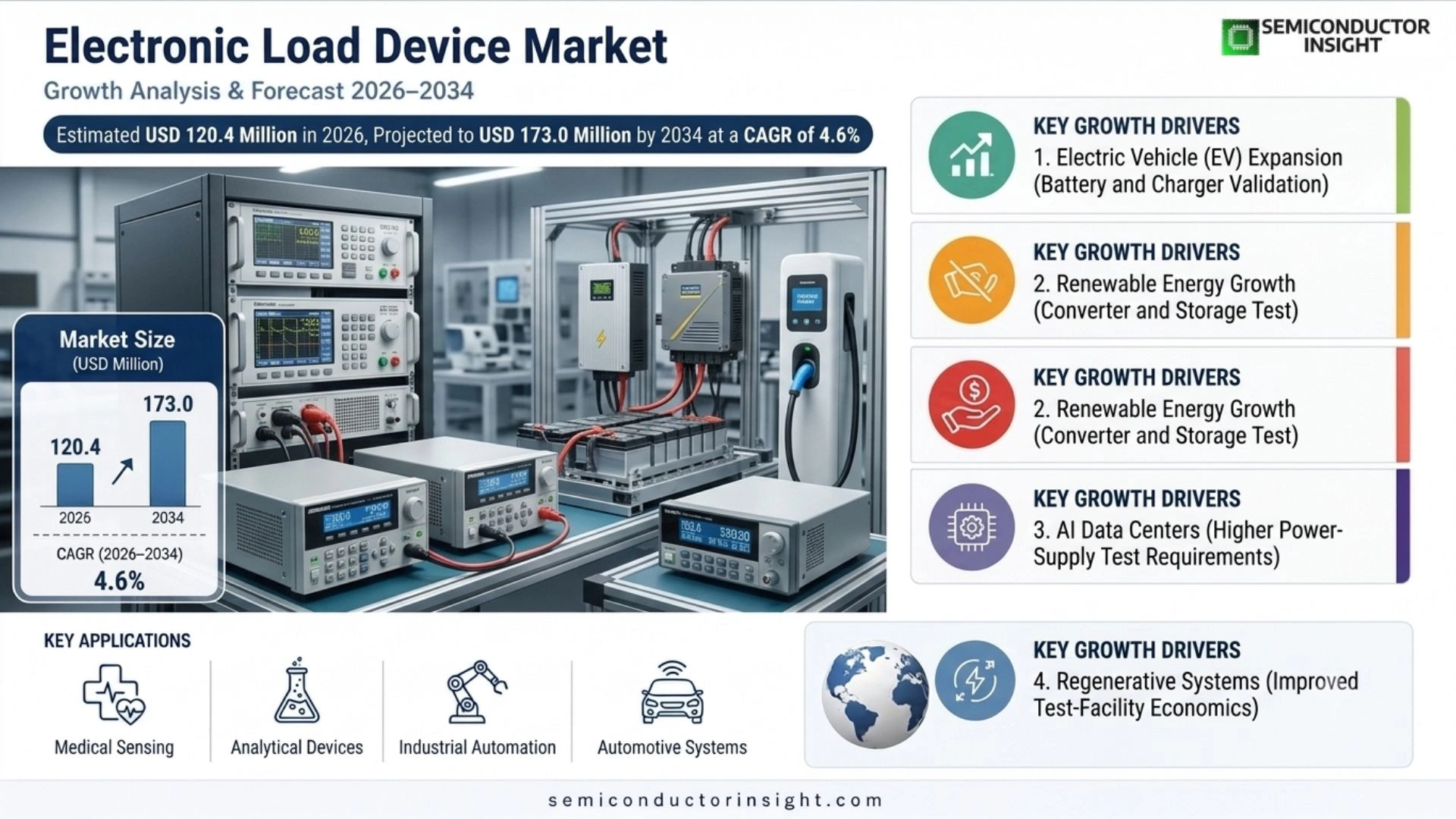
Electronic Load Device Market was valued at USD 115.1 million in 2025, is estimated at USD 120.4 million in 2026, and is projected to reach USD 173.0 million by 2034, representing an anchor-derived CAGR of 4.6% during 2026–2034. Asia Pacific is the largest regional market in 2025 on the controlling report scope, while the commercial growth mechanism is increasingly shaped by EV and battery validation, renewable power testing, data-center power electronics, higher-voltage DC systems and the shift toward regenerative test equipment.
Electronic load devices are programmable instruments that absorb electrical power while controlling current, voltage, resistance or power to emulate the behavior of a real load. They are used to validate power supplies, batteries, chargers, converters, solar equipment and other energy-producing devices. Modern loads rely on power semiconductors and digital control rather than a simple resistive element, enabling repeatable dynamic profiles, automated test sequences and protection functions.
The source market is segmented by type into DC and AC electronic loads, with applications in electronic manufacturing, new energy, communications and other industries. Additional scope distinguishes low-, medium- and high-power ratings and end users across industrial, commercial, government/defense and research markets. These axes matter commercially because a 300 W benchtop load and a 100 kW regenerative battery system address very different procurement, cooling and infrastructure requirements.
Current product roadmaps show a clear move toward higher power density and regeneration. Keysight’s EL4936A is a 6 kW regenerative DC electronic load in a 1U form factor. Kikusui’s PXZ family supports high-capacity regenerative testing and parallel operation to hundreds of kilowatts, while ITECH’s IT6000B combines bidirectional power supply and regenerative electronic load functions and scales to megawatt-class systems. These architectures reduce the heat that conventional loads dump into test facilities.
Demand expands with the number and complexity of power-electronic systems being developed. The IEA reported more than 20 million electric cars sold globally in 2025 and record renewable capacity additions of roughly 800 GW. Both trends increase testing of battery packs, on-board chargers, inverters, DC-DC converters, charging infrastructure, solar systems and energy-storage hardware, creating more use cases for programmable loads with wide voltage ranges and automated profiles.
Segment Analysis: By Type
By type, the source segments the market into DC and AC electronic loads. DC is the leading category because most battery, power-supply, telecom, semiconductor and renewable-energy development occurs on DC buses. AC loads are important where engineers must emulate grid-connected or alternating-current equipment, including UPS, inverters, generators and appliances. Regenerative capability is becoming more important in both high-power test environments.
| Type | Technical role | Market position |
|---|---|---|
| DC | DC electronic loads sink current from power supplies, batteries, fuel cells, solar simulators, converters and other DC sources while controlling constant-current, constant-voltage, constant-resistance or constant-power modes. Advanced systems add fast dynamic profiles, arbitrary I-V behavior, battery discharge testing, short-circuit emulation and parallel operation. They range from benchtop hundreds-of-watt units to regenerative systems above 100 kW. | Leading source-defined type. The addressable application base is broad because most electronics and battery systems expose DC rails during development and production. Growth is strongest at high voltage and high power as EV batteries, charging equipment, energy storage and server power systems expand. Suppliers differentiate on accuracy, slew rate, low-voltage operation, regeneration, channel density and test automation. |
| AC | AC electronic loads emulate alternating-current demand for inverters, UPS systems, generators, grid-connected converters and appliances. They can reproduce power factor, nonlinear current waveforms and dynamic load changes that are difficult to simulate with passive resistor banks. In advanced energy labs they are used alongside AC sources and power analyzers to validate conversion efficiency and grid behavior. | A smaller but strategically important segment. AC loads benefit from renewable-energy, microgrid, UPS and power-quality testing, particularly when products must operate across multiple grid conditions. The market requires strong measurement synchronization, waveform control and safety. Regenerative AC architectures are attractive at high power because they reduce heat dissipation during long-duration test cycles. |
Regenerative architecture is redefining high-power electronic loads
Traditional electronic loads convert the energy they absorb into heat, which means a 100 kW test can also become a 100 kW cooling problem. Regenerative systems instead convert absorbed DC power back to usable AC power for the facility. The economics improve as test power and duty cycle increase. This is why regeneration is most compelling for EV batteries, energy storage, inverters and high-power converter validation rather than low-cost benchtop production tests.
Segment Analysis: By Application
By application, the source segments demand into Electronic Manufacturing Industry, New Energy Field, Communication Industry and Others. Electronic manufacturing remains the largest because every power supply or powered subsystem requires design validation and production test. New-energy applications are increasing in importance as EV batteries, charging systems, solar, wind and stationary storage push voltage, power and test duration upward.
| Application | Demand characteristics |
|---|---|
| Electronic Manufacturing Industry | Largest application. Power supply, adapter, server, consumer-electronics and component factories use electronic loads for R&D, quality assurance and automated production testing. Buyers need repeatability, fast interfaces and integration with ATE software. High channel density and cost per test point matter in mass production, while R&D labs prioritize flexibility, dynamic modes and measurement accuracy. |
| New Energy Field | Battery cells, modules and packs, photovoltaic equipment, fuel cells, inverters and stationary storage require programmable load profiles over wide voltage and power ranges. Long-duration cycling makes regenerative architectures particularly attractive because energy can be returned instead of dissipated as heat. Growth in EV and renewable deployment therefore translates into demand for higher-power, bidirectional and more automated test systems. |
| Communication Industry | Telecom rectifiers, base-station power units, data-center power shelves and backup systems require validation under dynamic and fault conditions. Electronic loads emulate changing network demand and can verify transient response, current limiting and redundancy. As AI data centers adopt higher rack power and distributed DC architectures, suppliers can expand into server and power-delivery validation beyond traditional telecom equipment. |
| Others | Aerospace, defense, research, education, rail, industrial drives and semiconductor labs use electronic loads for specialized test. These applications are smaller in volume but can require high voltage, isolated interfaces, calibration traceability or unusual dynamic waveforms. Vendors with modular hardware and programmable software can address these niches without creating entirely separate product platforms. |
Power rating and end-user mix determine the commercial model
The source divides power into below 100 W, 100 W–10 kW and above 10 kW, with the middle range described as the largest because it covers a wide span of R&D and production uses. Industrial customers dominate end-user demand, while government, defense and research buyers support premium specialized systems. Above 10 kW, procurement shifts toward facility engineering, grid connection, cooling and safety, making systems integration a larger share of the sale.
Regional Analysis
Asia Pacific is the largest electronic load device market because it combines electronics manufacturing, battery production, renewable-energy equipment, EV supply chains and several important test-equipment vendors. North America is a premium R&D and automated-test market, Europe is driven by automotive electrification and renewable power, and other regions are more dependent on imported systems tied to infrastructure projects.
Why does electronic-load demand follow manufacturing and power-system development?
Electronic loads are capital tools purchased where engineers design, validate or mass-produce power hardware. A region can therefore have strong end-market energy demand without equally strong test-equipment demand if products are engineered elsewhere. Asia leads through manufacturing scale, while North America and Europe generate high-value demand through R&D, automotive and compliance-intensive systems. Regenerative equipment becomes particularly attractive where electricity and cooling costs are material.
| Region | Position | Growth outlook | Demand profile | What decides supplier selection |
|---|---|---|---|---|
| Asia Pacific | Largest | High | Electronics + batteries + EVs + renewables | Price/performance, local service, automation software and high-power availability |
| North America | Premium technology market | Moderate-high | R&D + EV + aerospace + data centers | Accuracy, automation, calibration, regeneration and system integration |
| Europe | Electrification-driven | Moderate-high | Automotive + renewable power + industrial | Energy efficiency, safety, compliance and regenerative capability |
| South America | Emerging | Moderate | Renewables + automotive + industrial labs | Imported equipment cost, support and financing |
| Middle East & Africa | Project-led | Selective | Solar + data centers + telecom + research | High-voltage capability, service network and turnkey integration |
Competitive Landscape
The source profiles Keysight Technologies, National Instruments, Kikusui Electronics, GW Instek, TDK-Lambda, ITECH, Shenzhen Maynuo Electronic, Nanjing Maynuo Electronics, Goodwill Instruments and Changzhou Dingchen Electronics. Competition is segmented between premium precision test-and-measurement brands, Japanese and Taiwanese electronic-load specialists, and cost-competitive Chinese suppliers. Product differentiation increases sharply with voltage, power, regeneration and automation complexity.
Keysight competes at the premium end through tightly integrated measurement, automation and regenerative power-test systems. National Instruments contributes modular test and software integration, especially where electronic loads are part of a broader automated validation rack. Kikusui has a broad dedicated electronic-load portfolio spanning benchtop, high-voltage and regenerative systems and benefits from deep power-electronics test expertise in Japan and Asia.
GW Instek addresses both compact and high-power programmable loads, including systems that can be paralleled for large battery, EV charger and solar testing. ITECH has expanded aggressively into bidirectional and regenerative platforms using modern power-semiconductor technology, giving Chinese suppliers a route into higher-value applications historically dominated by Japanese, U.S. and European brands. Maynuo and other regional vendors compete strongly where purchase price and local availability dominate.
Software and system integration are increasingly important. Customers want automated sequences, data logging, Ethernet or fieldbus interfaces, battery profiles and synchronization with power supplies, scopes and power analyzers. A vendor that exposes reliable APIs and integrates with common ATE environments can remain embedded in a customer’s test architecture for years, creating switching costs beyond the hardware specification.
Service networks also matter because calibration and uptime affect production and engineering schedules. A lower-cost load can be expensive if repair requires international shipment or if calibration data does not satisfy customer quality systems. Premium suppliers defend share through support, traceability and system engineering, while regional competitors gain ground when they build local service capability and deliver comparable automation features.
| Competitive tier | Representative companies | Commercial basis |
|---|---|---|
| Premium precision / automated test | Keysight Technologies; National Instruments | Compete on measurement accuracy, software integration, calibration, ATE architecture and high-value R&D or production validation. |
| Specialist electronic-load and power-test leaders | Kikusui Electronics; GW Instek; TDK-Lambda; ITECH | Compete on breadth of DC/AC products, high-voltage/high-power capability, regeneration, modular scaling and application engineering. |
| Regional cost-competitive suppliers | Shenzhen Maynuo Electronic; Nanjing Maynuo Electronics; Goodwill Instruments; Changzhou Dingchen Electronics | Compete on price, availability and fit-for-purpose performance in general electronics manufacturing and local industrial markets. |
Companies profiled in the source scope
Keysight Technologies, National Instruments, Kikusui Electronics Corporation, GW Instek, TDK-Lambda, ITECH Electronics, Shenzhen Maynuo Electronic, Nanjing Maynuo Electronics, Goodwill Instruments, Changzhou Dingchen Electronics.
Production Capacity Analysis
Electronic-load production capacity is less constrained by specialized raw materials than by power-electronics design, calibration, thermal engineering and manufacturing quality. High-power products require large semiconductor switch assemblies, magnetics, cooling systems, grid interfaces and protection. Regenerative systems add bidirectional power conversion and compliance requirements, making engineering capability and test infrastructure more important barriers than factory floor space alone.
Asia-Pacific contains a large share of global electronic-instrument and power-electronics manufacturing, including Japanese, Taiwanese and Chinese suppliers. North American and European brands may design and assemble premium systems locally or through global supply networks, but they rely on worldwide semiconductor, magnetics, connector and enclosure supply. This makes component availability important, particularly for high-current power modules and precision measurement electronics.
Scaling a 500 W bench load is fundamentally different from scaling a 500 kW regenerative rack. High-power systems require parallel power stages, busbars, liquid or forced-air cooling, isolation, contactors and grid-interconnection hardware. Production volume may be lower, but each system has higher engineering content. Vendors can therefore expand revenue without building consumer-electronics-like unit capacity if they move into high-power integrated test systems.
Calibration and final test are important capacity constraints. Every channel must meet accuracy, protection and dynamic-response specifications across temperature and power. Regenerative products must also verify grid behavior and safety. As systems scale, burn-in and full-power testing consume significant facility energy and infrastructure, giving established suppliers with dedicated high-power test labs an advantage over entrants with only assembly capability.
| Capacity layer | Where it concentrates | Commercial constraint |
|---|---|---|
| Power semiconductor and control electronics | Global, with strong Asia supply | Switching devices, current sensors, ADCs, controllers and isolated interfaces determine efficiency, accuracy and response; high-power models increasingly benefit from SiC. |
| Instrument assembly | Japan, Taiwan, China, U.S. and other test-equipment hubs | Thermal design, wiring, protection and repeatable build quality become harder as voltage and current rise. |
| Calibration / full-power validation | Specialized factory labs and service centers | High-power test infrastructure, traceable standards and grid interfaces can limit throughput more than mechanical assembly. |
| Regional service / integration | Distributor and vendor networks near customers | Commissioning, calibration, repair and automation support determine practical capacity to serve production and R&D customers. |
Market Dynamics
Market growth is driven by the electrification of transport and energy systems, increasing power density in data centers and electronics, and a shift from dissipative to regenerative testing. The market is restrained by the high purchase and facility-integration cost of large systems, while lower-power applications remain highly price competitive. The strongest vendors turn these pressures into modular product families that scale from bench validation to automated high-power test racks.
Market Drivers
| Factor | Directional impact | Why it matters |
|---|---|---|
| EV and battery testing | High | Growing battery and charging-system development increases demand for programmable high-voltage DC loads and bidirectional systems. |
| Renewable power conversion | High | Solar, wind and storage deployment expands inverter, converter and storage-system validation. |
| Data-center and telecom power density | Medium-High | Higher rack power and more complex DC architectures increase power-supply and backup-system test requirements. |
| Regenerative test economics | Medium-High | Returning absorbed energy reduces heat and facility operating cost during long high-power test cycles. |
EV scale expands battery and charger validation
IEA data show electric-car sales exceeded 20 million globally in 2025. Every platform requires development and production testing of battery packs, onboard chargers, DC-DC converters, traction inverters and charging systems. Electronic loads provide repeatable current and power profiles, while regenerative systems become increasingly valuable as pack voltages and test powers rise.
Renewable growth increases converter and storage test
Record solar and wind additions mean more inverters, DC optimizers, storage systems and grid-control hardware must be validated. Electronic loads can emulate downstream demand, battery discharge or DC bus behavior during development. The opportunity spans component R&D, manufacturing and field service, with high-power regenerative systems particularly relevant to long-duration storage and inverter testing.
AI data centers raise power-supply test requirements
Server racks and network systems are moving toward higher power density and more complex power-delivery architectures. Engineers need to test transient response, redundancy, current sharing, protection and efficiency across power shelves and converters. Compact rack-mount loads with fast digital control fit naturally into automated data-center hardware validation and can be paralleled as rack power increases.
Regeneration improves test-facility economics
At high duty cycles, a conventional electronic load turns valuable electricity into heat and forces the HVAC system to remove it. Regenerative loads can return much of that energy to the facility, lowering both electrical and cooling costs. The lifecycle savings are most compelling in battery cycling, power-converter burn-in and other tests that operate near rated power for long periods.
Market Restraints
| Factor | Directional impact | Why it matters |
|---|---|---|
| High initial cost | High | Regenerative, high-voltage and high-power systems require expensive power stages, protection and measurement hardware. |
| Facility integration | Medium-High | Large systems need grid connection, cooling, safety interlocks and sometimes specialized power distribution before they can operate. |
| Price competition at low power | Medium-High | Benchtop DC loads are mature and crowded, limiting margins where advanced regeneration or precision is unnecessary. |
| Calibration and service requirements | Medium | Production and regulated users need traceability and uptime, increasing lifecycle support obligations for suppliers. |
High-power regeneration requires significant capital
A regenerative load contains bidirectional power conversion, grid protection, precision measurement and high-current thermal hardware. Purchase prices can therefore be far above simple dissipative loads. Customers need enough annual test energy or productivity benefit to justify the investment. This limits adoption in small laboratories even when the technology is technically superior.
The facility can become part of the instrument installation
A multi-hundred-kilowatt electronic load needs appropriate mains capacity, breakers, contactors, grounding, cooling and safety controls. Regenerative operation may require site-specific review of how returned energy is handled. These infrastructure requirements lengthen sales cycles and increase the value of application engineering, but they also prevent plug-and-play adoption in many existing labs.
Low-power products face commoditization
For routine power-supply production tests, a mature non-regenerative DC load may be sufficient. Chinese and Taiwanese suppliers offer broad ranges of programmable benchtop equipment, creating price pressure. Premium vendors must therefore justify higher prices through accuracy, channel density, automation software, service or specialized performance rather than rely on the basic load function.
Calibration and downtime can outweigh purchase price
An electronic load is a measurement and control instrument, so drift or protection failures can invalidate test results or stop a production line. Customers in aerospace, defense and quality-controlled manufacturing require traceable calibration and responsive service. Vendors without local support can lose high-value business even when their hardware specification is competitive.
Market Opportunities
Megawatt-class battery and storage test
Grid-scale batteries, heavy vehicles and large energy-storage systems require test power far above traditional benchtop instruments. Modular regenerative racks can scale into hundreds of kilowatts or megawatts while returning energy to the facility. This creates a systems business involving power hardware, safety, cooling, software and commissioning rather than a simple instrument sale.
Bidirectional source/load platforms
Many applications need both sourcing and sinking: a battery emulator powers a device in one step and absorbs returned energy in another. Combining programmable supply and regenerative load functions reduces rack complexity and improves test flexibility. Vendors such as ITECH are explicitly pursuing this architecture, and the model is likely to spread across EV, storage and converter validation.
High-density ATE for server and power electronics
Compact regenerative loads can increase test power per rack while lowering heat generation. That is valuable in server, telecom and semiconductor power labs where floor space and cooling are expensive. Integrating waveform generation, data logging and remote APIs creates recurring opportunities for automated test racks that can be replicated across multiple engineering and manufacturing sites.
Software-defined test workflows
Electronic loads increasingly operate as nodes in automated systems rather than manually adjusted instruments. Vendors can differentiate through APIs, sequencing, battery profiles, remote dashboards and integration with measurement platforms. Software makes a modular hardware family more reusable across industries and creates customer switching costs that can protect margins in an otherwise competitive hardware market.
Supply Chain Analysis
Semiconductors and power components. The first stage determines efficiency, voltage range and thermal design. Low-power loads can use conventional silicon MOSFETs, while high-voltage regenerative systems increasingly benefit from wide-bandgap devices such as SiC. Precision current sensors, isolation, ADCs and digital controllers determine measurement quality. Component quality matters because a failure can damage both the instrument and expensive equipment under test.
Instrument design and manufacturing. Manufacturers combine the power stage with cooling, protection, firmware and user interfaces. The design challenge is to maintain stable control across different DUT behaviors and modes while preventing oscillation or unsafe transients. High-power products require modularization so channels or racks can be paralleled without current imbalance. This engineering depth separates specialist suppliers from generic power-electronics assemblers.
Calibration and automation integration. After assembly, each load must be calibrated across voltage, current and power. Customers may then integrate the unit with sources, power analyzers, oscilloscopes and factory software. Reliable LAN, USB, GPIB, CAN or other interfaces can determine whether a product is selected for ATE. Calibration certificates and software drivers therefore become part of the commercial product, not ancillary services.
End-use and lifecycle support. Loads are used repeatedly under high electrical stress, so service, firmware updates and calibration are recurring requirements. Production customers may standardize one platform across factories, creating multi-year demand for identical units and spare channels. Vendors with global service networks can monetize this lifecycle and defend share even when lower-cost competitors offer similar headline voltage and power ratings.
Recent Developments in the Electronic Load Device Market
Developments tracked to September 2026. Entries are dated to the official publication date where available.
- 21 July 2026 Product support update
GW Instek published an updated brochure for the PEL-5000C high-power DC electronic load family, which supports up to 24 kW per unit and parallel operation to 192 kW. The platform targets batteries, EV chargers and solar panels and reflects continued expansion of modular high-power test capability among Asian suppliers. Source - 2026 Regenerative high-power platform
Kikusui’s current PXZ regenerative electronic-load platform supports high-voltage operation, more than 90% regenerative efficiency at rated conditions and very large parallel configurations. The product family illustrates the shift toward energy recovery for battery, inverter and power-system testing. Source - 2026 Compact regenerative ATE
Keysight’s EL4936A regenerative DC electronic load provides 6 kW sinking capability at up to 800 V in a 1U chassis and can return energy to the grid instead of dissipating it as heat. The architecture directly addresses rack density and facility cooling in automated high-power test. Source - 2026 Bidirectional system scaling
ITECH’s IT6000B integrates bidirectional DC power supply and regenerative electronic-load functions, uses SiC power technology and supports parallel scaling into very high power. The platform is positioned for batteries, automotive electronics and green-energy testing, expanding competition in integrated source/load systems. Source - 5 May 2026 Demand backdrop
IEA’s 2026 electric-car data showed global electric-car sales exceeded 20 million in 2025. Continued EV scale increases the number of battery, charger and power-electronics platforms requiring high-voltage validation and repeated load profiles. Source
Report Scope & Segmentation
| Attribute | Coverage |
|---|---|
| Report title | Electronic Load Device Market, Trends, Business Strategies 2025-2032 |
| Base / estimate / forecast | 2025 base year; 2026 estimated year; 2034 forecast end year; CAGR measured for 2026–2034. |
| By Type | DC (including modular, benchtop and other forms); AC (including regenerative, non-regenerative and other forms). |
| By Application | Electronic Manufacturing Industry; New Energy Field; Communication Industry; Others. |
| By Power Rating | Low Power (Below 100W); Medium Power (100W–10kW); High Power (Above 10kW). |
| By End User | Industrial; Commercial; Government & Defense; Research & Academia. |
| Regions | North America, Europe, Asia-Pacific, South America, and Middle East & Africa, with country-level analysis where relevant to the source scope. |
| Companies | Keysight Technologies, National Instruments, Kikusui Electronics Corporation, GW Instek, TDK-Lambda, ITECH Electronics, Shenzhen Maynuo Electronic, Nanjing Maynuo Electronics, Goodwill Instruments, Changzhou Dingchen Electronics |
| Customization Scope | Free report customization (equivalent to up to 4 analyst working days) with purchase. Addition or alteration to country, regional and segment scope. |
Frequently Asked Questions
What is the size of the electronic load device market?
Using the controlling source page’s published USD 110 million value for 2024 and USD 158 million endpoint for 2032, the consistent series gives a rebased market size of approximately USD 115.1 million in 2025, an estimated USD 120.4 million in 2026 and about USD 173.0 million by 2034. The anchor-derived CAGR is 4.6% during 2026–2034.
What is an electronic load device?
An electronic load is a programmable instrument that absorbs power from a device under test while controlling current, voltage, resistance or power. It uses semiconductor power stages and feedback control to emulate real electrical demand. Engineers use electronic loads to validate batteries, power supplies, chargers, converters, solar systems, telecom equipment and other sources under repeatable static and dynamic conditions.
Which type leads the market?
DC electronic loads are the leading source-defined type because most batteries, power supplies, telecom rails, server power systems and renewable-energy components are developed around DC buses. DC loads cover a very wide range from low-power benchtop instruments to regenerative high-voltage racks. AC loads remain essential for UPS, inverter, grid and appliance testing but address a narrower set of applications.
Which application is largest?
The Electronic Manufacturing Industry is the largest source-defined application because power supplies and powered subsystems require R&D, quality and production testing. The New Energy Field is one of the strongest growth areas because EV batteries, charging systems, inverters, solar equipment and stationary storage increase both the number and power rating of validation tests.
Which region leads the electronic load device market?
Asia Pacific is the largest region because electronics, batteries, EV components, solar equipment and test instruments are manufactured at scale in China, Japan, Taiwan and South Korea. North America remains an important premium R&D and ATE market, while Europe has strong demand from automotive electrification, industrial drives and renewable-energy engineering.
Why are regenerative electronic loads important?
A conventional high-power load converts absorbed electrical energy into heat, which increases facility cooling and wastes electricity. A regenerative electronic load converts much of the absorbed power back into usable AC energy for the local facility. This can materially improve lifecycle economics in long-duration battery, inverter and converter tests operating at tens or hundreds of kilowatts.
What power ratings are covered in the source scope?
The source segments the market into Below 100 W, 100 W–10 kW and Above 10 kW. The middle range covers many laboratory and production applications and is described as the largest. Above 10 kW, the commercial model changes because customers must consider facility power, grid interfaces, cooling, safety, parallel operation and often regenerative energy recovery.
What are the main restraints on market growth?
The main restraints are high capital cost for regenerative and high-power systems, facility-integration requirements, strong price competition in low-power equipment and calibration/service obligations. Many routine production tests do not need premium regenerative architecture, so suppliers must demonstrate either operating-cost savings, automation value, better accuracy or a unique high-voltage/high-power capability to justify higher prices.
Who are the key companies in the source scope?
The source profiles Keysight Technologies, National Instruments, Kikusui Electronics, GW Instek, TDK-Lambda, ITECH, Shenzhen Maynuo Electronic, Nanjing Maynuo Electronics, Goodwill Instruments and Changzhou Dingchen Electronics. Competition ranges from premium ATE and measurement vendors to specialist power-test companies and cost-competitive Asian manufacturers serving general electronics markets.
What technology shift matters most through 2034?
The most important shift is toward modular regenerative and bidirectional test platforms that can both source and sink power, scale from kilowatts to hundreds of kilowatts, automate complex profiles and reduce facility heat. As EV, storage and renewable systems increase in voltage and power, customers will increasingly value energy recovery, rack density, software integration and scalable architecture rather than a simple dissipative load.
Research Sources & Evidence Base

Get Sample Report PDF for Exclusive Insights
Report Sample Includes
- Table of Contents
- List of Tables & Figures
- Charts, Research Methodology, and more...
 Download Sample Report PDF