Silicon PIN Photodiode Market Insights
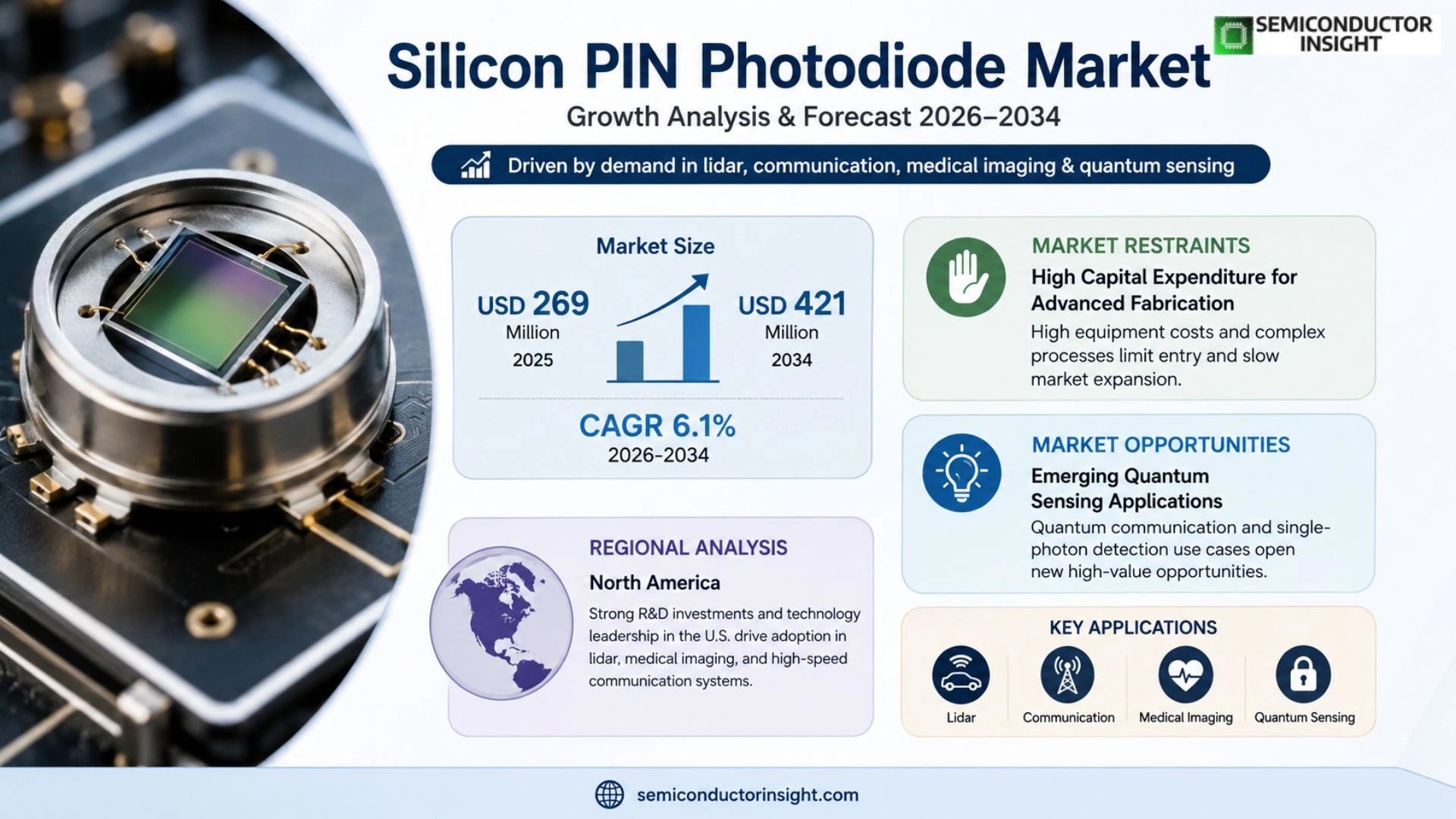
Silicon PIN Photodiode market size was valued at USD 269 million in 2025 and is expected to reach USD 421 million by 2034, exhibiting a CAGR of 6.1 % during the forecast period.
Silicon PIN photodiodes are semiconductor photodetectors built on a silicon‑based P‑I‑N structure that converts incoming optical signals into electrical signals with high efficiency. Their relatively wide intrinsic region creates a large depletion layer under reverse bias, delivering lower capacitance, faster response, strong linearity and improved weak‑light detection. Compared with ordinary photosensitive devices they combine mature process technology, controllable cost, high reliability and flexible packaging across the visible to near‑infrared range.
The market expands because industrial automation, medical diagnostics, life‑science instrumentation and high‑speed data links increasingly demand higher performance optical detection. Companies such as Hamamatsu and Excelitas emphasize high sensitivity, low dark current and fast response as core strengths, while manufacturers like TE Connectivity target AI‑enabled data centers and smart factories. However, price pressure in commodity segments and competition from emerging photonic technologies present ongoing challenges for suppliers.
MARKET DRIVERS
Rising Demand for High‑Speed Optical Communications
Silicon PIN Photodiode Market is benefitting from a surge in data‑center traffic, where carriers require detectors capable of sub‑nanosecond response times. Manufacturers are shifting to PIN structures because they provide low capacitance and superior bandwidth, allowing link speeds beyond 40 Gb/s without excessive power draw. This performance edge translates into higher equipment uptime and lower total cost of ownership for operators.
Growth of Automotive Lidar and Driver‑Assistance Systems
Automakers are integrating Lidar arrays to meet stricter safety regulations and to differentiate premium models. Silicon PIN photodiodes offer the combination of temperature stability and wavelength selectivity needed for reliable distance measurement under varying ambient light. As vehicle production ramps up, component procurement volumes are expected to increase markedly, nudging supply chains toward larger wafer runs and lower per‑unit costs.
➤ “The convergence of 5G backhaul and autonomous‑driving optics creates a dual‑track growth vector for silicon‑based photodetectors.”
Beyond telecom and automotive, medical imaging equipment such as optical coherence tomography (OCT) scanners is adopting PIN devices for their linear response and low noise floor. This diversification reduces reliance on any single end‑use, thereby stabilizing revenue streams across Silicon PIN Photodiode Market through 2025 and beyond.
MARKET CHALLENGES
Stringent Qualification Requirements in Aerospace
Aerospace programs demand radiation‑hard photodiodes that can survive prolonged exposure to cosmic rays. The rigorous testing protocols extend lead times and increase material costs, discouraging smaller suppliers from entering the segment. Consequently, Silicon PIN Photodiode Market faces a bottleneck where only a handful of qualified vendors can service high‑value contracts.
Other Challenges
Supply‑Chain Volatility
Fluctuations in silicon wafer pricing and logistical disruptions in key foundries elevate production expenses. End‑users are responding by holding larger inventories, which paradoxically compresses cash flow for manufacturers and hampers investment in next‑generation process nodes.
MARKET RESTRAINTS
High Capital Expenditure for Advanced Fabrication
Transitioning to sub‑micron PIN structures requires cleanrooms equipped with deep‑UV lithography and CMP tools costing upwards of $150 million. Many regional players lack access to such facilities, limiting their ability to compete on performance or price. This capital barrier reins in the overall expansion rate of Silicon PIN Photodiode Market.
Additionally, the need for precision doping profiles to achieve low dark current adds process complexity. Companies that cannot guarantee yield improvements face margins erosion, which suppresses broader market participation.
MARKET OPPORTUNITIES
Emerging Quantum Sensing Applications
Quantum key distribution (QKD) systems rely on single‑photon detection, and recent advances suggest silicon PIN photodiodes can be engineered for low‑noise operation at visible wavelengths. Early adopters in secure communications are evaluating these detectors as cost‑effective alternatives to more exotic superconducting devices. Successful integration could open a high‑margin niche within Silicon PIN Photodiode Market.
Parallel to QKD, the rise of wearable health monitors that employ optical pulse oximetry creates modest but steady demand for miniaturized, low‑power PIN sensors. Companies that tailor device footprints to flexible substrates stand to capture a share of this expanding consumer‑grade segment.
Silicon PIN Photodiode Market Trends
Shift Toward High‑Speed, Low‑Noise Detection in Data‑Center Optics
Silicon PIN Photodiode Market is witnessing a pronounced migration of revenue toward devices optimized for high‑speed optical links. As data‑center traffic surges, designers demand photodiodes that combine sub‑nanosecond response with minimal dark current, enabling error‑free transmission at 100 Gb/s and beyond. Manufacturers such as Hamamatsu and Excelitas have introduced new variants with reduced junction capacitance, which translates directly into lower jitter in receiver modules. This technical shift is not merely a product upgrade; it reshapes bill‑of‑materials calculations for server manufacturers, pushing them to allocate more of their component budget to specialized photodiodes rather than legacy silicon photodetectors.
Other Trends
Integration of Silicon PIN Photodiodes into Advanced Sensing Platforms
Beyond pure communication, Silicon PIN Photodiode Market is expanding its footprint in industrial and medical sensing ecosystems. The intrinsic region’s breadth supports superior linearity, a trait that is being leveraged in spectroscopy instruments and laser‑based quality‑control stations. Companies like onsemi and TE Connectivity are embedding pin‑photodiodes into modular sensor arrays that feed AI‑driven analytics engines. This convergence creates a feedback loop: as AI models demand higher fidelity data, sensor designers turn to photodiodes with tighter noise specifications, which in turn raises the entry barrier for new suppliers and rewards those with mature process control.
Strategic Positioning of Mid‑Range Applications Amid Price Pressures
While premium segments enjoy margin uplift, the bulk of unit volume continues to be sourced for mid‑range applications such as consumer electronics and generic industrial detection. Silicon PIN Photodiode Market’s pricing dynamics reflect a delicate balance: commodity‑grade devices still compete on cost, yet manufacturers are differentiating through packaging choices,ceramic versus plastic,and customized spectral response windows. This nuanced pricing strategy allows vendors to protect profitability in a market where volume alone no longer guarantees competitive advantage. Buyers, in turn, are evaluating total cost of ownership, favoring suppliers that can bundle photodiode performance with reliable supply chain traceability across Japan, the United States, China, and Taiwan.
COMPETITIVE LANDSCAPE
Key Industry Players
Silicon PIN Photodiode Market Competitive Overview
Hamamatsu Photonics K.K. dominates the high‑performance segment, leveraging its long‑standing reputation for low‑dark‑current devices and a broad portfolio that spans visible to near‑infrared wavelengths. Its vertically integrated production line in Japan ensures tight control over wafer quality and package reliability, which is decisive for customers in optical‑communication receivers and precision medical imaging. The market structure reflects a concentration of scale‑players in Japan and the United States, while Chinese and Taiwanese firms provide volume‑oriented offerings that keep unit prices competitive. This geographic split creates a dual‑track dynamic: premium, application‑specific parts are sourced from established Japanese manufacturers, whereas large‑volume, cost‑sensitive orders are increasingly satisfied by Asian suppliers that benefit from regional semiconductor ecosystems.
Beyond the headline names, several niche participants are shaping the value chain. Vishay Intertechnology differentiates through its metal‑can packages tailored for rugged industrial inspection equipment, whereas Excelitas Technologies focuses on life‑science and automotive applications, emphasizing fast response and customized spectral tuning. onsemi and ams‑OSRAM are expanding their silicon photonics portfolios to address AI‑enabled data centers and smart‑vehicle sensing, pairing photodiodes with advanced driver‑assistance modules. TE Connectivity injects a systems perspective by bundling photodiodes with connectors and signal‑conditioning ICs, targeting automated‑factory upgrades. Smaller innovators such as Dexerials, LASER COMPONENTS Detector Group, KODENSHI, Everlight Electronics, Ushio, and Beijing Lightsensing Technologies add depth in packaging formats and regional distribution, creating a fragmented but highly interactive supplier landscape.
List of Key Silicon PIN Photodiode Companies Profiled
- Hamamatsu Photonics K.K.
- Vishay Intertechnology, Inc.
- Excelitas Technologies Corp.
- onsemi
- ams‑OSRAM AG
- TE Connectivity
- Dexerials Corporation
- LASER COMPONENTS Detector Group
- KODENSHI CORP.
- Everlight Electronics Co., Ltd.
- Ushio Inc.
- Beijing Lightsensing Technologies Ltd
Segment Analysis:
| Segment Category | Sub-Segments | Key Insights |
| By Type |
|
Ceramic Package is favored for its robustness in demanding industrial environments, delivering superior thermal stability and long‑term reliability. It supports stringent packaging standards required by high‑precision optical communication modules.
|
| By Application |
|
Optical Communication drives demand for ultra‑fast response and low dark‑current devices, underpinning high‑speed data links in data centers and telecom networks. The segment values linearity and spectral coverage across visible to near‑infrared bands.
|
| By End User |
|
Telecommunications leverages silicon PIN photodiodes for backbone network equipment, where reliability and low latency are paramount. End‑users seek devices that maintain performance under continuous operation and varied environmental conditions.
|
| By Wavelength Sensitivity |
|
Near Infrared Band is increasingly adopted for smart‑robot vision and automotive driver‑assist sensors, offering deeper penetration and reduced ambient light interference. This spectral window aligns with emerging AI‑enabled perception systems.
|
| By Response Speed |
|
High Speed meets the performance expectations of AI data‑center interconnects and next‑generation lidar, where ultra‑fast electrical conversion is critical. Designers value low capacitance and rapid rise times.
|
Regional Analysis: Silicon PIN Photodiode Market
North America
OEMs in the region integrate Silicon PIN photodiodes into next‑generation LiDAR arrays, prioritising low dark current and high quantum efficiency to meet autonomous‑vehicle range requirements. Early adopters in telecommunications exploit the devices’ bandwidth for dense‑wave division multiplexing, driving modest but steady upgrades in network equipment.
Federal safety standards for autonomous driving and medical imaging equipment explicitly reference photodiode performance thresholds, compelling manufacturers to certify their silicon‑based solutions against tighter noise and linearity criteria.
The region’s emphasis on on‑shoring wafer fabrication curtails exposure to geopolitical disruptions, while strategic stockpiling of key substrates ensures continuity for high‑volume product lines.
Beyond automotive and medical markets, industrial automation firms adopt the photodiodes for precision positioning systems, leveraging their linear response to improve closed‑loop control accuracy.
Europe
European manufacturers blend legacy silicon processes with emerging heterogenous integration, creating photodiodes that coexist with silicon‑photonic circuits. The region’s strong emphasis on energy‑efficient infrastructure drives demand in smart‑grid sensors, where low‑power operation aligns with sustainability targets. Collaborative research initiatives funded by the EU accelerate material‑level improvements, fostering a pipeline of devices that boast higher responsivity without sacrificing cost competitiveness. At the same time, stringent environmental compliance forces firms to adopt greener fab practices, adding a layer of operational discipline that appeals to OEMs seeking reliable, eco‑conscious suppliers.
Asia‑Pacific
Asia‑Pacific remains a prolific producer of silicon wafers, and the proliferation of consumer‑electronics firms has spurred a wave of incremental upgrades to photodiode performance. Nations such as China, Japan, and South Korea channel significant government subsidies toward optical‑sensor research, intertwining photodiode development with broader smart‑city agendas. The rapid rollout of 5G and early 6G trials creates ancillary demand for high‑speed, low‑jitter detectors, positioning the region as an emerging hub for communication‑focused applications. Supply‑chain agility, underpinned by dense fab clusters, enables short lead times that many global brands now depend upon.
South America
In South America, the market is guided by cost‑sensitive sectors such as agricultural monitoring and low‑cost medical diagnostics. Local firms prioritize ruggedized photodiodes that can endure harsh field conditions, emphasizing thermal stability over ultra‑high bandwidth. Public‑private partnerships are emerging to fund pilot projects that embed Silicon PIN photodiodes in remote sensing platforms, aiming to improve crop yield predictions and water‑management efficiency. Although volume remains modest, the region’s focus on pragmatic, value‑driven solutions creates niche opportunities for manufacturers willing to tailor specifications to local operating environments.
Middle East & Africa
The Middle East & Africa exhibit a nascent but opportunistic Silicon PIN photodiode landscape, driven largely by defense procurement and solar‑energy monitoring. Defense agencies invest in high‑resolution infrared imaging systems, where the photodiodes’ low noise floor translates directly to clearer target detection. Parallelly, utility companies adopt optical sensors for photovoltaic‑plant performance tracking, leveraging the devices’ stability under high temperature fluctuations. Limited local fabrication capacity is offset by strategic import agreements, and regional hubs are beginning to cultivate R&D capabilities that could, over the next decade, shift the balance toward more indigenous design activity.
Report Scope
This market research report provides a comprehensive analysis of the Silicon PIN Photodiode Market , covering the forecast period 2026–2034. It offers detailed insights into market dynamics, technological advancements, competitive landscape, and key trends shaping the industry.
Key focus areas of the report include:
- Market Overview: The report begins with an overview outlining its current market scenario, key growth indicators, and industry transformation drivers. It discusses macroeconomic factors, demand–supply balance, regulatory landscape, and the strategic role of semiconductors in powering advancements across industries such as automotive, telecommunications, consumer electronics, and industrial automation.
- Market Size & Forecast: Historical data and future projections for revenue, unit shipments, and market value across major regions and segments.
- Segmentation Analysis: Detailed breakdown by product type, technology, application, and end-user industry to identify high-growth segments and investment opportunities.
- Regional Insights: Insights into market performance across North America, Europe, Asia-Pacific, Latin America, and the Middle East & Africa, including country-level analysis where relevant.
- Competitive Landscape: Profiles of leading market participants, including their product offerings, R&D focus, manufacturing capacity, pricing strategies, and recent developments such as mergers, acquisitions, and partnerships.
- Technology Trends & Innovation: Assessment of emerging technologies, integration of AI/IoT, semiconductor design trends, fabrication techniques, and evolving industry standards.
- Market Drivers & Restraints: Evaluation of factors driving market growth along with challenges, supply chain constraints, regulatory issues, and market-entry barriers.
- Stakeholder Insights: Insights for component suppliers, OEMs, system integrators, investors, and policymakers regarding the evolving ecosystem and strategic opportunities.
Primary and secondary research methods are employed, including interviews with industry experts, data from verified sources, and real-time market intelligence to ensure the accuracy and reliability of the insights presented.
FREQUENTLY ASKED QUESTIONS:
What is the current market size of Silicon PIN Photodiode Market?
-> Silicon PIN Photodiode market is expected to reach USD 421 million by 2034, exhibiting a CAGR of 6.1 % during the forecast period.
Which key companies operate in Silicon PIN Photodiode Market?
-> Key players include Hamamatsu Photonics K.K., Vishay Intertechnology, Inc., Excelitas Technologies Corp., onsemi, ams‑OSRAM AG, OSI Optoelectronics, TE Connectivity, Dexerials Corporation, LASER COMPONENTS Detector Group, KODENSHI CORP., Everlight Electronics Co., Ltd., Ushio Inc., Beijing Lightsensing Technologies Ltd, among others.
What are the key growth drivers?
-> Key growth drivers include industrial automation, medical diagnostics, semiconductor equipment demand, intelligent vehicles, and high‑speed data link expansion.
Which region dominates the market?
-> Asia‑Pacific is the fastest‑growing region, while North America remains a dominant market.
What are the emerging trends?
-> Emerging trends include integration of AI/IoT for smart sensing, miniaturized high‑speed photodiodes, and expanded use in autonomous vehicle and data‑center applications.

Get Sample Report PDF for Exclusive Insights
Report Sample Includes
- Table of Contents
- List of Tables & Figures
- Charts, Research Methodology, and more...