Multimode Fiber Coupler Market Insights
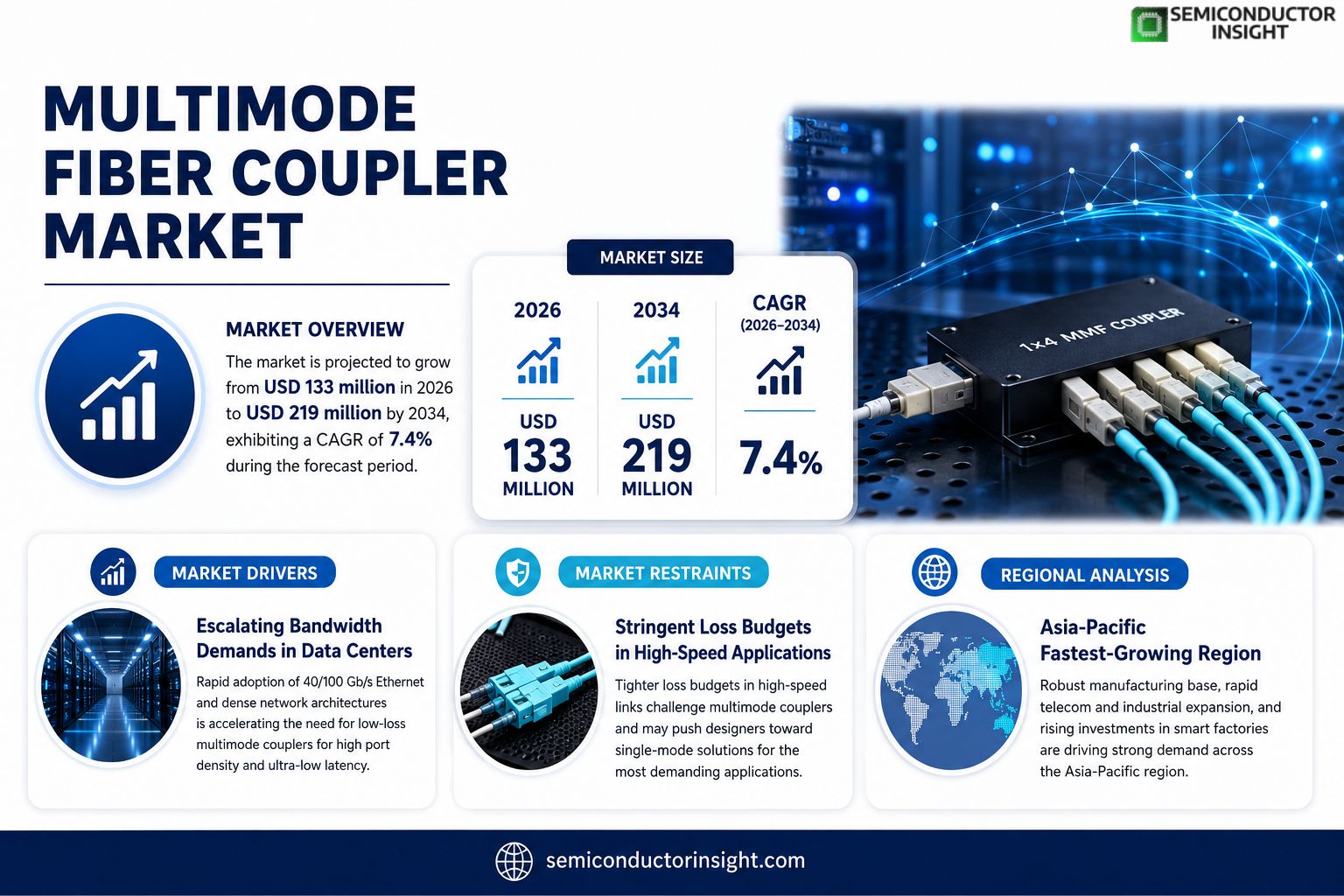
Multimode Fiber Coupler market size was valued at USD 133 million in 2025. Forecasts indicate it will rise to USD 219 million by 2034, reflecting a CAGR of 7.4 % over the period.
A multimode fiber coupler is a passive optical power‑management device designed for multimode fiber links and systems. Its core role is to split, combine, tap or selectively couple wavelengths within a single unit, thereby addressing optical‑path distribution, signal monitoring, power combining and system‑integration requirements across multimode networks.The market gains momentum because investment in broadband infrastructure continues, test‑instrument manufacturers demand higher‑performance passive components, and emerging applications such as fiber‑sensing and spectroscopy require stable coupling ratios and low insertion loss. Recent collaborationssuch as a February 2024 partnership between an optics supplier and a major telecom equipment makerillustrate how OEM relationships are expanding product portfolios for telecom, LAN, CATV and industrial sensing segments.
MARKET DRIVERS
Escalating Bandwidth Demands in Data Centers
Enterprises are upgrading to 40 Gb/s and 100 Gb/s Ethernet across campus and hyperscale environments. This shift forces network architects to adopt dense, low‑loss distribution architectures where multimode fiber couplers become indispensable for splitting and combining signals without compromising eye‑diagram integrity. Multimode Fiber Coupler Market therefore benefits from the cascading need for higher port density and reduced latency.
Cost‑Effective Transmission for Short‑Reach Links
Compared with single‑mode alternatives, multimode platforms offer a lower total cost of ownership for distances under 2 km, a range that covers most enterprises, educational campuses, and industrial facilities. The reduced need for expensive lasers and precision alignment translates into tangible savings on both capital and operational expenditures. Vendors that can demonstrate budget‑friendly solutions are gaining traction among procurement teams focused on ROI.
➤ “Multimode couplers simplify network roll‑out, cutting provisioning time by up to 30 %.”
Manufacturers are exploiting this advantage by integrating automated testing and pre‑qualified fiber assemblies, which further shortens deployment cycles. The growing emphasis on rapid time‑to‑market amplifies the relevance of Multimode Fiber Coupler Market as a strategic component in modern optical infrastructures.
MARKET CHALLENGES
Technical Compatibility Across Legacy Equipment
Many organizations still operate legacy optical transceivers that were designed around older coupling standards. Aligning new multimode couplers with these older devices often requires custom adapters or firmware updates, inflating integration costs and extending project timelines. This mismatch can deter firms from fully embracing upgraded distribution architectures.
Other Challenges
Standardization Gaps
The absence of a universally accepted specification for insertion loss and polarization dependent loss in multimode couplers leads to variability in product performance. End‑users must perform extensive acceptance testing, which adds overhead to procurement processes.
MARKET RESTRAINTS
Stringent Loss Budgets in High‑Speed Applications
As Ethernet speeds climb, the permissible loss budget tightens, making it harder for certain multimode couplers to meet the required margins without resorting to additional amplification. This technical ceiling can push designers toward single‑mode solutions for the most demanding links, thereby limiting the growth ceiling of Multimode Fiber Coupler Market.
MARKET OPPORTUNITIES
Emergence of 400 Gb/s Ethernet over Multimode
Recent demonstrations of 400 Gb/s operation over OM4/OM5 fiber open a new corridor for multimode technologies. Early adopters are seeking couplers that can maintain low split losses at these elevated data rates, presenting a niche yet lucrative segment for suppliers that can certify their products for such performance levels. Investment in R&D to meet these thresholds could unlock a wave of demand in sectors such as AI‑driven supercomputing clusters and next‑generation enterprise backbones.
Multimode Fiber Coupler Market Trends
Shift Toward System‑Level Optical Management
The past decade has seen multimode couplers move beyond simple power splitters toward platform‑like modules that define the loss budget of an entire instrument. Customers now evaluate devices not only on insertion loss but also on directivity, thermal stability and packaging flexibility, because a single coupler often sits at the nexus of source, detector and signal processing. This behavior is evident in telecom LAN upgrades, where 1×2 and 2×2 formats are selected to match equipment topology, and in spectroscopy rigs that rely on wavelength‑selective filter couplers to isolate narrow bands without adding external optics. The consequence is a purchasing logic anchored in system performance rather than component inventory, prompting suppliers to broaden their catalogues with large‑core, double‑clad and micro‑optic options.
Other Trends
Product Architecture Evolution
Three distinct layers now characterize the offering spectrum. The baseline tier comprises conventional fused biconical taper and fusion‑taper parts that satisfy the majority of communication and test‑instrument needs. Above this, a large‑core family addresses high‑power, double‑clad applications, demanding tolerance to modal dispersion and rugged packaging. The top tier introduces filter‑enabled couplers and micro‑optic solutions that merge splitting with spectral selection, thereby eliminating the need for downstream wavelength‑division components. Suppliers that can sustain reliable process repeatability across all three layers gain a competitive edge, because design engineers prefer a single source that can supply a complete matrix of core sizes, wavelengths and coupling ratios.
Geographic Supply‑Chain Configuration
Manufacturing footprints remain concentrated in North America, Europe and East Asia, reflecting a legacy of optoelectronic expertise and cost‑effective fabrication. U.S. and German firms dominate the high‑precision FBT segment, while Chinese and Taiwanese players excel in rapid‑turnaround custom orders. Demand originates from a ly dispersed user basenetwork operators, research labs and medical equipment makersso sales are typically routed through quote‑based channels rather than bulk catalog purchases. This structure implies that growth will be driven by project‑specific contracts that require tight collaboration on specification definition, rather than by volume scaling of a single standard part.
Customization and Application Integration
In sectors such as coherent detection, fiber sensing and advanced manufacturing, the coupler functions as a critical interface that must be co‑engineered with lasers, detectors and control electronics. Suppliers that provide configurable connector types, fiber lengths and graded insertion‑loss specifications reduce downstream development cycles and lower total cost of ownership. As instrument platforms become more modular, the ability to source a coupler that aligns with both optical performance and mechanical envelope becomes a decisive factor in vendor selection. Consequently, firms investing in comprehensive engineering libraries and offering OEM/ODM pathways are positioned to capture a larger share of high‑value contracts across the expanding application landscape.
COMPETITIVE LANDSCAPEKey Industry Players
Competitive Dynamics in the Multimode Fiber Coupler Market
Thorlabs, Inc. dominates the high‑volume segment by leveraging a broad catalog of 1×2, 2×2 and 1×N couplers that cover the full spectrum of core sizes from 50 µm to 1000 µm. Its deep integration with optical test and instrumentation OEMs gives the company a dual advantage: economies of scale in standard parts and rapid engineering turn‑around for custom specifications. The firm’s ability to package fused‑biconical taper (FBT) and micro‑optic filter technologies under a unified system‑engineer portal creates a “one‑stop” procurement experience, forcing smaller competitors to specialize or partner. Beneath the tier‑one layer, a second tier of playersmost notably MKS Instruments and Laser Components Germanyfocus on large‑core, double‑clad solutions that serve high‑power laser testing rigs and industrial sensing rigs. Their product portfolios stress thermal resilience and low insertion‑loss performance, attributes that attract customers in aerospace and harsh‑environment deployments where reliability outweighs pure cost considerations.Beyond the two dominant strata, a constellation of niche firms supplies highly differentiated couplers. Lightel Technologies and AC Photonics, for example, concentrate on wavelength‑selective filter couplers that enable multiplexed spectroscopy setups. Companies such as Fibertronics, Inc. and Agiltron Inc. have carved out market share by offering “design‑to‑order” services, providing extensive parameter matrices that let system integrators fine‑tune directivity and coupling ratios without additional redesign cycles. Smaller European and Asian outfitsSEDI‑ATI Fibres Optiques, DK Photonics Technology Limited, and HYC Co., Ltd.compete on ultra‑fast lead times and localized support, a strategy that resonates with research laboratories needing small‑batch, high‑precision components. The overall competitive picture is therefore a mix of scale‑driven breadth, specialty‑driven depth, and service‑oriented agility.
List of Key Multimode Fiber Coupler Companies Profiled
- Thorlabs, Inc.
- MKS Instruments, Inc.
- Laser Components Germany GmbH
- Lightel Technologies, Inc.
- Fibertronics, Inc.
- Agiltron Inc.
- Fiberdyne Labs, Inc.
- AC Photonics, Inc.
- OZ Optics Ltd.
- SEDI-ATI Fibres Optiques
- DK Photonics Technology Limited
- Opneti Communications Co Ltd.
- HYC Co., Ltd.
- FOCI Fiber Optic Communications, Inc.
- LSTECH Co., Ltd.
Segment Analysis:
| Segment Category | Sub-Segments | Key Insights |
| By Type |
|
FBT Couplers
|
| By Application |
|
Test & Instrumentation
|
| By End User |
|
System Integrators
|
| By Technology Platform |
|
Micro‑Optic Filtering
|
| By Market Role |
|
Custom Engineering Solutions
|
Regional Analysis: Multimode Fiber Coupler Market
North America
Manufacturers are standardising on multimode couplers for robotic cell networks, where the trade‑off between simplicity and deterministic timing aligns with production line economics. Vendors that optimise connector ergonomics gain preference among system integrators seeking rapid rollout.
Hyperscale operators favour multimode architectures for rack‑level aggregation, leveraging the lower insertion loss and tighter form factor to boost rack density without incurring the expense of single‑mode transceivers.
Federal broadband initiatives prioritize multimode deployments in campus‑type networks, where rapid installation and modest reach requirements dovetail with funding guidelines that stress cost containment.
Emerging polymer‑based waveguide technologies are reshaping coupler design, delivering higher thermal tolerance and enabling a new class of plug‑and‑play modules that appeal to OEMs seeking reduced BOM complexity.
Europe
European markets display a nuanced balance between legacy multimode installations and a gradual shift toward higher‑speed optics. Railway signalling and aerospace testing facilities still rely heavily on multimode couplers for deterministic short‑haul links, appreciating the proven reliability of existing standards. At the same time, a wave of sustainability mandates is prompting data‑center operators to reassess power‑per‑bit metrics, where multimode solutions can offer lower energy consumption per transmitted bit compared with over‑engineered single‑mode alternatives. Procurement policies that reward modularity further encourage system integrators to select couplers that can be re‑used across multiple projects, extending asset lifecycles. Vendor collaborations with standards bodies are critical in this environment, as alignment on IEC specifications reduces certification overhead and smooths cross‑border deployments.
Asia‑Pacific
The Asia‑Pacific region is witnessing a surge in manufacturing hubs that embed multimode fiber couplers within intelligent factory networks. Companies are attracted by the modest cost structure and the ability to quickly retrofit existing copper backbones with fiber, a move that streamlines latency‑sensitive control loops. Education and research institutions are also significant adopters, employing multimode platforms for high‑throughput laboratory instrumentation where flexibility outweighs absolute bandwidth limits. While large‑scale telecom operators tend toward single‑mode for long‑haul, the regional appetite for short‑reach interconnects sustains a healthy pipeline of OEM activity. Strategic investments in local component fabs are reducing import reliance, fostering a more resilient supply chain for Multimode Fiber Coupler Market.
South America
In South America, the rollout of municipal smart‑city projects is creating pockets of demand for multimode couplers, especially in traffic‑management and public‑safety surveillance systems that need reliable, short‑range connectivity. The region’s cost‑sensitive telecom carriers appreciate the lower capital outlay associated with multimode deployments for metro‑edge aggregation, where distance constraints align with network topology. However, economic volatility imposes a cautious procurement stance, prompting operators to favour vendors that can provide extended warranty terms and localized support. Partnerships between regional distributors and overseas manufacturers are therefore becoming a decisive factor in market penetration.
Middle East & Africa
The Middle East & Africa landscape is shaped by flagship projects in oil‑field monitoring and desert‑based research stations, environments that demand rugged fiber solutions capable of withstanding temperature extremes. Multimode fiber couplers, when packaged with hardened housings, meet these criteria while delivering the cost efficiencies prized by project financiers. In parallel, emerging educational campuses are upgrading legacy LANs to multimode fiber, a step that future‑proofs campus networks without incurring the higher expense of single‑mode infrastructure. Vendor strategies that combine on‑site training with after‑sales service are resonating strongly, as local engineering teams seek to build in‑house expertise for long‑term maintenance.
Report Scope
This market research report provides a comprehensive analysis of the Multimode Fiber Coupler Market , covering the forecast period 2026–2034. It offers detailed insights into market dynamics, technological advancements, competitive landscape, and key trends shaping the industry.
Key focus areas of the report include:
- Market Overview: The report begins with an overview outlining its current market scenario, key growth indicators, and industry transformation drivers. It discusses macroeconomic factors, demand–supply balance, regulatory landscape, and the strategic role of semiconductors in powering advancements across industries such as automotive, telecommunications, consumer electronics, and industrial automation.
- Market Size & Forecast: Historical data and future projections for revenue, unit shipments, and market value across major regions and segments.
- Segmentation Analysis: Detailed breakdown by product type, technology, application, and end-user industry to identify high-growth segments and investment opportunities.
- Regional Insights: Insights into market performance across North America, Europe, Asia-Pacific, Latin America, and the Middle East & Africa, including country-level analysis where relevant.
- Competitive Landscape: Profiles of leading market participants, including their product offerings, R&D focus, manufacturing capacity, pricing strategies, and recent developments such as mergers, acquisitions, and partnerships.
- Technology Trends & Innovation: Assessment of emerging technologies, integration of AI/IoT, semiconductor design trends, fabrication techniques, and evolving industry standards.
- Market Drivers & Restraints: Evaluation of factors driving market growth along with challenges, supply chain constraints, regulatory issues, and market-entry barriers.
- Stakeholder Insights: Insights for component suppliers, OEMs, system integrators, investors, and policymakers regarding the evolving ecosystem and strategic opportunities.
Primary and secondary research methods are employed, including interviews with industry experts, data from verified sources, and real-time market intelligence to ensure the accuracy and reliability of the insights presented.
FREQUENTLY ASKED QUESTIONS:
What is the current market size of Multimode Fiber Coupler Market?
-> Multimode Fiber Coupler Market was valued at USD 133 million in 2025 and is expected to reach USD 219 million by 2034.
Which key companies operate in Multimode Fiber Coupler Market?
-> Key players include MKS Instruments, Inc., Thorlabs, Inc., Lightel Technologies, Inc., Laser Components Germany GmbH, Fibertronics, Inc., Agiltron Inc., Fiberdyne Labs, Inc., AC Photonics, Inc., OZ Optics Ltd., SEDI-ATI Fibres Optiques, DK Photonics Technology Limited, Opneti Communications Co Ltd., HYC Co., Ltd., FOCI Fiber Optic Communications, Inc., LSTECH Co., Ltd., ESS Tech Incorporated, Logos Co., Ltd.
What are the key growth drivers?
-> Key growth drivers include expanding broadband and FTTx deployments, increasing demand for high‑performance test and instrumentation, growth in fiber sensing, spectroscopy, medical and industrial optics, and the shift toward large‑core and filter‑coupled multimode solutions that require low insertion loss and high reliability.
Which region dominates the market?
-> Asia‑Pacific is the fastest‑growing region due to strong manufacturing capabilities and rising telecom and industrial demand, while North America and Europe remain significant markets with high‑value application segments.
What are the emerging trends?
-> Emerging trends include development of large‑core and double‑clad couplers, integration of micro‑optic filter technologies, increased customization through OEM/ODM services, and broader adoption in spectroscopy, medical imaging, and harsh‑environment industrial systems.

Get Sample Report PDF for Exclusive Insights
Report Sample Includes
- Table of Contents
- List of Tables & Figures
- Charts, Research Methodology, and more...
 Download Sample Report PDF