
Miniature Thermocouple Market Insights
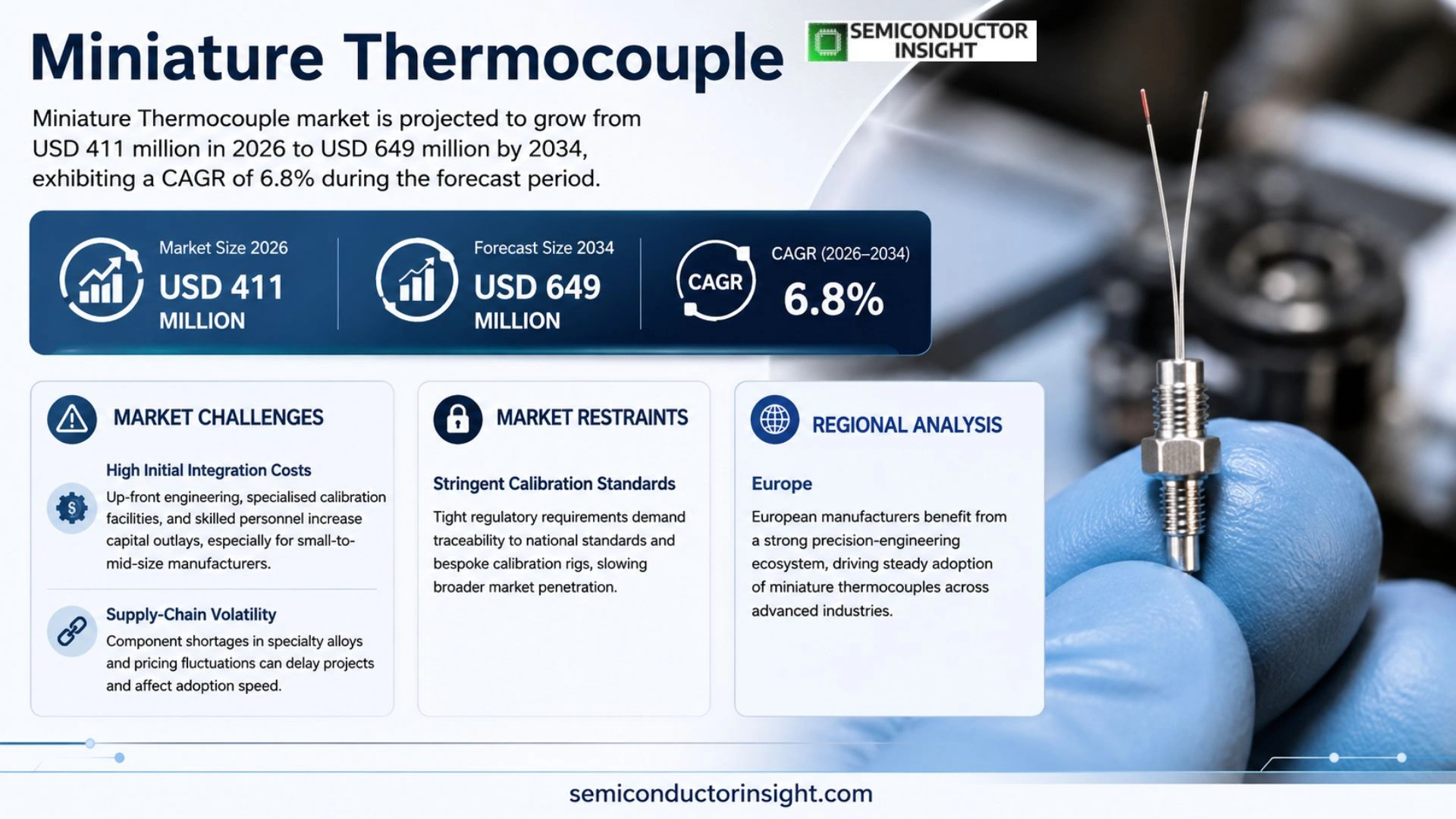
Miniature Thermocouple market is projected to grow from USD 411 million in 2026 to USD 649 million by 2034, exhibiting a CAGR of 6.8% during the forecast period.
Miniature thermocouples are ultra‑fine diameter contact temperature sensors that directly convert temperature signals into millivolt‑level electromotive forces based on the Seebeck effect. Their core structure consists of two different metal or alloy conductors welded together at the measuring end to form a miniature thermal junction; physical encapsulation and electromagnetic shielding are provided by insulating materials and a metal sheath, enabling precise measurement across a range of –200 °C to +1300 °C.
The market is experiencing rapid growth due to several factors, including heightened demand for extreme‑environment sensing in new‑energy and semiconductor manufacturing, expanding adoption of IIoT‑enabled “sensor + transmitter” solutions for predictive maintenance, and growing applications in aerospace and medical interventional devices. Initiatives by key players such as Durex Industries and OMEGA,who continue investing in laser‑welded junction technology and digital signal conditioning,are further accelerating adoption.
MARKET DRIVERS
Technological Miniaturisation in Sensor Design
Miniature Thermocouple Market is benefitting from advances in micro‑fabrication that allow temperature probes to be embedded within compact assemblies. Engineers can now monitor hot spots without compromising space constraints, a capability that has reshaped product development in sectors such as medical devices and unmanned aerial systems. This shift reduces overall system weight and improves reliability, encouraging manufacturers to replace bulkier temperature sensors.
Demand for Real‑Time Process Control
Industries that depend on precise thermal management,particularly semiconductor fabrication and advanced metallurgy,are turning to miniature thermocouples for instant feedback. The ability to capture temperature fluctuations within milliseconds supports tighter quality tolerances and reduces scrap rates. As factories adopt tighter process windows, the preference for compact, fast‑responding sensing elements becomes a decisive factor.
➤ Companies that integrate miniature thermocouples into edge‑computing modules gain a measurable advantage in predictive maintenance strategies.
Another driver stems from regulatory pressure on emissions and energy efficiency. Compliance officers are mandating more detailed thermal data to verify that equipment operates within approved envelopes. Miniature thermocouples satisfy these requirements while fitting into existing equipment footprints, making them a cost‑effective compliance tool.
MARKET CHALLENGES
High Initial Integration Costs
Despite their benefits, Miniature Thermocouple Market faces resistance from firms hesitant to invest in redesigning legacy platforms. Up‑front engineering effort, specialised calibration facilities, and the need for skilled personnel increase capital outlays, especially for small‑to‑mid‑size manufacturers.
Other Challenges
Supply‑Chain Volatility
Component shortages in specialty alloys and limited availability of precision winding equipment can delay project timelines. Even modest fluctuations in raw‑material pricing ripple through the cost structure, nudging end users to reconsider adoption speed.
MARKET RESTRAINTS
Stringent Calibration Standards
Regulatory frameworks governing temperature measurement enforce tight calibration tolerances. For miniature thermocouples, maintaining traceability to national standards often demands bespoke calibration rigs, which many suppliers are not equipped to provide at scale. This regulatory hurdle slows broader market penetration.
Material Compatibility Limits
When operating in aggressive chemical or high‑pressure environments, the small cross‑section of these sensors can limit the choice of protective sheaths. Designers must balance durability against the very size advantage that drives demand, a compromise that can deter use in certain niche applications.
MARKET OPPORTUNITIES
Emerging IoT‑Enabled Diagnostic Platforms
The convergence of Miniature Thermocouple Market with Internet‑of‑Things ecosystems opens a channel for remote monitoring and analytics. By embedding these sensors within connected devices, manufacturers can offer subscription‑based performance dashboards, creating recurring revenue streams beyond the initial hardware sale.
Growth in Additive Manufacturing
Additive manufacturing techniques now permit the direct integration of thermocouple junctions into printed components. This capability reduces assembly steps and opens up custom‑geometry applications that were previously infeasible, positioning Miniature Thermocouple Market at the forefront of next‑generation product design.
Miniature Thermocouple Market Trends
Shift Toward Extreme‑Environment Sensing
The most visible development in Miniature Thermocouple Market is the migration from conventional temperature monitoring to applications that demand survivability in hostile conditions. New‑energy generation, semiconductor wafer processing, and hydrogen‑rich environments now require sensors that tolerate temperatures above 1200 °C and resist corrosive media. Manufacturers such as Durex Industries and OMEGA have expanded their alloy portfolios to include nickel‑based superalloys and refractory metals, delivering junctions that maintain signal fidelity despite aggressive thermal cycling. This shift is not merely technical; it reshapes procurement strategies, as end‑users prioritize long‑life parts that lower replacement frequency and reduce downtime in high‑value production lines. The resulting premium pricing, reflected in an average unit cost of $130, supports higher margins for vendors that can guarantee reliability under extreme stress.
Other Trends
Advanced Manufacturing Techniques
Precision machining and hermetic sealing lie at the heart of modern miniature thermocouple fabrication. Recent process refinements,multiple drawing stages, laser micro‑welding, and magnesium‑oxide insulation filling,have driven junction diameters into the sub‑tens‑micron range, delivering millisecond‑level thermal response. Automation of the welding step, coupled with in‑line thermoelectric potential calibration, reduces variability and shortens lead times. These capabilities enable small‑batch, highly customized production runs that cater to medical catheter sensors and aerospace arrays, markets where flexibility outweighs economies of scale. Companies that have integrated real‑time moisture‑bake controls report a measurable drop in insulation resistance drift, translating into more stable field performance.
Digital Integration and Customization
The convergence of Miniature Thermocouple Market with the Industrial Internet of Things is fostering a new generation of “sensor‑plus‑transmitter” modules. Digital signal conditioning circuits now sit beside the junction, providing standardized outputs (e.g., 4–20 mA, Modbus) that feed directly into predictive‑maintenance platforms. This architecture eliminates the need for downstream amplifiers, thereby simplifying wiring harnesses in tight spaces such as aerospace fuel lines or semiconductor reactors. Simultaneously, client‑driven specifications are pushing vendors toward multi‑point array designs, where several miniature junctions are embedded along a single sheath to capture temperature gradients. The combined effect of smart electronics and bespoke form factors is opening revenue opportunities beyond traditional OEM sales, encouraging service‑based contracts that include firmware updates and remote calibration.
COMPETITIVE LANDSCAPE
Key Industry Players
Miniature Thermocouple Market: Competitive Overview
The market is tightly clustered around a handful of multinational firms that command the bulk of revenue and production capacity. Durex Industries and OMEGA together account for well over half of global shipments, leveraging advanced laser‑welding facilities and extensive distribution networks across North America and Europe. Their ability to deliver ultra‑high‑temperature alloys and fully calibrated sensor‑plus‑transmitter modules gives them a decisive edge in sectors such as aerospace, semiconductor fabrication and new‑energy equipment, where reliability and fast thermal response are non‑negotiable. This concentration creates high entry barriers for newcomers, yet also forces incumbents to continuously invest in miniaturization and digital integration to retain OEM contracts.
Beyond the dominant duo, a suite of specialized manufacturers occupies niche but strategically important segments. Companies like ERCIAT (France) and WIKA (Germany) excel in rugged, grounded‑type sensors for petrochemical and power‑generation plants, while JUMO and Endress+Hauser provide bespoke calibration services for process‑automation users. In the United States, firms such as Thermometrics Corporation, Minco, Watlow, and TE Connectivity focus on intelligent sensor modules that embed wireless telemetry for IIoT deployments. Asian players,including Anhui Ahvorko Electric (China) and RKC Instrument (Japan),are gaining traction in high‑volume automotive and medical‑device supply chains through cost‑effective manufacturing and localized support. This layered competitive fabric ensures that buyers can source both mass‑produced and highly customized solutions within the same market.
List of Key Miniature Thermocouple Companies Profiled
- Durex Industries
- OMEGA
- Thermometrics Corporation
- Minco
- Watlow
- ERC IAT
- WIKA
- JUMO
- Conax Technologies
- Endress+Hauser
- TC Ltd
- Labfacility
- Temprel
- National Basic Sensor
- TE Connectivity
- RKC Instrument
- Anhui Ahvorko Electric
Segment Analysis:
| Segment Category | Sub-Segments | Key Insights |
| By Type |
|
K Type remains the leading sub‑segment because it offers a broad temperature range and reliable performance in harsh industrial environments. – Provides excellent resistance to oxidation and high‑temperature stability. – Widely adopted in petrochemical and power generation settings due to its robust construction. – Supports straightforward calibration procedures, enhancing field serviceability. |
| By Application |
|
Petroleum & Petrochemicals drives the majority of demand as manufacturers require sensors that sustain extreme temperatures and corrosive media. – Enables precise monitoring of reactor and distillation column temperatures. – Supports safety systems through rapid response to thermal excursions. – Aligns with stringent industry standards for reliability and longevity. |
| By End User |
|
Industrial Automation is the premier end‑user segment, leveraging miniature thermocouples for real‑time process control. – Facilitates predictive maintenance through continuous temperature profiling. – Integrates seamlessly with PLC and SCADA systems. – Benefits from the compact form factor that fits within constrained equipment housings. |
| By Manufacturing Process |
|
Precision Wire Drawing underpins the entire product value chain, ensuring sub‑millimeter diameters and uniform thermal characteristics. – Generates consistent thermoelectric coefficients across batches. – Supports downstream laser welding by delivering clean, defect‑free wire surfaces. – Enhances long‑term stability, critical for aerospace and high‑temperature applications. |
| By Emerging Technology |
|
Integrated Sensor‑Transmitter Modules are gaining prominence as customers seek plug‑and‑play solutions for digital factories. – Consolidates signal conditioning, digital conversion, and communications in a single footprint. – Reduces wiring complexity and improves electromagnetic immunity. – Aligns with IIoT platforms, enabling remote diagnostics and data analytics. |
Regional Analysis: Miniature Thermocouple Market
Europe
European Union directives on equipment safety and emissions create a predictable compliance landscape, prompting manufacturers to embed miniature thermocouples early in product development. This pre‑emptive approach reduces redesign cycles and aligns with the continent’s push for circular‑economy practices, where component longevity and recyclability are paramount.
Clusters in Germany, Switzerland, and the Nordics act as incubators for sensor miniaturization, blending materials science with digital manufacturing. Collaborative projects funded by Horizon Europe accelerate the migration of laboratory breakthroughs into commercially viable thermocouple formats, reinforcing the region’s competitive edge.
Leading OEMs in aerospace and medical devices request bespoke thermocouple geometries that fit within increasingly compact assemblies. European suppliers respond with rapid prototyping capabilities, leveraging additive manufacturing to deliver low‑volume, high‑precision runs that satisfy niche requirements without inflating cost structures.
A geographically concentrated network of alloy producers and specialty coating firms minimizes lead‑time disruptions. By maintaining strategic stockpiles of critical raw materials, European firms can sustain output even when global logistics face turbulence, preserving market confidence.
North America
In the United States and Canada, Miniature Thermocouple Market is driven by a surge in advanced manufacturing, particularly within the semiconductor and renewable‑energy sectors. Companies prioritize sensors that can survive harsh thermal cycling while occupying minimal board real estate, a requirement that aligns with the push toward higher power densities. The region’s venture‑capital ecosystem fuels start‑ups focused on novel thermocouple architectures, fostering a pipeline of differentiated products. Meanwhile, defense contracts emphasize ruggedization, prompting suppliers to integrate protective encapsulation techniques that meet stringent military specifications. The combination of aggressive R&D investment and a demand landscape that values both performance and miniaturization sustains North America’s role as a catalyst for innovation in this niche.
Asia-Pacific
Asia‑Pacific manufacturers leverage cost‑effective production capabilities to meet rising demand from automotive electronics and consumer appliances. Nations such as China, Japan, and South Korea are scaling up facilities that specialize in high‑volume, precision‑cutting of thermocouple wires, enabling them to serve global OEMs seeking competitive pricing without sacrificing accuracy. Simultaneously, regional governments are incentivizing smart‑factory initiatives, where embedded temperature monitoring becomes integral to predictive maintenance strategies. This policy backdrop encourages integration of miniature thermocouples into IoT‑enabled equipment, expanding the addressable market beyond traditional industrial uses. The resulting blend of manufacturing scale and emerging digitalization efforts positions Asia‑Pacific as a pivotal growth engine for the broader market.
South America
South American adoption of miniature thermocouples is closely linked to the expansion of hydro‑electric and bio‑fuel power projects, where precise temperature control is essential for system efficiency. Local engineers favor compact sensors that can be retrofitted into legacy turbines and reactors, reducing the need for extensive redesign. Additionally, growing aerospace maintenance, repair, and overhaul (MRO) facilities in Brazil are standardizing on miniature thermocouples to streamline diagnostic workflows. While overall market size remains modest compared with other regions, these sector‑specific drivers create a niche environment that encourages specialized product offerings tailored to the continent’s energy and aerospace infrastructure.
Middle East & Africa
In the Middle East, high‑temperature industrial processes in petrochemical complexes and desalination plants drive interest in robust miniature thermocouples that can survive extreme environments. Emirates and Saudi Arabia are investing heavily in digital twins for plant optimization, where dense networks of compact temperature sensors feed real‑time analytics. African markets, though less mature, are witnessing incremental uptake in medical device manufacturing, where space‑constrained designs benefit from the reduced footprint of miniature thermocouples. Partnerships between multinational sensor firms and regional distributors aim to build local expertise, laying groundwork for a gradual increase in market penetration as infrastructure projects mature.
Report Scope
This market research report provides a comprehensive analysis of the Miniature Thermocouple Market , covering the forecast period 2026–2034. It offers detailed insights into market dynamics, technological advancements, competitive landscape, and key trends shaping the industry.
Key focus areas of the report include:
- Market Overview: The report begins with an overview outlining its current market scenario, key growth indicators, and industry transformation drivers. It discusses macroeconomic factors, demand–supply balance, regulatory landscape, and the strategic role of semiconductors in powering advancements across industries such as automotive, telecommunications, consumer electronics, and industrial automation.
- Market Size & Forecast: Historical data and future projections for revenue, unit shipments, and market value across major regions and segments.
- Segmentation Analysis: Detailed breakdown by product type, technology, application, and end-user industry to identify high-growth segments and investment opportunities.
- Regional Insights: Insights into market performance across North America, Europe, Asia-Pacific, Latin America, and the Middle East & Africa, including country-level analysis where relevant.
- Competitive Landscape: Profiles of leading market participants, including their product offerings, R&D focus, manufacturing capacity, pricing strategies, and recent developments such as mergers, acquisitions, and partnerships.
- Technology Trends & Innovation: Assessment of emerging technologies, integration of AI/IoT, semiconductor design trends, fabrication techniques, and evolving industry standards.
- Market Drivers & Restraints: Evaluation of factors driving market growth along with challenges, supply chain constraints, regulatory issues, and market-entry barriers.
- Stakeholder Insights: Insights for component suppliers, OEMs, system integrators, investors, and policymakers regarding the evolving ecosystem and strategic opportunities.
Primary and secondary research methods are employed, including interviews with industry experts, data from verified sources, and real-time market intelligence to ensure the accuracy and reliability of the insights presented.
FREQUENTLY ASKED QUESTIONS:
What is the current market size of Miniature Thermocouple Market?
-> Miniature Thermocouple market is projected to grow from USD 411 million in 2026 to USD 649 million by 2034, exhibiting a CAGR of 6.8%
Which key companies operate in Miniature Thermocouple Market?
-> Key players include Durex Industries, OMEGA, Thermometrics Corporation, Minco, Watlow, ERCIAT, WIKA, JUMO, Conax Technologies, Endress+Hauser, TE Connectivity, RKC Instrument, Anhui Ahvorko Electric, among others.
What are the key growth drivers?
-> Key growth drivers include the rise of new energy and semiconductor manufacturing demanding ultra‑high temperature and corrosion‑resistant sensors, the Industrial Internet of Things driving integrated sensor‑transmitter solutions, and increasing applications in aerospace, medical interventional catheters, and extreme environment monitoring.
Which region dominates the market?
-> Europe and North America hold the largest market share due to established manufacturing bases, while the Asia‑Pacific region shows the fastest growth driven by expanding electronics and automotive sectors.
What are the emerging trends?
-> Emerging trends include integration of digital signal conditioning for IIoT, development of miniature thermocouples capable of withstanding hydrogen and strong electromagnetic interference, and customization for minimally invasive medical and aerospace applications.

Get Sample Report PDF for Exclusive Insights
Report Sample Includes
- Table of Contents
- List of Tables & Figures
- Charts, Research Methodology, and more...
 Download Sample Report PDF




