
Hydrogen Pressure Sensors Market Insights
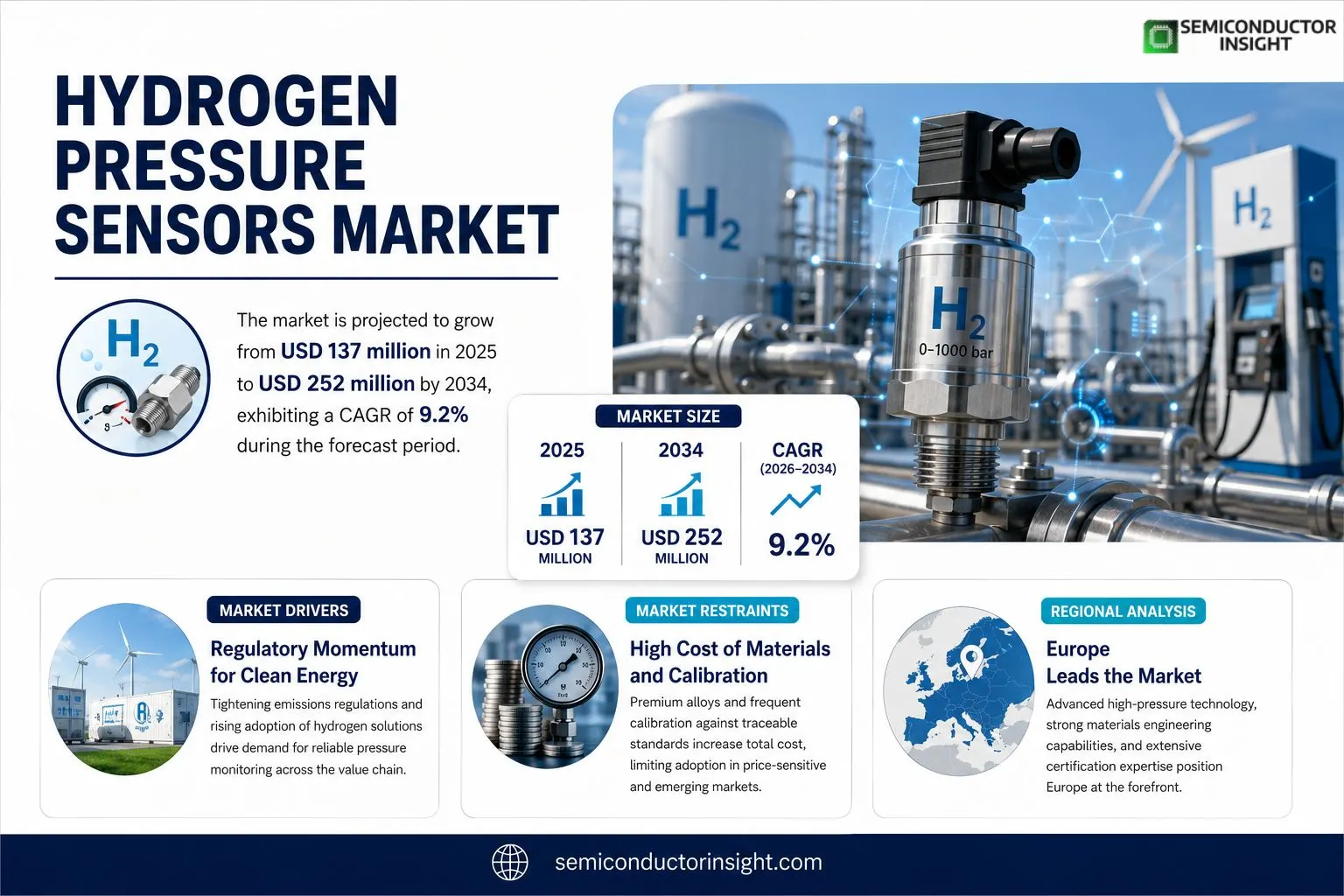
Hydrogen Pressure Sensors market size was valued at USD 137 million in 2025. The market is projected to reach USD 252 million by 2034, exhibiting a CAGR of 9.2% during the forecast period.
Hydrogen pressure sensors are specialized pressure measurement devices used across hydrogen production, storage, transport, refueling and fuel‑cell systems. Their core value lies in delivering stable, controllable and interlock‑ready pressure signals under high‑pressure, pulsating, temperature‑varying and hazardous media conditions, thereby enabling flow control, safety protection, condition monitoring and efficiency optimization.The market is experiencing growth because manufacturers emphasize resistance to hydrogen embrittlement and permeation, long‑term stability and system‑level compatibility. Product designs commonly feature dry‑welded measuring cells,oil‑free cavities seal‑free internal structures,and materials such as 316L or high‑nickel stainless steel,gold‑plated diaphragms,titanium alloy or silicon‑on‑sapphire solutions. Typical customers include fuel‑cell vehicle component suppliers,hydrogen refueling station equipment vendors,electrolyzer and compressor manufacturers,industrial gas companies and test‑bench providers. Certification requirements (EC79, E1, ATEX, IECEx & SIL) further shape competitive offerings.
MARKET DRIVERS
Regulatory Momentum for Clean Energy
Governments across Europe and North America have tightened emissions standards, prompting utilities and OEMs to adopt hydrogen as a core vector for decarbonization. This regulatory thrust creates a steady pipeline of projects that demand reliable pressure monitoring, thereby expanding Hydrogen Pressure Sensors Market. Compliance pressures are translating into early‑stage procurement cycles, which firms can leverage to secure long‑term contracts.
Technological Advances in Sensor Miniaturization
Recent breakthroughs in MEMS fabrication have enabled sensors that are both smaller and faster, opening applications in portable fuel‑cell vehicles and distributed generation sites. The reduced footprint means manufacturers can embed pressure monitoring directly onto printed circuit boards, cutting wiring complexity and maintenance overhead. Companies that adopt these technologies are seeing design‑to‑market times shrink by several weeks.
➤ Manufacturers that integrate MEMS technology can slash response times by up to 40%.
Industrial end‑users are increasingly seeking integrated data‑analytics solutions, and sensor vendors that bundle cloud‑ready diagnostics are gaining a competitive edge. The ability to provide real‑time alerts and predictive maintenance insights not only improves safety but also drives higher margin services, reinforcing the overall growth trajectory of the sector.
MARKET CHALLENGES
High Cost of Materials and Calibration
The premium alloys required to withstand hydrogen embrittlement add a noticeable surcharge to bill‑of‑materials. Coupled with the need for frequent calibration against traceable standards, the total cost of ownership can deter small‑scale operators from adopting advanced sensing solutions. This price sensitivity restricts market penetration in emerging economies where capital is constrained.
Other Challenges
Supply Chain Vulnerabilities
shortages of specialty silicone and rare‑earth components have led to longer lead times, sometimes exceeding six months. When project timelines are compressed, buyers may revert to legacy pressure gauges, slowing the migration to modern hydrogen‑specific sensors.
MARKET RESTRAINTS
Limited Access to High‑Purity Hydrogen Sources
Many regions lack dedicated hydrogen production infrastructure, forcing end‑users to rely on mixed‑gas streams that contain contaminants. Sensors calibrated for ultra‑pure hydrogen can produce erroneous readings when exposed to impurities, prompting firms to install auxiliary filtration systems that raise total project costs.In addition, the scarcity of certified testing facilities for hydrogen pressure devices creates bottlenecks in product validation. Companies that cannot demonstrate compliance quickly may lose bids to competitors with more established validation pathways, curbing their ability to capture market share.
MARKET OPPORTUNITIES
Integration with IoT Platforms
The convergence of sensor hardware with cloud‑based IoT ecosystems presents a fertile avenue for growth. By embedding secure communication modules, manufacturers can offer subscription‑based monitoring services that provide continuous performance dashboards to operators. This model not only creates recurring revenue streams but also lowers the barrier to entry for smaller installers who benefit from turnkey solutions.Another promising segment lies in the retrofit of existing natural‑gas pipelines for hydrogen blending. Sensors that can dynamically adjust to varying pressure regimes enable utilities to incrementally increase hydrogen ratios without costly infrastructure overhauls. The ability to monetize incremental hydrogen throughput positions these sensor solutions as strategic assets in the evolving energy mix.
Hydrogen Pressure Sensors Market Trends
Materials Engineering Drives Competitive Edge
Hydrogen Pressure Sensors Market is increasingly defined by the ability of manufacturers to overcome hydrogen‑induced degradation. Suppliers are emphasizing dry‑welded measuring cells, oil‑free cavities, and seal‑free internal structures to mitigate embrittlement and permeation. High‑nickel stainless steel, titanium alloys, gold‑plated diaphragms, and silicon‑on‑sapphire technologies now appear in product literature as essential differentiators rather than optional upgrades. This shift reflects a broader industry logic: reliability in harsh hydrogen environments outweighs traditional specifications such as range or linearity. Companies that can validate long‑term stability through accelerated life testing gain leverage with vehicle OEMs and station integrators, because the cost of unscheduled downtime in hydrogen infrastructure is disproportionately high.
Other Trends
Application Segmentation and Form‑Factor Differentiation
Demand for hydrogen pressure sensors now spans a spectrum of use cases, each imposing distinct design constraints. On‑board vehicle systems prioritize compact enclosures, vibration resistance, low power draw, and compliance with EC79 or E1 standards. Stationary refueling equipment and large‑scale electrolyzer installations demand explosion‑proof housings, overload capacity, and serviceability that align with ATEX and IECEx certifications. Test‑bench and development rigs, by contrast, value high accuracy, multi‑channel digital interfaces (RS485, USB, I²C), and rapid data acquisition. As a result, product portfolios are fragmenting into sub‑segmentsultra‑high pressure (1000‑5000 bar), high pressure (350‑1000 bar), medium pressure (10‑350 bar), and low pressure (<10 bar)each matched to a specific application niche. This granularity expands the addressable market beyond the traditional “sensor” definition, creating opportunities for niche players to specialize in particular pressure ranges or output protocols.
Certification, Connectivity and Regional Leadership
Regulatory compliance is evolving from a checklist item to a market entry barrier, especially for premium offerings. European manufacturers dominate the certification arena, leveraging deep expertise in high‑pressure metallurgy and long‑term reliability validation. Japanese firms excel at integrating sensors into compact fuel‑cell powertrains, while Chinese companies are gaining ground through cost‑effective structural designs and expanding coverage across emerging hydrogen hubs. Concurrently, the industry is embedding sensors within broader control architectures: digital outputs such as CAN and Ethernet are supplanted for traditional analog signals, turning each sensor into a smart node capable of real‑time diagnostics and predictive maintenance. This convergence of safety standards, connectivity, and regional specialization signals a maturing market where value is captured through system‑level integration rather than isolated measurement capability.
COMPETITIVE LANDSCAPE
Key Industry Players
Hydrogen Pressure Sensors: Competitive Dynamics
The segment is dominated by a handful of multinational firms that have translated advanced materials engineering into commercially viable sensors. TE Connectivity leverages its broad portfolio of dry‑welded measuring cells and gold‑plated diaphragms to secure long‑term contracts with major fuel‑cell vehicle OEMs, while WIKA has entrenched itself in European refueling stations through a suite of ATEX‑certified transmitters built on high‑nickel stainless steel housings. Both companies benefit from deep certification expertise, allowing them to price above pure component cost and lock in downstream integrators that cannot afford to re‑qualify safety‑critical hardware. This concentration creates a tiered market: a premium tier where reliability and compliance dictate price, and a cost‑focused tier where emerging regional players chase volume in mid‑range applications such as electrolyzer monitoring.Beyond the tier‑1 leaders, a diverse set of niche manufacturers is shaping the next wave of adoption. Japanese specialist Nagano Keiki continues to differentiate with titanium‑alloy sensors optimized for 700 bar vehicle tanks, whereas Chinese firms such as Guangzhou Ankai Electronic Instrument and Shenzhen Stone Sensor Technology are expanding their share by offering oil‑free cavity designs at competitive price points for large‑scale storage projects. European outfits like HYDAC and KELLER focus on modular, monobloc metal designs that integrate seamlessly into process‑control loops, while US‑based Core Sensors and Parker emphasize digital interfaces (RS485, USB, CAN) that cater to test‑bench customers seeking high‑resolution data acquisition. The competitive pressure is shifting toward hybrid value propositions that blend material durability, certification breadth, and connectivity, compelling even the most established players to accelerate product‑line diversification.
List of Key Hydrogen Pressure Sensors Companies Profiled
- TE Connectivity
- WIKA
- Nagano Keiki
- Core Sensors
- HYDAC
- KELLER
- Parker
- BD|SENSORS
- Huba Control
- Gems Sensors
- Micro Sensor Co., Ltd.
- Guangzhou Ankai Electronic Instrument Co., Ltd.
- Shenzhen Stone Sensor Technology Co., Ltd.
- Kistler
Segment Analysis:
| Segment Category | Sub-Segments | Key Insights |
| By Type |
|
High Pressure segment dominates due to its alignment with emerging fuel‑cell vehicle platforms and refueling station standards.
|
| By Application |
|
Fuel‑Cell Systems emerge as the principal demand driver.
|
| By End User |
|
Vehicle OEMs set the highest bar for sensor performance.
|
| By Pressure Range |
|
350‑1000 Bar range gains traction as it aligns with both high‑pressure storage tanks and advanced compressor technologies.
|
| By Certification |
|
EC79 certification is increasingly viewed as the baseline for market entry in Europe and beyond.
|
Regional Analysis: Hydrogen Pressure Sensors Market
Europe
The EU’s Safety Directives mandate real‑time pressure monitoring for hydrogen pipelines, compelling sensor makers to secure CE marking and comply with ATEX classifications. Recent revisions tighten permissible leakage thresholds, prompting vendors to embed redundant safety loops and enhance diagnostic transparency. Aligning product roadmaps with these evolving standards reduces certification lag and opens tender opportunities across the continent.
Industrial hydrogen refineries, rail‑based fuel‑cell locomotives, and offshore wind‑to‑hydrogen platforms constitute the primary demand clusters. Refineries prioritize high‑temperature tolerance, whereas transport applications require compact, vibration‑resistant designs. Offshore projects demand corrosion‑resistant housings to survive marine conditions, shaping divergent product specifications within the same regional market.
Proximity to silicon wafer foundries in Germany and polymer extrusion sites in Poland shortens lead times for MEMS‑based pressure sensors. Collaborative logistics hubs in the Benelux region streamline component consolidation, allowing manufacturers to respond swiftly to fluctuating order volumes and to mitigate geopolitical disruptions affecting raw‑material sourcing.
The convergence of green‑hydrogen parks in the Netherlands and hydrogen‑powered public transport pilots in France creates a pipeline for modular sensor platforms. Early adopters can leverage custom firmware updates to tailor pressure thresholds, offering a selling point for integrators seeking scalability across disparate installations.
North America
In North America, Hydrogen Pressure Sensors Market benefits from a robust private‑sector investment climate. Venture capital flows into start‑ups developing silicon‑on‑glass pressure transducers, while legacy players focus on ruggedized housings for large‑scale storage projects. Federal incentives for hydrogen blending in natural‑gas networks stimulate demand for sensors that can endure fluctuating pressure cycles. The competitive landscape is characterized by rapid product iteration, prompting firms to embed machine‑learning analytics that predict sensor drift, thereby extending service intervals and reducing operational expenditures for end users.
Asia‑Pacific
Asia‑Pacific’s trajectory is driven by expansive industrialization and aggressive hydrogen roadmaps in Japan, South Korea, and Australia. Manufacturing hubs prioritize cost‑effective sensor solutions without compromising safety certifications, leading to a surge in partnerships with Chinese component suppliers. The region’s emphasis on distributed hydrogen generationparticularly in coastal solar‑hydrogen installationscreates niche demand for low‑power, wireless pressure sensors that can operate on limited energy budgets. Market participants who can harmonise quality with price competitiveness are poised to capture a sizable share of upcoming projects.
South America
South America’s engagement with hydrogen is emerging, anchored by Brazil’s interest in green‑hydrogen export corridors and Argentina’s pilot projects in renewable‑powered electrolysis. The nascent market faces infrastructure constraints, prompting reliance on modular sensor kits that simplify installation in remote sites. Local engineering firms increasingly seek technology transfer agreements to develop in‑house calibration capabilities, reducing dependence on imported calibration services. As governments clarify regulatory frameworks, demand for compliant pressure sensors is expected to accelerate, opening avenues for early entrants.
Middle East & Africa
The Middle East & Africa region leverages abundant renewable energy potential to advance hydrogen production, especially in the United Arab Emirates and Saudi Arabia. High ambient temperatures steer manufacturers toward sensor designs featuring extended temperature ranges and protective encapsulation. Simultaneously, emerging economies in Africa view hydrogen as a strategic import substitute, fostering interest in compact, low‑cost pressure monitoring devices for small‑scale projects. Partnerships with European technology providers are increasingly common, facilitating knowledge transfer and ensuring adherence to international safety norms.
Report Scope
This market research report provides a comprehensive analysis of the Hydrogen Pressure Sensors Market , covering the forecast period 2026–2034. It offers detailed insights into market dynamics, technological advancements, competitive landscape, and key trends shaping the industry.
Key focus areas of the report include:
- Market Overview: The report begins with an overview outlining its current market scenario, key growth indicators, and industry transformation drivers. It discusses macroeconomic factors, demand–supply balance, regulatory landscape, and the strategic role of semiconductors in powering advancements across industries such as automotive, telecommunications, consumer electronics, and industrial automation.
- Market Size & Forecast: Historical data and future projections for revenue, unit shipments, and market value across major regions and segments.
- Segmentation Analysis: Detailed breakdown by product type, technology, application, and end-user industry to identify high-growth segments and investment opportunities.
- Regional Insights: Insights into market performance across North America, Europe, Asia-Pacific, Latin America, and the Middle East & Africa, including country-level analysis where relevant.
- Competitive Landscape: Profiles of leading market participants, including their product offerings, R&D focus, manufacturing capacity, pricing strategies, and recent developments such as mergers, acquisitions, and partnerships.
- Technology Trends & Innovation: Assessment of emerging technologies, integration of AI/IoT, semiconductor design trends, fabrication techniques, and evolving industry standards.
- Market Drivers & Restraints: Evaluation of factors driving market growth along with challenges, supply chain constraints, regulatory issues, and market-entry barriers.
- Stakeholder Insights: Insights for component suppliers, OEMs, system integrators, investors, and policymakers regarding the evolving ecosystem and strategic opportunities.
Primary and secondary research methods are employed, including interviews with industry experts, data from verified sources, and real-time market intelligence to ensure the accuracy and reliability of the insights presented.
FREQUENTLY ASKED QUESTIONS:
What is the current market size of Hydrogen Pressure Sensors Market?
-> Hydrogen Pressure Sensors Market was valued at USD 137 million in 2025 and is expected to reach USD 252 million by 2034, growing at a CAGR of 9.2%.
Which key companies operate in Hydrogen Pressure Sensors Market?
-> Key players include TE Connectivity, Nagano Keiki, WIKA, Core Sensors, EFE, Variohm EuroSensor, HYDAC, ESI Technology, BD|SENSORS, Huba Control, Gems Sensors, Baker Hughes, Parker, KELLER, Kistler, Baumer, Hyundai KEFICO, Micro Sensor Co., Ltd., Guangzhou Ankai Electronic Instrument Co., Ltd., Shenzhen Stone Sensor Technology Co., Ltd., Astemo & Nagano, Fuji Electric, Accutherm Industrial Co., Ltd., Hydrotechnik UK.
What are the key growth drivers?
-> Key growth drivers include expanding hydrogen production and storage infrastructure, increasing adoption of fuel‑cell vehicles, stringent safety and certification requirements (EC79, ATEX, IECEx, SIL), and the need for reliable high‑pressure sensing solutions in electrolyzers, compressors and refueling stations.
Which region dominates the market?
-> Europe leads the market, driven by advanced high‑pressure technology, strong materials engineering capabilities, and extensive certification expertise.
What are the emerging trends?
-> Emerging trends include higher pressure capability (up to 5 000 Bar), tighter certification standards, deeper digital integration through interfaces such as RS485, USB, I²C and CAN, and the transition of sensors into connected nodes within broader hydrogen‑system control architectures.

Get Sample Report PDF for Exclusive Insights
Report Sample Includes
- Table of Contents
- List of Tables & Figures
- Charts, Research Methodology, and more...
 Download Sample Report PDF





