Energy Storage Cells Contact System (CCS) Market Insights
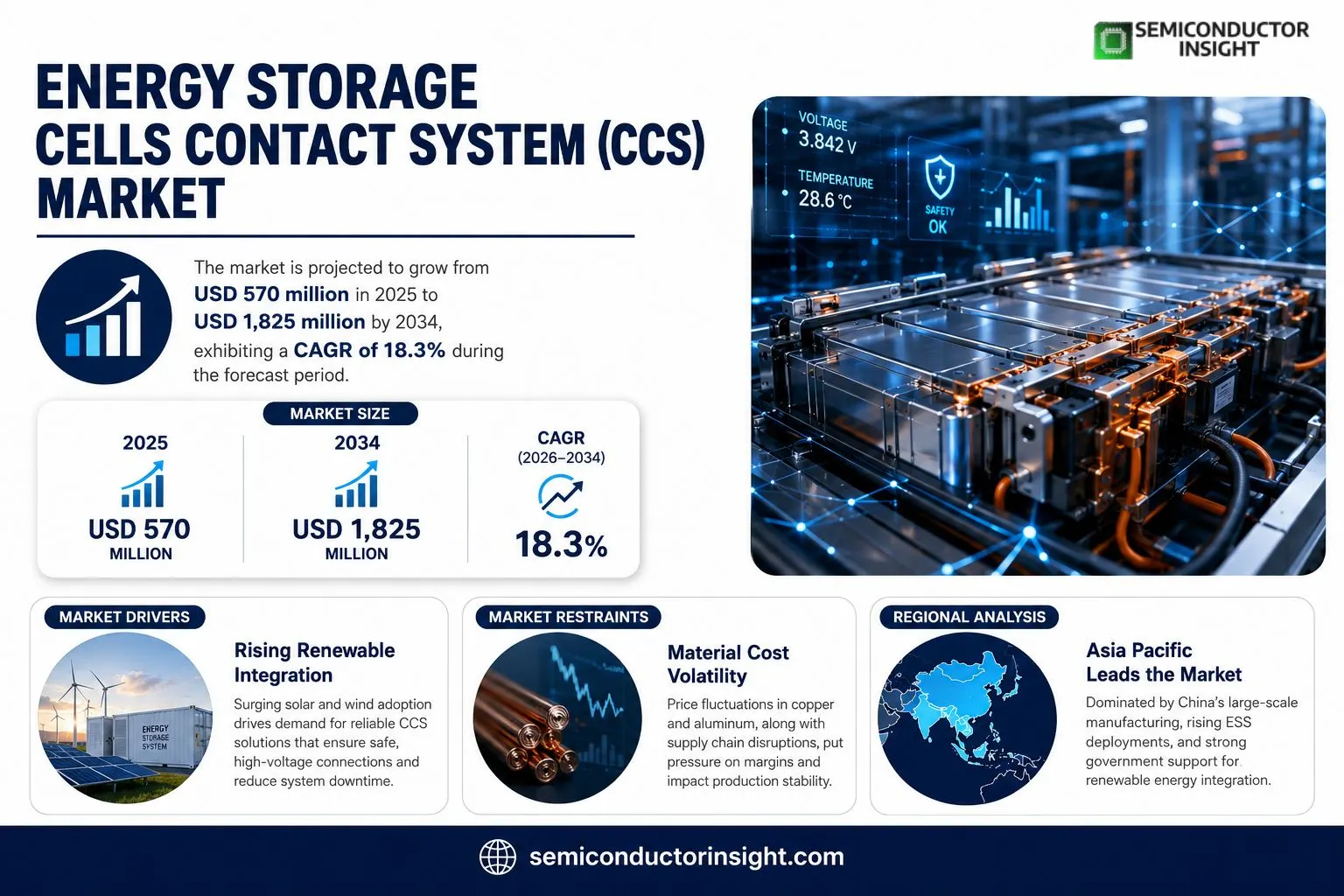
Energy Storage Cells Contact System (CCS) market size was valued at USD 570 million in 2025. The market is projected to reach USD 1,825 million by 2034, exhibiting a CAGR of 18.3% during the forecast period.
Cells Contact System (CCS) is a core component of new‑energy battery packs, comprising signal‑acquisition elements such as wiring harnesses, FPC/FFC, plastic structural parts and copper/aluminum busbars assembled by thermoforming or riveting. It enables high‑voltage series‑parallel cell connections and provides temperature and voltage sampling within the Battery Management System.The market is gaining momentum because renewable‑energy penetration drives demand for grid‑scale storage, while government incentives accelerate deployment of residential and commercial ESS solutions. At the same time, material price volatility for copper and aluminum introduces cost pressures, prompting manufacturers to pursue modular designs and integrated sensor functions for improved reliability.
MARKET DRIVERS
Rising Renewable Integration
The surge in utility‑scale solar and wind projects has exposed the need for reliable interfacing hardware. Energy Storage Cells Contact System (CCS) Market solutions now serve as the mechanical bridge that safeguards high‑current connections, reducing downtime and protecting expensive inverter banks.
Cost Pressures on Grid Modernization
Operators are tightening capex budgets while still pursuing grid resilience. Advanced CCS designs that incorporate modular tooling and reduced material waste are delivering up to 15% lower installation costs, prompting procurement teams to favor vendors offering these efficiencies.
➤ Manufacturers that embed real‑time diagnostics into contact systems can command premium pricing, as operators increasingly value predictive maintenance over reactive repairs.
Consequently, the convergence of tighter margins and higher reliability standards is accelerating adoption across both legacy substations and emerging micro‑grid deployments.
MARKET CHALLENGES
Regulatory Heterogeneity
Jurisdictions continue to publish divergent safety codes for high‑voltage interconnections. This patchwork forces suppliers to maintain multiple certification portfolios, inflating engineering overhead and slowing time‑to‑market for new CCS models.
Other Challenges
Supply‑Chain Volatility
The reliance on specialty alloys and precision stamping has made the CCS segment vulnerable to raw‑material price swings, particularly for copper and titanium alloys, which have risen 8% year‑over‑year.
MARKET RESTRAINTS
Limited Adoption in Distributed Energy Resources
Smaller rooftop installations often bypass dedicated CCS components, opting for simpler busbar connections that lack the robustness required for larger scale storage farms. This preference depresses overall market volume in the residential segment.Additionally, the perceived complexity of integrating CCS hardware with existing SCADA platforms deters some operators from upgrading legacy assets, especially where internal engineering resources are constrained.These factors together create a ceiling on market penetration until standardization efforts gain broader acceptance across the distributed energy landscape.
MARKET OPPORTUNITIES
Smart Connectivity Solutions
Embedding IoT sensors within CCS assemblies opens a pathway for tiered service models, where manufacturers can offer condition‑based contracts alongside hardware sales. Early pilots have demonstrated a 20% reduction in unplanned outages, suggesting a compelling value proposition for utilities seeking reliability guarantees.
Energy Storage Cells Contact System (CCS) Market Trends
Rising Demand from Grid‑Scale Storage Installations
The surge in utility‑scale battery projects has pushed manufacturers to accelerate CCS production. In 2025 the market generated roughly US$570 million, and analysts anticipate revenue to approach US$1.8 billion by 2034. This jump is not merely a function of higher unit salescapacity is forecast to exceed 18 million modules that yearwhile the average selling price hovers near US$33 per unit, delivering a gross margin close to 27 percent. The shift toward large‑capacity storage is driven by the need for grid stability as renewable penetration climbs, prompting utilities to adopt modular busbar solutions that simplify installation and reduce wiring complexity. For suppliers, the expanding addressable market translates into longer production runs, better amortization of tooling, and the ability to negotiate bulk material contracts that soften raw‑material price swings.
Other Trends
Material Cost Volatility
Copper and aluminum, the primary conductors in CCS assemblies, have experienced pronounced price oscillations in recent years. When metal costs spike, per‑unit production expense rises, squeezing the 26‑percent profit envelope that many vendors enjoy. Companies that have diversified their supply base or invested in alloy substitution are better positioned to protect margins. Moreover, the lack of universal quality standards forces manufacturers to adopt stricter testing protocols, which can add to overhead but also creates a competitive edge for firms that can certify higher reliability scores to OEMs.
Functional Integration and Modular Design
Beyond basic current conduction, modern CCS units increasingly embed sensors for voltage, temperature, and fault detection. This evolution reflects a broader industry move toward smarter battery management, where real‑time data feeds predictive maintenance algorithms. Modular architectures further enable system integrators to swap out individual CCS blocks without redesigning the entire pack, lowering life‑cycle costs and shortening field service cycles. As grid‑level storage grows in complexity, the safety and intelligence features of CCS will become decisive factors in supplier selection, encouraging R&D spend on integrated monitoring chips and standardized connector families.
COMPETITIVE LANDSCAPEKey Industry Players
Energy Storage Cells Contact System (CCS) Market – Competitive Overview
The CCS arena is dominated by a handful of multinational firms that combine deep engineering expertise with expansive supply‑chain networks. Amphenol, leveraging its long‑standing reputation in high‑performance interconnects, has captured a sizable share of automotive and utility‑scale projects by offering modular busbar assemblies that meet stringent thermal‑management standards. Leoni’s strategic focus on advanced wiring harnesses and flexible printed circuits places it at the core of next‑generation battery packs, especially in European and North‑American grid‑storage programs. Meanwhile, Molex and ElringKlinger have differentiated themselves through aggressive acquisition of niche PCB specialists, enabling tighter integration of signal‑acquisition modules and reducing the overall bill of materials for OEMs. The concentration of these players forces smaller entrants to pursue either highly customized solutions or cost‑leadership in emerging markets such as Southeast Asia, where local manufacturing incentives lower entry barriers.Beyond titans, a vibrant layer of specialized manufacturers sustains the ecosystem. Companies like Suzhou West Deane New Power Electric and Shenzhen Uniconn Technology excel in high‑volume copper‑busbar production, capitalising on China’s abundant raw‑material supply. Dongguan Silicon Xiang Insulation Material and Xiamen Hongxin Electronics Technology Group focus on proprietary plastic structural components that enable rapid thermo‑forming processes, delivering lighter modules for residential ESS installations. Smaller firms such as YD Electronic Technology and Shenglan Technology invest heavily in sensor‑fusion capabilities, embedding voltage and temperature monitoring directly into the contact system. This diversification creates a competitive pressure that encourages continual innovation, as each segment strives to improve reliability, reduce lifecycle costs, and meet the evolving safety standards imposed by grid‑operator regulations.
List of Key Energy Storage Cells Contact System (CCS) Companies Profiled
- Amphenol Corporation
- Molex LLC
- ElringKlinger AG
- Leoni AG
- Yazaki Corporation
- CelLink Technologies
- Suzhou West Deane New Power Electric Co., Ltd.
- Shenzhen Uniconn Technology Co., Ltd.
- Dongguan Silicon Xiang Insulation Material Co., Ltd.
- Xiamen Hongxin Electronics Technology Group Inc.
- Suzhou Recodeal Interconnect System Co., Ltd.
- Kunshan Kersen Science & Technology Co., Ltd.
- Shenglan Technology Co., Ltd.
- Huizhou Speed Wireless Technology Co., Ltd.
- Sun.King Technology Group Limited
Segment Analysis:
| Segment Category | Sub-Segments | Key Insights |
| By Type |
|
Wire Harness – The wire‑harness segment is dominant because it forms the primary conduit for signal and power transmission within the CCS architecture. It benefits from:
These qualitative strengths drive broader adoption across residential, commercial and utility‑scale energy storage solutions. |
| By Application |
|
Commercial/Industrial ESS – This application segment is emerging as the leading driver for CCS evolution. Its qualitative appeal stems from:
These factors collectively shape product road‑maps toward smarter, more resilient energy storage infrastructures. |
| By End User |
|
Lithium‑ion Batteries – Lithium‑ion remains the focal end‑user due to its pervasive role in modern ESS deployments. Qualitative insights include:
These considerations reinforce the strategic importance of CCS innovation for lithium‑ion‑centric storage ecosystems. |
| By System Architecture |
|
Modular CCS Platforms – Modularity is gaining traction as manufacturers seek flexibility across diverse storage projects. Key qualitative drivers:
These attributes position modular platforms as a strategic response to evolving market requirements. |
| By Functional Integration |
|
Signal Acquisition & Monitoring – The integration of sensing capabilities within CCS is shaping the next wave of intelligent storage solutions. Qualitative observations:
These functional enhancements underscore a shift toward more autonomous and resilient energy storage ecosystems. |
Regional Analysis: Energy Storage Cells Contact System (CCS) Market
Europe
The EU’s revised Energy Efficiency Directive embeds specific performance metrics for CCS components, nudging manufacturers toward higher thermal tolerances. National incentives for grid‑scale storage further tighten procurement criteria, emphasizing lifecycle cost assessments over initial capital outlays. This regulatory pressure accelerates the shift from legacy contacts to digitally enabled, self‑diagnostic units.
Recent disruptions in rare‑metal sourcing have prompted European firms to diversify supplier bases across Eastern Europe and Scandinavia. Collaborative procurement consortia are emerging, pooling demand to secure long‑term contracts that smooth price volatility and reduce lead times for critical CCS components.
High‑frequency welding and additive‑manufactured contact arms are gaining acceptance in pilot projects tied to offshore wind farms. These techniques deliver tighter tolerances, which translates into lower contact resistance and extended service intervalskey considerations for operators managing dispersed storage assets.
Established European players are leveraging legacy certifications to retain market share, while new entrants focus on smart‑sensor integration. The ensuing rivalry is expected to sharpen product roadmaps, with an emphasis on predictive maintenance algorithms that integrate directly with utility SCADA platforms.
North America
In North America, Energy Storage Cells Contact System (CCS) Market reflects a mosaic of state‑level incentives and federal directives that together foster a pragmatic approach to storage deployment. Utilities are prioritizing retrofits that minimize excavation costs, which drives demand for compact, high‑current contacts that can be installed within existing conduit footprints. Meanwhile, private‑equity‑backed startups are exploiting the region’s venture ecosystem to fast‑track the commercialization of solid‑state contact technologies, aiming to reduce arc‑over incidents in high‑density battery farms. The competitive environment rewards firms that can certify across both UL and IEC regimes, ensuring cross‑border applicability for projects that span the United States and Canada. As grid operators seek to balance intermittent solar generation with reliable dispatch, the emphasis on rapid fault isolation and modular replacement continues to shape procurement strategies.
Asia‑Pacific
Asia‑Pacific’s rapid urbanization fuels a distinct set of pressures on Energy Storage Cells Contact System (CCS) Market. In densely populated megacities, space constraints dictate the adoption of vertically stacked storage modules, which in turn demand contact systems with a reduced footprint yet uncompromised current‑carrying capacity. Governments across China, India, and South‑East Asia have introduced performance‑based rebates that reward installations meeting stringent safety thresholds, prompting local manufacturers to scale up automated assembly lines that can uphold tight quality standards. Integration with renewable micro‑grids is common, and operators often require CCS solutions that can tolerate frequent charge‑discharge cycles without degrading contact integrity. The region’s competitive pricing pressures are balanced by an accelerating shift toward standards harmonization, enabling exporters to tap into emerging markets without redesigning hardware.
South America
In South America, Energy Storage Cells Contact System (CCS) Market is shaped by a combination of expanding renewable portfolios and legacy hydro‑electric infrastructure. Utilities are experimenting with hybrid storage configurations that pair pumped hydro with lithium‑ion banks, creating a need for CCS units capable of seamless transition between low‑frequency and high‑frequency operating modes. Local content regulations compel manufacturers to source a portion of components domestically, fostering a nascent supply chain for contact alloys and insulating ceramics. While cost sensitivity remains high, project sponsors are willing to invest in higher‑grade contacts if they can demonstrate reduced outage risk in remote installations where maintenance logistics are challenging. Collaborative research initiatives between universities and industry are beginning to address corrosion issues specific to tropical climates.
Middle East & Africa
The Middle East & Africa region presents a heterogeneous landscape for Energy Storage Cells Contact System (CCS) Market. In the Gulf, large‑scale solar farms are paired with utility‑scale batteries that operate under extreme temperature swings, compelling vendors to develop contacts with enhanced thermal expansion compensation. Conversely, several African nations are piloting off‑grid storage solutions to extend electrification, which calls for ruggedized CCS designs that can survive dusty, high‑humidity environments. Public‑private partnerships are emerging as a financing mechanism, allowing multinational OEMs to introduce advanced contact technologies while training local technicians. Regulatory bodies are gradually updating safety codes to reflect the nuanced requirements of battery‑centric grids, a development that will likely raise the baseline performance expectations for all market participants.
Report Scope
This market research report provides a comprehensive analysis of the Energy Storage Cells Contact System (CCS) Market , covering the forecast period 2026–2034. It offers detailed insights into market dynamics, technological advancements, competitive landscape, and key trends shaping the industry.
Key focus areas of the report include:
- Market Overview: The report begins with an overview outlining its current market scenario, key growth indicators, and industry transformation drivers. It discusses macroeconomic factors, demand–supply balance, regulatory landscape, and the strategic role of semiconductors in powering advancements across industries such as automotive, telecommunications, consumer electronics, and industrial automation.
- Market Size & Forecast: Historical data and future projections for revenue, unit shipments, and market value across major regions and segments.
- Segmentation Analysis: Detailed breakdown by product type, technology, application, and end-user industry to identify high-growth segments and investment opportunities.
- Regional Insights: Insights into market performance across North America, Europe, Asia-Pacific, Latin America, and the Middle East & Africa, including country-level analysis where relevant.
- Competitive Landscape: Profiles of leading market participants, including their product offerings, R&D focus, manufacturing capacity, pricing strategies, and recent developments such as mergers, acquisitions, and partnerships.
- Technology Trends & Innovation: Assessment of emerging technologies, integration of AI/IoT, semiconductor design trends, fabrication techniques, and evolving industry standards.
- Market Drivers & Restraints: Evaluation of factors driving market growth along with challenges, supply chain constraints, regulatory issues, and market-entry barriers.
- Stakeholder Insights: Insights for component suppliers, OEMs, system integrators, investors, and policymakers regarding the evolving ecosystem and strategic opportunities.
Primary and secondary research methods are employed, including interviews with industry experts, data from verified sources, and real-time market intelligence to ensure the accuracy and reliability of the insights presented.
FREQUENTLY ASKED QUESTIONS:
What is the current market size of Energy Storage Cells Contact System (CCS) Market?
-> Energy Storage Cells Contact System (CCS) Market was valued at USD 570 million in 2025 and is expected to reach USD 1825 million by 2034, representing a CAGR of 18.3% over the forecast period.
Which key companies operate in Energy Storage Cells Contact System (CCS) Market?
-> Key players include Amphenol, Diehl Metal, Molex, ElringKlinger, ENNOVI, Leoni, CelLink Technologies, Yazaki, Suzhou West Deane New Power Electric Co., Ltd., Shenzhen Uniconn Technology Co., Ltd., Dongguan Silicon Xiang Insulation Material Co., Ltd., Suzhou Recodeal Interconnect System Co., Ltd., Xiamen Hongxin Electronics Technology Group Inc., Suzhou Wanxiang Technology Co., Ltd., Kunshan Kersen Science & Technology Co., Ltd., YD Electronic Technology Co., Ltd., Shenzhen Deren Electronic Co., Ltd., Xiamen Bolion Tech. Co., Ltd., Shenglan Technology Co., Ltd., Huizhou China Eagle Electronic Technology Co., Ltd., Huizhou Speed Wireless Technology Co., Ltd., Shenzhen Hui Chuang Da Technology Co., Ltd., Sun.King Technology Group Limited, Jiangsu Riying Electronics Co., Ltd., Changzhou NRB Corporation, Guangdong Mingji Hi‑Tech Electronics Co., Ltd..
What are the key growth drivers?
-> Key growth drivers include the rapid increase in renewable energy penetration (solar and wind), supportive government policies and subsidies, rising demand for grid‑scale and residential energy storage, continuous advancements in battery management systems, and the need for high‑reliability CCS components for long‑term stable operation.
Which region dominates the market?
-> Asia dominates the Energy Storage Cells Contact System market, driven by large‑scale manufacturing capacity in China, strong demand from Chinese grid‑scale storage projects, and expanding activities of major regional OEMs.
What are the emerging trends?
-> Emerging trends include the integration of advanced sensor functions (voltage, temperature, condition monitoring), modular design approaches to reduce maintenance costs, increased intelligence and automation through AI‑enabled BMS integration, and enhanced safety designs to meet stricter grid‑scale standards.

Get Sample Report PDF for Exclusive Insights
Report Sample Includes
- Table of Contents
- List of Tables & Figures
- Charts, Research Methodology, and more...