LR Button Cell Market Insights
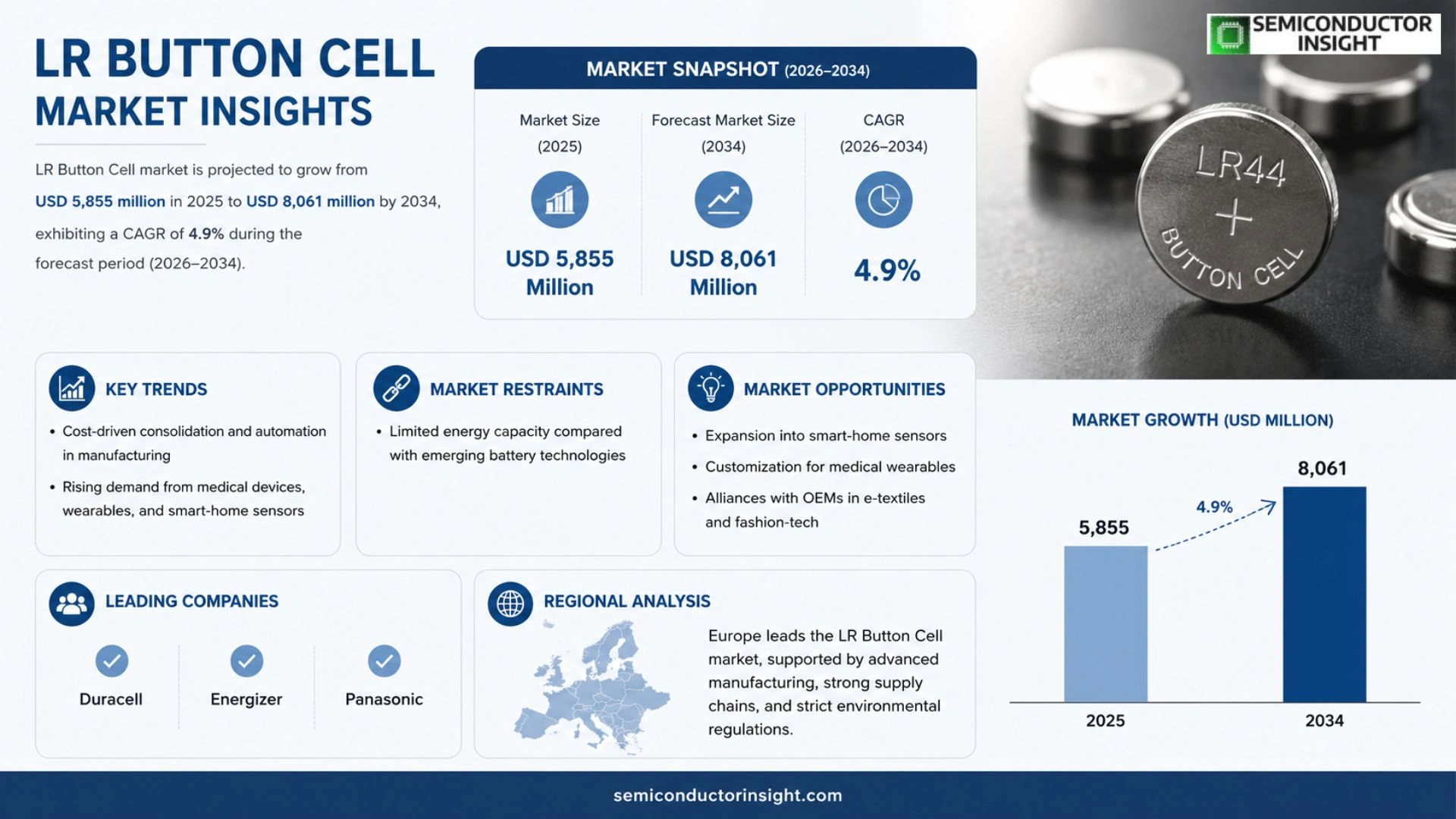
Global LR Button Cell market size is projected to grow from USD 5,855 million in 2025 to USD 8,061 million by 2034, exhibiting a CAGR of 4.9% during the forecast period.
LR Button Cell refers to a small alkaline button battery that uses zinc‑manganese dioxide chemistry with an alkaline potassium hydroxide electrolyte. It provides a stable voltage (typically 1.5 V) and long shelf life for low‑power devices such as watches, calculators, toys, laser pointers and various medical instruments; common models include LR44, LR41 and LR1130.
The market stays robust because cost‑effective power solutions remain essential for high‑volume consumer electronics and disposable medical devices. Although rechargeable and silver‑oxide alternatives exert pricing pressure, manufacturers are advancing leakage resistance and further miniaturisation to satisfy tighter device constraints. At the same time, stricter environmental regulations are driving stronger recycling initiatives and greener material sourcing across the supply chain.
MARKET DRIVERS
Increasing Demand for Miniaturized Power Sources
Manufacturers of wearables, medical implants and IoT sensors are opting for compact, reliable energy modules. LR Button Cell Market benefits from this shift because button cells deliver high energy density in a footprint that fits tight design envelopes. As device manufacturers prioritize battery life over bulk, procurement volumes for LR‑type button cells have risen steadily.
Regulatory Push for Safer Batteries
Recent safety regulations in Europe and North America require sealed, leak‑proof cells for consumer electronics. LR button cells, with their hermetically sealed construction, meet these standards without extensive redesign. Companies that adopt compliant cells avoid costly redesign cycles and accelerate time‑to‑market.
➤ Button‑cell manufacturers that invest in low‑mercury chemistries are seeing improved acceptance across regulated markets.
Supply‑chain resilience also influences buying patterns. LR Button Cell Market has benefited from diversified raw‑material sourcing, which cushions manufacturers against short‑term price spikes in lithium and zinc.
MARKET CHALLENGES
Cost Sensitivity in High‑Volume Applications
Automotive infotainment and large‑scale IoT deployments pressure battery suppliers to keep unit costs below a tight threshold. While LR button cells offer performance benefits, their manufacturing expense per amp‑hour can exceed that of alternative chemistries, prompting some OEMs to seek cheaper substitutes.
Other Challenges
Manufacturing Yield Constraints
The precision required to assemble sub‑millimeter cells leads to higher reject rates. Incremental improvements in yield demand investment in advanced automation, which can be prohibitive for smaller producers.
MARKET RESTRAINTS
Limited Energy Capacity Compared with Emerging Formats
LR Button Cell Market faces a ceiling in applications that require sustained power output beyond a few weeks. Emerging solid‑state and thin‑film batteries can store more energy in similar form factors, nudging design engineers toward those alternatives for long‑duration deployments.
MARKET OPPORTUNITIES
Expansion into Smart‑Home Sensors
Smart‑home ecosystems rely on dozens of battery‑powered sensors that are replaced infrequently. LR button cells, with their low self‑discharge rate, align well with this use case. Companies that tailor packaging for wall‑mounted devices can capture a growing slice of the residential market.
Customization for Medical Wearables
Medical wearables demand strict biocompatibility and long service life. By offering LR button cells coated with hypoallergenic materials and calibrated for low‑drain circuits, manufacturers can secure contracts with device makers focused on chronic‑care monitoring.
Finally, strategic alliances with OEMs developing next‑generation e‑textiles present a channel for LR Button Cell Market to infiltrate fashion‑tech products, where discrete power sources are a competitive differentiator.
LR Button Cell Market Trends
Cost‑Driven Consolidation in LR Button Cell Market
LR Button Cell Market is increasingly shaped by manufacturers’ pursuit of lower unit costs while maintaining acceptable performance. Zinc‑manganese dioxide chemistry remains the cheapest viable chemistry for low‑power devices, which explains why bulk producers are investing in larger electro‑forming facilities and automated sealing lines. The cost advantage translates into tighter margins for high‑volume applications such as toys and watches, where price sensitivity outweighs the modest energy‑density gap compared with premium silver‑oxide cells. As a result, the segment is witnessing a modest but steady uptick in order volumes, especially in emerging regions where disposable consumer electronics continue to expand.
Other Trends
Environmental Regulation and Recycling Initiatives
Stringent waste‑battery directives in Europe and North America are compelling LR Button Cell manufacturers to redesign packaging and adopt closed‑loop recycling schemes. Companies that integrate collection programs into their distribution networks are gaining preferential shelf space with major retailers. The regulatory pressure also spurs incremental R&D aimed at reducing potassium hydroxide leakage and extending shelf life, which in turn lowers the environmental footprint of each unit.
Miniaturization and Shelf‑Life Enhancement
Device designers are pushing for ever‑smaller form factors without sacrificing operating voltage. Producers respond by refining electrode thickness and employing advanced separators that improve ionic conductivity. Parallel improvements in electrolyte formulation have pushed typical shelf life beyond five years, a figure that reassures OEMs of long‑term reliability for remote‑control and medical‑instrument applications.
Regional Demand Shifts and Supply‑Chain Resilience
While traditional demand hubs in Europe remain stable, LR Button Cell Market is experiencing a noticeable pull from Southeast Asian manufacturers who benefit from lower labor costs and proximity to raw‑material suppliers such as zinc powder producers. This geographic shift is prompting Western players to diversify their supplier base, reducing exposure to potential disruptions in any single region. The strategic re‑allocation of sourcing not only safeguards supply continuity but also opens avenues for collaborative innovation on greener production methods.
COMPETITIVE LANDSCAPE
Key Industry Players
Competitive Dynamics and Market Structure of Global LR Button Cell Producers
LR Button Cell arena is anchored by a handful of multinational manufacturers whose scale permits aggressive pricing and extensive distribution networks. Duracell, Energizer and Panasonic together command roughly one‑third of global shipments, leveraging vertically integrated supply chains that span zinc‑powder polishing to precision sealing. Their dominance stems from long‑standing OEM relationships in watches, toys and low‑power medical devices, plus continuous investment in leak‑resistant cell designs that sustain brand loyalty among bulk buyers. The concentration of capacity among these three firms creates a competitive environment where margin pressure is moderated by the ability to secure raw‑material contracts at favorable terms, while also enabling rapid response to regional regulatory shifts concerning disposable batteries.
Beyond the tier‑one giants, the market features a diverse set of niche manufacturers that thrive on specialized product lines or regional market knowledge. Companies such as Zhongyin (Ningbo) Battery, Tiger Head, GP and FDK Corporation focus on high‑volume LR44 and LR41 variants for Asia‑Pacific toy manufacturers, often differentiating through tighter tolerances and bespoke packaging solutions. Smaller entrants like Mustar, Golden Power and Vinnic Power have carved out positions in emerging economies by offering cost‑effective alternatives that meet local safety standards, while firms such as EASTAR Battery and MICROCELL Battery emphasize recycling‑friendly formulations to address tightening environmental regulations. This layered competitive fabric ensures that while the market appears mature, continual innovation in shelf‑life stability and eco‑compliance generates incremental opportunities for both established and emerging players.
List of Key LR Button Cell Companies Profiled
- Duracell
- Energizer
- Panasonic
- Zhongyin (Ningbo) Battery
- Tiger Head
- GP
- FDK Corporation
- Mustar
- Golden Power
- Vinnic Power
- EASTAR Battery
- MICROCELL Battery
- Changhong
- Maxell
- Huatai Group
Segment Analysis:
| Segment Category | Sub-Segments | Key Insights |
| By Type |
|
Standard alkaline LR cells remain the dominant type because they balance low cost with reliable voltage output for a broad range of everyday gadgets.
|
| By Application |
|
Watches and time‑keeping devices drive the bulk of demand because of the sheer volume of personal timepieces worldwide.
|
| By End User |
|
Individual consumers anchor the market through repetitive purchases for everyday gadgets.
|
| By Voltage |
|
1.5 V standard cells dominate because the majority of legacy and contemporary low‑power devices are engineered around this voltage level.
|
| By Form Factor |
|
Standard button sizes continue to be the core offering, reflecting entrenched device architectures across the consumer space.
|
Regional Analysis: LR Button Cell Market
Europe
The EU’s Battery Directive mandates high recovery rates for button cells, compelling manufacturers to redesign end‑of‑life processes. Companies that pre‑emptively integrate recycling‑friendly materials are gaining preferential access to government‑backed procurement programs, especially in health‑care and automotive sectors.
Localized sourcing of manganese dioxide and electrolytes mitigates disruptions caused by geopolitical tensions. Firms are establishing strategic stockpiles within the EU to secure continuity, a practice that rivals in Asia are beginning to emulate.
Research clusters around Munich and Stockholm focus on solid‑state button cell prototypes. Partnerships between universities and industry accelerate the translation of laboratory breakthroughs into commercially viable formats, shortening time‑to‑market for premium devices.
European users prioritize longevity and environmental credentials. Marketing narratives that highlight low‑impact production and extended service life resonate strongly, influencing purchase decisions in consumer electronics and medical wearables.
North America
In North America, LR Button Cell Market is shaped by a fragmented supplier base and a strong focus on cost efficiency. While the United States lacks a unified regulatory regime comparable to Europe, individual states are introducing recycling incentives that gradually harmonize standards. Manufacturers capitalize on a robust logistics infrastructure that supports rapid distribution to the automotive and consumer‑electronics sectors. Strategic investments in high‑throughput coating technologies enable firms to meet the volume demands of large‑scale OEMs without sacrificing product consistency. Companies that balance price competitiveness with incremental performance improvements are securing the most advantageous supply contracts.
Asia‑Pacific
The Asia‑Pacific region presents a contrasting dynamic, where rapid urbanization fuels demand for compact power sources across mobile devices and IoT gadgets. Nations such as China, Japan, and South Korea host dense manufacturing clusters that excel in scaling production, yet they grapple with inconsistent environmental policies. This creates a dual environment where low‑cost output coexists with rising pressure from multinational customers for greener practices. Firms that adopt modular designs and invest in regional recycling facilities are better positioned to satisfy both price‑sensitive markets and increasingly sustainability‑aware buyers.
South America
In South America, market growth is anchored by expanding healthcare infrastructure and a burgeoning consumer‑electronics market. Regulatory frameworks remain nascent, allowing local manufacturers to experiment with cost‑effective material blends. However, import reliance on European and Asian components introduces supply‑chain vulnerabilities. Companies that forge joint ventures with local distributors gain access to smaller retail channels and can tailor product specifications to regional device standards, thereby enhancing market penetration.
Middle East & Africa
The Middle East & Africa region exhibits a niche but evolving landscape for LR Button Cell Market. Accelerated adoption of renewable‑energy storage and portable medical equipment drives modest demand. Limited local production capabilities mean most cells are imported, exposing the market to price fluctuations. Enterprises that establish regional assembly hubs, leveraging duty‑free zones and partnering with telecom operators for device integration, are creating footholds that could translate into broader market influence as digital health initiatives expand.
Report Scope
This market research report provides a comprehensive analysis of the LR Button Cell Market , covering the forecast period 2026–2034. It offers detailed insights into market dynamics, technological advancements, competitive landscape, and key trends shaping the industry.
Key focus areas of the report include:
- Market Overview: The report begins with an overview outlining its current market scenario, key growth indicators, and industry transformation drivers. It discusses macroeconomic factors, demand–supply balance, regulatory landscape, and the strategic role of semiconductors in powering advancements across industries such as automotive, telecommunications, consumer electronics, and industrial automation.
- Market Size & Forecast: Historical data and future projections for revenue, unit shipments, and market value across major regions and segments.
- Segmentation Analysis: Detailed breakdown by product type, technology, application, and end-user industry to identify high-growth segments and investment opportunities.
- Regional Insights: Insights into market performance across North America, Europe, Asia-Pacific, Latin America, and the Middle East & Africa, including country-level analysis where relevant.
- Competitive Landscape: Profiles of leading market participants, including their product offerings, R&D focus, manufacturing capacity, pricing strategies, and recent developments such as mergers, acquisitions, and partnerships.
- Technology Trends & Innovation: Assessment of emerging technologies, integration of AI/IoT, semiconductor design trends, fabrication techniques, and evolving industry standards.
- Market Drivers & Restraints: Evaluation of factors driving market growth along with challenges, supply chain constraints, regulatory issues, and market-entry barriers.
- Stakeholder Insights: Insights for component suppliers, OEMs, system integrators, investors, and policymakers regarding the evolving ecosystem and strategic opportunities.
Primary and secondary research methods are employed, including interviews with industry experts, data from verified sources, and real-time market intelligence to ensure the accuracy and reliability of the insights presented.
FREQUENTLY ASKED QUESTIONS:
What is the current market size of LR Button Cell Market?
-> Global LR Button Cell market size is projected to grow from USD 8,061 million by 2034, exhibiting a CAGR of 4.9% during the forecast period.
Which key companies operate in LR Button Cell Market?
-> Key players include Duracell, Zhongyin (Ningbo) Battery, Panasonic, Tiger Head, Energizer, Nanfu, Toshiba, GP, FDK Corporation, Mustang, Changhong, Maxell, Golden Power, Huatai Group, Weijiang Power, Huizhou WinPow Industrial, Guangdong Liwang New Energy, EASTAR Battery, MICROCELL Battery, Vinnic Power, PKCELL, Camelion, Sunmol Battery.
What are the key growth drivers?
-> Key growth drivers include stable demand from watches, toys, calculators and portable electronics, low‑cost advantage of alkaline chemistry, expansion in emerging markets, and ongoing improvements in leakage resistance, shelf‑life and miniaturization.
Which region dominates the market?
-> Asia accounts for the largest share of production and consumption, driven by extensive manufacturing bases in China, Japan, South Korea and growing demand across Southeast Asia and India.
What are the emerging trends?
-> Emerging trends include enhanced environmental compliance and recycling programs, development of higher energy‑density alkaline chemistries, and design innovations targeting longer shelf life and reduced leakage for high‑volume consumer applications.
Get Sample Report PDF for Exclusive Insights
Report Sample Includes
- Table of Contents
- List of Tables & Figures
- Charts, Research Methodology, and more...
 Download Sample Report PDF