Power Battery Cells Contact System (CCS) Market Insights
Power Battery Cells Contact System (CCS) market size was valued at USD 3,616 million in 2025 and will grow to USD 9,934 million by 2034, exhibiting a CAGR of 15.7% during the forecast period.
A Power Battery Cells Contact System (CCS) is a modular component installed in battery modules for electric vehicles and other power applications. It enables series‑parallel cell interconnection, voltage and temperature signal acquisition, and communication with the Battery Management System (BMS), thereby ensuring efficient current flow, safety and data integrity.Accelerated electrification pushes demand as EV sales are expected to exceed 20 million units in 2025. Policy incentives such as purchase subsidies further stimulate battery adoption, while continuous improvements in energy density and charging speed raise technical requirements for CCS solutions. A recent industry survey of manufacturers and suppliers highlights rising production capacity190 million units slated for 2025and an average unit price of roughly USD 20.8.
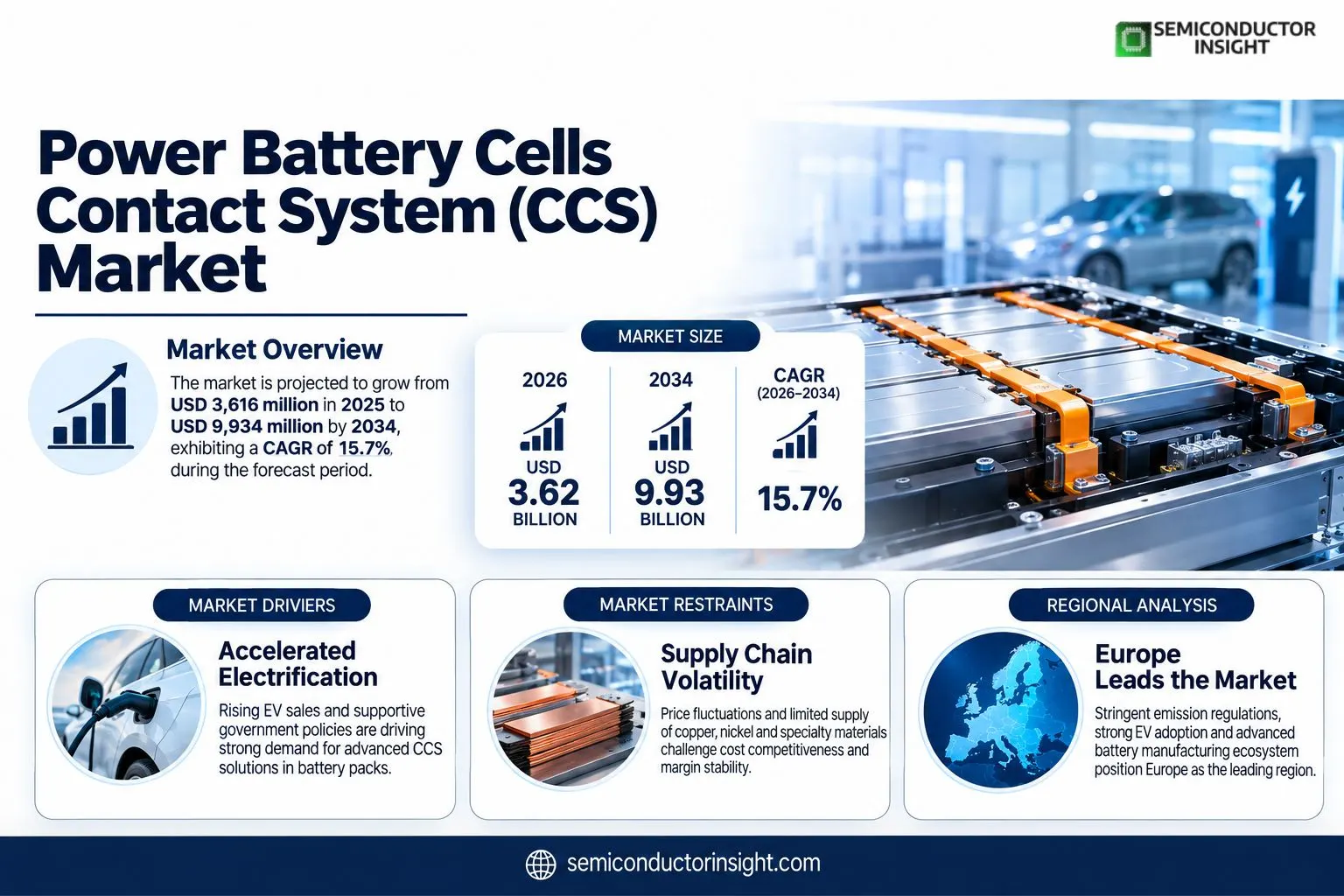
MARKET DRIVERS
Electrification of Mobility Platforms
The surge in electric‑vehicle rollouts across Europe and Asia has forced OEMs to prioritize compact, high‑current contact solutions. Power Battery Cells Contact System (CCS) Market suppliers that can deliver lower resistance paths and proven thermal stability are now preferred partners, because they directly influence vehicle range and charger compatibility.
Regulatory Pressure on Safety Standards
New safety directives mandate rigorous testing of cell interconnects to prevent short‑circuit incidents under crash conditions. Companies that have invested in advanced sealing technologies and conductive‑gap monitoring are gaining market share, as certification timelines tighten and manufacturers look to avoid costly redesigns.
➤ Manufacturers that integrate real‑time contact diagnostics can differentiate their EV platforms while reducing warranty claims.
Finally, the transition to higher voltage architectures (800 V and above) creates a natural demand for contact systems that can handle increased electrical stress without sacrificing durability. Power Battery Cells Contact System (CCS) Market players offering modular, scalable designs are positioned to capture orders from both legacy and next‑generation vehicle programs.
MARKET CHALLENGES
Supply‑Chain Volatility for Critical Materials
Nickel, copper, and specialty polymers essential to contact interfaces face periodic shortages that ripple through Power Battery Cells Contact System (CCS) Market. Production planners must hedge against price spikes, which compress margins for firms lacking diversified sourcing strategies.
Other Challenges
Manufacturing Complexity
The precision stamping and laser welding steps required to meet tolerances below 50 µm drive up capital expenditures. Small‑scale vendors often lack the economies of scale to compete with tier‑one suppliers, leading to market consolidation.Additionally, the rapid evolution of battery chemistries forces ongoing redesign of contact geometries. Companies that cannot iterate quickly risk obsolescence as automakers adopt solid‑state cells.
MARKET RESTRAINTS
Cost Sensitivity in Mass‑Market Segments
While premium EV brands can absorb higher component costs, volume manufacturers remain tightly bound to bill‑of‑materials targets. Power Battery Cells Contact System (CCS) Market solutions that exceed cost thresholds are often replaced by lower‑priced alternatives, even if they sacrifice performance.
MARKET OPPORTUNITIES
Integration of Smart Monitoring Electronics
Embedding miniature sensors within the contact system opens a pathway to predictive maintenance services. Providers that bundle connectivity with analytics can unlock recurring revenue streams and justify premium pricing, particularly in fleet‑operated electric buses and delivery vans.
Power Battery Cells Contact System (CCS) Market Trends
Accelerated Electrification Drives CCS Volume
The surge in electric‑vehicle registrations has pushed the required output of Power Battery Cells Contact System (CCS) units to unprecedented levels. In 2025 production reached roughly 190 million units, a figure that reflects both the scale of EV roll‑out and the expanding role of CCS in commercial trucks, two‑wheelers and portable power tools. Because a CCS bridges individual cells, transfers current, and relays temperature and voltage data to the BMS, every additional vehicle adds a proportional demand for these modular components. Manufacturers such as Kosen Technology and Huichuangda have already expanded capacity to 3 million and 12 million units respectively, indicating that supply chains are being re‑aligned to meet the near‑term volume shock. This upward pressure on unit sales improves economies of scale, nudging average prices toward the $20 range while preserving healthy gross margins near 27 percent.
Other Trends
Policy Incentives Bolster CCS Adoption
Governments across North America, Europe and Asia have introduced purchase subsidies, zero‑emission mandates and stricter fleet regulations. These measures translate directly into higher battery pack orders, which in turn increase the need for reliable interconnect solutions. The CCS market benefits from this policy environment because its safety‑critical function aligns with regulators’ focus on crash survivability and thermal runaway prevention. As a result, companies that can certify their busbars and PCB‑based contact systems to stringent automotive standards are gaining preferential access to OEM supply lists, a competitive edge that reshapes the supplier landscape.
Technology Evolution Redefines CCS Architecture
Advancements in cell chemistryparticularly the shift toward high‑energy pouch and prismatic formatshave forced CCS designers to rethink layout density and signal routing. New FPC and flexible PCB solutions enable tighter packaging while maintaining low resistance pathways, a requirement as charging currents climb beyond 500 A in fast‑charge scenarios. Simultaneously, integration of temperature‑sensing nodes directly onto busbars reduces wiring harness complexity and cuts overall vehicle weight. Suppliers that invest in these integrated designs can command premium pricing and support OEMs seeking to improve vehicle range without sacrificing safety. The ripple effect extends to the upstream raw‑material market, where demand for high‑purity copper and aluminum alloys is rising in tandem with the need for thinner, more conductive busbars.
COMPETITIVE LANDSCAPEKey Industry Players
Power Battery Cells Contact System (CCS) Market – Competitive Overview
The CCS arena is dominated by a handful of suppliers that command the bulk of unit shipments and revenue. Amphenol, with its extensive busbar and connector portfolio, leverages deep relationships with Tier‑1 EV manufacturers to secure long‑term contracts, thereby shaping the supply chain hierarchy. Diehl Metal and Molex follow closely, each differentiating through advanced materials engineering that reduces resistance and improves thermal management. These incumbents benefit from scale economies, enabling price competitiveness while maintaining healthy margin levels. Their dominance forces smaller entrants to specialize in niche applications such as high‑performance electric motorcycles or power‑tool modules, where customization outweighs pure volume considerations.Beyond the top tier, a diverse set of regional players addresses specific market segments. Companies like Suzhou West Deane New Power Electric and Shenzhen Uniconn Technology focus on cost‑efficient PCB‑based CCS solutions for commercial vehicle platforms in China. Meanwhile, European firms such as Leoni and ElringKlinger concentrate on safety‑critical systems for passenger‑vehicle modules, capitalizing on stringent regulatory environments. The proliferation of these specialized firms adds depth to the competitive field, encouraging continuous innovation in materials, signal‑integrity design, and integration with battery‑management architectures.
List of Key Power Battery Cells Contact System Companies Profiled
- Amphenol
- Diehl Metal
- Molex
- ElringKlinger
- Leoni
- Yazaki
- Suzhou West Deane New Power Electric Co., Ltd.
- Shenzhen Uniconn Technology Co., Ltd.
- Dongguan Silicon Xiang Insulation Material Co., Ltd.
- Suzhou Recodeal Interconnect System Co., Ltd.
- Xiamen Hongxin Electronics Technology Group Inc.
- Kunshan Kersen Science & Technology Co., Ltd.
Segment Analysis:
| Segment Category | Sub-Segments | Key Insights |
| By Type |
|
Wire Harness – CCS is emerging as the prevalent choice because it offers robust mechanical integrity and straightforward integration with existing vehicle architectures.
|
| By Application |
|
Passenger Vehicles drive the most intense innovation activity for CCS solutions.
|
| By End User |
|
OEMs shape design specifications and set performance expectations for CCS components.
|
| By Battery Chemistry |
|
Pouch Cells are gaining traction as they enable thinner pack designs, influencing CCS configurations.
|
| By Market Trend |
|
Safety‑Critical Solutions dominate strategic road‑maps as regulators and consumers demand fault‑tolerant designs.
|
Regional Analysis: Power Battery Cells Contact System (CCS) Market
Europe
The EU’s Green Deal and battery‑cell recycling directives force manufacturers to rethink connector lifecycles. This compulsion drives firms to integrate recyclable materials into contact systems, creating a niche for suppliers that can certify compliance while preserving electrical performance.
Recent mergers among European tooling companies have reduced supplier fragmentation. The resulting scale allows tighter coordination on tolerances, which translates into lower failure rates for high‑current CCS assemblies across vehicle lines.
Several OEMs have signed long‑term agreements with contact‑system innovators to co‑develop smart‑monitoring circuits. These collaborations embed diagnostic capability directly into the CCS, opening aftermarket revenue streams through predictive maintenance services.
The concentration of electrical‑engineering talent in Germany and France fuels rapid prototyping. Companies leverage local research institutes to iterate designs faster than competitors operating in less collaborative ecosystems.
North America
North America’s approach to Power Battery Cells Contact System (CCS) Market reflects a blend of aggressive cost‑reduction targets and a strong emphasis on performance. Automakers prioritize lightweight connectors that can handle higher discharge currents, a requirement driven by the continent’s expanding electric‑vehicle fleet. The region’s venture capital landscape fuels startups that focus on novel alloy compositions, promising incremental gains in conductivity. Meanwhile, large OEMs maintain strategic alliances with legacy component makers to secure supply certainty, especially for long‑range trucks that push CCS limits. This dual‑track strategy creates a marketplace where price and precision vie for dominance, compelling suppliers to differentiate through modular designs that can be quickly adapted across model lines.
Asia‑Pacific
In Asia‑Pacific, Power Battery Cells Contact System (CCS) Market is shaped by rapid scaling of production capacity and a policy environment that encourages domestic sourcing. Nations such as China and South Korea invest heavily in battery‑cell ecosystems, prompting contact‑system manufacturers to align closely with local cell producers. The emphasis on mass‑production efficiency leads firms to standardize connector geometries, yet the diversity of vehicle architectures across the region forces a parallel track of bespoke solutions for premium segments. This tension between uniformity and customization has spurred a wave of advanced automation that can toggle between high‑volume runs and low‑volume, high‑spec orders without sacrificing quality.
South America
South America’s involvement in Power Battery Cells Contact System (CCS) Market is emerging, driven by governmental incentives aimed at expanding electric‑mobility in urban centers. Local manufacturers are exploring partnership models with European and Asian suppliers to acquire technology know‑how while keeping a foothold in cost‑sensitive markets. The nascent stage of the supply chain encourages a focus on modular, plug‑and‑play contact systems that can be retrofitted to a variety of vehicle platforms, reducing entry barriers for fleet operators transitioning to electric power. This pragmatic approach creates a niche for firms that can offer flexible, service‑oriented contracts rather than pure product sales.
Middle East & Africa
The Middle East & Africa region presents a distinct set of opportunities for Power Battery Cells Contact System (CCS) Market, largely tied to its growing interest in renewable‑energy integration and off‑grid power solutions. Companies operating in harsh climate conditions demand contact systems with superior thermal resilience, prompting local players to source materials that can withstand extreme temperature swings. Collaborative projects between oil‑and‑gas firms and electric‑vehicle entrants are fostering hybrid supply chains, where CCS technology is repurposed for both transportation and stationary storage applications. This cross‑sector utilization encourages vendors to adopt a broader product portfolio, positioning themselves as integral partners in the region’s diversified energy transition.
Report Scope
This market research report provides a comprehensive analysis of the Power Battery Cells Contact System (CCS) Market , covering the forecast period 2026–2034. It offers detailed insights into market dynamics, technological advancements, competitive landscape, and key trends shaping the industry.
Key focus areas of the report include:
- Market Overview: The report begins with an overview outlining its current market scenario, key growth indicators, and industry transformation drivers. It discusses macroeconomic factors, demand–supply balance, regulatory landscape, and the strategic role of semiconductors in powering advancements across industries such as automotive, telecommunications, consumer electronics, and industrial automation.
- Market Size & Forecast: Historical data and future projections for revenue, unit shipments, and market value across major regions and segments.
- Segmentation Analysis: Detailed breakdown by product type, technology, application, and end-user industry to identify high-growth segments and investment opportunities.
- Regional Insights: Insights into market performance across North America, Europe, Asia-Pacific, Latin America, and the Middle East & Africa, including country-level analysis where relevant.
- Competitive Landscape: Profiles of leading market participants, including their product offerings, R&D focus, manufacturing capacity, pricing strategies, and recent developments such as mergers, acquisitions, and partnerships.
- Technology Trends & Innovation: Assessment of emerging technologies, integration of AI/IoT, semiconductor design trends, fabrication techniques, and evolving industry standards.
- Market Drivers & Restraints: Evaluation of factors driving market growth along with challenges, supply chain constraints, regulatory issues, and market-entry barriers.
- Stakeholder Insights: Insights for component suppliers, OEMs, system integrators, investors, and policymakers regarding the evolving ecosystem and strategic opportunities.
Primary and secondary research methods are employed, including interviews with industry experts, data from verified sources, and real-time market intelligence to ensure the accuracy and reliability of the insights presented.
FREQUENTLY ASKED QUESTIONS:
What is the current market size of Power Battery Cells Contact System (CCS) Market?
-> Power Battery Cells Contact System (CCS) Market was valued at USD 3616 million in 2025 and is expected to reach USD 9934 million by 2034, growing at a CAGR of 15.7% during the forecast period.
Which key companies operate in Power Battery Cells Contact System (CCS) Market?
-> Key players include Amphenol, Diehl Metal, Molex, ElringKlinger, ENNOVI, Leoni, CelLink Technologies, Yazaki, Suzhou West Deane New Power Electric Co., Ltd., Shenzhen Uniconn Technology Co., Ltd., Dongguan Silicon Xiang Insulation Material Co., Ltd., Suzhou Recodeal Interconnect System Co., Ltd., Xiamen Hongxin Electronics Technology Group Inc., Suzhou Wanxiang Technology Co., Ltd., Kunshan Kersen Science & Technology Co.,Ltd., YD Electronic Technology Co., Ltd., Shenzhen Deren Electronic Co., Ltd., Xiamen Bolion Tech. Co., Ltd., Shenglan Technology Co., Ltd., Huizhou China Eagle Electronic Technology Co., Ltd., Huizhou Speed Wireless Technology Co., Ltd., Shenzhen Hui Chuang Da Technology Co., Ltd., Sun.King Technology Group Limited, Jiangsu Riying Electronics Co., Ltd., Changzhou NRB Corporation, Guangdong Mingji Hi-Tech Electronics Co., Ltd..
What are the key growth drivers?
-> Key growth drivers include accelerated electrification (rising EV sales exceeding 20 million units by 2025), supportive government policies (subsidies and environmental regulations), and continuous battery technology advancements (higher energy density, power output, and faster charging).
Which region dominates the market?
-> The reference does not specify a single dominant region; market coverage is with significant activity across North America, Europe, and Asia.
What are the emerging trends?
-> Emerging trends include increasing integration of CCS with advanced Battery Management Systems, growth in modular CCS designs for various EV platforms, and heightened focus on cost‑effective high‑volume production (projected 190 million units in 2025).

Get Sample Report PDF for Exclusive Insights
Report Sample Includes
- Table of Contents
- List of Tables & Figures
- Charts, Research Methodology, and more...
 Download Sample Report PDF