Lithium-ion Battery Tab Lead Market Insights
Lithium-ion Battery Tab Lead market was valued at USD 853 million in 2025 and is expected to reach USD 1,894 million by 2034, reflecting a CAGR of 11.9% over the forecast period.
Lithium‑ion battery tab leads serve as the conductive bridges that link individual cells to external circuitry. Produced mainly from aluminum, copper or nickel‑based alloys, they carry high currents while providing mechanical support that maintains cell alignment during assembly and operation. Because their resistance directly affects overall battery efficiency, manufacturers optimise material purity and surface treatment to enhance conductivity, thermal dissipation and weld reliability. These leads are therefore indispensable across power‑train packs for electric vehicles, portable consumer electronics and large‑scale energy‑storage modules.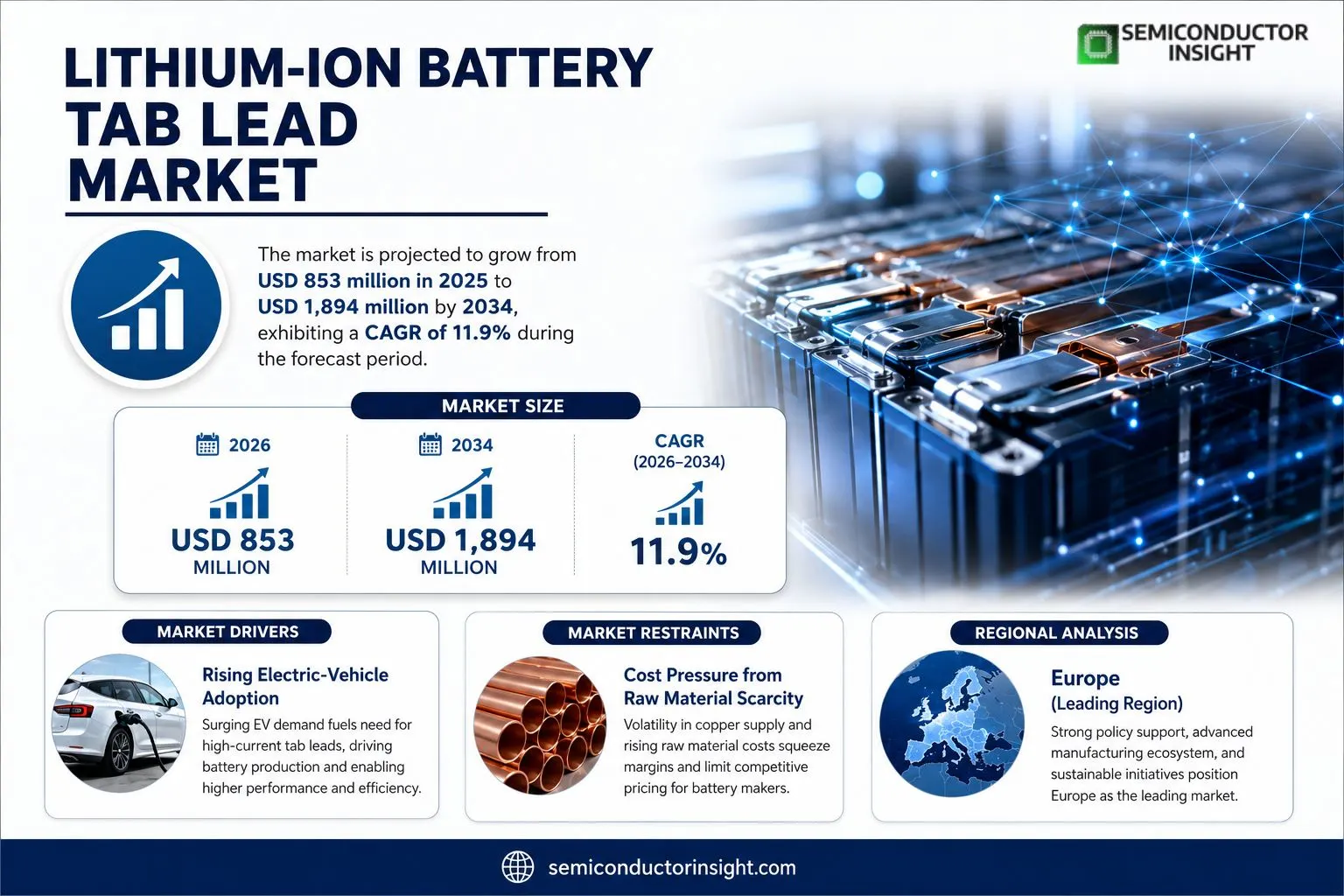
MARKET DRIVERS
Rising electric‑vehicle adoption
The surge in electric‑vehicle (EV) registrations across Europe, China and the United States has generated a steady demand for higher‑capacity lithium‑ion cells. Battery manufacturers are consequently expanding production lines, which amplifies the need for reliable tab leads that can sustain higher current loads without excessive heating.
Scaling of renewable‑energy storage
Utility‑scale storage projects are transitioning from legacy chemistries to lithium‑ion formats because of their superior round‑trip efficiency. This shift forces cell designers to adopt tab‑lead configurations that optimize space utilization and minimize internal resistance, thereby enhancing overall system performance.
➤ “Tab‑lead engineering now directly influences cell cost parity with incumbent technologies, making it a decisive factor for OEMs seeking price competitiveness.”
Manufacturers that invest early in precision‑formed copper tab leads are positioning themselves to capture a larger share of the emerging supply chain, as downstream assemblers prioritize components that reduce cell failure rates and extend service life.
MARKET CHALLENGES
Supply volatility of high‑purity copper
copper mines are experiencing operational disruptions due to geopolitical tensions and environmental restrictions. The resulting scarcity of high‑grade copper billets drives up the price of tab‑lead blanks, squeezing margins for battery pack producers that must maintain cost‑effective pricing for end‑users.
Other Challenges
Manufacturers also grapple with intense competition from low‑cost Asian suppliers who prioritize volume over stringent quality controls, leading to inconsistent dimensional tolerances that can affect cell reliability.
Regulatory compliance
Stringent RoHS and REACH regulations compel producers to validate that every alloy component of the tab lead complies with hazardous substance limits, adding testing overhead and certification expenses that smaller players struggle to absorb.
MARKET RESTRAINTS
Cost pressure from raw‑material scarcity
As the price of copper and associated alloying elements climbs, downstream battery pack assemblers face a tightening cost floor. Even modest increases in tab‑lead pricing ripple through the bill of materials, limiting the ability of OEMs to offer competitive pricing on final EV or storage products.
MARKET OPPORTUNITIES
Advanced tab‑lead alloys for higher energy density
Research into nickel‑copper‑tin (Ni‑Cu‑Sn) and silver‑based alloys promises reduced electrical resistance while maintaining mechanical robustness. Early adopters that qualify these materials can market cells with marginally higher energy density, a compelling proposition for premium EV segments seeking extended range.Furthermore, the growing emphasis on recyclability encourages firms to develop tab leads that simplify material recovery, opening a niche service market for closed‑loop supply chains and creating a differentiated value proposition for environmentally conscious brands.
Lithium-ion Battery Tab Lead Market Trends
Shift Toward Higher‑Conductivity Substrates
The conductive link between individual cells and external circuitry is increasingly built from refined aluminum and copper alloys. Manufacturers are prioritizing substrate grades that reduce electrical resistance while maintaining mechanical resilience. This material tightening aligns with the demand for denser energy packs, where even marginal voltage loss translates into measurable range gains for electric vehicles. The downstream pressure comes from OEMs that request tighter tolerances on tab thickness and surface finish, prompting suppliers to invest in precision rolling and plating lines. As a result, the overall design cycle shortens, and yields improve, allowing firms to differentiate on performance rather than sheer volume.
Other Trends
Supply‑Chain Pressures on Raw Materials
Aluminum and copper price swings have become a routine consideration for budgeting teams. While large producers such as the Aluminum Corporation of China can influence pricing through output adjustments, smaller specialty alloy makers lack that leverage, creating pockets of cost uncertainty. In response, several tab‑lead fabricators are exploring dual‑sourcing agreements and forward‑contract mechanisms to lock in feedstock rates. The strategic aim is to shield production schedules from sudden spikes that could erode the modest gross margins typical of this segment. Concurrently, recycling initiatives are gaining traction, with reclaimed copper offering a cost‑effective alternative that also satisfies sustainability mandates from downstream customers.
Margin Dynamics and Premium Product Pathways
Profitability in the sector remains anchored to the balance between standard‑grade volume sales and niche high‑performance offerings. Standard leads, produced at scale, compete heavily on price, limiting margin expansion. Conversely, leads engineered for extreme current loadsfeaturing advanced surface treatments and tighter thickness tolerancescommand higher price points and deliver better profitability per unit. Companies that can integrate these premium lines into existing facilities without substantial capital outlay stand to capture a larger share of the value chain. This shift encourages a strategic reevaluation of product portfolios, where diversification into high‑margin, application‑specific leads becomes a core growth lever.
COMPETITIVE LANDSCAPEKey Industry Players
Lithium‑ion Battery Tab Lead Competitive Overview
Sumitomo Electric Industries commands the largest share of the tab‑lead market, leveraging its long‑standing expertise in aluminum extrusion and precision stamping. The firm’s close integration with upstream metal suppliers such as Aluminum Corporation of China allows it to secure low‑cost, high‑purity feedstock, while an extensive engineering team tailors lead geometry for high‑current EV power‑pack modules. This combination of scale, supply‑chain control, and technical depth gives Sumitomo a decisive edge in winning contracts from the world’s biggest battery manufacturers, and it shapes the overall concentration of the market.Beyond the market leader, a cluster of specialist firms fuels innovation in niche segments. JX Advanced Metals focuses on copper‑based leads for consumer‑electronics devices where dimensional tolerance is paramount. Proterial and Tokushuu Kinzoku Excel (TOKKIN) differentiate through proprietary surface‑treatment patents that boost welding reliability. Zacros, Misuzu Holding and Materion supply alloy‑enhanced leads aimed at high‑temperature automotive applications. Engineered Materials Solutions and Avocet Battery Materials target the emerging energy‑storage arena with lightweight, high‑conductivity aluminum variants. Smaller players such as Soulbrain SLD, Nepes Yahad, SPTEC, LS FOUR TECH and Henan Chalco Aluminum occupy regional niches in Asia and Europe, often partnering with local cell assemblers to meet specific regulatory or performance criteria.
List of Key Lithium-ion Battery Tab Lead Companies Profiled
- Sumitomo Electric Industries
- JX Advanced Metals
- Proterial
- TOKUSHU KINZOKU EXCEL (TOKKIN)
- Zacros
- Misuzu Holding
- Materion
- Engineered Materials Solutions
- Avocet Battery Materials
- Soulbrain SLD
- Soulbrain Holdings
- Nepes Yahad
- SPTEC
- LS FOUR TECH
- Henan Chalco Aluminum
Segment Analysis:
| Segment Category | Sub-Segments | Key Insights |
| By Type |
|
Positive Electrode Dedicated Type
|
| By Application |
|
New Energy Vehicle Power Battery Systems
|
| By End User |
|
Automotive OEMs
|
| By Base Material |
|
Pure Aluminum Substrate Leads
|
| By Thickness |
|
0.08‑0.2mm
|
Regional Analysis: Lithium-ion Battery Tab Lead Market
Europe
The EU’s harmonized safety standards provide manufacturers with a clear roadmap, reducing time spent on compliance checks. By treating the tab‑lead component as a critical safety element, regulators have accelerated certification pathways, encouraging firms to invest in higher‑grade alloys and tighter tolerances.
A wave of mergers among raw‑material suppliers and downstream fabricators has trimmed redundancies. Consolidated entities now command better bargaining power with miners, while offering OEMs integrated logistics that cut lead times and improve forecast accuracy.
European R&D labs are experimenting with ultra‑thin tab designs that support higher discharge rates. Early field trials indicate that refined tab geometry can shave a few millimeters off overall cell thickness, a benefit prized by portable‑device makers seeking slimmer products.
Venture capital funds focused on clean‑energy hardware have earmarked capital for startups that propose novel lead‑tab processing methods. Coupled with government grants for sustainable manufacturing, the funding environment fuels a pipeline of innovative pilots.
North America
In North America, Lithium-ion Battery Tab Lead Market is shaped by a blend of aggressive vehicle‑electrification targets and a vibrant consumer‑electronics sector. U.S. manufacturers benefit from a dense network of specialty alloy producers that can deliver custom‑grade leads on short notice. However, the market contends with fragmented state‑level recycling rules, which occasionally create uncertainty around material recovery costs. Companies are responding by building localized recycling loops that keep lead within regional supply chains, thereby reducing exposure to import‑tariff volatility. Partnerships between EV battery makers and aerospace firms highlight a cross‑industry appetite for high‑reliability tab solutions, reinforcing the market’s resilience despite regulatory patchwork.
Asia‑Pacific
The Asia‑Pacific arena operates at a scale unmatched by any other region, and its influence on Lithium-ion Battery Tab Lead Market is unmistakable. Rapid capacity expansion at cell factories in China, South Korea, and Japan drives a relentless demand for consistent lead quality. Localized production of tab leads close to battery assembly lines cuts transportation overhead and enhances just‑in‑time inventory practices. Yet, the region faces mounting pressure to upgrade environmental safeguards, prompting several governments to tighten emissions standards for lead‑processing plants. This regulatory shift nudges manufacturers toward cleaner smelting technologies, a move that could reshape cost structures but also open avenues for premium‑priced eco‑certified products.
South America
South America’s contribution to Lithium-ion Battery Tab Lead Market remains modest but is gradually gaining strategic relevance. Brazil’s emerging battery‑manufacturing clusters are beginning to source lead domestically, leveraging the continent’s mineral wealth. Local initiatives aim to develop a value‑added processing hub that can serve both automotive and renewable‑energy storage projects. While logistics challenges persistparticularly the need to connect inland mines with coastal portsregional trade agreements are easing cross‑border movement of semi‑finished tab components. As manufacturers prioritize supply‑chain diversification, South America is poised to become a secondary source for lead‑tab material, especially for firms seeking to mitigate reliance on Asian exporters.
Middle East & Africa
In the Middle East & Africa, Lithium-ion Battery Tab Lead Market is at an exploratory stage. Emerging renewable‑energy installations and nascent EV adoption in the United Arab Emirates and South Africa generate a quiet but steady appetite for battery components. Local metal‑working firms are experimenting with small‑batch tab‑lead production, often in partnership with European technology licensors. The region’s strategic location offers a potential transshipment advantage, allowing lead‑tab shipments to flow between Asia and Europe with reduced lead times. Nevertheless, limited domestic expertise and the need for substantial capital investment keep the market’s footprint relatively narrow, prompting stakeholders to focus on joint‑venture models that blend local market insight with external technical know‑how.
Report Scope
This market research report provides a comprehensive analysis of the Lithium-ion Battery Tab Lead Market , covering the forecast period 2026–2034. It offers detailed insights into market dynamics, technological advancements, competitive landscape, and key trends shaping the industry.
Key focus areas of the report include:
-
Market Overview: The report begins with an overview outlining its current market scenario, key growth indicators, and industry transformation drivers. It discusses macroeconomic factors, demand–supply balance, regulatory landscape, and the strategic role of semiconductors in powering advancements across industries such as automotive, telecommunications, consumer electronics, and industrial automation.
- Market Size & Forecast: Historical data and future projections for revenue, unit shipments, and market value across major regions and segments.
- Segmentation Analysis: Detailed breakdown by product type, technology, application, and end-user industry to identify high-growth segments and investment opportunities.
- Regional Insights: Insights into market performance across North America, Europe, Asia-Pacific, Latin America, and the Middle East & Africa, including country-level analysis where relevant.
- Competitive Landscape: Profiles of leading market participants, including their product offerings, R&D focus, manufacturing capacity, pricing strategies, and recent developments such as mergers, acquisitions, and partnerships.
- Technology Trends & Innovation: Assessment of emerging technologies, integration of AI/IoT, semiconductor design trends, fabrication techniques, and evolving industry standards.
- Market Drivers & Restraints: Evaluation of factors driving market growth along with challenges, supply chain constraints, regulatory issues, and market-entry barriers.
- Stakeholder Insights: Insights for component suppliers, OEMs, system integrators, investors, and policymakers regarding the evolving ecosystem and strategic opportunities.
Primary and secondary research methods are employed, including interviews with industry experts, data from verified sources, and real-time market intelligence to ensure the accuracy and reliability of the insights presented.
FREQUENTLY ASKED QUESTIONS:
What is the current market size of Lithium-ion Battery Tab Lead Market?
-> Lithium-ion Battery Tab Lead Market was valued at USD 853 million in 2025 and is expected to reach USD 1,894 million by 2034, at a CAGR of 11.9% during the forecast period.
Which key companies operate in Lithium-ion Battery Tab Lead Market?
-> Key players include Sumitomo Electric Industries, JX Advanced Metals, Proterial, TOKUSHU KINZOKU EXCEL (TOKKIN), Zacros, MISUZU HOLDING, Materion, Engineered Materials Solutions, Avocet Battery Materials, Soulbrain SLD, Soulbrain Holdings, Nepes Yahad, SPTEC, LS FOUR TECH, Henan Chalco Aluminum.
What are the key growth drivers?
-> Key growth drivers include rapid electrification of transportation, rising demand for high‑energy‑density power batteries, expansion of consumer‑electronics markets, and large‑scale deployment of energy‑storage systems.
Which region dominates the market?
-> Asia-Pacific leads the market, driven by strong EV adoption in China, Japan, and South Korea, while North America and Europe also show significant growth.
What are the emerging trends?
-> Emerging trends include development of higher‑conductivity aluminum and copper alloys, precision‑optimized tab‑lead designs for lower resistance and better thermal performance, and increased automation in manufacturing processes.
Get Sample Report PDF for Exclusive Insights
Report Sample Includes
- Table of Contents
- List of Tables & Figures
- Charts, Research Methodology, and more...
 Download Sample Report PDF