
Electric Car Battery Leak Detection Sensor Market Insights
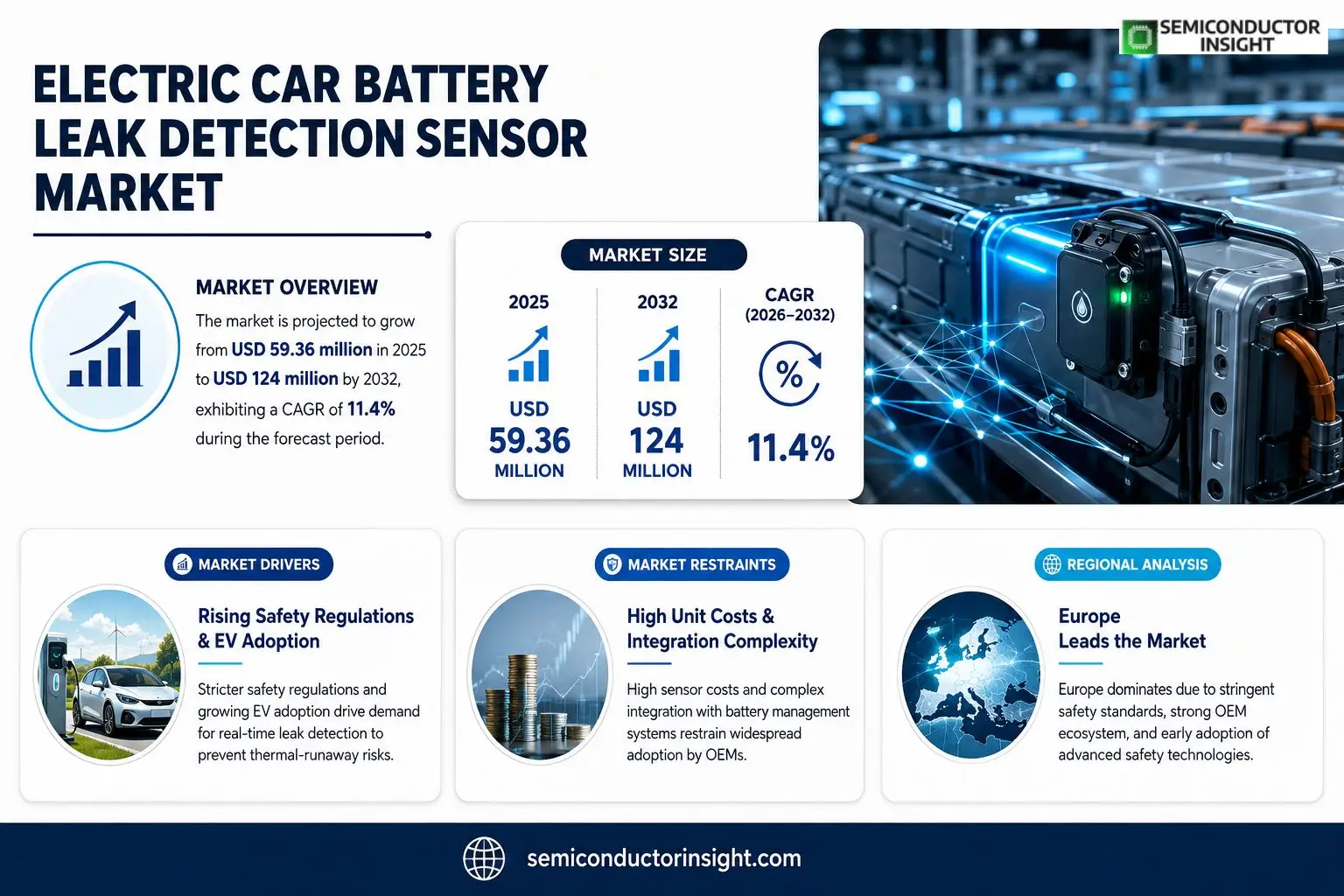
Electric Car Battery Leak Detection Sensor market size was valued at USD 59.36 million in 2025. The market is projected to grow from USD 59.36 million in 2025 to USD 124 million by 2032, exhibiting a CAGR of 11.4% during the forecast period.
An Electric Car Battery Leak Detection Sensor is an automotive‑grade device engineered to monitor the safety condition of traction‑battery systems. It senses characteristic signals such as electrolyte solvent vapors, coolant vapors, or hydrogen released from sealed cells or packs under abnormal conditions, thereby identifying potential leakage risks. The sensor offers high sensitivity, good repeatability and traceability, enabling early detection of defective cells and reducing the probability of thermal runaway and safety incidents.The market is gaining momentum because battery capacities are increasing and regulatory scrutiny on EV safety is tightening. In 2025 production reached roughly 50 000 units at an average price of USD 1 300 per unit; capacity utilization stood at about 50% with an average gross margin near 40%. The industry chain spans upstream suppliers of core components and sensitive materials, midstream firms focused on design, manufacturing and integrated testing, and downstream OEMs integrating sensors into passenger‑car and commercial‑vehicle battery packs for real‑time leakage monitoring. Leading players such as Amphenol Sensors, SGX Sensortech, Fuji Bridex, Yamaha Fine Technologies and INFICON are expanding portfolios to meet growing demand.
MARKET DRIVERS
Regulatory Safety Requirements
Stringent safety standards imposed by authorities in North America, Europe and China compel manufacturers to incorporate leak detection capabilities directly into battery packs. Compliance is no longer optional; non‑conforming vehicles face delayed type‑approval and potential market exclusion, which pushes OEMs to source reliable sensors early in the design cycle.
Increasing EV Battery Complexity
Battery modules now feature higher energy densities, multi‑cell architectures, and liquid‑phase electrolyte chemistries that amplify the risk of internal leakage. As pack architectures evolve, the failure modes become less predictable, prompting a shift toward proactive monitoring solutions rather than post‑incident remediation.
➤ Manufacturers that embed silicon‑based leak sensors during the cell‑stacking process report a 30 % reduction in warranty claims related to electrolyte spills.
Beyond compliance, early‑stage leak detection offers a brand‑protective advantage; automakers can differentiate their vehicles by highlighting enhanced occupant safety, a narrative that resonates with increasingly safety‑conscious consumers.
MARKET CHALLENGES
Cost Sensitivity of OEMs
While safety is paramount, the price pressure on electric vehicle components remains intense. Adding a sensor to every battery pack inflates the bill of materials, and OEMs must balance this against margin targets, especially in price‑competitive segments.
Integration Complexity
Leak detection sensors must interface with existing Battery Management Systems (BMS) without compromising signal integrity. Achieving seamless integration often requires custom firmware and additional validation steps, extending development timelines.
Other Challenges
Supply Chain Bottlenecks
The semiconductor shortage that began in 2020 continues to affect niche sensor categories. Limited fab capacity for high‑temperature, chemically resistant dies forces manufacturers to negotiate longer lead times, which can delay vehicle launch schedules.
MARKET RESTRAINTS
High Unit Costs
Advanced leak detection sensors rely on materials such as palladium‐alloy electrodes and hermetic packaging, driving up per‑unit expense. For volume‐sensitive EV models, these costs can represent a materiality threshold that discourages broader adoption until economies of scale materialize.
MARKET OPPORTUNITIES
Integration with Vehicle Telematics
Embedding leak sensor data into vehicle‑wide telematics platforms enables real‑time alerts to drivers and service centers. This connected‑service model opens revenue streams through predictive maintenance contracts and insurance premium reductions, fostering a new ecosystem around safety analytics.Furthermore, the rise of over‑the‑air (OTA) update capabilities allows manufacturers to refine sensor thresholds post‑sale, extending the useful life of the detection hardware and providing a continual value proposition to end‑users.
Electric Car Battery Leak Detection Sensor Market Trends
Increasing Safety Regulations Accelerate Sensor Adoption
Electric Car Battery Leak Detection Sensor Market is feeling pressure from tightening safety standards worldwide. As manufacturers pursue higher energy‑density packs, the probability of electrolyte or gas escape rises, prompting regulators to demand real‑time monitoring. OEMs are therefore embedding leak detection modules directly into battery enclosures rather than treating them as optional accessories. This shift reduces warranty claims linked to thermal‑runaway incidents and aligns product design with emerging certification protocols. Early‑stage detection also supports faster recall resolution, protecting brand reputation and minimizing downtime for fleet operators. The confluence of stricter legislation and heightened consumer awareness is reshaping procurement strategies, pushing suppliers to prioritize sensor reliability and certification compliance.
Other Trends
Integration into Battery Management Systems
A noticeable trend in Electric Car Battery Leak Detection Sensor Market is the migration of stand‑alone sensors into unified battery‑management architectures. Engineers are leveraging the same communication buses that handle state‑of‑charge data to transmit leak alerts, thereby eliminating separate wiring harnesses. This consolidation improves signal integrity, cuts installation labor, and enables predictive algorithms to correlate temperature spikes with vapor signatures. Manufacturers that can certify seamless firmware updates gain a competitive edge, because vehicle platforms can evolve without physical hardware revisions. The result is a more agile product portfolio that can be tailored to both passenger and commercial electric vehicles, expanding the addressable market for sensor providers.
Supply‑Chain Consolidation Reduces Cost Pressures
Downstream pressure to keep vehicle pricing attractive is encouraging upstream players in Electric Car Battery Leak Detection Sensor Market to form strategic alliances. Component suppliers of sensitive materials and circuit chips are merging capabilities, which lifts overall production efficiency and raises capacity utilisation from the previous low‑mid‑teens to a more sustainable level. Higher utilisation improves gross‑margin stability, allowing manufacturers to offer competitive unit pricing without sacrificing sensor performance. This tightening of the supply chain also shortens lead times, a factor that resonates with OEMs facing rapid model roll‑outs. As a result, sensor makers can focus investment on R&D for enhanced detection thresholds rather than on expanding manufacturing footprints.
COMPETITIVE LANDSCAPE
Key Industry Players
Electric Car Battery Leak Detection Sensor Market: Competitive Overview
Amphenol Sensors commands the largest share of sensor segment, leveraging its extensive portfolio of automotive‑grade chemical sensors and a manufacturing footprint that spans North America, Europe, and Asia‑Pacific. The firm’s ability to couple high‑sensitivity detection modules with existing battery management architectures has entrenched it as a preferred supplier for Tier‑1 OEMs such as Tesla and BYD. Its vertical integrationfrom raw‑material sourcing to final testenables tighter control over yield and cost, a critical advantage given the modest capacity utilization rates reported in 2025. Competitive pressure stems from a handful of midsize firms that specialize in niche chemistries, pressuring Amphenol to expand its R&D pipeline and offer differentiated firmware that supports remote diagnostics and over‑the‑air updates.Beyond the market leader, a constellation of specialized players adds depth to the ecosystem. SGX Sensortech and INFICON have cultivated expertise in miniature conductive coatings that improve leak detection at low vapor concentrations, positioning them well for premium EV manufacturers that prioritize safety certifications. Fuji Bridex and Yamaha Fine Technologies focus on ruggedized benchtop calibrators, serving testing labs that validate sensor performance under extreme temperature swings. Keyitec, Cincinnati Test Systems, and Restek occupy the upstream niche of component supply, providing custom MEMS chips and reference gases. Emerging entrants such as Bosch, Continental, and Denso are repurposing their existing power‑train sensor lines to capture a share of the growing safety‑monitoring mandate, a move that could reshape supplier negotiations in the next product cycle.
List of Key Electric Car Battery Leak Detection Sensor Companies Profiled
- Amphenol Sensors
- SGX Sensortech
- Fuji Bridex
- Yamaha Fine Technologies
- Keyitec
- INFICON
- Cincinnati Test Systems
- Restek
- Bosch
- Continental
- Denso
- Honeywell Sensing & IoT
- TE Connectivity
Segment Analysis:
| Segment Category | Sub-Segments | Key Insights |
| By Type |
|
Handheld Sensors are emerging as the leading type for field diagnostics because they provide rapid, portable assessment of battery pack integrity.
|
| By Application |
|
Passenger Cars dominate the application landscape as OEMs embed sensors directly into high‑energy‑density packs.
|
| By End User |
|
Vehicle Manufacturers are the primary drivers of sensor adoption because they seek to embed safety by design.
|
| By Sensing Technology |
|
Conductivity‑Based Sensors are viewed as the leading technology due to their high sensitivity to electrolyte vapors.
|
| By Output Signal |
|
Digital Switch Output is gaining prominence as OEMs prioritize fault‑clear communication within the vehicle network.
|
Regional Analysis: Electric Car Battery Leak Detection Sensor Market
EU safety standards now require real‑time monitoring of battery enclosures, compelling OEMs to source sensors that deliver continuous leak alerts. The regulatory pressure translates into a premium on certified components, prompting domestic manufacturers to secure compliance certifications ahead of competitors.
A compact supplier base concentrated in Germany and Italy delivers both silicon‑based and optical sensor variants, fostering close collaboration on design‑for‑manufacture initiatives. This proximity shortens development cycles and reduces logistical overhead, strengthening the overall value chain resilience.
Flagship electric models from leading European brands now list leak‑detection as a standard safety feature, reflecting a strategic move to mitigate warranty exposure and reinforce brand trust among environmentally conscious buyers.
Research consortia funded by the European Commission are experimenting with nanomaterial coatings that amplify sensor sensitivity, hinting at a next‑generation product class that could reshape procurement criteria for years to come.
North America
North America remains a strong contender, driven chiefly by the United States’ aggressive electrification incentives and an entrenched culture of safety innovation. Automakers are integrating leak‑detection sensors early in platform engineering to align with both federal safety guidelines and the expectations of a consumer base that values early‑adopter technologies. Supply chains benefit from a diversified pool of sensor manufacturers, ranging from established silicon specialists to emerging startups focused on AI‑enhanced diagnostics. The competitive landscape encourages rapid iteration, pushing firms to deliver increasingly compact modules that fit tighter battery pack architectures.
Asia‑Pacific
The Asia‑Pacific region is witnessing a surge in electric‑vehicle production, yet Electric Car Battery Leak Detection Sensor Market is still maturing. Governments in China, South Korea and Japan are tightening safety regulations, prompting OEMs to evaluate sensor options that balance cost with reliability. Local component producers leverage large‑scale manufacturing capabilities to keep prices attractive, but the market experiences fragmented adoption as tier‑2 manufacturers scramble to meet emerging certification standards. Strategic partnerships with European suppliers are increasingly common, as Asian firms seek to accelerate technology transfer and meet the rising safety expectations of global partners.
South America
In South America, market movement is anchored by Brazil’s expanding electric‑vehicle rollout and a nascent regulatory framework that is beginning to reference battery safety. While overall vehicle volumes are modest compared to other regions, early‑stage pilots by regional automakers are testing leak‑detection sensors as part of broader safety demonstrations. Import reliance on European and North American sensor makers exposes the market to longer lead times, yet also creates an opportunity for local assemblers to add value through system integration services tailored to regional climate conditions.
Middle East & Africa
The Middle East & Africa segment shows cautious optimism. Wealthier Gulf states are introducing high‑end electric models as part of sustainability visions, prompting a selective demand for premium leak‑detection sensors. African markets, still in the nascent phase of EV adoption, focus on cost‑effective solutions that can survive harsh temperature swings. Regional distributors are increasingly acting as intermediaries, bundling sensors with after‑sales support contracts to reassure end‑users about battery safety in extreme operating environments.
Report Scope
This market research report provides a comprehensive analysis of the Electric Car Battery Leak Detection Sensor Market , covering the forecast period 2026–2034. It offers detailed insights into market dynamics, technological advancements, competitive landscape, and key trends shaping the industry.
Key focus areas of the report include:
- Market Overview: The report begins with an overview outlining its current market scenario, key growth indicators, and industry transformation drivers. It discusses macroeconomic factors, demand–supply balance, regulatory landscape, and the strategic role of semiconductors in powering advancements across industries such as automotive, telecommunications, consumer electronics, and industrial automation.
- Market Size & Forecast: Historical data and future projections for revenue, unit shipments, and market value across major regions and segments.
- Segmentation Analysis: Detailed breakdown by product type, technology, application, and end-user industry to identify high-growth segments and investment opportunities.
- Regional Insights: Insights into market performance across North America, Europe, Asia-Pacific, Latin America, and the Middle East & Africa, including country-level analysis where relevant.
- Competitive Landscape: Profiles of leading market participants, including their product offerings, R&D focus, manufacturing capacity, pricing strategies, and recent developments such as mergers, acquisitions, and partnerships.
- Technology Trends & Innovation: Assessment of emerging technologies, integration of AI/IoT, semiconductor design trends, fabrication techniques, and evolving industry standards.
- Market Drivers & Restraints: Evaluation of factors driving market growth along with challenges, supply chain constraints, regulatory issues, and market-entry barriers.
- Stakeholder Insights: Insights for component suppliers, OEMs, system integrators, investors, and policymakers regarding the evolving ecosystem and strategic opportunities.
Primary and secondary research methods are employed, including interviews with industry experts, data from verified sources, and real-time market intelligence to ensure the accuracy and reliability of the insights presented.
FREQUENTLY ASKED QUESTIONS:
What is the current market size of Electric Car Battery Leak Detection Sensor Market?
-> Electric Car Battery Leak Detection Sensor Market was valued at USD 59.36 million in 2025 and is expected to reach USD 124 million by 2032, growing at a CAGR of 11.4% during the forecast period.
Which key companies operate in Electric Car Battery Leak Detection Sensor Market?
-> Key players include Amphenol Sensors, SGX Sensortech, Fuji Bridex, Yamaha Fine Technologies, Keyitec, INFICON, Cincinnati Test Systems, Restek, REDLINE.
What are the key growth drivers?
-> Key growth drivers include rising electric vehicle adoption, higher battery energy density, stricter safety regulations, increasing consumer awareness of battery safety, and the need to prevent thermal‑runaway incidents.
Which region dominates the market?
-> Asia-Pacific is a leading region due to its high electric‑vehicle production and adoption rates, while Europe also shows strong demand driven by stringent safety standards.
What are the emerging trends?
-> Emerging trends include integration of leak detection sensors into battery management systems, adoption of AI/IoT for predictive safety monitoring, and development of standardized safety modules for next‑generation electric vehicles.

Get Sample Report PDF for Exclusive Insights
Report Sample Includes
- Table of Contents
- List of Tables & Figures
- Charts, Research Methodology, and more...
 Download Sample Report PDF


