6G Communication Market Insights
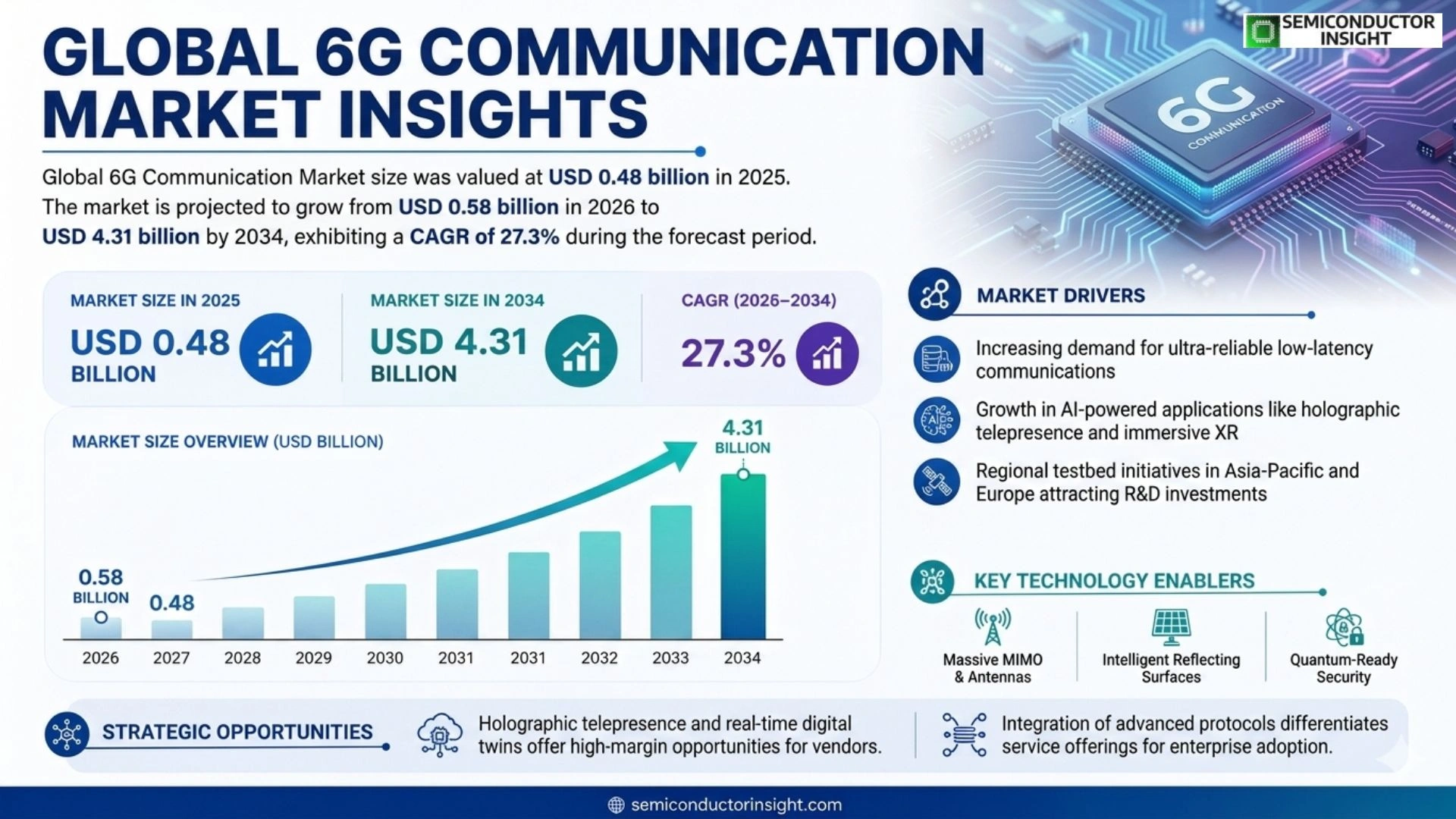
Global 6G Communication Market size was valued at USD 0.48 billion in 2025. The market is projected to grow from USD 0.58 billion in 2026 to USD 4.31 billion by 2034, exhibiting a CAGR of 27.3% during the forecast period.
6G communication represents the next generation of wireless technology that aims to deliver terahertz‑band frequencies, sub‑millisecond latency, and massive device connectivity powered by integrated artificial intelligence and edge computing capabilities.
The market is accelerating because governments worldwide are allocating new spectrum bands, while enterprises seek ultra‑reliable low‑latency communications for immersive XR experiences and autonomous systems. Furthermore, substantial R&D investments from leading vendors,such as Nokia’s partnership with Qualcomm announced in March 2024 to co‑develop AI‑enabled radio chips,are driving rapid prototype deployments. Additionally, the rise of data‑intensive applications like holographic telepresence and smart cities fuels demand for the unprecedented throughput promised by 6G.
MARKET DRIVERS
Rising Demand for Ultra‑High‑Speed Connectivity
Global data traffic is expected to increase by more than 30 % annually, compelling telecom operators to explore ultra‑low latency and multi‑gigabit throughput solutions. 6G Communication Market is positioned to address this surge by leveraging terahertz spectrum and advanced beamforming technologies.
Government Investment and Spectrum Allocation
Major economies have earmarked multi‑billion‑dollar budgets for next‑generation network research, and regulatory bodies are allocating dedicated spectrum bands for 6G trials. This policy support reduces entry barriers and accelerates commercialization timelines.
➤ By 2030, 6G Communication Market is projected to exceed $200 billion, driven by AI‑integrated networks and immersive services.
In addition, the convergence of artificial intelligence, edge computing, and Internet of Everything creates new revenue streams for service providers, reinforcing the growth trajectory of 6G Communication Market.
MARKET CHALLENGES
Technical Complexity of Terahertz Bands
Operating at terahertz frequencies introduces severe propagation losses and hardware design challenges. Developing energy‑efficient transceivers and robust signal processing algorithms remains a critical hurdle for early deployments.
Other Challenges
Infrastructure Rollout Constraints
Deploying dense small‑cell networks in urban environments requires extensive capital investment and coordination with local authorities, potentially slowing market penetration.
MARKET RESTRAINTS
High Capital Expenditure Requirements
The transition from 5G to 6G demands substantial upgrades to backhaul, core networking, and spectrum licensing. Small and medium‑size operators may struggle to secure financing, limiting broader adoption of 6G Communication Market solutions.
MARKET OPPORTUNITIES
Emerging AI‑Driven Services
AI‑powered applications such as holographic telepresence, immersive XR, and real‑time digital twins require the ultra‑reliable low‑latency communications that 6G promises. These use cases open high‑margin opportunities for equipment vendors and software providers.
Integration of massive MIMO, intelligent reflecting surfaces, and quantum‑ready security protocols will further differentiate service offerings, encouraging enterprises to adopt the next‑generation network architecture.
Regional initiatives in Asia‑Pacific and Europe are already establishing testbeds that attract multinational R&D investments, positioning 6G Communication Market for rapid scaling once standards are finalized.
6G Communication Market Trends
Terahertz‑Band Expansion and Ultra‑Low Latency
6G Communication Market is being reshaped by a coordinated shift toward terahertz‑band spectrum that delivers multi‑gigabit per second data rates combined with sub‑millisecond latency. This combination unlocks ultra‑reliable low‑latency communications essential for immersive extended‑reality (XR) platforms, autonomous vehicle coordination, and mission‑critical industrial automation. Governments worldwide are allocating new high‑frequency bands, enabling operators to prototype dense network slices that support billions of concurrent device connections. Early field trials in major metropolitan regions have shown that the expanded spectrum can sustain continuous high‑throughput streams, a prerequisite for next‑generation smart‑city services such as real‑time traffic orchestration and pervasive sensor networks.
Other Trends
AI‑Enabled Radio Architecture
Leading vendors are integrating artificial‑intelligence capabilities directly into radio hardware, allowing real‑time spectrum selection, interference mitigation, and predictive load balancing. A notable collaboration announced in March 2024 between a prominent network equipment manufacturer and a global semiconductor leader focuses on co‑developing AI‑driven radio chips that autonomously adjust transmission parameters based on traffic analytics. This approach reduces operational expenditures while enhancing reliability across 6G Communication Market. Additional R&D programs from other industry players emphasize self‑optimizing network fabrics, which streamline the rollout of ultra‑dense micro‑cell deployments and improve end‑user experience in bandwidth‑intensive scenarios such as holographic collaboration and high‑definition mobile gaming.
Edge‑Centric Services and Data‑Intensive Applications
Edge computing is emerging as a foundational layer for 6G services, bringing processing capability to the network edge to meet stringent latency requirements. By colocating compute resources with radio access points, latency is reduced to microsecond levels, enabling real‑time holographic telepresence, precision agriculture, and advanced health‑monitoring systems that rely on instantaneous data feedback. Enterprises are deploying distributed edge‑server clusters that interoperate seamlessly with 6G radio access, creating a feedback loop that accelerates the adoption of data‑intensive applications throughout the market. The convergence of edge infrastructure, AI‑enabled radios, and terahertz spectrum forms a synergistic ecosystem that drives sustained investment and positions 6G Communication Market for rapid expansion over the coming decade.
COMPETITIVE LANDSCAPE
Key Industry Players
Emerging 6G Landscape: Global Leaders and Strategic Alliances
6G Communication Market is currently shaped by a handful of multinational telecom equipment giants that command the majority of R&D spend and prototype roll‑outs. Nokia, leveraging its partnership with Qualcomm, leads in AI‑enabled radio front‑ends, while Huawei continues to dominate Chinese spectrum allocations and leverages its extensive patent portfolio to set early standards. Samsung’s aggressive investment in terahertz antenna arrays and Ericsson’s focus on network virtualization create a competitive triad that defines the core market structure. These leaders are complemented by strategic collaborations with cloud and semiconductor firms, reinforcing a vertically integrated ecosystem that accelerates time‑to‑market for ultra‑low‑latency services.
Beyond the dominant trio, a diverse set of niche but influential players contributes critical components and services. Qualcomm supplies next‑generation modem chips, Intel and AMD (via Xilinx) provide high‑performance compute for edge AI, and MediaTek focuses on cost‑effective handset integration. Operators such as SK Telecom, Verizon, AT&T, and China Mobile are early adopters, testing live 6G pilots and shaping service‑level requirements. Cisco and ZTE add networking infrastructure expertise, while emerging startups like Pivotal Comm and Rohde & Schwarz expand specialized testing and measurement capabilities. This layered ecosystem ensures that innovation is diffused across hardware, software, and service domains, fostering a robust competitive environment.
List of Key 6G Communication Market Companies Profiled
- Nokia
- Huawei
- Samsung
- Ericsson
- Qualcomm
- Intel
- AMD (Xilinx)
- MediaTek
- SK Telecom
- Verizon
- AT&T
- China Mobile
- ZTE
- Cisco
- Pivotal Comm
Segment Analysis:
| Segment Category | Sub-Segments | Key Insights |
| By Type |
|
AI‑Integrated Radios are emerging as the leading type because they embed intelligent spectrum management, enabling adaptive beamforming and real‑time traffic prioritization.
|
| By Application |
|
Immersive XR Experiences dominate the application landscape as they demand the ultra‑high throughput and sub‑millisecond latency that only 6G can reliably deliver.
|
| By End User |
|
Enterprise & Manufacturing are emerging as the most enthusiastic end‑user cohort, leveraging 6G to create deterministic, ultra‑reliable links for Industry 4.0 automation.
|
| By Architecture |
|
Distributed Massive MIMO stands out as the leading architectural approach, delivering unprecedented spatial multiplexing that underpins 6G’s capacity ambitions.
|
| By Deployment Scenario |
|
Urban Dense Networks are expected to dominate early 6G roll‑outs because they provide the high‑capacity backbones necessary for next‑generation smart‑city services.
|
Regional Analysis: North America
United States
The demand for higher data rates and lower latency is propelling the adoption of 6G solutions across various sectors, including autonomous vehicles, smart cities, industrial automation, and immersive extended reality. The competitive landscape features established players alongside emerging startups, each vying for a position in the evolving market. Regulatory policies are actively shaping the ecosystem, with a focus on spectrum allocation and data privacy. The growth of 6G Communication Market in the United States is contingent on addressing challenges related to infrastructure deployment costs and ensuring seamless integration with existing 5G networks. Opportunities lie in developing specialized 6G solutions for vertical industries and fostering innovation in network security and privacy.
Significant investments are being made in upgrading and expanding the telecommunications infrastructure to support 6G deployments. This includes enhancing fiber optic networks, deploying advanced base stations, and exploring innovative network architectures.
Government regulatory bodies are actively engaged in allocating spectrum bands suitable for 6G operations. This involves balancing the needs of various stakeholders and ensuring efficient spectrum utilization.
Ongoing research and development efforts are focused on advancing key 6G technologies, including advanced antenna systems, artificial intelligence integration, and novel modulation techniques.
Ensuring the security and privacy of 6G networks is a paramount concern. This involves developing robust security protocols and addressing potential vulnerabilities.
Europe
Europe is strategically positioning itself as a hub for 6G innovation. Several countries, particularly in Western and Northern Europe, are leading the charge in research, development, and standardization efforts. The European Union’s commitment to technological leadership is evident in its funding initiatives and policy frameworks that encourage 6G advancements. The focus is on leveraging 6G to drive economic growth and address societal challenges across various sectors. Business strategies emphasize collaboration between European telecom operators, technology providers, and research institutions to accelerate the development and deployment of 6G solutions. The emphasis is on sustainable and energy-efficient network architectures, aligning with broader environmental goals. The market is expected to see significant growth in the areas of smart manufacturing, connected transportation, and digital health, all facilitated by the capabilities of 6G.
Europe’s approach to 6G is characterized by a strong emphasis on open standards and interoperability. The pursuit of technological sovereignty is also a key driver, with initiatives aimed at reducing reliance on specific vendors and fostering domestic innovation. Challenges include securing sufficient funding for large-scale infrastructure deployments and navigating complex regulatory landscapes across different member states.
Asia-Pacific
The Asia-Pacific region is anticipated to be the largest market for 6G communication globally. Driven by rapid economic growth, a burgeoning digital economy, and a large population, countries like China, Japan, and South Korea are making substantial investments in 6G research and development. China, in particular, is aggressively pursuing 6G leadership through significant government funding and strategic partnerships. The focus is on leveraging 6G for applications such as smart cities, industrial automation, and advanced manufacturing. Business strategies revolve around cultivating a strong domestic ecosystem for 6G technology and fostering innovation in areas such as artificial intelligence, edge computing, and advanced materials. The region’s high mobile penetration rates and increasing demand for data services further fuel the growth of the 6G market.
Key challenges include addressing infrastructure deployment costs in some parts of the region and navigating complex regulatory frameworks. The competitive landscape features a mix of established telecom operators and emerging technology companies. The Asia-Pacific market presents significant opportunities for companies offering specialized 6G solutions tailored to the unique needs of different countries and industries.
Middle East & Africa
The Middle East & Africa region is poised for considerable 6G market growth, albeit with some unique considerations. Several countries in the region are investing in upgrading their telecommunications infrastructure and exploring the potential of 6G to drive economic diversification and digital transformation. The focus is expected to be on applications such as smart cities, industrial automation, and connected transportation, particularly in the context of ambitious national development plans. Business strategies will involve partnerships between telecom operators, technology providers, and government entities to enable 6G deployments.
Challenges in this region include infrastructure limitations in some areas and varying levels of regulatory maturity. Opportunities lie in addressing the specific needs of emerging economies and leveraging 6G to bridge the digital divide. The region’s increasing adoption of IoT and industrial automation will drive demand for 6G-enabled solutions.
Report Scope
This market research report provides a comprehensive analysis of the 6G Communication Market , covering the forecast period 2026–2034. It offers detailed insights into market dynamics, technological advancements, competitive landscape, and key trends shaping the industry.
Key focus areas of the report include:
- Market Overview: The report begins with an overview outlining its current market scenario, key growth indicators, and industry transformation drivers. It discusses macroeconomic factors, demand–supply balance, regulatory landscape, and the strategic role of semiconductors in powering advancements across industries such as automotive, telecommunications, consumer electronics, and industrial automation.
- Market Size & Forecast: Historical data and future projections for revenue, unit shipments, and market value across major regions and segments.
- Segmentation Analysis: Detailed breakdown by product type, technology, application, and end-user industry to identify high-growth segments and investment opportunities.
- Regional Insights: Insights into market performance across North America, Europe, Asia-Pacific, Latin America, and the Middle East & Africa, including country-level analysis where relevant.
- Competitive Landscape: Profiles of leading market participants, including their product offerings, R&D focus, manufacturing capacity, pricing strategies, and recent developments such as mergers, acquisitions, and partnerships.
- Technology Trends & Innovation: Assessment of emerging technologies, integration of AI/IoT, semiconductor design trends, fabrication techniques, and evolving industry standards.
- Market Drivers & Restraints: Evaluation of factors driving market growth along with challenges, supply chain constraints, regulatory issues, and market-entry barriers.
- Stakeholder Insights: Insights for component suppliers, OEMs, system integrators, investors, and policymakers regarding the evolving ecosystem and strategic opportunities.
Primary and secondary research methods are employed, including interviews with industry experts, data from verified sources, and real-time market intelligence to ensure the accuracy and reliability of the insights presented.
FREQUENTLY ASKED QUESTIONS:
What is the current market size of 6G Communication Market?
-> 6G Communication Market size was valued at USD 0.48 billion in 2025. The market is projected to grow from USD 0.58 billion in 2026 to USD 4.31 billion by 2034.
Which key companies operate in 6G Communication Market?
-> Key players include Nokia and Qualcomm, which have announced strategic collaborations to develop AI‑enabled radio chips for 6G, alongside other major telecommunications equipment manufacturers.
What are the key growth drivers?
-> Key growth drivers include government allocation of new spectrum bands, enterprise demand for ultra‑reliable low‑latency communications in immersive XR and autonomous systems, and substantial R&D investments from leading vendors.
Which region dominates the market?
-> Regional dominance is not explicitly detailed in the provided data; the market growth is described as global, driven by worldwide spectrum initiatives and cross‑regional technology deployments.
What are the emerging trends?
-> Emerging trends include terahertz‑band frequencies, sub‑millisecond latency, massive device connectivity, integration of artificial intelligence and edge computing, and data‑intensive applications such as holographic telepresence and smart‑city infrastructures.
Get Sample Report PDF for Exclusive Insights
Report Sample Includes
- Table of Contents
- List of Tables & Figures
- Charts, Research Methodology, and more...
 Download Sample Report PDF