
MARKET INSIGHTS
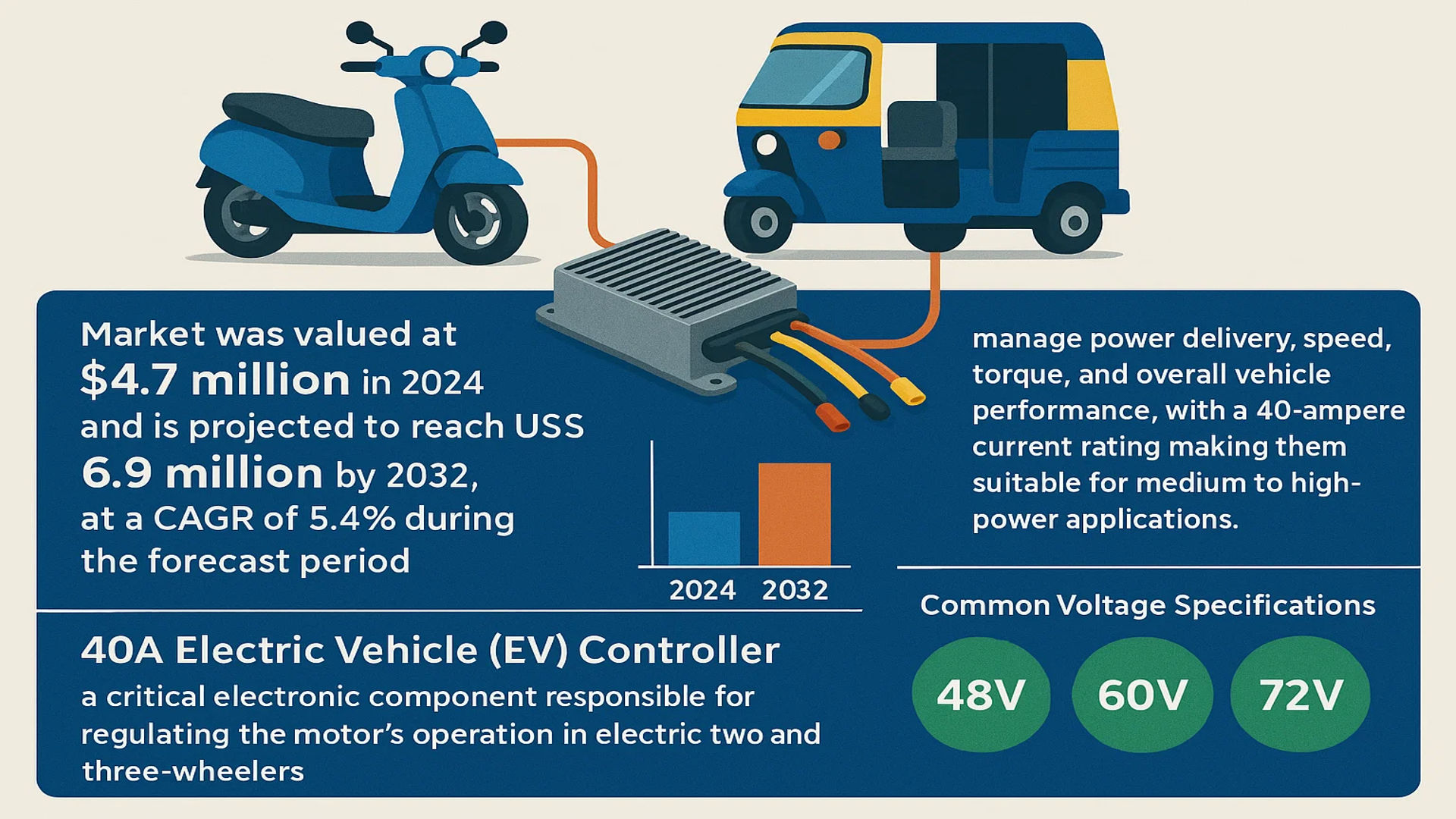
The global 40A Electric Two and Three Wheeler Controller Market was valued at 4.7 million in 2024 and is projected to reach US$ 6.9 million by 2032, at a CAGR of 5.4% during the forecast period.
A 40A Electric Vehicle (EV) Controller is a critical electronic component responsible for regulating the motor’s operation in electric two and three-wheelers. These controllers manage power delivery, speed, torque, and overall vehicle performance, with a 40-ampere current rating making them suitable for medium to high-power applications. Common voltage specifications for these controllers include 48V, 60V, and 72V, catering to a diverse range of vehicle requirements.
The market is experiencing steady growth, primarily driven by the global surge in electric mobility adoption, particularly in Asia-Pacific regions. Stringent government regulations promoting zero-emission vehicles and the implementation of new national standard policies for electric vehicles are compelling manufacturers to develop higher performance and safer controllers. Furthermore, the expanding last-mile delivery and logistics sector, which heavily relies on electric three-wheelers, is creating substantial demand for these robust controllers capable of handling larger loads. Key players such as GOBAO, Wuxi Jinghui Electronics, and Jiangsu Xiechang Electronic Technology dominate the market with a wide portfolio of products, including advanced sine wave and vector control solutions.
MARKET DYNAMICS
MARKET DRIVERS
Global Shift Towards Electric Mobility to Accelerate Controller Demand
The global transition toward electric vehicles represents one of the most significant drivers for the 40A electric two and three wheeler controller market. With over 350 million electric two-wheelers already in operation worldwide and annual sales exceeding 50 million units, the demand for reliable motor controllers continues to escalate. This growth is particularly pronounced in emerging economies where electric two and three wheelers serve as primary transportation modes. Governments worldwide are implementing aggressive electrification policies, with more than 15 countries announcing complete phase-outs of internal combustion engines for two and three wheelers by 2040. The 40A controller specification has emerged as the industry standard for medium-duty applications due to its optimal balance between power handling capability and cost efficiency, making it the preferred choice for manufacturers targeting the mass market segment.
Technological Advancements in Motor Control Systems to Enhance Market Growth
Rapid technological innovations in power electronics and control algorithms are driving substantial improvements in 40A controller performance and reliability. The transition from traditional square wave controllers to advanced sine wave and vector control technologies has resulted in 25-30% improvements in energy efficiency and significantly reduced motor noise levels. These advancements enable smoother acceleration, better torque control, and extended battery life, addressing key consumer concerns about electric vehicle performance. The integration of smart features such as regenerative braking, Bluetooth connectivity for parameter adjustment, and real-time diagnostics has transformed basic controllers into intelligent system management units. Manufacturers are increasingly incorporating MOSFET and IGBT technologies that can handle higher current densities while maintaining thermal stability, allowing for more compact controller designs without compromising the 40A rating.
Expansion of E-commerce and Last-Mile Delivery Services to Fuel Market Expansion
The explosive growth of e-commerce and last-mile delivery services worldwide has created unprecedented demand for electric three-wheelers equipped with 40A controllers. The global last-mile delivery market is projected to require over 5 million electric vehicles by 2025, with electric three-wheelers accounting for approximately 40% of this fleet. These vehicles require controllers capable of handling frequent start-stop cycles, varying load conditions, and extended daily operation – specifications that align perfectly with 40A controller capabilities. Delivery fleets particularly value the robustness and reliability of 40A controllers, as vehicle downtime directly impacts operational efficiency and profitability. The trend toward organized logistics and standardized fleet operations has driven consistent demand for quality-controlled components, benefiting established controller manufacturers with proven reliability records.
MARKET CHALLENGES
Intense Price Competition and Margin Pressures to Challenge Market Sustainability
The 40A electric vehicle controller market faces significant challenges from intense price competition, particularly from manufacturers offering lower-quality alternatives. With over 200 manufacturers operating primarily in China and Southeast Asia, price wars have compressed profit margins to single-digit percentages in many cases. This hyper-competitive environment forces established players to either compromise on quality components or accept reduced profitability. The situation is exacerbated by the presence of uncertified and non-compliant products that bypass quality testing and safety standards, creating an uneven playing field for manufacturers who invest in research and development and quality assurance processes. These market conditions make it difficult for companies to justify investments in next-generation technologies, potentially slowing innovation in the sector.
Other Challenges
Supply Chain Vulnerabilities
The global semiconductor shortage and fluctuating raw material prices have created significant supply chain challenges for controller manufacturers. Critical components such as microcontrollers, power MOSFETs, and capacitors have experienced extended lead times and price increases of 20-40% over the past two years. These disruptions affect production schedules and increase manufacturing costs, forcing companies to either absorb higher expenses or pass them to customers. The geographical concentration of electronic component manufacturing in specific regions creates additional vulnerability to geopolitical tensions and trade restrictions.
Technical Compatibility Issues
The lack of standardization across motor types, battery configurations, and vehicle architectures creates significant technical compatibility challenges. Manufacturers must develop multiple controller variants to accommodate different motor specifications, voltage requirements, and communication protocols. This fragmentation increases development costs, complicates inventory management, and limits economies of scale. The absence of universal standards also makes it difficult for aftermarket suppliers to guarantee compatibility, potentially limiting replacement market opportunities.
MARKET RESTRAINTS
Regulatory Compliance and Certification Requirements to Constrain Market Growth
Increasingly stringent regulatory requirements and certification processes represent significant restraints for the 40A controller market. Governments worldwide are implementing more comprehensive safety standards and performance requirements for electric vehicle components, including mandatory certifications such as CE, RoHS, and ISO standards. These compliance requirements add substantial costs and time to product development cycles, particularly for smaller manufacturers with limited resources. The certification process for a new controller design can take 6-12 months and cost upwards of $50,000, creating barriers to market entry and product innovation. Additionally, differing regulatory frameworks across regions complicate international expansion strategies, forcing manufacturers to develop region-specific products and obtain multiple certifications.
Technical Complexity and Thermal Management Issues to Limit Performance Enhancements
The technical challenges associated with managing heat dissipation in 40A controllers present significant restraints on performance enhancements. At continuous 40-ampere operation, controllers generate substantial thermal loads that must be effectively dissipated to prevent component failure and ensure reliability. Advanced thermal management solutions, such as liquid cooling or sophisticated heat sink designs, increase manufacturing complexity and cost. The physical size constraints of two and three-wheeled vehicles further complicate thermal management, as available space for heat dissipation is limited. These technical constraints make it challenging to increase power density or reduce controller size without compromising reliability or increasing costs substantially.
Consumer Awareness and Quality Perception Issues to Hinder Market Development
Limited consumer awareness about controller technology and quality differences creates market restraints by encouraging price-based purchasing decisions rather than value considerations. Many end-users cannot distinguish between high-quality and inferior controllers, leading them to choose the lowest-priced options without understanding potential reliability and performance implications. This market dynamic disadvantages manufacturers investing in quality components, advanced features, and rigorous testing procedures. The prevalence of counterfeit and substandard products further damages overall market perception, making it difficult for quality-focused manufacturers to command appropriate price premiums. Educational barriers and technical complexity prevent most consumers from appreciating the value of advanced controller features, limiting market development for premium products.
MARKET OPPORTUNITIES
Emergence of Smart Cities and Integrated Mobility Solutions to Create New Opportunities
The global smart city initiative and development of integrated mobility ecosystems present substantial opportunities for advanced 40A controller technologies. Urban areas worldwide are implementing intelligent transportation systems that require connected vehicles with real-time data capabilities. Modern 40A controllers with embedded connectivity and data logging features can provide valuable operational data for fleet management, maintenance planning, and urban transportation planning. The integration of IoT capabilities enables remote diagnostics, over-the-air updates, and performance optimization based on usage patterns. These smart controllers can communicate with charging infrastructure, traffic management systems, and other vehicles, creating opportunities for enhanced safety features and optimized energy management.
Advancements in Battery Technology and Fast-Charging Infrastructure to Enable Market Expansion
Recent breakthroughs in battery technology and the rapid expansion of charging infrastructure create significant opportunities for 40A controller market growth. The development of higher-capacity battery systems capable of delivering sustained high-current output enables more powerful motor systems that benefit from robust 40A controllers. The proliferation of fast-charging stations specifically designed for electric two and three-wheelers allows for quicker turnaround times, increasing vehicle utilization rates and consequently demanding more durable controllers. Compatibility with emerging battery technologies such as solid-state and lithium-sulfur batteries presents additional opportunities for controller manufacturers to develop specialized products optimized for these power sources.
Growing Aftermarket and Replacement Segment to Provide Sustainable Growth Opportunities
The expanding installed base of electric two and three-wheelers worldwide creates substantial opportunities in the aftermarket and replacement controller segment. With average controller replacement cycles of 3-5 years depending on usage patterns, the replacement market is growing proportionally to the vehicle population. This segment offers higher margins than original equipment manufacturing due to reduced competitive pressures and greater customer willingness to pay for reliability and performance. The trend toward vehicle upgradation and performance enhancement also drives aftermarket sales, as users seek to improve their vehicles’ capabilities beyond original specifications. Established manufacturers with strong brand recognition and proven reliability records are particularly well-positioned to capitalize on these opportunities.
40A ELECTRIC TWO AND THREE WHEELER CONTROLLER MARKET TRENDS
Advancements in Motor Control Technologies to Emerge as a Trend in the Market
The global 40A electric vehicle controller market is undergoing a significant transformation, driven by technological advancements in motor control algorithms and power electronics. While traditional square wave controllers still hold a substantial market share due to their cost-effectiveness, there is a pronounced shift towards more sophisticated sine wave and vector control technologies. These advanced controllers offer superior performance, including smoother operation, reduced motor noise, and higher overall efficiency, which can lead to extended battery life and range—a critical factor for consumer adoption. Furthermore, the integration of smart features such as regenerative braking, Bluetooth connectivity for smartphone app integration, and over-the-air (OTA) firmware updates is becoming increasingly standard. This evolution is not merely about performance enhancement; it is a direct response to stringent global safety and efficiency standards that are being implemented, particularly in key markets like China and the European Union, pushing manufacturers towards innovation.
Other Trends
Rapid Electrification of Last-Mile Logistics
The explosive growth of e-commerce and the subsequent demand for efficient urban delivery solutions is a primary catalyst for the three-wheeler segment. Electric three-wheelers, particularly cargo variants, are becoming the vehicle of choice for last-mile delivery fleets due to their lower operational costs and zero tailpipe emissions. This surge is directly fueling demand for robust 40A controllers capable of handling heavier loads and frequent start-stop cycles inherent in urban logistics. The market for these utility vehicles is projected to see a compound annual growth rate of over 7% in the coming years, creating a substantial and sustained demand for high-current controllers. This trend is most visible in densely populated regions across Asia and is increasingly spreading to urban centers in South America and Africa.
Stringent Government Regulations and Standardization
Government policies worldwide are acting as a powerful driver for both market growth and technological refinement. Initiatives like China’s New National Standard for electric vehicles mandate specific performance and safety criteria, compelling manufacturers to adopt higher-quality components, including advanced controllers. Similarly, incentives and subsidies for electric vehicle adoption in numerous countries are making electric two and three-wheelers more accessible to a broader consumer base. However, this regulatory landscape also presents a challenge; the push for standardization can sometimes stifle innovation by locking in certain technical specifications. Manufacturers must navigate this complex environment, balancing compliance with the need to develop next-generation products that offer competitive advantages in a crowded marketplace.
COMPETITIVE LANDSCAPE
Key Industry Players
Companies Strive to Strengthen their Product Portfolio to Sustain Competition
The global competitive landscape for 40A Electric Two and Three Wheeler Controllers is characterized by a high degree of fragmentation, with a multitude of manufacturers, particularly concentrated in the Asia-Pacific region. While the market is populated by numerous small and medium-sized enterprises, a few key players have begun to consolidate their positions through technological innovation and strategic market expansion. The market’s growth is propelled by the rapid electrification of transportation, especially in emerging economies, creating intense competition centered on product reliability, efficiency, and cost-effectiveness.
GOBAO is recognized as a significant player in the market, largely due to its extensive product range that caters to various voltage requirements, including popular 60V and 72V systems. Their focus on robust and durable controllers for both two-wheelers and high-load three-wheelers has established a strong foothold, particularly in the Asian and African markets where these vehicles are crucial for logistics and personal transport.
Similarly, Wuxi Jinghui Electronics and Jiangsu Xiechang Electronic Technology have secured notable market shares. Their growth is heavily attributed to strong domestic manufacturing capabilities in China, which allow for competitive pricing and rapid adaptation to the evolving technical standards set by national policies. These companies benefit from the vast local demand and a well-established supply chain for electronic components.
Furthermore, these leading companies are actively engaged in growth initiatives such as geographical expansion into new emerging markets and continuous research and development into more efficient sine-wave and vector control technologies. These efforts are critical to meeting the increasing demand for smoother operation, higher energy efficiency, and longer vehicle range.
Meanwhile, other prominent players like Ananda Drive Techniques and sine-power are strengthening their market presence through significant investments in R&D for smart controllers with enhanced features like regenerative braking and IoT connectivity. Their strategy involves forming strategic partnerships with electric vehicle OEMs to integrate their controllers directly into new vehicle models, ensuring a steady demand and fostering brand loyalty in a competitive landscape.
List of Key 40A Electric Two and Three Wheeler Controller Companies Profiled
- GOBAO (China)
- Wuxi Jinghui Electronics (China)
- Jiangsu Xiechang Electronic Technology (China)
- Ananda Drive Techniques (China)
- Taicheung (China)
- Wuxi Lingbo Electronic Technology (China)
- Yuan Lang (China)
- CHANGZHOU YIERTONG ELECTRONIC (China)
- sine-power (China)
- Jiangsu Jinfeng Mechanical & Electrical (China)
- Wenling Nine Continent Electromechanical (China)
Segment Analysis:
By Voltage Type
72V Segment Dominates the Market Due to Superior Power Delivery for Heavy-Duty Applications
The market is segmented based on voltage type into:
- 48V
- 60V
- 72V
- Others
By Application
Electric Three-Wheeler Segment Leads Due to High Adoption in Commercial Logistics and Passenger Transport
The market is segmented based on application into:
- Electric Two-Wheeler
- Electric Three-Wheeler
By Technology
Sine Wave Controllers Lead the Market Owing to Superior Motor Efficiency and Quieter Operation
The market is segmented based on technology into:
- Square Wave
- Sine Wave
- Vector Control
By End-Use Vehicle
Passenger and Cargo Tricycles Segment Dominates Due to Proliferation in Last-Mile Delivery and Urban Mobility
The market is segmented based on end-use vehicle into:
- Electric Motorbikes
- Passenger Tricycles
- Cargo/Logistics Tricycles
- Special Purpose Vehicles (e.g., Sanitation, Engineering)
Regional Analysis: 40A Electric Two and Three Wheeler Controller Market
Asia-Pacific
The Asia-Pacific region dominates the global 40A controller market, accounting for over 65% of total volume consumption in 2024. This leadership position is driven by massive electric vehicle adoption in China and India, where these controllers are essential components for electric two-wheelers and three-wheelers used in last-mile delivery and passenger transport. China’s implementation of the New National Standard policy has accelerated demand for higher-performance, certified controllers. The region’s manufacturing ecosystem, concentrated in provinces like Jiangsu and Zhejiang, enables competitive pricing with companies like Wuxi Jinghui Electronics and Jiangsu Xiechang Electronic Technology leading production. While cost sensitivity keeps 60V and 72V systems prevalent, growing environmental awareness is pushing manufacturers toward more efficient sine-wave and vector control technologies.
North America
The North American market shows steady growth focused on performance and reliability standards rather than volume. Stringent safety regulations from organizations like UL and SAE drive demand for controllers with robust protection features and thermal management. The market is characterized by higher-value applications including utility vehicles, recreational EVs, and specialized commercial transport. While the overall EV adoption rate is lower than Asia, the average selling price per unit is significantly higher due to premium features and compliance requirements. Recent infrastructure investments under the Inflation Reduction Act are indirectly supporting EV component manufacturing, though the region remains largely dependent on imports for controller supply.
Europe
Europe’s market is shaped by strict EU regulations on vehicle safety and electromagnetic compatibility, driving innovation in controller design. The region shows growing demand for 40A controllers in light electric cargo vehicles and urban mobility solutions. Germany and France lead in technological adoption with emphasis on energy efficiency and smart connectivity features. European manufacturers focus on high-reliability applications where controllers must operate in varying climatic conditions. The market faces pressure from cost-competitive Asian imports, but maintains premium segments through quality certifications and custom solutions for specialized vehicle manufacturers.
South America
South America represents an emerging market where economic factors significantly influence adoption patterns. Countries like Brazil and Argentina are seeing growth in electric three-wheelers for commercial applications, particularly in urban logistics and public transportation. The market remains price-sensitive with strong preference for basic functionality over advanced features. Infrastructure challenges including inconsistent charging networks and voltage stability issues affect controller specifications and durability requirements. While the market shows potential, growth is constrained by economic volatility and limited local manufacturing capabilities, creating reliance on imported components.
Middle East & Africa
This region presents a developing market opportunity with growth primarily driven by urban transportation needs and environmental initiatives. The UAE and Saudi Arabia are leading adoption through government-backed electric mobility projects and infrastructure development. The market requires controllers capable of operating in high-temperature environments with robust dust and moisture protection. While the overall market size remains small compared to other regions, increasing urbanization and focus on sustainable transportation create long-term growth potential. The absence of strong local manufacturing means the market depends entirely on imports, primarily from Chinese and European suppliers.
Report Scope
This market research report provides a comprehensive analysis of the global and regional 40A Electric Two and Three Wheeler Controller markets, covering the forecast period 2025–2032. It offers detailed insights into market dynamics, technological advancements, competitive landscape, and key trends shaping the industry.
Key focus areas of the report include:
- Market Size & Forecast: Historical data and future projections for revenue, unit shipments, and market value across major regions and segments.
- Segmentation Analysis: Detailed breakdown by product type, technology, application, and end-user industry to identify high-growth segments and investment opportunities.
- Regional Outlook: Insights into market performance across North America, Europe, Asia-Pacific, Latin America, and the Middle East & Africa, including country-level analysis where relevant.
- Competitive Landscape: Profiles of leading market participants, including their product offerings, R&D focus, manufacturing capacity, pricing strategies, and recent developments such as mergers, acquisitions, and partnerships.
- Technology Trends & Innovation: Assessment of emerging technologies, integration of AI/IoT, semiconductor design trends, fabrication techniques, and evolving industry standards.
- Market Drivers & Restraints: Evaluation of factors driving market growth along with challenges, supply chain constraints, regulatory issues, and market-entry barriers.
- Stakeholder Analysis: Insights for component suppliers, OEMs, system integrators, investors, and policymakers regarding the evolving ecosystem and strategic opportunities.
Primary and secondary research methods are employed, including interviews with industry experts, data from verified sources, and real-time market intelligence to ensure the accuracy and reliability of the insights presented.
FREQUENTLY ASKED QUESTIONS:
What is the current market size of Global 40A Electric Two and Three Wheeler Controller Market?
-> 40A Electric Two and Three Wheeler Controller Market was valued at 4.7 million in 2024 and is projected to reach US$ 6.9 million by 2032, at a CAGR of 5.4% during the forecast period.
Which key companies operate in Global 40A Electric Two and Three Wheeler Controller Market?
-> Key players include GOBAO, Wuxi Jinghui Electronics, Jiangsu Xiechang Electronic Technology, Ananda Drive Techniques, and Taicheung, among others.
What are the key growth drivers?
-> Key growth drivers include global electric vehicle adoption, urbanization, last-mile delivery demand, and government regulations promoting electric mobility.
Which region dominates the market?
-> Asia-Pacific is the dominant market, with China being the largest producer and consumer of 40A controllers.
What are the emerging trends?
-> Emerging trends include integration of IoT for smart monitoring, adoption of vector control technology, and development of higher efficiency sine wave controllers.

Get Sample Report PDF for Exclusive Insights
Report Sample Includes
- Table of Contents
- List of Tables & Figures
- Charts, Research Methodology, and more...
 Download Sample Report PDF





