New Energy Battery Cells Contact System (CCS) Market Insights
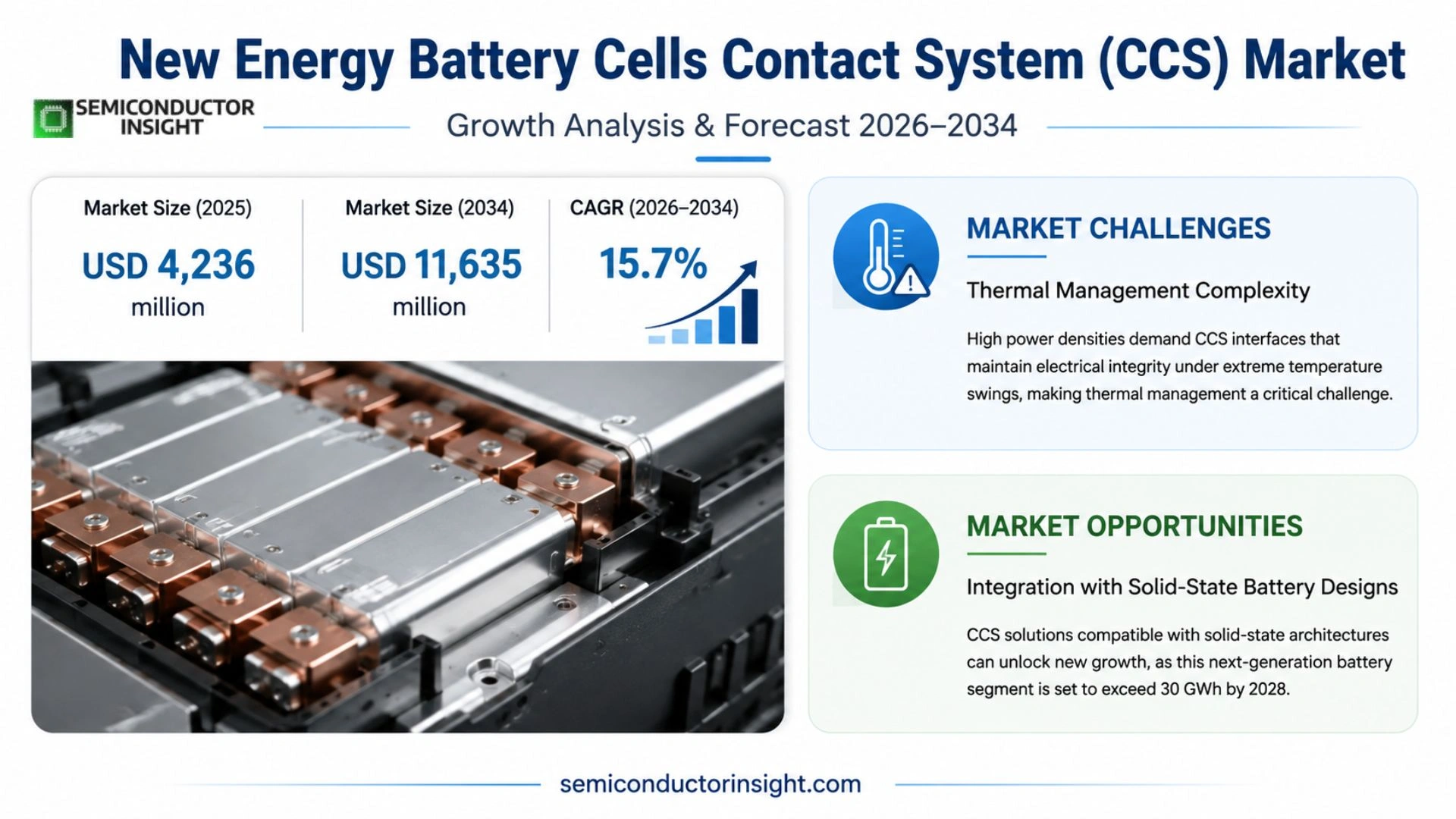
New Energy Battery Cells Contact System (CCS) market size was valued at USD 4,236 million in 2025 and will grow to USD 11,635 million by 2034, reflecting a CAGR of 15.7% over the forecast period.
The Battery Cells Contact System (CCS) serves as a core module within new‑energy battery packs. It integrates signal‑acquisition components such as wiring harnesses, FPC/FFC assemblies, plastic structural parts and copper/aluminum busbars into a single unit through thermoforming or riveting. This architecture enables high‑voltage series‑parallel cell connections while providing temperature and voltage sampling for the Battery Management System (BMS). Compared with conventional busbars, the integrated CCS offers lighter weight, higher precision and enhanced safety, supporting higher energy‑density packs and automated assembly lines.
Market expansion is fueled by accelerating electric‑vehicle deployments,global battery installations are set to exceed 1,000 GWh in 2025,and rapid growth in stationary energy‑storage projects. OEMs demand tighter functional‑safety standards and more accurate BMS sensing, prompting suppliers to shift from simple conductive parts toward highly integrated, multi‑sensor solutions. Companies such as Amphenol, Molex and Leoni have announced new SMT‑free FPC/CCS designs and intelligent fault‑tolerant modules, underscoring the move toward higher reliability and deeper BMS integration.
MARKET DRIVERS
Rising EV Adoption Accelerates Demand
The surge in electric‑vehicle registrations across Europe and Asia has forced OEMs to reevaluate battery pack architecture. Contact systems that guarantee low‑resistance pathways are now seen as indispensable for extending range and meeting warranty expectations. As battery capacities inch toward 100 kWh per vehicle, New Energy Battery Cells Contact System (CCS) Market experiences a proportional lift in component orders.
Regulatory Incentives Tighten Standards
Stringent safety regulations introduced by the UNECE and China’s GB/T standards mandate higher discharge‑current capabilities and robust isolation mechanisms. Manufacturers that fail to integrate compliant contact modules risk costly recalls. Hence, policy pressure translates directly into higher design spend on CCS solutions.
➤ The contact system can represent up to 12% of a battery pack’s total cost, making it a focal point for cost‑optimization initiatives.
Beyond compliance, the cost‑share argument encourages suppliers to pursue materials engineering and automated assembly, which in turn unlocks margin expansion for players that master high‑volume production.
MARKET CHALLENGES
Thermal Management Complexity
As cell chemistries push power densities beyond 250 W·h·kg⁻¹, heat removal becomes a bottleneck. The contact interface must maintain electrical integrity while tolerating temperature swings of 60 °C or more. Failure to synchronize CCS design with cooling architecture frequently leads to premature degradation, eroding consumer confidence.
Other Challenges
Supply Chain Bottlenecks
The reliance on high‑purity copper alloys and gold‑plated terminals creates a fragile upstream network. Recent mining disruptions and export restrictions have inflated raw‑material prices by roughly 18%, compressing profit margins for assemblers that cannot secure long‑term contracts.
MARKET RESTRAINTS
Material Cost Volatility
New Energy Battery Cells Contact System (CCS) Market grapples with unpredictable commodity pricing. Copper and specialty alloys, which form the backbone of low‑resistance contacts, have exhibited cyclical spikes linked to global infrastructure spending. When these inputs surge, OEMs often defer non‑essential upgrades, constraining demand for premium CCS configurations.
MARKET OPPORTUNITIES
Integration with Solid‑State Battery Designs
Emerging solid‑state cells demand contact solutions that can endure higher stacking pressures and operate without liquid electrolytes. Early adopters that engineer CCS modules compatible with ceramic interfaces stand to capture a disproportionate share of the next‑generation battery segment, projected to surpass 30 GWh by 2028.
Furthermore, the convergence of digital twins and AI‑driven failure prediction offers a pathway for service‑oriented revenue models. Companies that embed sensors within the contact stack can monetize real‑time health monitoring, turning a traditionally static component into a data‑rich asset.
New Energy Battery Cells Contact System (CCS) Market Trends
Integration and Multi‑Sensor Capability
The core of modern power packs is shifting from a simple conductive link to a system‑level module that combines current distribution, voltage and temperature sensing, and safety insulation. This evolution is driven by the surge in electric‑vehicle battery installations, which passed the 1,000 GWh threshold in 2025, and by the parallel expansion of grid‑scale storage projects. By embedding diagnostic functions directly into the contact system, manufacturers can offer higher fault‑tolerance and tighter BMS feedback, reducing the need for external sensing hardware. The result is a more compact pack architecture, lower assembly time, and a measurable uplift in overall vehicle safety metrics,factors that are reshaping procurement specifications across OEMs.
Other Trends
Cost Pressure and Material Volatility
While demand accelerates, the price trajectory of copper and aluminum remains unpredictable, pressuring margins that already sit around 27 % on an average unit price of US$20.8. Suppliers are therefore investing in alloy optimization and hybrid busbar designs to offset raw‑material swings. At the same time, injection‑molded plastic brackets and vacuum‑formed carriers are being refined to cut weight without sacrificing structural rigidity, delivering incremental cost savings that echo through the supply chain. Companies such as Koson Technology and Huichuangda, with capacities of 3 million and 12 million units respectively, are leveraging these efficiencies to stay competitive.
Supply‑Chain Flexibility and Customization
Customer expectations are moving from “plug‑and‑play” components toward highly customized solutions that match diverse cell formats,blade, pouch, and cylindrical. This trend forces manufacturers to adopt modular production lines capable of rapid change‑over, while also expanding engineering services to co‑design CCS modules with OEMs. The emerging demand for intelligent, fault‑tolerant designs in high‑voltage (400 V/800 V) platforms underscores the need for end‑to‑end testing and lifecycle validation. Those who can integrate signal acquisition, fuse isolation, and diagnostic firmware into a single, scalable package will secure the most valuable contracts in both automotive and stationary storage markets.
COMPETITIVE LANDSCAPE
Key Industry Players
Competitive Overview of Global CCS Suppliers
The CCS arena is anchored by a handful of large‑scale manufacturers that dominate capacity and pricing power. Koson Technology, with a 3 million‑unit annual busbar line, and Huichuangda, offering 12 million modules per year, together supply more than 60 % of the estimated 223 million units slated for 2025. Their dominance stems from vertically integrated supply chains that combine copper/aluminum extrusion, precision plastic molding, and automated riveting in a single facility. This integration reduces lead‑time, secures material availability, and yields margin resilience even when base metal prices fluctuate. The market structure therefore resembles a duopoly at the high‑end of volume, while a second tier of mid‑size firms competes on specialized designs for emerging cell formats such as blade and high‑energy‑density pouch batteries.
Beyond the top tier, a diverse set of niche players adds depth to the competitive landscape. European connector specialists like Amphenol and Molex leverage extensive automotive certification portfolios to win contracts with premium EV makers seeking stringent functional‑safety compliance. German‑based ElringKlinger and Italy’s Leoni focus on modular plastic‑to‑metal hybrids that address the shift toward 800 V platforms. Asian innovators,including Suzhou West Deane New Power Electric, Shenzhen Uniconn Technology, and Xiamen Hongxin Electronics,differentiate through rapid prototyping of SMT‑free FPC/CCS and intelligent fault‑diagnostic modules. Their agility enables them to capture orders from energy‑storage system integrators that value customized signal‑acquisition layouts over sheer volume. Collectively, these players foster a competitive environment where product integration, reliability engineering, and co‑development with BMS providers are the primary levers for market share gains.
List of Key New Energy Battery Cells Contact System Companies Profiled
- Koson Technology
- Amphenol
- Molex
- ElringKlinger
- Leoni
- Huichuangda
- Yazaki
- CelLink Technologies
- Suzhou West Deane New Power Electric Co., Ltd.
- Shenzhen Uniconn Technology Co., Ltd.
- Dongguan Silicon Xiang Insulation Material Co., Ltd.
- Xiamen Hongxin Electronics Technology Group Inc.
- Kunshan Kersen Science & Technology Co.,Ltd.
- Shenglan Technology Co., Ltd.
- Sun.King Technology Group Limited
Segment Analysis:
| Segment Category | Sub-Segments | Key Insights |
| By Type |
|
Integrated Busbar Solutions
|
| By Application |
|
Power Battery Dominance
|
| By End User |
|
OEM Preference for System‑Level Supply
|
| By Integration Level |
|
Shift Toward Intelligent Modules
|
| By Manufacturing Process |
|
Process Innovation Drives Flexibility
|
Regional Analysis: New Energy Battery Cells Contact System (CCS) Market
Asia‑Pacific
Companies are relocating key component fabs to reduce exposure to geopolitical volatility. Proximity to lithium processing hubs shortens lead times and supports quicker iteration of connector designs, giving local players a strategic edge in cost and customization.
Harmonized safety standards across China, Japan, and Korea streamline certification pathways. This convergence enables manufacturers to roll out unified CCS platforms across multiple markets without redundant testing, accelerating time‑to‑market.
Joint ventures between battery cell producers and connector specialists are proliferating. These alliances blend material science expertise with high‑precision engineering, fostering solutions that address thermal runaway mitigation more effectively.
Expansion of electric buses and commercial two‑wheelers in India and Indonesia is stretching CCS requirements beyond passenger‑car norms, prompting design adaptations for higher current loads and rugged operating conditions.
North America
In North America, the CCS conversation is tightly linked to incumbent automotive giants revisiting legacy platforms. The region benefits from a mature engineering talent pool and a robust IP ecosystem, which together nurture incremental improvements in connector durability. Federal emission standards continue to push manufacturers toward higher‑energy‑density packs, indirectly raising the bar for contact reliability. Venture capital is increasingly targeting start‑ups that claim to deliver modular, plug‑and‑play solutions, suggesting a potential shift from bespoke designs to more standardized offerings. The challenge lies in reconciling stringent safety approvals with the desire for rapid product cycles, a tension that shapes investment decisions and partnership strategies.
Europe
European manufacturers are leveraging the CCS niche to differentiate premium electric models. Stringent type‑approval regulations compel suppliers to prove long‑term robustness under varied climatic conditions, from Scandinavia’s cold snaps to Southern Europe’s heatwaves. This regulatory pressure spurs innovation in corrosion‑resistant alloys and advanced sealing techniques. Meanwhile, the EU’s Circular Economy Action Plan incentivizes designs that facilitate disassembly and recycling, prompting a re‑examination of connector material choices. Market participants that can demonstrate compliance while maintaining cost efficiency are poised to capture contracts with both legacy OEMs and emerging electric‑vehicle startups.
South America
South America remains a nascent arena for CCS adoption, yet recent government pledges for electric public transit are igniting interest. Brazil’s expanding electric‑bus fleet creates a testing ground for high‑current contact modules, while Argentina’s automotive incentives encourage pilot projects in passenger vehicles. Supply‑chain constraints, particularly limited local manufacturing capacity, compel firms to import components, raising the importance of reliable after‑sales support. Companies that can combine robust logistics with localized technical assistance are likely to forge early footholds as the market matures.
Middle East & Africa
The Middle East & Africa region is gradually integrating CCS considerations as sovereign wealth funds allocate capital toward renewable transport projects. Harsh desert environments demand connectors with superior thermal management and dust‑intrusion protection. In the UAE, collaborations between utility operators and EV manufacturers are experimenting with fast‑charging corridors, demanding contact systems that can sustain repeated high‑power cycles. African nations, though still early in the adoption curve, are exploring electric mobility for urban logistics, where cost‑effective, low‑maintenance connectors could become a decisive factor for scaling.
Report Scope
This market research report provides a comprehensive analysis of the New Energy Battery Cells Contact System (CCS) Market , covering the forecast period 2026–2034. It offers detailed insights into market dynamics, technological advancements, competitive landscape, and key trends shaping the industry.
Key focus areas of the report include:
- Market Overview: The report begins with an overview outlining its current market scenario, key growth indicators, and industry transformation drivers. It discusses macroeconomic factors, demand–supply balance, regulatory landscape, and the strategic role of semiconductors in powering advancements across industries such as automotive, telecommunications, consumer electronics, and industrial automation.
- Market Size & Forecast: Historical data and future projections for revenue, unit shipments, and market value across major regions and segments.
- Segmentation Analysis: Detailed breakdown by product type, technology, application, and end-user industry to identify high-growth segments and investment opportunities.
- Regional Insights: Insights into market performance across North America, Europe, Asia-Pacific, Latin America, and the Middle East & Africa, including country-level analysis where relevant.
- Competitive Landscape: Profiles of leading market participants, including their product offerings, R&D focus, manufacturing capacity, pricing strategies, and recent developments such as mergers, acquisitions, and partnerships.
- Technology Trends & Innovation: Assessment of emerging technologies, integration of AI/IoT, semiconductor design trends, fabrication techniques, and evolving industry standards.
- Market Drivers & Restraints: Evaluation of factors driving market growth along with challenges, supply chain constraints, regulatory issues, and market-entry barriers.
- Stakeholder Insights: Insights for component suppliers, OEMs, system integrators, investors, and policymakers regarding the evolving ecosystem and strategic opportunities.
Primary and secondary research methods are employed, including interviews with industry experts, data from verified sources, and real-time market intelligence to ensure the accuracy and reliability of the insights presented.
FREQUENTLY ASKED QUESTIONS:
What is the current market size of New Energy Battery Cells Contact System (CCS) Market?
-> New Energy Battery Cells Contact System (CCS) market will grow to USD 11,635 million by 2034, reflecting a CAGR of 15.7% over the forecast period.
Which key companies operate in New Energy Battery Cells Contact System (CCS) Market?
-> Key players include Amphenol, Diehl Metal, Molex, ElringKlinger, ENNOVI, Leoni, CelLink Technologies, Yazaki, Suzhou West Deane New Power Electric Co., Ltd., Shenzhen Uniconn Technology Co., Ltd., Dongguan Silicon Xiang Insulation Material Co., Ltd., Suzhou Recodeal Interconnect System Co., Ltd., Xiamen Hongxin Electronics Technology Group Inc., Suzhou Wanxiang Technology Co., Ltd., Kunshan Kersen Science & Technology Co., Ltd., YD Electronic Technology Co., Ltd., Shenzhen Deren Electronic Co., Ltd., Xiamen Bolion Tech. Co., Ltd., Shenglan Technology Co., Ltd., Huizhou China Eagle Electronic Technology Co., Ltd., Huizhou Speed Wireless Technology Co., Ltd., Shenzhen Hui Chuang Da Technology Co., Ltd., Sun.King Technology Group Limited, Jiangsu Riying Electronics Co., Ltd., Changzhou NRB Corporation, Guangdong Mingji Hi-Tech Electronics Co., Ltd., among others.
What are the key growth drivers?
-> Key growth drivers include the rapid expansion of global electric‑vehicle battery installations (projected to exceed 1,000 GWh by 2025), accelerating deployment of energy‑storage systems, rising functional‑safety standards for battery management, automation and cost‑reduction advances in CCS manufacturing, and the shift toward higher‑energy‑density battery chemistries that demand integrated, lightweight, and high‑precision contact systems.
Which region dominates the market?
-> Asia dominates the CCS market, with China leading in production capacity and demand, followed by significant growth in Japan and South Korea. Europe and North America remain important, but Asia’s scale and accelerated electrification make it the primary growth engine.
What are the emerging trends?
-> Emerging trends include the development of fully integrated busbars that combine current distribution, voltage/temperature acquisition, and safety functions; flexible and modular CCS designs for blade‑ and pouch‑cell architectures; SMT‑free FPC/CCS and intelligent CCS solutions with built‑in diagnostics; and the incorporation of fuse/isolation mechanisms for large‑scale energy‑storage applications.
Get Sample Report PDF for Exclusive Insights
Report Sample Includes
- Table of Contents
- List of Tables & Figures
- Charts, Research Methodology, and more...