
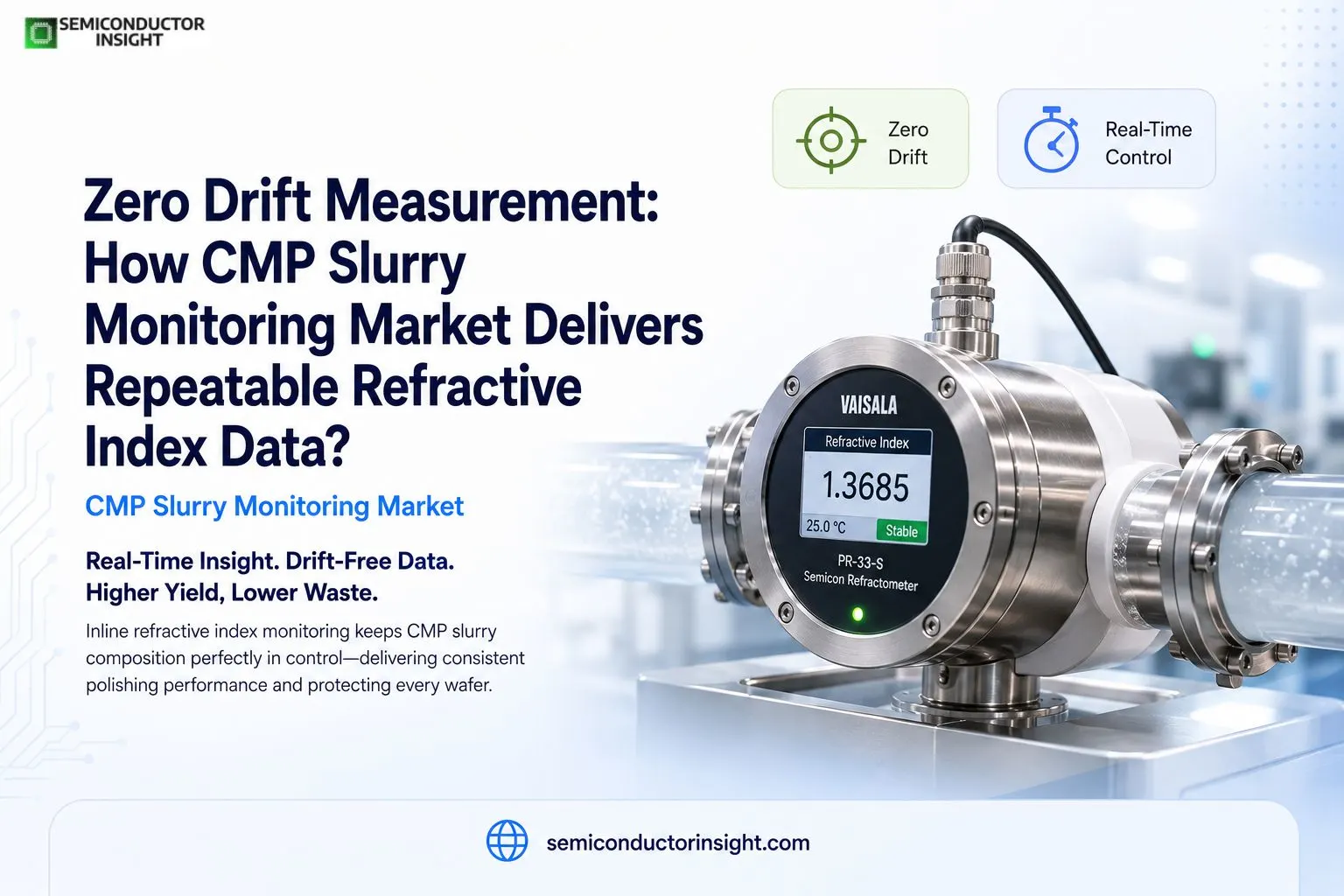
Zero Drift Measurement: How CMP Slurry Monitoring Market Delivers Repeatable Refractive Index Data?
Leading semiconductor fabrication plants now use inline process refractometers to continuously measure refractive index of CMP slurry, because every blend has a unique composition and unique refractive index that can be validated instantly.
This real-time measurement provides a more accurate picture of slurry variations than discrete lab sampling, and it is virtually drift-free, unaffected by flow rate or bubbles. Inline refractive index measurement has become the industry standard for fast, accurate, real-time slurry monitoring in fabs.
Slurry Consistency Directly Determines Wafer Quality and Yield
- The composition of the slurry used in chemical mechanical polishing greatly impacts wafer quality, and fabs must continuously monitor slurry composition throughout the day to ensure batch-to-batch consistency and optimal wafer quality.
- Slurry is delivered concentrated and can vary from batch to batch; fabs dilute it with deionized water and add hydrogen peroxide just before polishing because H₂O₂ degrades into water and oxygen over time, creating a limited window for consistent planarization.
- Even the slightest deviation from specification can result in expensive equipment contamination and wafer scrap, which is why reliability of each chemical solution is a top concern.
Three Strategic Installation Points Maximize Process Protection
Refractometers can be installed on supply lines to monitor incoming slurry and H₂O₂ and define the dilution target concentration level, in the slurry blender tank for real-time control of H₂₂ blending concentration and blending time, and at the CMP tool to ensure slurry composition is within set limits before it contacts wafers. This multi-point deployment allows fabs to detect faults in slurry blending and dispense systems before defective slurry reaches the wafer surface.
Hardware Designed For Harsh Wet-Chemical Environments
The Vaisala PR-33-S Semicon Refractometer is specifically designed for in-line, real-time measurement in semiconductor manufacturing, with metal-free Teflon and sapphire-wetted parts and surfaces that make it ideal for slurries and harsh chemicals.
Its robust design promises long-term stability and a long lifespan, built-in diagnostics give an instant overview of measurement performance, and the integrated temperature sensor ensures highly accurate refractive index measurement while tolerating process vibrations with no measurement errors.
There is no measurement drift, the device is virtually maintenance-free, requires no consumables, and does not generate chemical waste.
Take a Quick Glance at Our In-Depth Analysis Report: https://semiconductorinsight.com/report/cmp-slurry-monitoring-market/
Quantitative Impact on Fab Operations and Waste Reduction
- Studies have proven Vaisala refractometers to have excellent agreement with reference titration but with the advantage of real-time results that are direct and repeatable from the process.
- By verifying that slurries consistently meet requirements, refractometers allow fabs to ensure optimal wafer quality and yield while reducing waste, making them a safe, cost-effective, and low-maintenance method for monitoring slurry density and composition.
- Leading fabs now use refractometers as the tool of choice to detect blending and dispense faults early, which prevents costly downstream defects.
Industry 4.0 Integration Enables Fast Feedback and Predictive Action
Modern semiconductor manufacturing increasingly relies on Industry 4.0 frameworks that continuously monitor high-value manufacturing assets and enable faster responses to production needs, which aligns perfectly with real-time slurry monitoring.
Edge devices near the CMP tool can receive sensory refractive index data and predict process quality in real-time, enabling corrective actions in less than one second and reducing the risk of defective wafers. This fast feedback loop transforms refractive index measurement into actionable process control rather than passive data collection.
Advanced Node Demands Tighter Tolerances and Continuous Monitoring
As semiconductor devices adopt more 3D structures in NAND and DRAM memory chips, production engineers increasingly require precise metrology information to control production processes and optimize yield and performance of chips in production.
CMP Slurry Monitoring Market supports these advanced node requirements by delivering continuous, drift-free composition control that short-read metrology cannot provide, especially for deep trench and high-aspect-ratio planarization.
Sustainability and Cost Efficiency through Elimination of Lab Titration
The PR-33-S device provides a cost-efficient, reliable, and sustainable alternative to laboratory sampling and titration because it requires no consumables and does not generate chemical waste. This eliminates uncertainty introduced in sampling and sample handling such as H₂O₂ deterioration or temperature changes that plague lab-based methods.
CMP Slurry Monitoring Market is now defined by inline, real-time, no-consumable sensing that protects yield, reduces waste, and enables advanced node manufacturing at scale.

Comments (0)