
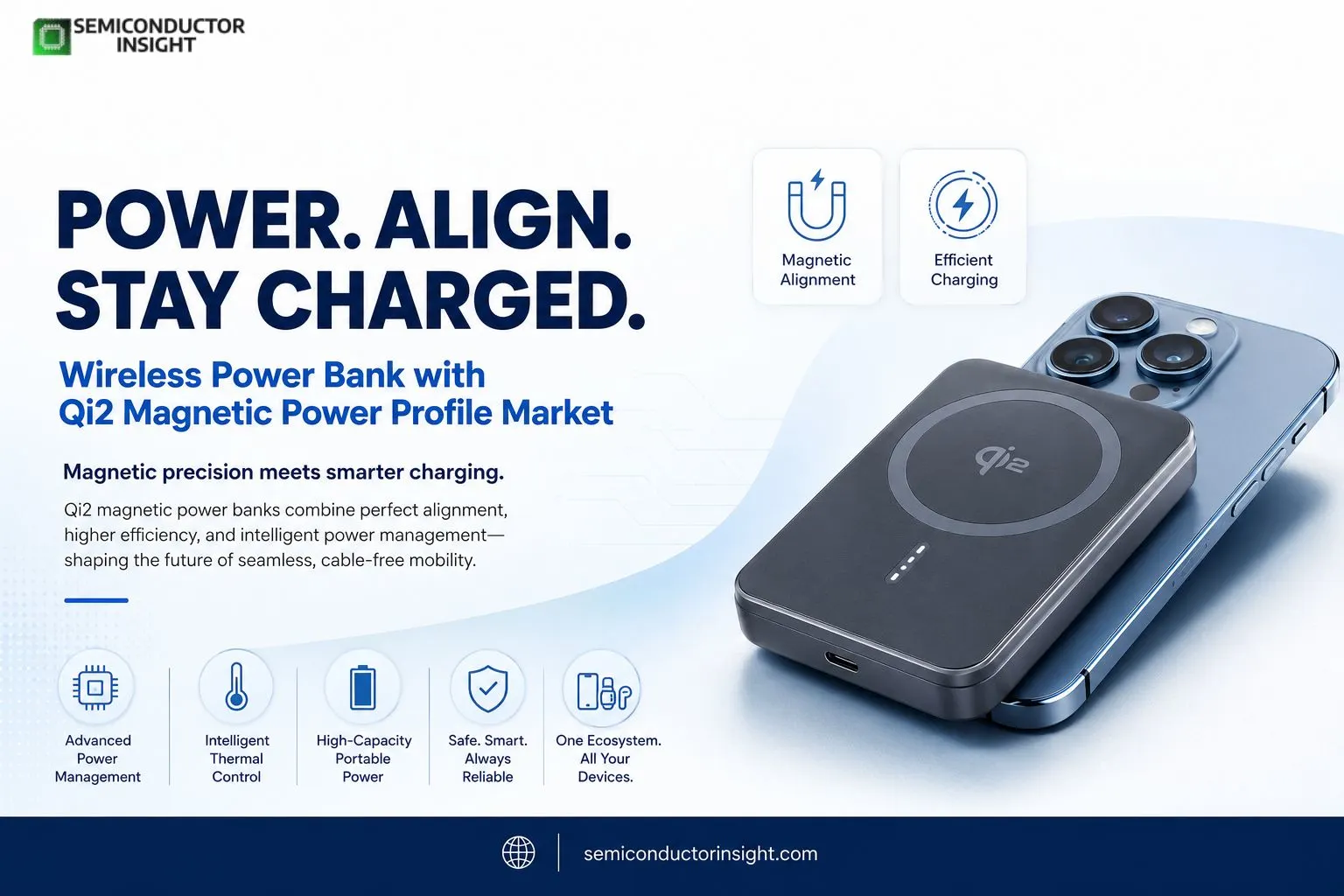
Wireless Power Bank with Qi2 Magnetic Power Profile Market 2026 How Fast Is Global Demand Rising with Over 1.5 Billion Qi Compatible Smartphones
The portable charging landscape is entering a new phase as Wireless Power Bank with Qi2 Magnetic Power Profile Market aligns with next-generation semiconductor innovations. Consumers are no longer looking only for larger battery capacity they expect secure magnetic attachment, higher charging efficiency, intelligent thermal management, and seamless compatibility across multiple devices.
Qi2, developed by the Wireless Power Consortium (WPC), introduces the Magnetic Power Profile (MPP), enabling improved alignment between chargers and smartphones while minimizing energy loss. This evolution is reshaping not only wireless accessories but also semiconductor demand for power management integrated circuits (PMICs), wireless charging controllers, gallium nitride (GaN) components, battery management systems, and advanced magnetics sensing technologies.
Why Qi2 Has Become More Than Just another Wireless Charging Standard?
Qi2 is not simply an upgrade in charging speed. It represents a redesign of wireless charging architecture based on magnetic precision. Unlike conventional Qi chargers that often suffer from coil misalignment, Qi2-certified devices automatically position charging coils using integrated magnets. This improves charging consistency while reducing unnecessary heat generation.
The new ecosystem is encouraging semiconductor manufacturers to design more compact power ICs capable of managing dynamic voltage regulation, foreign object detection, and adaptive thermal control. These improvements are becoming increasingly important as flagship smartphones integrate AI workloads that generate higher power consumption throughout the day.
Numbers That Explain the Momentum behind Magnetic Charging
Several industry indicators highlight why manufacturers are investing aggressively in Qi2-enabled products.
According to the Wireless Power Consortium, more than 1,000 wireless charging products have already completed Qi certification programs, with Qi2 certifications accelerating following the specification’s commercial rollout.
The International Energy Agency (IEA) estimates that global consumer electronics shipments continue to exceed 7 billion connected devices annually, creating enormous opportunities for wireless charging accessories.
Industry reports from major smartphone manufacturers indicate battery capacities have now commonly crossed 5,000 mAh, while premium flagship devices increasingly support wireless charging outputs between 15 W and 50 W, depending on proprietary charging protocols. Larger batteries naturally increase demand for high-capacity magnetic wireless power banks ranging from 5,000 mAh to 20,000 mAh.
These figures illustrate why semiconductor suppliers are focusing on higher-efficiency wireless charging chipsets rather than merely increasing charging wattage.
The Semiconductor Technologies Quietly Powering Every Magnetic Power Bank
- Behind every Qi2-certified wireless power bank lies an increasingly sophisticated semiconductor stack.
- Power management ICs continuously regulate voltage fluctuations to maintain charging efficiency.
- Wireless charging controller chips synchronize communication between smartphones and accessories.
- MOSFETs and GaN power devices reduce switching losses while improving energy conversion efficiency.
- Battery management systems monitor cell balancing, charging cycles, and temperature protection.
- Hall-effect sensors detect magnetic positioning with remarkable accuracy.
- Advanced firmware embedded inside charging controllers also enables adaptive charging algorithms that respond to battery health and environmental temperature in real time. This intelligence has become one of the biggest product differentiators in premium wireless charging accessories.
Product Launches That Are Redefining Consumer Expectations
The market has witnessed a steady wave of Qi2-enabled product introductions throughout 2025 and 2026.
Accessory manufacturers including Anker, Belkin, UGREEN, Baseus, and ESR have introduced Qi2-certified magnetic power banks supporting improved alignment and faster charging for compatible smartphones.
Meanwhile, smartphone manufacturers continue expanding compatibility with magnetic charging ecosystems. New flagship devices increasingly incorporate stronger magnetic arrays, making wireless charging more reliable during travel, office work, and gaming sessions.
Rather than selling individual accessories, brands are now building integrated ecosystems that include wireless chargers, battery packs, magnetic wallets, stands, and docking stations sharing a common magnetic architecture.
Why AI Smartphones Are Creating Unexpected Demand for Portable Power?
The rapid adoption of on-device AI features has significantly changed smartphone power consumption patterns.
Generative AI assistants, real-time language translation, AI image editing, and continuous background processing require sustained computational performance from neural processing units (NPUs). As these workloads increase, battery drain accelerates.
This trend has shifted purchasing behavior toward premium wireless power banks capable of delivering convenient top-up charging throughout the day without carrying additional cables.
The combination of AI-enabled smartphones and Qi2 magnetic charging is gradually transforming portable charging from an emergency accessory into an everyday productivity tool.
To Know More about the Report, You Can Freely Browse Our Latest Updated Report: https://semiconductorinsight.com/report/wireless-power-bank-with-qi2-magnetic-power-profile-market/
The New Race toward Smaller Chips and Smarter Energy Transfer
One of the most significant industry developments is the miniaturization of charging electronics.
Semiconductor companies are integrating multiple functions including wireless power transmission, battery protection, communication protocols, and thermal sensing within fewer integrated circuits.
This higher integration reduces PCB size, lowers manufacturing complexity, and enables slimmer magnetic power banks that remain lightweight without sacrificing capacity.
Simultaneously, improvements in semiconductor packaging technologies are helping reduce heat dissipation while increasing charging efficiency, allowing manufacturers to design compact accessories suitable for premium smartphones and foldable devices.
Where the Next Wave of Innovation Is Already Taking Shape
The next generation of wireless power banks is expected to extend well beyond smartphones.
Manufacturers are actively developing Qi2-compatible charging solutions for wireless earbuds, smartwatches, AR glasses, portable gaming devices, fitness trackers, and emerging AI wearables. Multi-device magnetic charging platforms are also becoming more intelligent through embedded semiconductor control systems capable of recognizing connected devices and automatically optimizing power allocation.
As semiconductor innovation continues advancing alongside evolving Qi2 specifications, magnetic wireless charging is steadily becoming a foundational element of the connected consumer electronics ecosystem rather than simply another accessory category.

Comments (0)