
Why Silicon Drift Detectors Equipment Market is Essential for Modern Spectroscopy?
Silicon Drift Detector equipment has become a core component in modern semiconductor analysis, particularly in applications requiring high-resolution X-ray detection. These detectors are widely used in energy-dispersive X-ray spectroscopy systems, where accurate identification of elemental composition is critical.
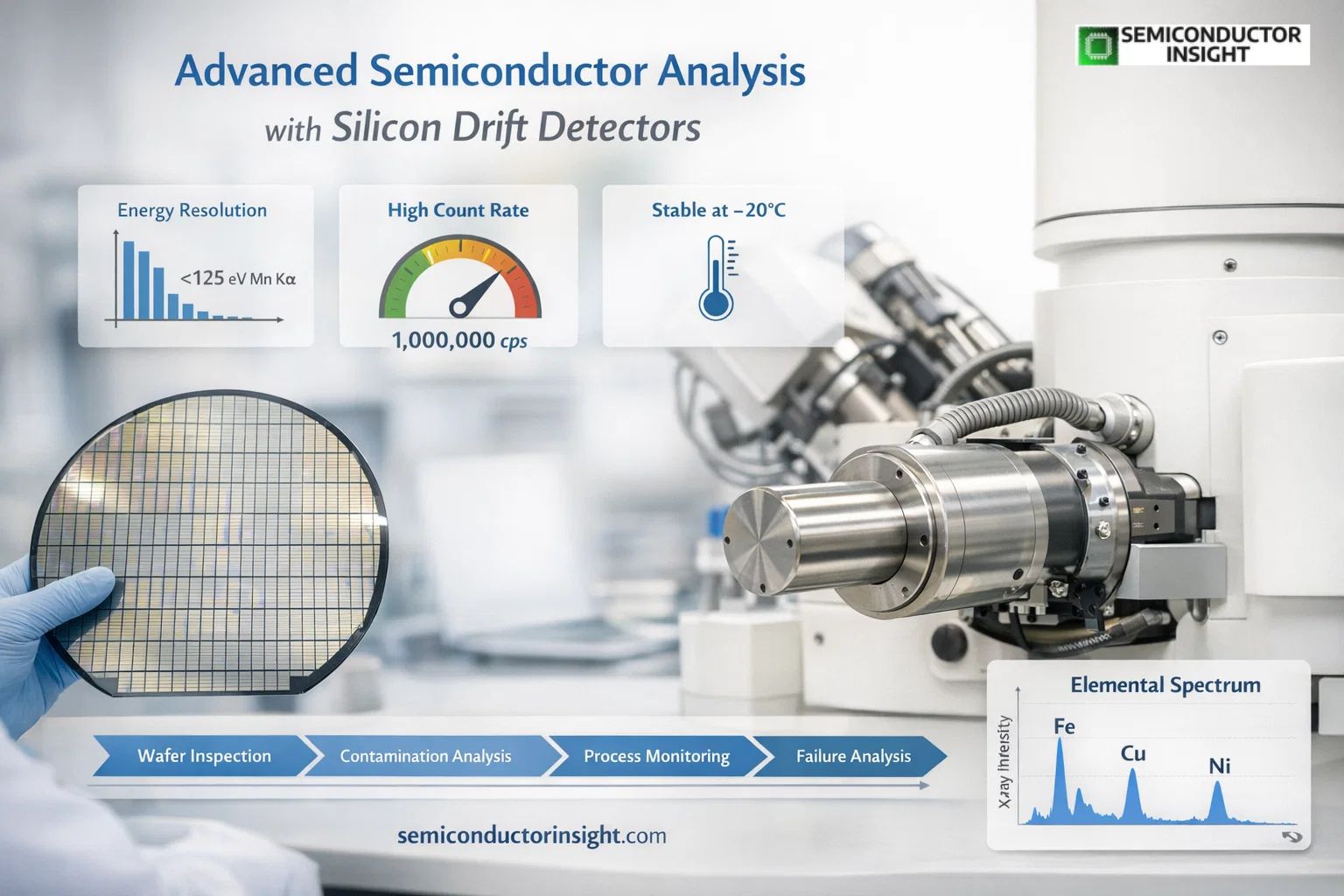
Silicon Drift Detectors are faster at processing signals and have far better energy resolution than typical detectors. They often get below 125 eV at manganese K-alpha lines, which is a standard used in many spectroscopy investigations and technical documents.
The importance of such precision becomes evident in semiconductor fabrication environments, where even trace contamination at parts-per-million levels can impact wafer performance. Facilities handling silicon wafers, compound semiconductors, and advanced packaging rely on these detectors to maintain strict quality thresholds.
The Physics behind Faster Detection
- At the heart of Silicon Drift Detector technology lies a unique electrode design that allows electrons generated by incoming X-rays to drift toward a small collection anode.
- This design reduces capacitance, enabling higher count rates without compromising resolution. In practical terms, modern systems can process over 1 million counts per second, making them highly efficient for high-throughput environments.
- This capability is especially relevant in semiconductor labs where time-sensitive analysis is routine.
- For example, failure analysis labs examining integrated circuits often deal with multiple samples per hour, requiring detectors that can maintain both speed and accuracy simultaneously.
Integration across Semiconductor Workflows
Wafer Inspection
↓
Contamination Analysis
↓
Process Monitoring
↓
Failure Analysis
↓
Final Quality Check
In wafer fabrication facilities, SDD systems are used to detect metallic impurities such as copper, iron, or nickel, which can disrupt electrical properties. During packaging, these detectors help verify solder composition and bonding integrity, ensuring long-term device reliability.
Equipment Evolution in Real Manufacturing Setups
Recent advancements in semiconductor manufacturing have pushed the capabilities of SDD equipment even further. Systems are now designed with compact architectures, making them easier to integrate into automated inspection tools. Some modern detectors operate at temperatures around -20°C using thermoelectric cooling, eliminating the need for liquid nitrogen systems that were once standard.
This shift has reduced operational complexity while maintaining performance. In high-volume semiconductor plants, this translates into fewer maintenance interruptions and more consistent analytical output. According to technical insights published through semiconductor equipment documentation and academic resources like IEEE, such innovations are playing a key role in improving throughput without compromising measurement reliability.
Real-World Application across Industries
While semiconductors remain a primary driver, Silicon Drift Detector equipment is also widely used in adjacent high-tech industries. In electronics recycling, for instance, SDD-based analyzers help identify valuable metals in circuit boards. In aerospace manufacturing, they are used to verify alloy compositions where even minor deviations can affect safety.
A practical example can be seen in advanced chip manufacturing hubs where thousands of wafers are processed daily. Each wafer undergoes multiple inspection cycles, with SDD systems ensuring that elemental composition remains within strict tolerances. This level of monitoring supports the production of high-performance chips used in smartphones, electric vehicles, and data centers.
Stay connected for additional in-depth information right here: https://semiconductorinsight.com/report/global-silicon-drift-detector-equipment-market/
Data Accuracy and Throughput in Numbers
- Modern Silicon Drift Detector systems offer clear performance gains that support semiconductor operations with greater precision and reliability.
- These systems typically deliver an energy resolution of 120-130 eV, a count rate capacity of up to 1,000,000 cps, and stable operation at around -20°C, while also detecting trace elements at the ppm level.
- These capabilities make SDD equipment especially valuable in precision-focused environments, where fast and accurate trace-element detection helps semiconductor devices meet increasingly strict performance standards.
A Shift toward Smarter Detection Systems
The latest trend in Silicon Drift Detector equipment is the integration of intelligent software and automation. Systems now include real-time spectral analysis, automated calibration, and cloud-based data storage. This allows engineers to monitor results remotely and make faster decisions during production cycles.
As semiconductor manufacturing becomes more complex with smaller node sizes and advanced materials, the demand for reliable and fast detection equipment continues to grow. Silicon Drift Detectors, with their combination of speed, precision, and adaptability, are positioned as one of the most essential tools supporting this transformation in semiconductor technology.

Comments (0)