
Why Is RF Matrix Switch Becoming Critical for 5G Advanced and AI Chip Validation?
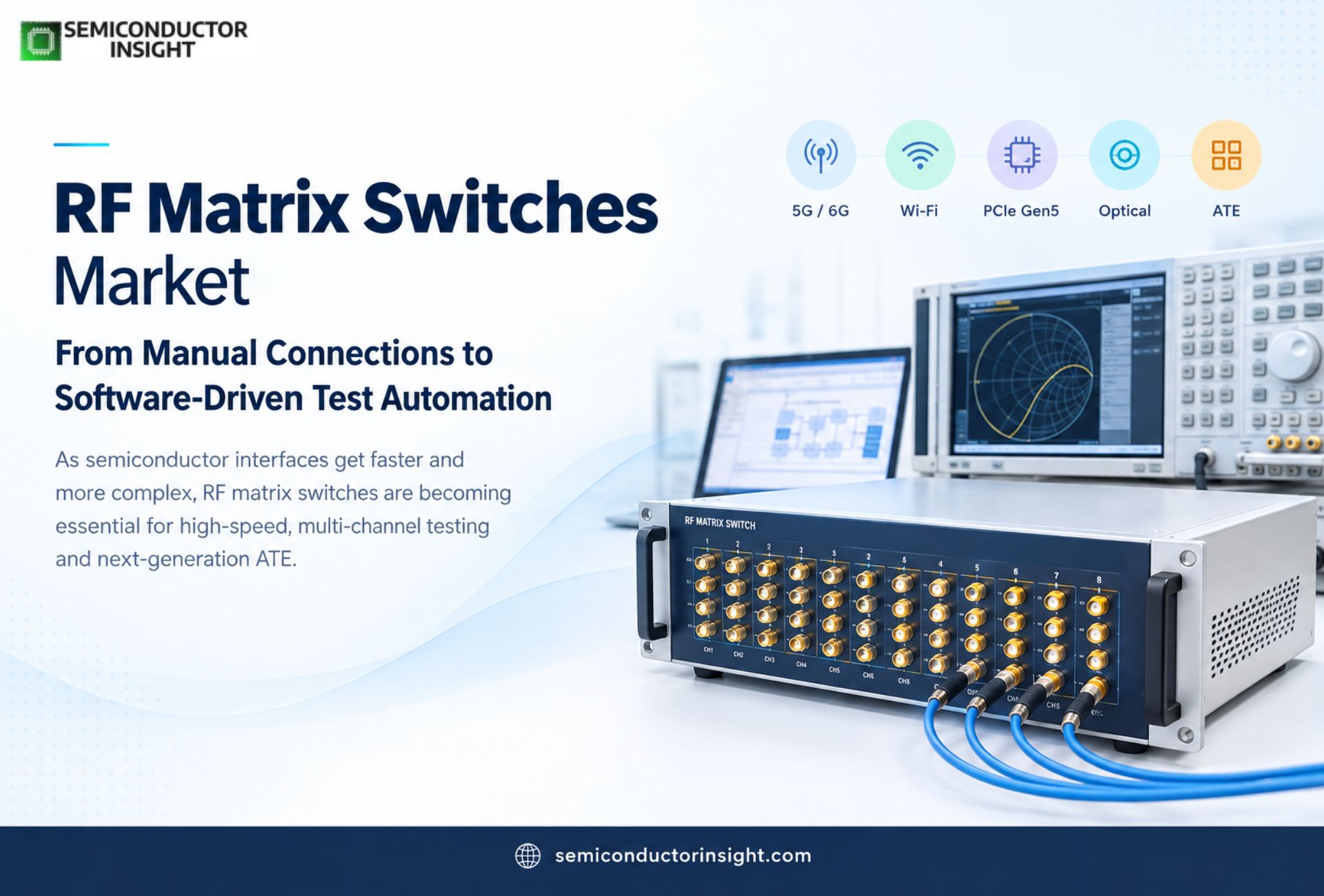
RF matrix switches are becoming an increasingly important part of semiconductor test infrastructure as engineers move from one-device-at-a-time measurements toward automated, multi-channel validation. Instead of repeatedly disconnecting cables between a device under test and an oscilloscope, vector network analyzer, signal generator or RF tester, a switch matrix can electronically route different signal paths through a controlled test architecture.
- That matters as semiconductor interfaces become faster and more densely integrated.
- Advantest’s current V93000 platform supports RF testing for 5G, 5G Advanced, Wi-Fi 6/6E/7, UWB, Bluetooth and other wireless technologies, while its RF architecture combines switching and signal-routing functions to support parallel measurements.
From Cable Changes to Software Controlled Routing
The most visible change is happening inside automated test laboratories. An RF matrix allows engineers to define which input connects with which output through software rather than manually moving cables between instruments.
This is particularly valuable when dozens of signals must be characterized repeatedly. Tektronix demonstrated RF-switch-based automated testing for PCIe Gen5, where an x16 interface can require validation across multiple differential lanes. Its documented configuration uses 40 GHz switching hardware and can support up to 18 lanes, while the PCIe Gen5 test environment operates at 32 GT/s.
Device Under Test → RF Matrix → Measurement Instrument → Software Control → Automated Result
The switch therefore becomes part of the measurement architecture rather than simply an accessory.
Frequency Headroom Is Becoming a Design Priority
- As wireless and high-speed semiconductor interfaces move toward higher frequencies, RF matrix specifications are being pushed beyond conventional laboratory switching requirements.
- The latest commercial test architectures already extend into millimeter-wave territory.
- Teradyne’s Spectrum RF Systems, for example, provide configurable mixed-technology test platforms with RF and switching instrumentation supporting configurations up to 26.5 GHz.
- At the component level, Analog Devices currently lists RF switch technologies extending to 90 GHz, demonstrating how semiconductor switching technology itself is being developed for increasingly demanding high-frequency environments.
Higher Frequency → Lower Tolerance for Signal Distortion → Greater Need for Controlled Switching → More Demanding RF Matrix Design
PCIe Gen5 Shows Why Matrix Architecture Matters
High-speed computing interfaces provide one of the clearest application examples. PCIe Gen5 operates at 32 GT/s, and testing multiple lanes can require repeated transmitter and receiver measurements.
Tektronix’s documented Gen5 approach uses RF switching to avoid continuous physical cable changes. Its example matrix uses eight SP6T 40 GHz switches and supports configurations of up to 18 lanes. The same documentation recommends phase-matched connections and warns that excessive relay cascading can add unwanted insertion loss.
This illustrates an important point for the RF Matrix Switch Market: switching density alone is not enough. Engineers must balance channel count, bandwidth, insertion loss, isolation, return loss, timing and path matching.
RF ATE Is Turning Switching Into a Throughput Tool
Automated test equipment is another major application zone. Modern semiconductor testers increasingly need to handle RF, analog, digital, power and mixed-signal devices within flexible architectures.
Advantest states that its V93000 platform supports RF, digital, power and analog testing, while its RF solution is designed for high parallelism and multi-site testing. Teradyne similarly describes semiconductor ATE platforms for RF, analog, logic, power and mixed-signal technologies, emphasizing higher site counts and production efficiency.
That changes the role of switching from connection management to production optimization.
Semiconductor Switching Is Moving Into Thousands of Channels
The scale becomes particularly clear in automated semiconductor characterization. Keithley’s 700 Series switching systems can support up to 2,880 channels, with individual matrix configurations reaching hundreds of crosspoints. These systems are used for semiconductor research, characterization and production testing.
Although not every channel in such systems represents an RF path, the figure demonstrates the direction of semiconductor test architecture: greater connectivity, programmable routing and less manual intervention.
The same philosophy is appearing in wafer-level testing. Keithley systems can automate complex capacitance measurements and high-voltage device characterization up to 3 kV without manually reconfiguring test pins.
AI Chips Are Changing What Test Equipment Must Handle
The growth of AI processors is also changing semiconductor test requirements. Advanced processors combine enormous numbers of high-speed interfaces with increasingly complex power, memory and RF-adjacent subsystems.
Teradyne’s September 2026 semiconductor commentary highlights the growing importance of specialized interfaces, advanced packaging, system-level testing and data analytics as chip architectures become more complex.
For RF matrix suppliers, this creates demand for systems capable of handling larger test configurations while preserving signal integrity and allowing software-controlled expansion.
The Next Test Rack Is Being Designed Around Flexibility
- The direction of the RF Matrix Switch Market is increasingly visible in the architecture of modern test systems.
- Instead of building a dedicated instrument connection for every measurement, manufacturers are using programmable switching to share expensive RF resources across multiple devices, channels and test conditions.
- The value is particularly apparent when a test rack must move between characterization and production.
- A programmable matrix can redirect signals, recall predefined configurations and integrate with automation software. Tektronix’s Switch Matrix software, for example, supports relay configuration, de-embedding, saved setups, graphical wiring views and programmatic integration.
- This makes software compatibility almost as important as the physical RF specification.
You can freely browse our most recent updated report to learn more about it before scrolling further: https://semiconductorinsight.com/report/rf-matrix-switch-market/
Where the Technology Is Showing Up Next
The application map is expanding through several high-frequency semiconductor and electronics workflows:
5G Advanced → RF Transceiver Testing → Power Amplifier Validation → Wi-Fi 7 → PCIe Gen5 → Optical Module Testing → Mixed-Signal ATE → Semiconductor Characterization
The common requirement is controlled signal routing with repeatable electrical performance.
As test systems move toward higher frequencies, more lanes, greater automation and larger production volumes, RF matrix switches are becoming a connective layer between semiconductor devices and measurement infrastructure. Their importance is therefore increasingly determined not just by the number of ports they contain, but by how accurately and efficiently they can route complex RF signals inside automated test environments.

Comments (0)