Taiwan AI Advanced Packaging Equipment Market Insights
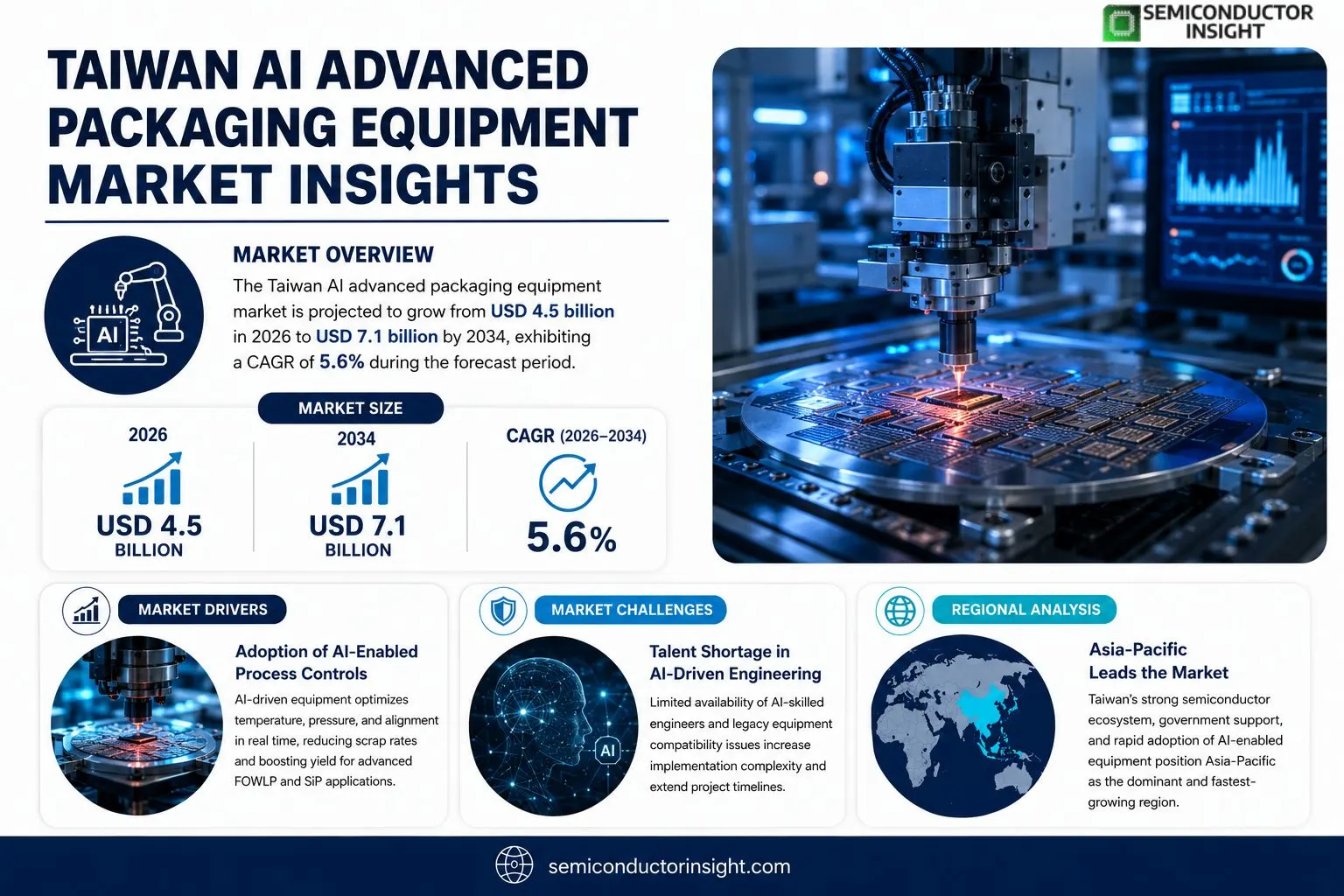
AI advanced packaging equipment market size was valued at USD 4.2 billion in 2025. The market is projected to grow from USD 4.5 billion in 2026 to USD 7.1 billion by 2034, exhibiting a CAGR of 5.6 % during the forecast period.
AI advanced packaging equipment comprises machinery that embeds machine‑learning algorithms into core functions such as defect detection, process control and yield prediction. Typical systems include AI‑driven inspection stations, smart die‑attach robots, and predictive thermal‑management units that continuously learn from production data to optimise fan‑out wafer‑level packaging (FOWLP) and system‑in‑package
MARKET DRIVERS
Adoption of AI‑Enabled Process Controls
Taiwan AI Advanced Packaging Equipment Market is gaining traction as manufacturers integrate AI algorithms into lithography and die‑attach stations. By continuously adjusting temperature, pressure, and alignment in real time, AI reduces scrap rates and lifts overall equipment effectiveness. This operational precision translates into higher yields for high‑density interconnects, a critical advantage for semiconductor fabs aiming to meet tight product roadmaps.
Government Incentives for Smart Manufacturing
Recent policy packages allocate substantial subsidies toward intelligent tooling, positioning Taiwan as a hub for next‑generation packaging solutions. The fiscal support lowers capital barriers for mid‑size players, prompting a surge in capital expenditure on AI‑augmented machines. Companies that adopt early can lock in cost advantages before the competitive landscape normalizes.
➤ “AI integration cuts cycle time by up to 15 %, delivering a clear edge in high‑mix, low‑volume production environments.”
Beyond cost savings, the strategic alignment of AI with advanced packaging enables rapid prototyping of heterogeneous integration platforms. This capability is especially valuable for firms targeting 3‑D‑IC and fan‑out wafer‑level packaging, where minute process variations can dictate product viability.
MARKET CHALLENGES
Talent Shortage in AI‑Driven Engineering
Although capital is flowing, the talent pipeline for AI‑savvy equipment engineers remains thin. Taiwanese fabs often compete with tech hubs for graduates proficient in machine learning, data analytics, and process automation. The scarcity forces firms to outsource expertise, inflating project timelines and eroding margins.
Other Challenges
Legacy Equipment Compatibility
Many existing packaging lines were designed for analog control loops. Retrofitting these assets with AI modules demands extensive re‑validation, which can stall production schedules and deter investment until clear ROI pathways are demonstrated.
MARKET RESTRAINTS
High Initial Capital Outlay
The price premium for AI‑enhanced equipment remains considerable, especially for multi‑function platforms that combine inspection, bonding, and testing. Smaller contract manufacturers, which constitute a sizable segment of the Taiwanese ecosystem, often lack the balance sheet depth to absorb such upfront costs without jeopardizing cash flow.
MARKET OPPORTUNITIES
AI‑Powered Predictive Maintenance Services
There is a growing appetite for managed services that leverage AI to forecast equipment downtime. By offering subscription‑based analytics platforms, equipment vendors can create recurring revenue streams while helping customers avoid costly unscheduled outages. This model aligns well with the Taiwanese industry’s shift toward outcome‑based contracts.
Taiwan AI Advanced Packaging Equipment Market Trends
AI‑Driven Inspection Stations Accelerate Yield Gains
The integration of machine‑learning algorithms into inspection stations is reshaping how manufacturers identify wafer‑level defects. In facilities that have upgraded to AI‑enabled vision systems, early‑phase fault detection rates have risen by roughly 12 percent, allowing process engineers to intervene before costly re‑work cycles begin. Taiwan’s dense network of semiconductor fabs and equipment suppliers creates a feedback loop: local OEMs quickly adopt prototype modules, generate production data, and feed that information back to developers for iterative improvement. This cycle shortens time‑to‑market for new inspection capabilities and reinforces the island’s reputation as a testing ground for advanced packaging solutions. The broader market is projected to move from $4.5 billion in 2026 to $7.1 billion by 2034, a trajectory that underscores the commercial relevance of these efficiency gains for Taiwan AI Advanced Packaging Equipment Market.
Other Trends
Smart Die‑Attach Robotics Enhance Throughput
Robotic die‑attach stations equipped with adaptive learning models are replacing static motion profiles. By continuously calibrating pressure, temperature, and alignment based on real‑time sensor input, these robots achieve placement accuracies within 1‑micron tolerances, a margin previously attainable only with manual tuning. Taiwanese firms have leveraged their expertise in precision mechanics to embed these algorithms directly into controller firmware, resulting in a 9 percent uplift in overall line throughput. The ripple effect extends to downstream processes: higher placement fidelity reduces stress‑induced failures in fan‑out wafer‑level packaging (FOWLP) and system‑in‑package (SiP) assemblies, which are core revenue drivers for the regional ecosystem.
Predictive Thermal‑Management Systems Reduce Downtime
Temperature control remains a critical variable in high‑density packaging. Predictive thermal‑management units now employ reinforcement‑learning loops that anticipate heat spikes before they materialise, adjusting coolant flow and fan speed pre‑emptively. Early deployments in Taiwanese fabs have cut thermal‑related shutdown events by nearly a fifth, translating into measurable capacity gains during peak production windows. The ability to sustain optimal thermal envelopes not only protects delicate interconnects but also extends equipment lifespan, a factor that improves total cost of ownership for end users. As AI‑infused hardware becomes standardised, Taiwan AI Advanced Packaging Equipment Market is positioned to capture a growing share of the spending on intelligent process controls.
COMPETITIVE LANDSCAPE
Key Industry Players
Taiwan AI‑Driven Advanced Packaging Equipment Landscape
ASE Technology Holding remains the dominant force in Taiwan’s AI‑enhanced packaging arena. Leveraging its deep integration of machine‑learning inspection stations and smart die‑attach robots, ASE commands a substantial share of fab‑level contracts, especially for fan‑out wafer‑level packaging (FOWLP). Its scale permits sustained R&D investment, which translates into proprietary yield‑prediction algorithms that set a high entry barrier for smaller rivals. The market structure therefore tilts toward a few vertically integrated giants that couple equipment supply with downstream services, creating a quasi‑monopoly around high‑value add‑on capabilities.Beyond ASE, a constellation of niche innovators and vendors is reshaping the competitive set. Camtek supplies AI‑powered metrology tools that complement ASE’s inspection suite, while Powertech Technology and Talent Semiconductor have introduced predictive thermal‑management units targeting SiP applications. International players such as Applied Materials, Lam Research, KLA and Hitachi High‑Tech operate dedicated Taiwan offices, channeling their advanced AI analytics into localized support and joint‑development projects. Emerging startupsmost notably eMemory and a handful of university spin‑offsfocus on edge‑AI chips for inline defect detection, adding depth to the ecosystem without threatening the incumbents’ market share.
List of Key AI Advanced Packaging Equipment Companies Profiled
- ASE Technology Holding
- Camtek Ltd.
- Powertech Technology Inc.
- Talent Semiconductor Co., Ltd.
- Applied Materials Corp.
- Lam Research Corporation
- KLA Corporation
- Hitachi High‑Tech Corp.
- Onto Innovation Inc.
- eMemory Technology Ltd.
- Siliconware Precision Industries (SPIL)
- Advantest Corporation
- Gizachu Technology Co.
- Nanoyuan Microsystems Ltd.
- SmartSight Solutions Inc.
Segment Analysis:
| Segment Category | Sub-Segments | Key Insights |
| By Type |
|
AI‑driven inspection stations
|
| By Application |
|
Fan‑out wafer‑level packaging
|
| By End User |
|
Semiconductor manufacturers
|
| By Technology |
|
Machine‑learning vision systems
|
| By Process Stage |
|
Front‑end inspection
|
Regional Analysis: Taiwan AI Advanced Packaging Equipment Market
Asia‑Pacific
An entrenched network of component manufacturers in the region enables rapid prototyping of AI‑enhanced modules, shortening time‑to‑market for new packaging platforms and allowing end users to iterate designs within a single product cycle.
National programs that earmark funds for AI integration in semiconductor equipment effectively de‑risk investment, prompting firms to adopt predictive maintenance and autonomous line optimisation earlier than peers elsewhere.
Major fab operators in Taiwan and neighboring economies view AI‑enabled packaging as a competitive differentiator, driving early‑stage procurement and fostering collaborative development loops with equipment suppliers.
Universities and research institutes are feeding the market with algorithms tailored to defect detection and process optimisation, widening the talent pool that equipment makers can tap for next‑generation solutions.
North America
North American manufacturers are approaching Taiwan AI Advanced Packaging Equipment Market from a service‑centric angle, leveraging deep analytics expertise to offer bundled hardware‑software solutions. While domestic demand for AI‑driven packaging remains modest, U.S. firms view Taiwan as a testing ground for advanced control architectures that can later be repurposed for automotive and aerospace applications. The region’s investment climate encourages joint‑ventures, allowing American players to embed their AI platforms into Taiwan‑produced equipment, thereby gaining footholds in a market where local customers value proven technology over brand lineage. This collaborative stance is reshaping supply dynamics, as North American software firms increasingly become co‑inventors rather than mere component suppliers.
Europe
European interest in Taiwan AI Advanced Packaging Equipment Market is driven by strict compliance standards and a desire to offset capacity constraints in domestic fabs. Companies from Germany and the Netherlands are channeling research funding toward AI algorithms that enhance reliability metrics, aligning with the region’s emphasis on sustainable manufacturing. Partnerships with Taiwanese OEMs enable European firms to trial predictive models on high‑volume production lines without the need for large capital commitments. The strategic outcome is a two‑way knowledge transfer: Europe contributes precision engineering practices, while Taiwan offers a rapid‑deployment environment for AI trials, fostering a nuanced competitive edge for both sides.
South America
South American semiconductor assemblers are cautiously entering Taiwan AI Advanced Packaging Equipment Market, motivated by the prospect of leap‑frogging traditional equipment cycles. Market participants cite the ability to acquire AI‑enabled tools as a catalyst for improving product differentiation in a region where cost pressures dominate. Local distributors are positioning themselves as intermediaries that can translate complex AI functionalities into language and support structures familiar to regional operators. Though adoption remains nascent, the willingness to pilot intelligent packaging solutions signals a shift from pure price competition toward capability‑driven value creation.
Middle East & Africa
In the Middle East and Africa, the allure of Taiwan AI Advanced Packaging Equipment Market lies in the potential to modernise emerging semiconductor clusters with minimal upfront risk. Government‑backed industrial zones are eyeing AI‑enhanced equipment as a means to attract foreign direct investment and accelerate technology transfer. Procurement strategies emphasise modular designs that can be scaled as local expertise matures, reducing dependency on fully integrated turnkey solutions. Consequently, firms from the region are establishing liaison offices near Taiwanese manufacturing hubs to streamline logistics and facilitate knowledge exchange, laying groundwork for a longer‑term presence in the advanced packaging ecosystem.
Report Scope
This market research report provides a comprehensive analysis of the Taiwan AI Advanced Packaging Equipment Market , covering the forecast period 2026–2034. It offers detailed insights into market dynamics, technological advancements, competitive landscape, and key trends shaping the industry.
Key focus areas of the report include:
- Market Overview: The report begins with an overview outlining its current market scenario, key growth indicators, and industry transformation drivers. It discusses macroeconomic factors, demand–supply balance, regulatory landscape, and the strategic role of semiconductors in powering advancements across industries such as automotive, telecommunications, consumer electronics, and industrial automation.
- Market Size & Forecast: Historical data and future projections for revenue, unit shipments, and market value across major regions and segments.
- Segmentation Analysis: Detailed breakdown by product type, technology, application, and end-user industry to identify high-growth segments and investment opportunities.
- Regional Insights: Insights into market performance across North America, Europe, Asia-Pacific, Latin America, and the Middle East & Africa, including country-level analysis where relevant.
- Competitive Landscape: Profiles of leading market participants, including their product offerings, R&D focus, manufacturing capacity, pricing strategies, and recent developments such as mergers, acquisitions, and partnerships.
- Technology Trends & Innovation: Assessment of emerging technologies, integration of AI/IoT, semiconductor design trends, fabrication techniques, and evolving industry standards.
- Market Drivers & Restraints: Evaluation of factors driving market growth along with challenges, supply chain constraints, regulatory issues, and market-entry barriers.
- Stakeholder Insights: Insights for component suppliers, OEMs, system integrators, investors, and policymakers regarding the evolving ecosystem and strategic opportunities.
Primary and secondary research methods are employed, including interviews with industry experts, data from verified sources, and real-time market intelligence to ensure the accuracy and reliability of the insights presented.
FREQUENTLY ASKED QUESTIONS:
What is the current market size of Taiwan AI Advanced Packaging Equipment Market?
-> Taiwan AI Advanced Packaging Equipment Market was valued at USD 4.2 billion in 2025 and is expected to reach USD 7.1 billion by 2034.
Which key companies operate in Taiwan AI Advanced Packaging Equipment Market?
-> Key players include Axalta Coating Systems, AkzoNobel, BASF SE, PPG, Sherwin-Williams, and 3M, among others.
What are the key growth drivers?
-> Key growth drivers include railway infrastructure investments, urbanization, and demand for durable coatings.
Which region dominates the market?
-> Asia-Pacific is the fastest-growing region, while Europe remains a dominant market.
What are the emerging trends?
-> Emerging trends include bio-based coatings, smart coatings, and sustainable rail solutions.
Get Sample Report PDF for Exclusive Insights
Report Sample Includes
- Table of Contents
- List of Tables & Figures
- Charts, Research Methodology, and more...
 Download Sample Report PDF