
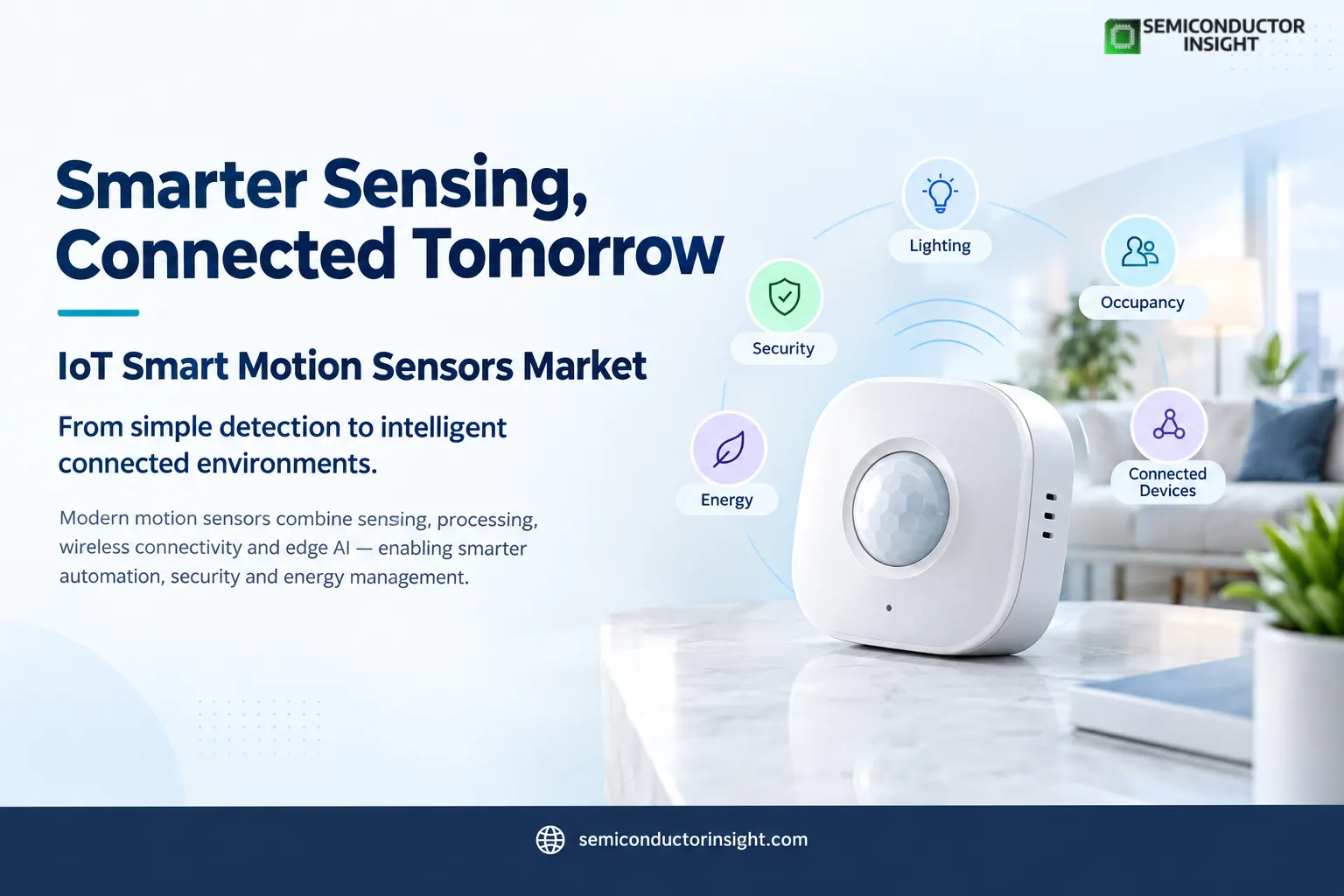
Why IoT Smart Motion Sensors Market Is Moving From Basic Detection to Context-Aware Sensing?
Motion sensing used to be relatively simple. A person entered a room, a sensor detected movement and a light switched on. The IoT era is turning that basic interaction into something much more sophisticated. Modern motion sensors can participate in lighting automation, security, occupancy monitoring, energy management and connected-device control.
The semiconductor layer is changing at the same time. Instead of treating the sensor as an isolated component, manufacturers are combining sensing, processing, wireless connectivity and increasingly edge AI capabilities into compact devices.
Explore the full report details in our recently refreshed edition anytime: https://semiconductorinsight.com/report/iot-smart-motion-sensors-market/
PIR is no longer the only conversation
- Passive infrared remains important for low-cost motion detection, but newer designs are expanding the sensing toolkit.
- mmWave radar can provide additional information about movement and presence, while combinations of sensing technologies can improve reliability in applications where conventional motion detection may be insufficient.
- Texas Instruments, for example, currently offers intelligent mmWave devices operating in the 60-64 GHz range. Its IWR6443 integrates 4 receivers, 3 transmitters, a 200 MHz Arm Cortex-R4F processor and 1,472 KB of RAM with a radar hardware accelerator and edge-AI capability.
- That level of integration illustrates where semiconductor innovation is heading: the sensor itself can perform substantially more processing before information reaches a cloud platform.
Presence is becoming more valuable than movement
The distinction between detecting movement and understanding presence is becoming increasingly important.
A person sitting almost completely still may be invisible to a traditional motion-triggered automation system, while newer sensing architectures can be designed to identify occupancy with greater sensitivity. This is particularly relevant for smart lighting, HVAC management, security and assisted-living environments.
- Matter 1.4 introduced enhanced occupancy-sensing capabilities covering radar, vision and ambient sensing, alongside configurable sensitivity and event-based reporting. The standard also strengthened support for battery-powered intermittently connected devices.
Connectivity is becoming part of the sensor architecture
IoT Smart Motion Sensors Market is not simply about the sensing element. Communication technology increasingly determines how useful that sensor becomes.
Thread, Bluetooth and other low-power connectivity technologies are enabling sensors to communicate with smart-home ecosystems without requiring every device to maintain a high-power connection continuously. Matter has specifically expanded support for intermittently connected devices such as motion and temperature sensors to improve their operation in battery-powered environments.
A recent Matter-certified motion sensor from Shenzhen Sonoff Technologies, certified in August 2026, uses Thread and Zigbee and supports automated lighting and security scenarios.
One sensor can now perform several jobs
Product design is also moving toward multifunction sensing. A 2026 Matter-certified wireless presence sensor combines PIR and mmWave radar with light, temperature and humidity sensing. The manufacturer specifies more than two years of battery life and Matter-over-Thread connectivity.
This combination changes the economics of connected-device design. Instead of deploying separate components for every environmental input, manufacturers can consolidate several sensing functions into a single wireless node.
Edge AI puts intelligence closer to the event
- Another important semiconductor development is moving inference toward the sensor or nearby microcontroller rather than sending every raw data point to the cloud.
- Texas Instruments describes edge-AI processing as a way to achieve real-time decisions with lower latency and energy consumption, while its embedded platforms combine MCUs, processors, wireless connectivity and radar sensing.
- The implication for motion sensing is significant. Instead of reporting only “movement detected,” an intelligent device can increasingly process patterns locally and determine what type of activity is relevant to an application.
The same sensing architecture is spreading beyond homes
The technology is also finding roles in vehicles, robotics and industrial environments. In January 2025, Texas Instruments introduced a 60 GHz mmWave radar sensor designed to support three in-cabin sensing applications using edge AI. The company said the architecture could replace multiple sensing technologies and reduce implementation costs by an average of US$20 per vehicle.
In March 2026, TI and NVIDIA also announced work combining mmWave radar with NVIDIA platforms for 3D perception and safety awareness in humanoid robotics.
Where the IoT sensor becomes an intelligent node
The most important change in IoT Smart Motion Sensors Market is therefore not simply higher detection accuracy. It is the conversion of a small semiconductor device into an intelligent node capable of sensing, interpreting and communicating physical activity.
As Matter, Thread, radar, edge AI and integrated semiconductor architectures continue converging, motion sensors are becoming less like passive switches and more like distributed perception points for connected environments. That shift gives the category relevance well beyond conventional smart-home automation, extending into buildings, vehicles, robotics, security and increasingly autonomous physical systems.

Comments (0)